Chipper Canter
ProductOverview
A chipper canter is a specialized machine that performs two milling operations simultaneously: it planes boards flat and simultaneously chips waste (bark, edges, defects) into uniform pieces. The machine is especially useful in mills processing variable-quality logs or in producing chip-grade material from secondary-breakdown waste. A log or slab enters the Feed System, passes under a Planing Head that planes opposite faces, and waste is shredded by a high-speed Chipping Head before being ejected onto the Chip Conveyor.
The Main Motor (40–80 horsepower) drives all the machinery: the cutterheads through a Planing Gearbox, the chip drum through the Chip Motor, and the feed rollers through a Speed Reducer. A Control Panel coordinates all speeds and allows adjustment of planing depth and feed rate.
How it works
The Main Motor (40–80 hp) is the prime mover. Its output is distributed through the Pulley System and Shaft Coupling to three destinations: the Planing Gearbox, the Chip Motor, and the Feed Motor.
The Planing Gearbox reduces motor speed to 1,200–3,000 rpm, driving the Top Cutterhead and Bottom Cutterhead. These are helical cutterheads, shafts with rotating Planing Knifes (typically 4–6 per head, arranged at a spiral angle). As the log advances through the Feed System at 60–150 feet per minute, it passes under the top Top Cutterhead (which planes the top face) and over the Bottom Cutterhead (which planes the bottom face) simultaneously. The spacing between heads sets the final thickness.
Simultaneously, the Chip Drum, a separate high-speed rotor turning at 1,000–2,000 rpm, intercepts the waste edge material (bark, knots, irregular edges) and shreds it into chips. The Chip Knifes (typically 3–4 reversible or replaceable blades mounted radially on the drum) strike the waste as it falls. The resulting chips (nominally 10–25 mm in size) drop onto the Chip Conveyor, which moves them to a hopper for collection or further processing.
Once the board exits both the planing and chipping sections, the planed lumber is conveyed away (usually to a kiln or storage deck), and the chips are collected for sale as pulpwood, particleboard fiber, or fuel.
Planing mechanism
The Planing Head contains two spindles: top and bottom, each rotating at the same speed (1,200–3,000 rpm depending on desired finish and material). The Planing Knifes are typically made of tungsten carbide (hard and long-lasting) or high-speed steel (less expensive, requires frequent resharpening).
The Planing Knifes on helical heads are arranged at an angle to the axis, so that instead of one knife engaging at a time (producing a chatter mark), multiple knives are always in slight contact, producing a smooth, continuous shaving. This results in superior surface finish compared to straight-knife heads.
The spacing between the top and bottom cutterheads is fixed or adjustable, determining the final thickness of the planed product. For example, a spacing of 1.5 inches produces 1.5-inch-thick lumber. The operator sets this spacing via the Control Panel.
Depth of cut is controlled by positioning the infeed Feed Rollers. If the rollers are set 0.25 inches lower than the discharge rollers, a 0.25-inch chip is removed. This "taper" setting allows the machine to self-adjust if the input material is variable in thickness.
Chipping mechanism
The Chip Drum is a high-speed rotor (1,000–2,000 rpm), much faster than the planing heads. It is positioned to intercept waste material, bark, edge trim, knots, as the log passes under the Planing Head. The Chip Knifes are reversible blades (flipped when dull) or replaceable cartridge blades for easy maintenance.
Chip size is controlled by the Chip Knifes and Chip Drum speed. Faster drum speed produces finer chips; slower speed produces coarser chips. A typical chip length is 10–25 mm, which is ideal for pulp or particleboard applications.
Chip moisture and quality depend on the input material. Fresh sawdust from the planing heads contains high moisture and packs easily; bark and hardwood waste may contain dirt or rocks, requiring robust blade design.
Feed system integration
The Feed System uses powered Feed Rollers to advance the material through both sections. The Feed Motor is variable-speed, allowing adjustment from 60 to 150 feet per minute. Slower feeds (60 ft/min) maximize chip production and planing surface finish but reduce overall throughput. Faster feeds (120–150 ft/min) maximize lumber output but may compromise finish quality.
A Control Panel-based PLC may adjust feed speed in real time, monitoring motor current draw. If the load (planing resistance) increases, the PLC may slow feed to prevent motor overload.
Drive coordination
The three motors (planing cutterheads, chip drum, and feed) must be synchronized. Modern machines use a single Main Motor with the output distributed through mechanical means (gearboxes, belts, chains) such that all functions are mechanically coupled. This ensures that when material is present, all actions are synchronized: planing and chipping occur together, and the feed rate matches the processing rate.
Older machines may use separate motors for each section, coordinated by the Control Panel. Modern controls monitor all three speeds and issue alerts if any component falls out of sync.
Maintenance and blade care
The Planing Knifes on the planing heads wear continuously. High-speed steel Planing Knifes are resharpened every 8–40 hours of operation (depending on wood species and depth of cut). Carbide Planing Knifes last much longer, 100–300 hours, but cannot be resharpened in-house (sent to a tool service).
The Chip Knifes are reversible, allowing two cuts per blade before disposal. A set of Chip Knifes typically lasts 20–60 hours before becoming dull and requiring replacement. Dull Chip Knifes produce fines (dust) instead of chips.
The Planing Gearbox and Shaft Coupling require routine lubrication. The Cutterhead Bearings and Chip Bearings should be inspected for wear.
Applications
Canter mills: Specialized mills that specialize in converting cants (blocky pieces from headrig breakdown) into chips + dimensional lumber. A canter takes a 4×8 cant, planes it to 3.5×7.5, and chips the edges.
Chip production: Mills producing their own chips for sale or internal pulping. A chipper canter can produce 2,000–4,000 board feet of chips per hour.
Value-added mills: High-end mills producing precision-planed lumber AND selling chips. This maximizes revenue by monetizing waste.
Salvage operations: Recovering usable lumber from defective logs, simultaneously producing chips from waste.
A typical chipper canter processes one 6-inch-diameter, 12-foot-long log in 1–2 minutes, outputting approximately 50 pounds of planed lumber and 30 pounds of chips.
Chipper Canter parts and their functions
7 top-level parts · 63 parts in total · full bill of materials below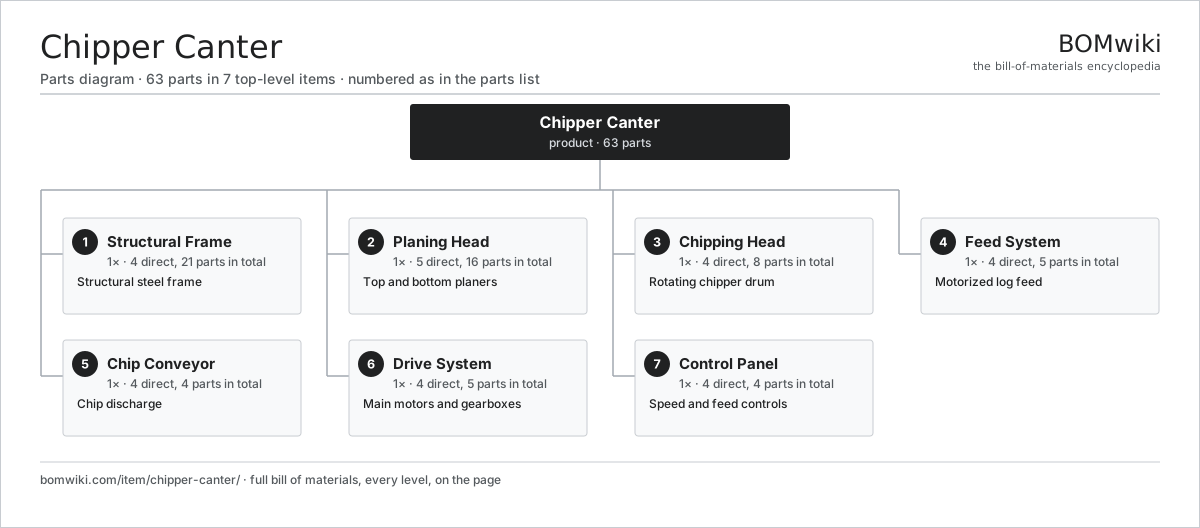
| # | Part | Qty | What it does |
|---|---|---|---|
| 1 | Structural Frame 4 parts | 1× | Structural steel frame |
| 2 | Planing Head 5 parts | 1× | Top and bottom planers |
| 3 | Chipping Head 4 parts | 1× | Rotating chipper drum |
| 4 | Feed System 4 parts | 1× | Motorized log feed |
| 5 | Chip Conveyor 4 parts | 1× | Chip discharge |
| 6 | Drive System 4 parts | 1× | Main motors and gearboxes |
| 7 | Control Panel 4 parts | 1× | Speed and feed controls |
3D model
No 3D model yet. Have a CAD file of this? Add a 3D model. STL renders right on this page; STEP, FreeCAD, and OpenSCAD sources are welcome too (openly licensed, like all 3D models on BOMwiki).
Build & assembly graph
expand / collapse · shared sub-assemblies converge · links to related products · est. labourTap an assembly to expand/collapse · tap a part to open it · use “Open page” for any node · drag to pan, scroll to zoom.
Bill of materials for Chipper Canter
7 top-level lines · 36 rows shown · 63 parts total · indented to 3 levels| # | Item / sub-assembly | Part no. | Qty/assy | Ext. qty | Parts | Type |
|---|---|---|---|---|---|---|
| 1 | Structural Frame 4 parts | chipper-canter-frame | 1× | 1 | 21 | assembly |
| 1.1 | Frame Beam | chipper-canter-frame-beam | 4× | 4 | · | part |
| 1.2 | Cross Member | chipper-canter-frame-cross-member | 6× | 6 | · | part |
| 1.3 | Gusset Plate | chipper-canter-frame-gusset | 8× | 8 | · | part |
| 1.4 | Fastener Set | fastener-set | 3× | 3 | · | part |
| 2 | Planing Head 5 parts | chipper-canter-planing-head | 1× | 1 | 16 | assembly |
| 2.1 | Top Cutterhead | chipper-canter-cutterhead-top | 1× | 1 | · | part |
| 2.2 | Bottom Cutterhead | chipper-canter-cutterhead-bottom | 1× | 1 | · | part |
| 2.3 | Planing Knife | chipper-canter-knife | 8× | 8 | · | part |
| 2.4 | Cutterhead Bearing | chipper-canter-cutterhead-bearing | 4× | 4 | · | part |
| 2.5 | Copper Winding | copper-winding | 2× | 2 | · | part |
| 3 | Chipping Head 4 parts | chipper-canter-chipping-head | 1× | 1 | 8 | assembly |
| 3.1 | Chip Drum | chipper-canter-chip-drum | 1× | 1 | · | part |
| 3.2 | Chip Knife | chipper-canter-chip-knife | 4× | 4 | · | part |
| 3.3 | Chip Motor | chipper-canter-chip-motor | 1× | 1 | · | part |
| 3.4 | Chip Bearing | chipper-canter-chip-bearing | 2× | 2 | · | part |
| 4 | Feed System 4 parts | chipper-canter-feed-system | 1× | 1 | 5 | assembly |
| 4.1 | Feed Roller | chipper-canter-feed-roller | 2× | 2 | · | part |
| 4.2 | Feed Motor | chipper-canter-feed-motor | 1× | 1 | · | part |
| 4.3 | Speed Reducer | chipper-canter-speed-reducer | 1× | 1 | · | part |
| 4.4 | Drive Belt | drive-belt | 1× | 1 | · | part |
| 5 | Chip Conveyor 4 parts | chipper-canter-chip-conveyor | 1× | 1 | 4 | assembly |
| 5.1 | Conveyor Screw | chipper-canter-conveyor-screw | 1× | 1 | · | part |
| 5.2 | Conveyor Housing | chipper-canter-conveyor-housing | 1× | 1 | · | part |
| 5.3 | Conveyor Motor | chipper-canter-conveyor-motor | 1× | 1 | · | part |
| 5.4 | Chip Hopper | chipper-canter-chip-hopper | 1× | 1 | · | part |
| 6 | Drive System 4 parts | chipper-canter-drive-system | 1× | 1 | 5 | assembly |
| 6.1 | Main Motor | chipper-canter-main-motor | 1× | 1 | · | part |
| 6.2 | Planing Gearbox | chipper-canter-planing-gearbox | 1× | 1 | · | part |
| 6.3 | Shaft Coupling | chipper-canter-coupling | 2× | 2 | · | part |
| 6.4 | Pulley System | chipper-canter-pulley-system | 1× | 1 | · | part |
| 7 | Control Panel 4 parts | chipper-canter-control-panel | 1× | 1 | 4 | assembly |
| 7.1 | Microcontroller | mcu | 1× | 1 | · | part |
| 7.2 | Variable Drive | chipper-canter-vsd | 1× | 1 | · | part |
| 7.3 | Pressure Sensor | pressure-sensor | 1× | 1 | · | part |
| 7.4 | Bare PCB | pcb-bare | 1× | 1 | · | part |
Something wrong in this list? Report a problem with this BOM.
Related products
same domain, ranked by shared parts Continuous Galvanizing Line
1,296 parts · shares 4 with this page
Continuous Galvanizing Line
1,296 parts · shares 4 with this page
 Decanter Centrifuge
172 parts · shares 4 with this page
Decanter Centrifuge
172 parts · shares 4 with this page
 Dynamic Balancing Machine
573 parts · shares 4 with this page
Electrocoating Line
2,977 parts · shares 4 with this page
Dynamic Balancing Machine
573 parts · shares 4 with this page
Electrocoating Line
2,977 parts · shares 4 with this page
Sourcing: possible vendors
Browse the supplier directory → Prices, MOQ, and lead times are algorithmic estimates, not quotes, and not claims about these companies. Company mappings are curated by keyword; est. price band $5k–$2M. How estimates work| Vendor | HQ | Specialty | MOQ | Lead time |
|---|---|---|---|---|
| atlascopco.com ↗ | Stockholm, SE | Compressors & industrial | 10 units | 12–20 wks |
|
🇦🇹Andritz
andritz.com ↗
|
Graz, AT | Process plants & machinery | 10 units | 12–20 wks |
| buhlergroup.com ↗ | Uzwil, CH | Food & materials processing | 10 units | 12–20 wks |
| gea.com ↗ | Düsseldorf, DE | Process technology | 10 units | 12–20 wks |
| mhi.com ↗ | Tokyo, JP | Heavy machinery | 10 units | 12–20 wks |
1,249-word article