Chlorine Dosing System
ProductOverview
Chlorine disinfection is a low-cost, widely practiced final treatment step for municipal wastewater. A chlorine dosing system injects sodium hypochlorite (NaOCl) solution into treated effluent, achieving 3–4 log pathogen reduction (bacteria) and 2–3 log virus reduction at residual levels of 0.5–1.0 mg/L free chlorine.
Chlorine's effectiveness is highly dependent on pH, temperature, and contact time. Optimal disinfection occurs at pH 6–7 and 5–15 minute residence time. A Residual Analyzer continuously monitors free chlorine, and a Control Panel adjusts pump output to maintain the setpoint, typically 0.7 mg/L free chlorine at point-of-compliance.
Chemical Reactions
Chlorine disinfection proceeds through two mechanisms:
Hypochlorous Acid (HOCl) Formation: Cl₂ + H₂O ⇌ HOCl + H⁺ + Cl⁻ (Cl₂ gas) NaOCl + H₂O ⇌ HOCl + Na⁺ + OH⁻ (sodium hypochlorite)
HOCl is the dominant disinfectant at pH 6–8; dissociation to OCl⁻ (hypochlorite ion) occurs at higher pH and significantly reduces efficacy. At pH 6, ~75% exists as HOCl; at pH 8, ~25% exists as HOCl.
Microbial Inactivation: HOCl penetrates cell membranes and denatures proteins, nucleic acids, and catalytic enzymes. The reaction is concentration × time dependent (CT concept):
CT = C (mg/L) × t (minutes)
For 2-log removal of E. coli at 20°C: CT ≈ 0.3 mg/L·min
Breakpoint Chlorination (optional): If reducing compounds (iron, manganese, ammonia) are present, chlorine is consumed forming chloramines or being oxidized to chlorate. Adding excess chlorine beyond the "breakpoint" (where all reducing agents are oxidized) ensures free chlorine residual.
Dosing Strategy
Demand-Driven Dosing: The Metering Pump output is proportional to the residual error. If measured residual drops below the setpoint, the pump increases stroke (0–100% range). If residual exceeds setpoint, pump decreases.
Typical proportional gain: 0.05–0.5 mL/min per 0.1 mg/L deviation.
Example Calculation:
- Target residual: 0.7 mg/L free chlorine
- Effluent flow: 100 m³/day (4.17 m³/h = 69.4 mL/s)
- Chlorine demand: 1.5 mg/L (measured via jar test)
- Total chlorine dose: 1.5 + 0.7 = 2.2 mg/L
- Mass chlorine required: 2.2 mg/L × 100 m³/day = 220 g/day = 9.2 g/h
- NaOCl solution (12% available Cl₂): 9.2 / 0.12 = 77 g/h = 77 mL/h
With day tank of 200 L at 12% NaOCl (24 kg Cl₂ available):
- Operating time per tank: 24 kg ÷ 0.220 kg/day = 109 days
Contact Chamber Design
The Contact Chamber must provide adequate detention time without short-circuiting:
V (m³) = Q (m³/min) × t (min)
For 10 m³/h = 0.167 m³/min and 10 minute contact time: V = 0.167 × 10 = 1.67 m³ minimum
The chamber uses internal baffles creating a plug-flow path:
- Single channel: minimal baffling, short-circuits possible
- Serpentine (3–4 passes): optimal contact, 90% of theoretical detention
- Multiple small compartments: excellent distribution
Baffling efficiency: The concentration distribution at outlet is modeled using the dispersion number (d):
d = D_L / (u × L)
Where D_L = dispersion coefficient, u = velocity, L = path length. Well-baffled reactors achieve d ≈ 0.01–0.05 (approaching ideal plug-flow, d = 0).
Residual Analysis
Two sensor types measure free chlorine:
Amperometric Probe: Applies voltage (typically 0.8–1.0 V) across a polarographic or Clark-type electrode. Chlorine reduction current is proportional to concentration:
Cl₂ + 2e⁻ + 2H⁺ → 2HCl (or HOCl)
Advantages: Fast response (10–30 sec), linear output, insensitive to CO₂. Disadvantages: Requires calibration every 1–4 weeks; affected by fouling (biofilm buildup).
Colorimetric Probe: Measures absorbance of DPD (N,N-diethyl-p-phenylenediamine) color-complex:
HOCl + DPD → colored compound (red, λ = 530 nm)
Advantages: Non-fouling, long calibration interval (3–6 months). Disadvantages: Slower response (2–5 min), requires DPD reagent cartridge replacement.
Both sensors output 4–20 mA to the Control Panel, which drives the Metering Pump via proportional-integral (PI) control:
Pump_output = K_p × error + K_i × ∫error dt
Typical tuning: K_p = 0.1–0.5, K_i = 0.01–0.05.
Residual Targets and Regulatory Requirements
- Municipal wastewater (non-potable reuse): 0.5–1.0 mg/L free chlorine
- Reclaimed water (irrigation): 1.0–2.0 mg/L free chlorine or 0.5 mg/L + UV
- Potable water (if direct reuse considered): Chlorine residual with multi-barrier (coagulation, filtration, UV, GAC)
- Typical discharge limit: <0.1 mg/L chlorine residual at final outfall (dechlorination required for sensitive receiving waters)
Chlorine Residual Decay
Free chlorine decreases over time and distance due to:
- Reaction with reducing compounds (continued oxidation of iron, sulfites)
- Photodegradation (UV light reducing hypochlorite)
- Volatilization (small amount of HOCl escapes as gas)
Decay follows pseudo-first-order kinetics:
C_t = C₀ × e^(-k × t)
Where k = decay rate (min⁻¹). Typical k ≈ 0.001–0.01 min⁻¹, meaning half-life = 70–700 minutes depending on water quality.
Safety Considerations
Chlorine Gas Hazards (liquid Cl₂, if used):
- Toxic vapor; exposure >10 ppm causes respiratory irritation; >100 ppm fatal
- Heavier than air; settles in low areas
- Requires detection alarm (>1 ppm) and safety vent with scrubber
Sodium Hypochlorite Hazards (solution used here):
- Corrosive; causes skin/eye burns
- Reactive with acids → chlorine gas
- Decomposes with heat or light → oxygen and chloride
Control Room Safety:
- Automatic pump shutoff if residual >2.0 mg/L (over-dosing alarm)
- Flow interlock: pump stops if effluent flow ceases
- Manual isolation valves and pressure relief on pump discharge
- Caustic scrubber vent if vapor release possible
Dechlorination
If discharge requires <0.1 mg/L residual (e.g., sensitive fisheries), dechlorination via Dechlorination System is necessary. Common dechlorinants:
Sodium Thiosulfate (Na₂S₂O₃): 2HOCl + Na₂S₂O₃ + H₂O → 2HCl + Na₂SO₄ + H₂SO₄
Advantages: Fast reaction (seconds), non-toxic byproducts, easy dosing. Disadvantages: Adds sulfate to effluent.
Sulfur Dioxide (SO₂): 2HOCl + SO₂ + 2H₂O → 2HCl + H₂SO₄
Advantages: Complete destruction, no residual. Disadvantages: SO₂ is toxic gas; requires specialized equipment.
Dechlorinant dose = 0.9 × residual chlorine (mg/L) (stoichiometric ratio for thiosulfate).
Operational Checklist
- Daily: Observe residual trend, check day tank level, inspect pump operation
- Weekly: Calibrate residual analyzer; sample outlet and verify lab analysis
- Monthly: Drain and refill day tank if not used regularly (NaOCl degrades ~5%/month at room temperature)
- Quarterly: Analyze treated water for THM/HAA (disinfection byproducts); adjust pH or change source if needed
- Annually: Replace analyzer probe; inspect pump diaphragm and check valves
Standards
- AWWA Standard C500: Sodium Hypochlorite
- ANSI/NSF 61: Drinking Water System Components (if potable reuse)
- EPA Manual: Microbial and Disinfection Byproducts Rules (MDBPR)
- WPCF MOP 8: Design of Municipal Wastewater Treatment Plants
Chlorine Dosing System parts and their functions
8 top-level parts · 36 parts in total · full bill of materials below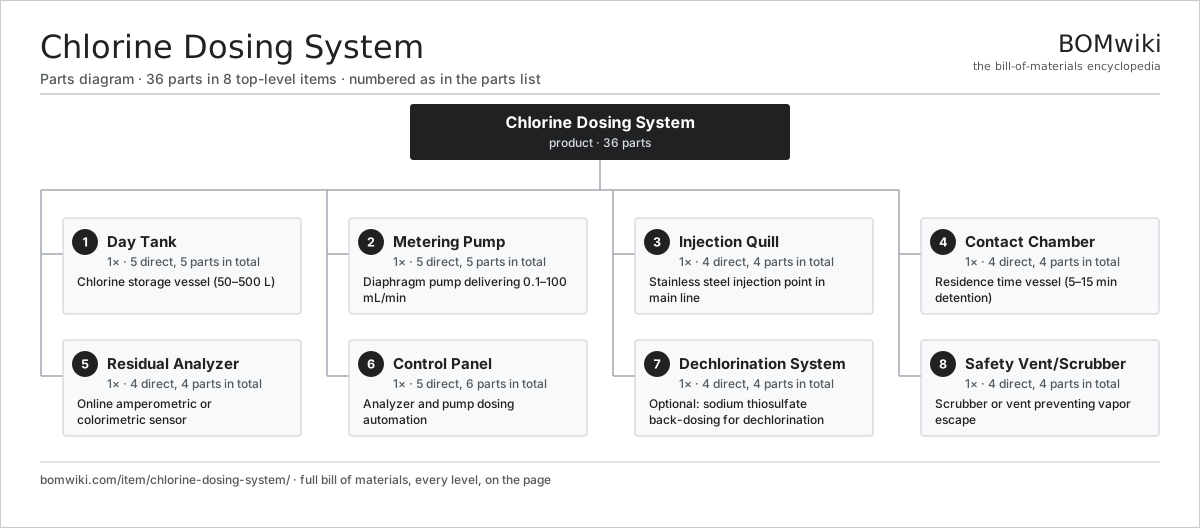
| # | Part | Qty | What it does |
|---|---|---|---|
| 1 | Day Tank 5 parts | 1× | Chlorine storage vessel (50–500 L) |
| 2 | Metering Pump 5 parts | 1× | Diaphragm pump delivering 0.1–100 mL/min |
| 3 | Injection Quill 4 parts | 1× | Stainless steel injection point in main line |
| 4 | Contact Chamber 4 parts | 1× | Residence time vessel (5–15 min detention) |
| 5 | Residual Analyzer 4 parts | 1× | Online amperometric or colorimetric sensor |
| 6 | Control Panel 5 parts | 1× | Analyzer and pump dosing automation |
| 7 | Dechlorination System 4 parts | 1× | Optional: sodium thiosulfate back-dosing for dechlorination |
| 8 | Safety Vent/Scrubber 4 parts | 1× | Scrubber or vent preventing vapor escape |
3D model
No 3D model yet. Have a CAD file of this? Add a 3D model. STL renders right on this page; STEP, FreeCAD, and OpenSCAD sources are welcome too (openly licensed, like all 3D models on BOMwiki).
Build & assembly graph
expand / collapse · shared sub-assemblies converge · links to related products · est. labourTap an assembly to expand/collapse · tap a part to open it · use “Open page” for any node · drag to pan, scroll to zoom.
Bill of materials for Chlorine Dosing System
8 top-level lines · 43 rows shown · 36 parts total · indented to 3 levels| # | Item / sub-assembly | Part no. | Qty/assy | Ext. qty | Parts | Type |
|---|---|---|---|---|---|---|
| 1 | Day Tank 5 parts | chlorine-dosing-system-day-tank | 1× | 1 | 5 | assembly |
| 1.1 | Storage Vessel | chlorine-dosing-system-storage-vessel | 1× | 1 | · | part |
| 1.2 | Vent Outlet | chlorine-dosing-system-vent-outlet | 1× | 1 | · | part |
| 1.3 | Fill Connection | chlorine-dosing-system-fill-connection | 1× | 1 | · | part |
| 1.4 | Suction Line | chlorine-dosing-system-suction-line | 1× | 1 | · | part |
| 1.5 | Float Switch | chlorine-dosing-system-float-switch | 1× | 1 | · | part |
| 2 | Metering Pump 5 parts | chlorine-dosing-system-metering-pump | 1× | 1 | 5 | assembly |
| 2.1 | Pump Motor | chlorine-dosing-system-pump-motor | 1× | 1 | · | part |
| 2.2 | Pump Head | chlorine-dosing-system-pump-head | 1× | 1 | · | part |
| 2.3 | Stroke Adjuster | chlorine-dosing-system-stroke-adjuster | 1× | 1 | · | part |
| 2.4 | Pulsation Damper | chlorine-dosing-system-pulsation-damper | 1× | 1 | · | part |
| 2.5 | Pressure Sensor | pressure-sensor | 1× | 1 | · | part |
| 3 | Injection Quill 4 parts | chlorine-dosing-system-injection-quill | 1× | 1 | 4 | assembly |
| 3.1 | Quill Body | chlorine-dosing-system-quill-body | 1× | 1 | · | part |
| 3.2 | Diffuser Holes | chlorine-dosing-system-diffuser-holes | 1× | 1 | · | part |
| 3.3 | Isolation Valve | chlorine-dosing-system-isolation-valve | 1× | 1 | · | part |
| 3.4 | Fastener Set | fastener-set | 1× | 1 | · | part |
| 4 | Contact Chamber 4 parts | chlorine-dosing-system-contact-chamber | 1× | 1 | 4 | assembly |
| 4.1 | Chamber Tank | chlorine-dosing-system-chamber-tank | 1× | 1 | · | part |
| 4.2 | Baffle System | chlorine-dosing-system-baffle-system | 1× | 1 | · | part |
| 4.3 | Drain Valve | chlorine-dosing-system-drain-valve | 1× | 1 | · | part |
| 4.4 | Level Sensor | chlorine-dosing-system-level-sensor | 1× | 1 | · | part |
| 5 | Residual Analyzer 4 parts | chlorine-dosing-system-residual-analyzer | 1× | 1 | 4 | assembly |
| 5.1 | Analyzer Cell | chlorine-dosing-system-analyzer-cell | 1× | 1 | · | part |
| 5.2 | Sample Line | chlorine-dosing-system-sample-line | 1× | 1 | · | part |
| 5.3 | Sample Pump | chlorine-dosing-system-sample-pump | 1× | 1 | · | part |
| 5.4 | Calibration Kit | chlorine-dosing-system-calibration-kit | 1× | 1 | · | part |
| 6 | Control Panel 5 parts | chlorine-dosing-system-control-panel | 1× | 1 | 6 | assembly |
| 6.1 | Analyzer Transmitter | chlorine-dosing-system-analyzer-transmitter | 1× | 1 | · | part |
| 6.2 | Microcontroller | mcu | 1× | 1 | · | part |
| 6.3 | Bare PCB | pcb-bare | 1× | 1 | · | part |
| 6.4 | LCD Panel | lcd-panel | 1× | 1 | · | part |
| 6.5 | Relay | relay | 2× | 2 | · | part |
| 7 | Dechlorination System 4 parts | chlorine-dosing-system-dechlorination | 1× | 1 | 4 | assembly |
| 7.1 | Dechlorinant Tank | chlorine-dosing-system-dechlorinant-tank | 1× | 1 | · | part |
| 7.2 | Secondary Pump | chlorine-dosing-system-secondary-pump | 1× | 1 | · | part |
| 7.3 | Dechlorinant Injection | chlorine-dosing-system-dechlorinant-injection | 1× | 1 | · | part |
| 7.4 | Pressure Sensor | pressure-sensor | 1× | 1 | · | part |
| 8 | Safety Vent/Scrubber 4 parts | chlorine-dosing-system-safety-vent | 1× | 1 | 4 | assembly |
| 8.1 | Scrubber Tank | chlorine-dosing-system-scrubber-tank | 1× | 1 | · | part |
| 8.2 | Air Inlet | chlorine-dosing-system-air-inlet | 1× | 1 | · | part |
| 8.3 | Exhaust Pump | chlorine-dosing-system-exhaust-pump | 1× | 1 | · | part |
| 8.4 | Scrubber Sump | chlorine-dosing-system-scrubber-sump | 1× | 1 | · | part |
Something wrong in this list? Report a problem with this BOM.
Related products
same domain, ranked by shared parts Cable Coiling Machine
36 parts · shares 3 with this page
Cable Coiling Machine
36 parts · shares 3 with this page
Sourcing: possible vendors
Browse the supplier directory → Prices, MOQ, and lead times are algorithmic estimates, not quotes, and not claims about these companies. Company mappings are curated by keyword; est. price band $5k–$2M. How estimates work| Vendor | HQ | Specialty | MOQ | Lead time |
|---|---|---|---|---|
| atlascopco.com ↗ | Stockholm, SE | Compressors & industrial | 10 units | 12–20 wks |
|
🇦🇹Andritz
andritz.com ↗
|
Graz, AT | Process plants & machinery | 10 units | 12–20 wks |
| buhlergroup.com ↗ | Uzwil, CH | Food & materials processing | 10 units | 12–20 wks |
| gea.com ↗ | Düsseldorf, DE | Process technology | 10 units | 12–20 wks |
| mhi.com ↗ | Tokyo, JP | Heavy machinery | 10 units | 12–20 wks |
1,110-word article