Chocolate Melanger
ProductOverview
A chocolate melanger is a benchtop stone-grinding mill designed specifically for bean-to-bar chocolate production and artisanal refinement. Unlike food processors or ball mills (general-purpose), a melanger uses rotating granite wheels to grind cocoa solids (≈50–100 microns initially) into a smooth paste (≤25 microns), a process called "conching" in chocolate terminology. The result is silky chocolate lacking the grainy texture of pre-ground cocoa.
Melangers bridge artisanal and small-scale commercial production: a home chocolatier can process 500 g of fermented cocoa beans into finished chocolate paste in one machine, controlling flavor development and texture. The key is the granite wheels: they generate moderate friction (warming paste to 40–50°C) without scorching, and their smooth surfaces reduce cocoa-particle-size progressively as they rotate.
How It Works
Stone Grinding Mechanics
The Granite Wheel Set consists of two granite wheels: an upper rotating wheel (keyed to the motor output shaft) and a lower fixed wheel mounted on a stationary bearing. The vertical separation is typically 2–5 mm, adjustable via the Wheel Gap Adjustment screw.
The Chocolate Paste Container, a ceramic-lined or stainless steel pan holding the chocolate paste, rotates beneath the wheels via a Drum Roller Support ball-bearing support. This drum rotation allows the chocolate mass to be distributed continuously under the wheels.
As the upper wheel rotates (1200–3000 RPM depending on speed setting), it orbits the lower wheel. The paste caught between the wheels is progressively ground: large cocoa particles are sheared into smaller fragments. The granular texture decreases as multiple passes occur.
Grinding vs. Conching Distinction
Grinding phase (0–4 hours): Motor runs at high speed (≥2000 RPM), wheels in close contact (≤2 mm gap). Cocoa solids are reduced from coarse particles (≈50–100 microns) to finer particles (≈10–20 microns). Cocoa butter (naturally present in cocoa beans, ≈50% by weight) melts from the friction heat, providing the paste's viscosity.
Conching phase (6–18 hours): Motor slows to 800–1500 RPM, wheels are separated slightly (≈3–5 mm), and the paste is continuously agitated and aerated. This phase allows volatile acids and off-flavors to evaporate, developing chocolate's complex flavor profile and achieving final smoothness (≤25 microns, imperceptible to the tongue).
The Heating System (Optional) maintains temperature at 40–50°C during conching, preventing cocoa butter from solidifying (which would jam the wheels) and maintaining fluidity. The Cooling Loop (Optional), if present, prevents overheating on hot days or during ultra-long runs.
Temperature Management
Cocoa butter's melting point is ≈34–38°C. If paste temperature drops below ≈35°C during operation, cocoa butter solidifies, increasing viscosity and potentially stalling the wheels. The Heating System (Optional), a low-power immersion heater, is thermostat-controlled via the Temperature Probe to maintain ≥40°C.
Conversely, during extended high-speed grinding, friction can raise paste temperature to ≥55°C. Excessive heat (>60°C) damages chocolate flavor and cocoa-butter crystal structure. If ambient is hot or wheel friction is high, the optional chocolate-melanger-cooling-loop circulates cool water through a jacket around the drum, maintaining ≤50°C.
Motor and Speed Control
The Melanger Motor, a 0.5–1 HP motor, is controlled via the Speed Controller (PWM or triac circuit). The Speed & Timer Control Panel MCU displays speed and elapsed time on the LCD display. A typical workflow:
- Grinding phase (0–4 hr): 80–100% speed (high shear)
- Transition (4–6 hr): 50–80% speed (medium shear, transition to finer texture)
- Conching phase (6–18 hr): 20–60% speed (gentle agitation, aeration, flavor development)
Slow speeds (20%) run ≈1200 RPM; fast speeds (100%) run ≈3000 RPM. The speed control allows the operator to adjust grinding intensity without stopping and restarting the machine.
Operational Workflow
From Cocoa Beans to Chocolate Paste
Fermentation & Roasting (external): Cocoa beans are harvested, fermented (5–7 days), dried, and roasted to develop flavor. Roasted beans arrive at the chocolatier's facility.
Winnowing (external): Roasted beans are cracked into small nibs (≈5–10 mm), removing the outer shell. Only cocoa nibs (≈55% cocoa solids + 45% cocoa butter) are retained.
Loading the melanger: Roasted cocoa nibs (500 g–2 kg) are added to the Chocolate Paste Container, often with a small amount of cane sugar (if making sweetened chocolate) or vanilla/spices. The drum cap is closed.
Grinding cycle: Motor is set to 90% speed. Wheels are adjusted to ≈1 mm gap (close contact). The melanger runs for 4–6 hours. Initial cocoa nibs are hard and grainy; after 1 hour, friction heat melts cocoa butter, and the nibs begin forming a paste. After 4 hours, the paste is smooth and glossy but coarse (≈20–30 microns).
Fine conching (optional): Motor is slowed to 40% speed, wheels are separated to ≈4 mm gap. The melanger runs for 10–14 additional hours. Paste is continuously agitated and aerated, developing flavor and achieving final smoothness (≤25 microns). Color deepens, and the texture becomes silky.
Completion: After 14–20 total hours, the Speed & Timer Control Panel alerts the operator. Motor is stopped. The chocolate paste (now ≈2.5 kg from 2 kg initial cocoa nibs + sugar + liquid ingredients) is scooped from the drum and cooled in a tempering machine or poured into molds.
Temperature Profile
Throughout the cycle, Temperature Probe monitors paste temperature:
- Hours 0–1: Rise from 20°C to 35°C (initial nibs friction)
- Hours 1–4: Maintain 40–45°C (grinding phase heating)
- Hours 4–18: Hold 40–50°C (conching phase, gentle heat)
- Post-cycle: Cool to ≤30°C (paste sets as cocoa butter solidifies)
If temperature exceeds 52°C at any point, the MCU can activate the Cooling Loop (Optional) pump to circulate cool water.
Grinding Results and Texture Science
Final chocolate texture is determined by:
- Particle size distribution: Uniform ≤25 micron particles feel smooth; any particles >30 microns create a grainy mouth feel.
- Cocoa butter crystallization: Beta (V) crystal form is stable and glossy; improper cooling can form undesirable alpha or gamma forms, causing bloom (white surface discoloration).
- Flavor development: Long conching (12–18 hours) allows volatile acids, off-flavors, and excessive moisture to evaporate, improving taste.
The melanger achieves #1 through stone-wheel grinding; #2 and #3 through controlled temperature and time.
Design Variants
Batch size: Small melangers (2 L) suit home use; larger units (10–50 L) serve small chocolate factories.
Automated programs: Advanced models include preset "grinding" and "conching" buttons, automating speed and duration sequences.
Drum materials: Ceramic-lined (non-reactive, thermal stability) vs. stainless steel (easier cleaning, less flavorful than ceramic).
Cooling jacket: Water-cooled drums are standard in tropical climates or during summer; air-cooled variants are simpler and sufficient for temperate zones.
Noise reduction: Enclosed granite stone mills with acoustic padding reduce operational noise from ≈85 dB to ≈70 dB.
Chocolate Melanger parts and their functions
8 top-level parts · 32 parts in total · full bill of materials below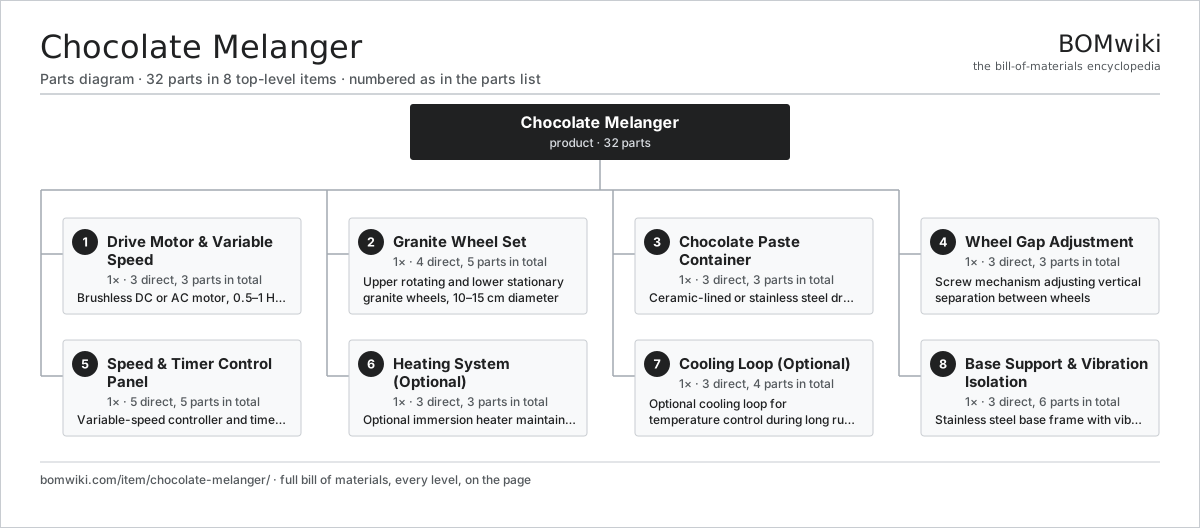
| # | Part | Qty | What it does |
|---|---|---|---|
| 1 | Drive Motor & Variable Speed 3 parts | 1× | Brushless DC or AC motor, 0.5–1 HP, variable-speed 1200–3000 rpm |
| 2 | Granite Wheel Set 4 parts | 1× | Upper rotating and lower stationary granite wheels, 10–15 cm diameter |
| 3 | Chocolate Paste Container 3 parts | 1× | Ceramic-lined or stainless steel drum or pan holding chocolate paste |
| 4 | Wheel Gap Adjustment 3 parts | 1× | Screw mechanism adjusting vertical separation between wheels |
| 5 | Speed & Timer Control Panel 5 parts | 1× | Variable-speed controller and timer interface |
| 6 | Heating System (Optional) 3 parts | 1× | Optional immersion heater maintaining paste temperature 40–50°C |
| 7 | Cooling Loop (Optional) 3 parts | 1× | Optional cooling loop for temperature control during long runs |
| 8 | Base Support & Vibration Isolation 3 parts | 1× | Stainless steel base frame with vibration isolation feet |
3D model
No 3D model yet. Have a CAD file of this? Add a 3D model. STL renders right on this page; STEP, FreeCAD, and OpenSCAD sources are welcome too (openly licensed, like all 3D models on BOMwiki).
Build & assembly graph
expand / collapse · shared sub-assemblies converge · links to related products · est. labourTap an assembly to expand/collapse · tap a part to open it · use “Open page” for any node · drag to pan, scroll to zoom.
Bill of materials for Chocolate Melanger
8 top-level lines · 35 rows shown · 32 parts total · indented to 3 levels| # | Item / sub-assembly | Part no. | Qty/assy | Ext. qty | Parts | Type |
|---|---|---|---|---|---|---|
| 1 | Drive Motor & Variable Speed 3 parts | chocolate-melanger-motor | 1× | 1 | 3 | assembly |
| 1.1 | Melanger Motor | chocolate-melanger-motor-body | 1× | 1 | · | part |
| 1.2 | Speed Controller | chocolate-melanger-speed-controller | 1× | 1 | · | part |
| 1.3 | Power Supply | chocolate-melanger-power-supply | 1× | 1 | · | part |
| 2 | Granite Wheel Set 4 parts | chocolate-melanger-wheel-pair | 1× | 1 | 5 | assembly |
| 2.1 | Upper Granite Wheel | chocolate-melanger-upper-wheel | 1× | 1 | · | part |
| 2.2 | Lower Granite Wheel | chocolate-melanger-lower-wheel | 1× | 1 | · | part |
| 2.3 | Wheel Support Ring | chocolate-melanger-wheel-mounting | 1× | 1 | · | part |
| 2.4 | Ball Bearing | ball-bearing | 2× | 2 | · | part |
| 3 | Chocolate Paste Container 3 parts | chocolate-melanger-drum | 1× | 1 | 3 | assembly |
| 3.1 | Ceramic-Lined Drum | chocolate-melanger-drum-body | 1× | 1 | · | part |
| 3.2 | Drum Roller Support | chocolate-melanger-drum-roller-ring | 1× | 1 | · | part |
| 3.3 | Drum Mounting Frame | chocolate-melanger-drum-mount | 1× | 1 | · | part |
| 4 | Wheel Gap Adjustment 3 parts | chocolate-melanger-tension-adjustment | 1× | 1 | 3 | assembly |
| 4.1 | Adjustment Lead-Screw | chocolate-melanger-adjustment-screw | 1× | 1 | · | part |
| 4.2 | Adjustment Lock-Nut | chocolate-melanger-adjustment-lock-nut | 1× | 1 | · | part |
| 4.3 | Gap Position Dial | chocolate-melanger-position-indicator | 1× | 1 | · | part |
| 5 | Speed & Timer Control Panel 5 parts | chocolate-melanger-controller | 1× | 1 | 5 | assembly |
| 5.1 | LCD Panel | lcd-panel | 1× | 1 | · | part |
| 5.2 | Microcontroller | mcu | 1× | 1 | · | part |
| 5.3 | Relay | relay | 1× | 1 | · | part |
| 5.4 | Bare PCB | pcb-bare | 1× | 1 | · | part |
| 5.5 | SMD Passive (R/C/L) | smd-passives | 1× | 1 | · | part |
| 6 | Heating System (Optional) 3 parts | chocolate-melanger-heating-element | 1× | 1 | 3 | assembly |
| 6.1 | Heating Element | heating-element | 1× | 1 | · | part |
| 6.2 | Temperature Probe | chocolate-melanger-temperature-sensor | 1× | 1 | · | part |
| 6.3 | Heating Relay | chocolate-melanger-heating-relay | 1× | 1 | · | part |
| 7 | Cooling Loop (Optional) 3 parts | chocolate-melanger-cooling-coil | 1× | 1 | 4 | assembly |
| 7.1 | Cooling Pump | chocolate-melanger-cooling-pump | 1× | 1 | · | part |
| 7.2 | Cooling Radiator | chocolate-melanger-cooling-radiator | 1× | 1 | · | part |
| 7.3 | Cooling Tubing | chocolate-melanger-cooling-lines | 2× | 2 | · | part |
| 8 | Base Support & Vibration Isolation 3 parts | chocolate-melanger-frame | 1× | 1 | 6 | assembly |
| 8.1 | Frame Tubing | chocolate-melanger-frame-tube | 1× | 1 | · | part |
| 8.2 | Isolation Feet | chocolate-melanger-isolation-feet | 4× | 4 | · | part |
| 8.3 | Fastener Set | fastener-set | 1× | 1 | · | part |
Something wrong in this list? Report a problem with this BOM.
Related products
same domain, ranked by shared parts Bread Machine
162 parts · shares 3 with this page
Bread Machine
162 parts · shares 3 with this page
 Compressor Ice Cream Maker
248 parts · shares 3 with this page
Electric Grain Mill
39 parts · shares 3 with this page
Compressor Ice Cream Maker
248 parts · shares 3 with this page
Electric Grain Mill
39 parts · shares 3 with this page
 Electric Pasta Maker
63 parts · shares 3 with this page
Electric Pasta Maker
63 parts · shares 3 with this page
 High-Speed Blender
158 parts · shares 3 with this page
High-Speed Blender
158 parts · shares 3 with this page
 Sous Vide Immersion Circulator
294 parts · shares 3 with this page
Sous Vide Immersion Circulator
294 parts · shares 3 with this page
Sourcing: possible vendors
Browse the supplier directory → Prices, MOQ, and lead times are algorithmic estimates, not quotes, and not claims about these companies. Company mappings are curated by keyword; est. price band $20–$600. How estimates work| Vendor | HQ | Specialty | MOQ | Lead time |
|---|---|---|---|---|
|
🇦🇺Breville
breville.com ↗
|
Sydney, AU | Kitchen appliances | 2,000 units | 6–10 wks |
| groupeseb.com ↗ | Écully, FR | Cookware & small appliances | 2,000 units | 6–10 wks |
| hamiltonbeach.com ↗ | Glen Allen, US | Small appliances | 2,000 units | 6–10 wks |
| panasonic.com ↗ | Osaka, JP | Electronics & appliances | 2,000 units | 6–10 wks |
|
🇨🇳Midea
midea.com ↗
|
Foshan, CN | Home appliances | 2,000 units | 6–10 wks |
1,158-word article