Cinema Sound Processor
ProductOverview
A cinema sound processor is the decoder and amplifier hub at the back of a movie theater, converting the encoded audio soundtrack on a DCP (Digital Cinema Package) into six to eight discrete speaker channels that fill the auditorium with surround sound. The processor receives a stereo or surround-compressed bitstream over an AES/EBU digital cable from the cinema server (the projection and playback control system), decodes Dolby Digital, DTS, Dolby Atmos, or straight PCM audio in real time, performs room equalization and level calibration, and drives six independent output channels to the left, center, right, surround left, surround right, and LFE (subwoofer) speakers, plus optional back surrounds. The Cinema Sound Processor lives in the equipment room at the back of the theater, away from audience noise, connected to the speakers via long balanced XLR cables.
How it works
The Input Stage receives an AES3 digital stream, a stereo pair of balanced XLR connectors carrying interleaved PCM audio or a compressed bitstream (Dolby Digital, DTS). The AES Receiver IC decodes the AES framing and detects the audio format: if it sees a Dolby Digital bitstream (a compressed 5.1 surround mix), or a DTS stream, it signals the DSP Processor (Sharc or ARM) to load the appropriate decoder. If it is stereo PCM, the DSP bypasses decoding.
The DSP Processor (Sharc or ARM) is the real-time processor. For Dolby Digital, it decompresses the bitstream (AC-3 codec) into six full-bandwidth channels: Left, Center, Right, Surround Left, Surround Right, and LFE (low-frequency effects). For DTS, it decompresses the DTS-ES 5.1 or DTS:X format. For stereo PCM (a fallback option), it can apply a matrix surround upmix to synthesize surround channels from the stereo pair.
Once the Decoder / DSP Engine has the six channels decoded, it applies room equalization: the Calibration Microphone has been placed at the audience center (the reference listening position), and the calibration routine measures the frequency response from each speaker. The DSP Processor (Sharc or ARM) computes EQ filters to flatten the response and match the calibration curve stored in memory. This is critical: many cinemas suffer poor sound because the left and right speakers are too bright, or the surrounds are too loud. Automated calibration (often called "cinema tuning" or "room correction") brings the theater into compliance with Dolby or DTS specifications.
The master level is set via the Master Level Fader, and the Output Amplifier Bank (5.1–7.1) consists of six independent output amplifiers. Each amp has a crossover filter to route frequency-appropriate content: the LFE output might be a low-pass filter at 120 Hz (only sending subwoofer-range content), the surround outputs might be bandpass filtered, and the main speakers receive full-range. This prevents the surrounds from competing with the main channels.
Surround sound formats and backwards compatibility
Modern cinema sound processors support multiple formats and gracefully degrade:
- Dolby Digital 5.1: AC-3 compressed, 384 kbit/s, industry standard since 1992. Six channels: L, C, R, Ls, Rs, LFE.
- DTS-ES 5.1: Higher bitrate than Dolby, slightly warmer tone, popular in European cinemas.
- Dolby Atmos: Object-based surround with height speakers. The processor decodes Atmos metadata and renders a mix-down to 7.1 or 5.1 if the theater does not have height speakers.
- Stereo fallback: If the server sends only stereo (e.g., a pre-recorded trailer in stereo), the processor can apply a late-night mode (matrix surround) or simply send stereo to left and right speakers, muting the surrounds.
The Format Select Button Bank on the Control Panel lets the cinema operator select the playback mode. Most modern cinemas run fully automated: the server detects the DCP format, the processor automatically switches to the right decoder, and the operator simply presses "Play."
Calibration and compliance
Cinema sound is standardized: Dolby specifies that at 85 dB SPL at the reference listening position (center of the auditorium), with a 1 kHz pink-noise test tone sent to each speaker, the processor outputs should be calibrated. The Calibration Microphone records the response, and the DSP Processor (Sharc or ARM) measures and stores the equalization needed. This calibration remains in memory and is applied to all future movie playbacks, ensuring that a film sounds the same in this theater as it does in any other Dolby-calibrated cinema.
Professional cinemas recalibrate every 3–6 months, or when speakers are replaced or repositioned. The Cinema Sound Processor can store multiple calibration profiles (e.g., "Premium," "Standard," "Late Night"), allowing the operator to select the right curve for the time of day and audience expectations.
LFE and subwoofer control
The LFE (Low-Frequency Effects) channel is dedicated to the subwoofer, carrying only content below 120 Hz, explosions, deep rumbles, musical bass. The LFE output filter may include a level trim (±12 dB) so the cinema operator can adjust subwoofer presence without remixing the DCP. In theaters with multiple subwoofers, the processor might send the same LFE signal to all of them, or the subs are run through a sub-bass management system downstream.
Real-world deployment
In a multiplex cinema, each auditorium has its own Cinema Sound Processor and bank of speakers. The playback server (a disguised PC running specialized cinema software like Dolby Cinema Server or Cinionic) sends video to the projector and audio via AES to the processor. When an employee loads a new DCP (movie), the server parses the metadata and automatically switches to the right audio format, Dolby Digital for studio films, Atmos for premium releases, stereo for some indie films. The processor detects the change and reconfigures in real time, all without user intervention. The Status LCD Display shows the current format ("Dolby Atmos 7.1," "DTS-ES 5.1," etc.) and the Monitor Output / QC can feed headphones for quality control checks.
Cinema Sound Processor parts and their functions
11 top-level parts · 839 parts in total · full bill of materials below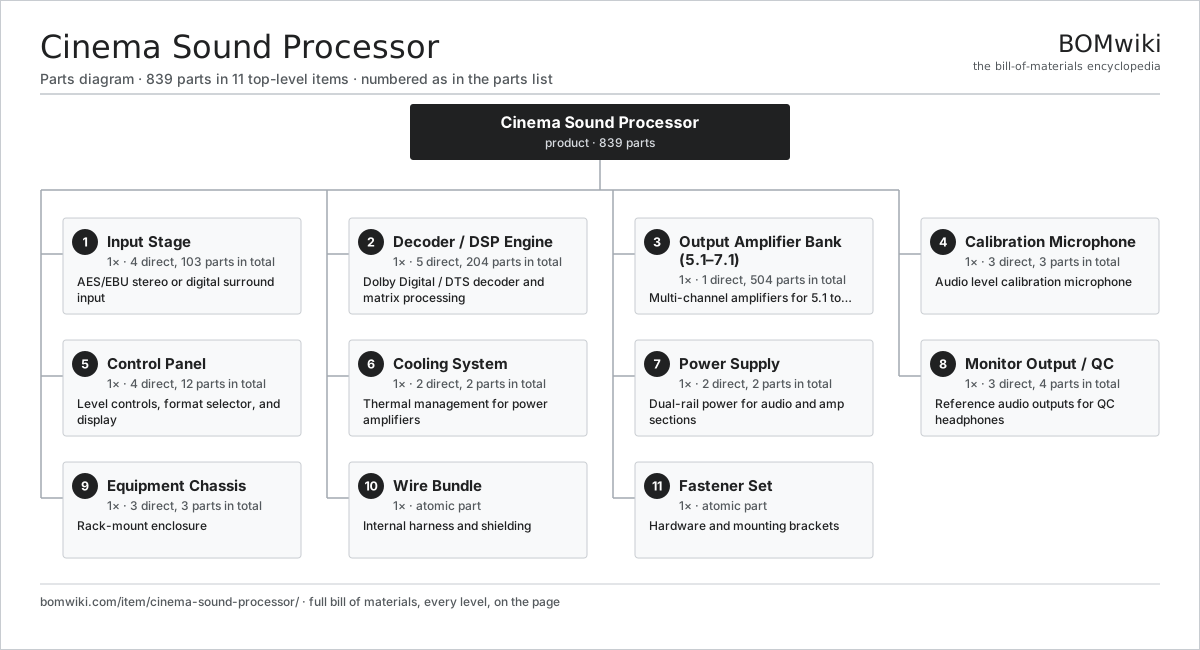
| # | Part | Qty | What it does |
|---|---|---|---|
| 1 | Input Stage 4 parts | 1× | AES/EBU stereo or digital surround input |
| 2 | Decoder / DSP Engine 5 parts | 1× | Dolby Digital / DTS decoder and matrix processing |
| 3 | Output Amplifier Bank (5.1–7.1) 1 parts | 1× | Multi-channel amplifiers for 5.1 to 7.1 surround |
| 4 | Calibration Microphone 3 parts | 1× | Audio level calibration microphone |
| 5 | Control Panel 4 parts | 1× | Level controls, format selector, and display |
| 6 | Cooling System 2 parts | 1× | Thermal management for power amplifiers |
| 7 | Power Supply 2 parts | 1× | Dual-rail power for audio and amp sections |
| 8 | Monitor Output / QC 3 parts | 1× | Reference audio outputs for QC headphones |
| 9 | Equipment Chassis 3 parts | 1× | Rack-mount enclosure |
| 10 | Wire Bundle | 1× | Internal harness and shielding |
| 11 | Fastener Set | 1× | Hardware and mounting brackets |
3D model
No 3D model yet. Have a CAD file of this? Add a 3D model. STL renders right on this page; STEP, FreeCAD, and OpenSCAD sources are welcome too (openly licensed, like all 3D models on BOMwiki).
Build & assembly graph
expand / collapse · shared sub-assemblies converge · links to related products · est. labourTap an assembly to expand/collapse · tap a part to open it · use “Open page” for any node · drag to pan, scroll to zoom.
Bill of materials for Cinema Sound Processor
11 top-level lines · 45 rows shown · 839 parts total · indented to 3 levels| # | Item / sub-assembly | Part no. | Qty/assy | Ext. qty | Parts | Type |
|---|---|---|---|---|---|---|
| 1 | Input Stage 4 parts | cinema-sound-input-stage | 1× | 1 | 103 | assembly |
| 1.1 | Bare PCB | pcb-bare | 1× | 1 | · | part |
| 1.2 | AES Receiver IC | cinema-sound-aes-receiver | 1× | 1 | · | part |
| 1.3 | Input Buffer Amplifier | cinema-sound-input-buffer | 1× | 1 | · | part |
| 1.4 | SMD Passive (R/C/L) | smd-passives | 100× | 100 | · | part |
| 2 | Decoder / DSP Engine 5 parts | cinema-sound-decoder-dsp | 1× | 1 | 204 | assembly |
| 2.1 | Bare PCB | pcb-bare | 1× | 1 | · | part |
| 2.2 | DSP Processor (Sharc or ARM) | cinema-sound-dsp-chip | 1× | 1 | · | part |
| 2.3 | Decoder Firmware ROM | cinema-sound-decoder-firmware | 1× | 1 | · | part |
| 2.4 | DSP Working Memory (SRAM) | cinema-sound-dsp-memory | 1× | 1 | · | part |
| 2.5 | SMD Passive (R/C/L) | smd-passives | 200× | 200 | · | part |
| 3 | Output Amplifier Bank (5.1–7.1) 1 parts | cinema-sound-output-stage | 1× | 1 | 504 | assembly |
| 3.1 | Output Amplifier Channel 5 parts | cinema-sound-channel-amp | 6× | 6 | 84 | assembly |
| 3.1.1 | Bare PCB | pcb-bare | 1× | 6 | · | part |
| 3.1.2 | Audio Output Driver IC | cinema-sound-output-amp-ic | 1× | 6 | · | part |
| 3.1.3 | Output Crossover / EQ Filter | cinema-sound-output-filter | 1× | 6 | · | part |
| 3.1.4 | Connector | connector | 1× | 6 | · | part |
| 3.1.5 | SMD Passive (R/C/L) | smd-passives | 80× | 480 | · | part |
| 4 | Calibration Microphone 3 parts | cinema-sound-calibration-mic | 1× | 1 | 3 | assembly |
| 4.1 | Microphone Capsule | cinema-sound-mic-capsule | 1× | 1 | · | part |
| 4.2 | Microphone Preamplifier | cinema-sound-mic-preamp | 1× | 1 | · | part |
| 4.3 | Microphone Stand | cinema-sound-mic-stand | 1× | 1 | · | part |
| 5 | Control Panel 4 parts | cinema-sound-control-panel | 1× | 1 | 12 | assembly |
| 5.1 | Master Level Fader | cinema-sound-master-fader | 1× | 1 | · | part |
| 5.2 | Format Select Button Bank 1 parts | cinema-sound-format-selector | 1× | 1 | 4 | assembly |
| 5.2.1 | Format Button | cinema-sound-format-button | 4× | 4 | · | part |
| 5.3 | Status LCD Display | cinema-sound-lcd-display | 1× | 1 | · | part |
| 5.4 | Control Button Panel 1 parts | cinema-sound-control-buttons | 1× | 1 | 6 | assembly |
| 5.4.1 | Pushbutton | cinema-sound-button | 6× | 6 | · | part |
| 6 | Cooling System 2 parts | cinema-sound-cooling-system | 1× | 1 | 2 | assembly |
| 6.1 | Aluminum Heatsink | cinema-sound-heatsink | 1× | 1 | · | part |
| 6.2 | Blower Motor | blower-motor | 1× | 1 | · | part |
| 7 | Power Supply 2 parts | cinema-sound-power-supply | 1× | 1 | 2 | assembly |
| 7.1 | Power Supply | power-supply | 1× | 1 | · | part |
| 7.2 | Voltage Regulator Module | cinema-sound-supply-regulation | 1× | 1 | · | part |
| 8 | Monitor Output / QC 3 parts | cinema-sound-monitor-output | 1× | 1 | 4 | assembly |
| 8.1 | Monitor Output Amplifier | cinema-sound-monitor-amp | 1× | 1 | · | part |
| 8.2 | Headphone Amp IC (250 mW stereo) | headphone-amp-hp-amp-ic | 1× | 1 | · | part |
| 8.3 | Connector | connector | 2× | 2 | · | part |
| 9 | Equipment Chassis 3 parts | cinema-sound-equipment-chassis | 1× | 1 | 3 | assembly |
| 9.1 | Rack Frame | cinema-sound-chassis-frame | 1× | 1 | · | part |
| 9.2 | Internal Shielding Cage | cinema-sound-internal-shield | 1× | 1 | · | part |
| 9.3 | Intake Filter / Baffle | cinema-sound-fan-filter | 1× | 1 | · | part |
| 10 | Wire Bundle | wire-bundle | 1× | 1 | · | part |
| 11 | Fastener Set | fastener-set | 1× | 1 | · | part |
Something wrong in this list? Report a problem with this BOM.
Related products
same domain, ranked by shared parts AV Receiver
1,097 parts · shares 3 with this page
AV Receiver
1,097 parts · shares 3 with this page
 LED Video Wall
2,795 parts · shares 3 with this page
LED Video Wall
2,795 parts · shares 3 with this page
 Video Production Switcher
3,640 parts · shares 3 with this page
Video Production Switcher
3,640 parts · shares 3 with this page
 Camera Control Unit
156 parts · shares 2 with this page
Camera Control Unit
156 parts · shares 2 with this page
 Loudspeaker Management Processor
42 parts · shares 2 with this page
Loudspeaker Management Processor
42 parts · shares 2 with this page
Sourcing: possible vendors
Browse the supplier directory → Prices, MOQ, and lead times are algorithmic estimates, not quotes, and not claims about these companies. Company mappings are curated by keyword; est. price band $50–$3k. How estimates work| Vendor | HQ | Specialty | MOQ | Lead time |
|---|---|---|---|---|
|
🇯🇵Sony
sony.com ↗
|
Tokyo, JP | Consumer electronics | 1,000 units | 8–12 wks |
| samsung.com ↗ | Suwon, KR | Electronics & displays | 1,000 units | 8–12 wks |
|
🇺🇸Harman
harman.com ↗
|
Stamford, US | Audio (JBL, AKG) | 1,000 units | 8–12 wks |
|
🇺🇸Bose
bose.com ↗
|
Framingham, US | Audio | 1,000 units | 8–12 wks |
| yamaha.com ↗ | Hamamatsu, JP | Audio & instruments | 1,000 units | 8–12 wks |
998-word article