CNG Dispenser
ProductOverview
CNG (Compressed Natural Gas) dispensers are the fuel pump equivalent for natural gas vehicles (NGVs), converting high-pressure gas from on-site compressors into vehicle-fillable volumes. Unlike liquid fuel dispensers, CNG systems manage pressure more than flow rate. A typical vehicle tank enters at ambient pressure and must be pressurized to 3000+ psi; the dispenser's job is to safely raise tank pressure through three discrete stages while measuring the dispensed energy in cubic feet.
The heart of a CNG dispenser is the Sequencing Valve Assembly, a three-stage solenoid manifold controlling the fill sequence. A vehicle tankvolume and pressure determine fill time (10–15 minutes typical); the dispenser regulates pressure stages to optimize fill rate while preventing damage to the tank, nozzle, or hose.
Pressure Stages and Fill Sequence
The station compressor delivers gas at 3600 psi into the dispenser inlet. The Compressor Outlet Regulator first-stage regulator reduces this to 2400 psi for the low-pressure fill stage. When a customer starts a fill:
Vent Stage (2 seconds): The Sequencing Valve Assembly opens a vent port, relieving any residual pressure in the nozzle and hose to atmosphere. This prevents a pressure spike when the vehicle tank is connected.
Low-Pressure Fill (20 seconds): The sequencing valve switches to the low-pressure (2400 psi) supply. Gas flows from compressor → Compressor Outlet Regulator regulator → low-pressure stage solenoid → Gas Volume Meter → CNG Nozzle Assembly. The vehicle tank pressure rises toward 2400 psi.
High-Pressure Fill (variable, 5–10 minutes): Once the vehicle tank approaches 2400 psi, the dispenser switches to high-pressure stage, allowing 3600 psi supply to flow directly (without the step-down regulator). Tank pressure rises from 2400 to 3000+ psi. A Pressure Sensor on the CNG Nozzle Assembly senses tank back-pressure; when tank pressure nears 3600 psi, the dispenser logic slows fill rate by proportionally controlling the solenoid duty cycle.
The Sequencing Logic Module microcontroller manages these transitions. Typical logic: if tank pressure < 500 psi, stay in low-pressure stage; at 500–2300 psi, continue low-pressure; at 2300+ psi, switch to high-pressure.
Volume Metering
The Gas Volume Meter is a turbine-type gas meter. As gas flows through, it drives a six-blade rotor at a speed proportional to volumetric flow. A Magnetic Pickup Sensor magnetic sensor counts rotor blade passes; each pass represents 0.01 cubic feet. The Display Console microcontroller accumulates pulses and calculates total volume dispensed.
CNG pricing is typically $X per cubic foot (e.g., $1.50/cf). The console multiplies volume × price and displays the charge. At 3.5 cubic feet per gallon equivalent (gasoline energy parity), a $1.50/cf CNG fill for 5 cf costs $7.50, roughly equivalent to 1.4 gallons of gasoline.
Moisture Removal
Natural gas from the atmosphere contains water vapor. Compressing gas to 3600 psi concentrates moisture; if not removed, water can freeze in the vehicle's regulator or react with metallic tank walls. The Desiccant Dryer is a desiccant dryer containing activated silica gel.
As gas flows through, the silica absorbs H₂O molecules. The cartridge becomes saturated after ~1000 vehicle fills and must be replaced. The Desiccant Dryer includes a color-indicating element: silica starts blue and turns pink when saturated, alerting technicians to schedule replacement.
Safety Pressure Relief
Two independent relief valves protect against overpressure:
- Station relief (primary): The Compressor Outlet Regulator regulator includes a pilot-operated relief that vents to atmosphere if downstream pressure exceeds ~2500 psi, protecting against regulator failure.
- Nozzle relief (secondary): The CNG Nozzle Assembly has an integral Nozzle Outlet Relief Valve cartridge set at 3300 psi. If a vehicle tank is over-pressurized (stuck in high-pressure stage too long), the nozzle relief opens, allowing gas to vent safely rather than rupturing the tank or hose.
The Safety Relief Valve provides a third backup relief at the dispenser outlet, further reducing catastrophic overpressure risk.
Pressure Monitoring
Two Pressure Gauge assemblies display real-time pressure:
- Tank side: Mechanical Bourdon Tube Gauge showing the vehicle tank pressure during fill. Technicians and customers can visually monitor fill progress.
- Outlet side: Electronic Pressure Sensor transmitting 4-20 mA to the Display Console, enabling closed-loop control of sequencing valve transitions.
A Pressure Gauge Snubber sintered bronze restrictor dampens pulsation noise from the gas flow, protecting the mechanical gauge from damage and extending its life.
Display and User Interface
The Display Console is a wall-mounted or pump-mounted unit with a backlit LCD. It shows:
- Price per cubic foot (set by operator, typically $1.25–$1.75)
- Volume dispensed (updated every 0.1 seconds as turbine spins)
- Total price (volume × price)
- Outlet pressure (vehicle tank pressure, sanity check)
- Fill time (elapsed seconds since fill start)
The console includes a reset button and keypad for technicians to enter time-of-use pricing and set customer payment limits (e.g., max $50 per fill).
Nozzle and Hose Assembly
The CNG Nozzle Assembly is the customer-facing interface. The Nozzle Body is aluminum alloy with a 3/8" NPT inlet from the dispenser outlet. Internally, a Nozzle Check Valve prevents backflow; if the Quick-Disconnect Coupler quick-disconnect is bumped during fill, the check valve prevents gas from backflowing into the dispenser.
The High-Pressure Hose is 25 feet of SAE 100R2AT hose (spiral-wrapped wire braid reinforcement), rated 3600 psi burst, connecting the dispenser outlet to the nozzle coupler. This length allows the nozzle to reach any vehicle's CNG filler door on a typical parking space.
The Quick-Disconnect Coupler is a flat-face poppet design similar to air compressor quick-couplers, but rated for 3600 psi. When the vehicle CNG filler cap is removed and the coupling is inserted, an internal check valve opens, allowing gas to flow into the vehicle tank. Releasing the coupler automatically closes the check valve, stopping gas flow and preventing a burst of escaping gas.
Maintenance and Lifespan
CNG dispensers require annual inspection and certification by the state fuel board:
- Pressure relief valve setpoints verified (mechanical load test or electronic transducer comparison)
- Meter calibration checked against standards
- Solenoid coils tested for electrical continuity
- Hose inspected for cracks or degradation
The desiccant cartridge should be replaced every 6–12 months depending on humidity. The Desiccant Dryer is a quick-change spin-on or threaded design; technicians can replace it without shutting down the station.
Typical dispenser lifespan is 15–20 years with proper maintenance. The main failure point is the Sequencing Valve Assembly solenoids, which may stick or lose seal integrity over time, causing erratic fill sequences.
CNG Dispenser parts and their functions
8 top-level parts · 44 parts in total · full bill of materials below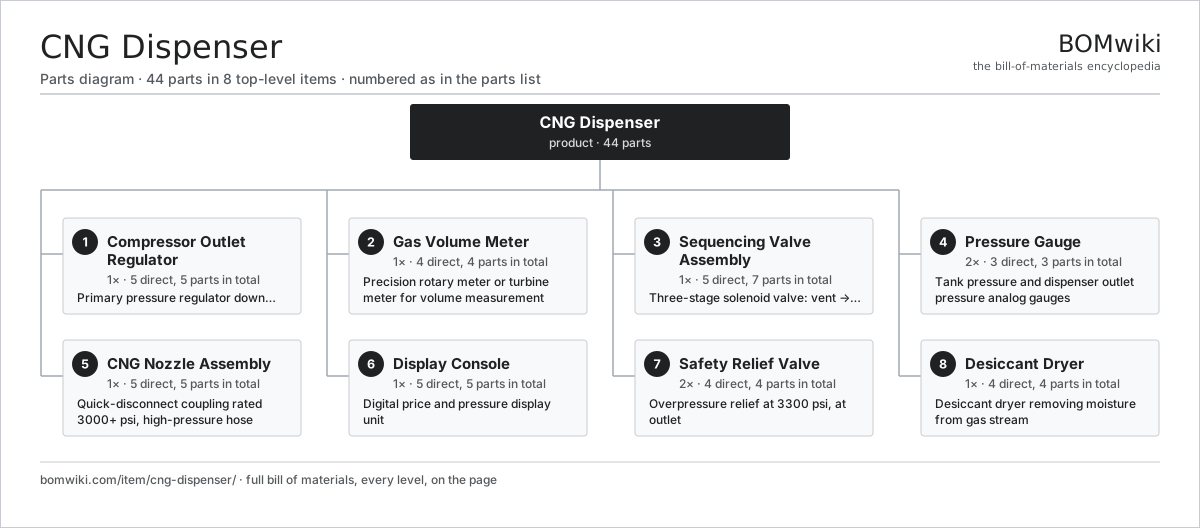
| # | Part | Qty | What it does |
|---|---|---|---|
| 1 | Compressor Outlet Regulator 5 parts | 1× | Primary pressure regulator down from 3600 psi station source |
| 2 | Gas Volume Meter 4 parts | 1× | Precision rotary meter or turbine meter for volume measurement |
| 3 | Sequencing Valve Assembly 5 parts | 1× | Three-stage solenoid valve: vent → low-pressure fill → high-pressure fill |
| 4 | Pressure Gauge 3 parts | 2× | Tank pressure and dispenser outlet pressure analog gauges |
| 5 | CNG Nozzle Assembly 5 parts | 1× | Quick-disconnect coupling rated 3000+ psi, high-pressure hose |
| 6 | Display Console 5 parts | 1× | Digital price and pressure display unit |
| 7 | Safety Relief Valve 4 parts | 2× | Overpressure relief at 3300 psi, at outlet |
| 8 | Desiccant Dryer 4 parts | 1× | Desiccant dryer removing moisture from gas stream |
3D model
No 3D model yet. Have a CAD file of this? Add a 3D model. STL renders right on this page; STEP, FreeCAD, and OpenSCAD sources are welcome too (openly licensed, like all 3D models on BOMwiki).
Build & assembly graph
expand / collapse · shared sub-assemblies converge · links to related products · est. labourTap an assembly to expand/collapse · tap a part to open it · use “Open page” for any node · drag to pan, scroll to zoom.
Bill of materials for CNG Dispenser
8 top-level lines · 43 rows shown · 44 parts total · indented to 3 levels| # | Item / sub-assembly | Part no. | Qty/assy | Ext. qty | Parts | Type |
|---|---|---|---|---|---|---|
| 1 | Compressor Outlet Regulator 5 parts | cng-dispenser-compressor-outlet | 1× | 1 | 5 | assembly |
| 1.1 | Pilot-Operated Regulator Stage | cng-dispenser-pilot-stage | 1× | 1 | · | part |
| 1.2 | Poppet Metering Valve | cng-dispenser-poppet-valve | 1× | 1 | · | part |
| 1.3 | Regulator Housing | cng-dispenser-regulator-body | 1× | 1 | · | part |
| 1.4 | Pressure Sensor | pressure-sensor | 1× | 1 | · | part |
| 1.5 | Fastener Set | fastener-set | 1× | 1 | · | part |
| 2 | Gas Volume Meter 4 parts | cng-dispenser-metering-block | 1× | 1 | 4 | assembly |
| 2.1 | Turbine Meter Rotor | cng-dispenser-meter-rotor | 1× | 1 | · | part |
| 2.2 | Meter Body | cng-dispenser-meter-housing | 1× | 1 | · | part |
| 2.3 | Magnetic Pickup Sensor | cng-dispenser-meter-pickup | 1× | 1 | · | part |
| 2.4 | Connector | connector | 1× | 1 | · | part |
| 3 | Sequencing Valve Assembly 5 parts | cng-dispenser-sequencing-valve | 1× | 1 | 7 | assembly |
| 3.1 | Vent Solenoid Valve | cng-dispenser-solenoid-valve-1 | 1× | 1 | · | part |
| 3.2 | Low-Pressure Fill Solenoid | cng-dispenser-solenoid-valve-2 | 1× | 1 | · | part |
| 3.3 | High-Pressure Fill Solenoid | cng-dispenser-solenoid-valve-3 | 1× | 1 | · | part |
| 3.4 | Sequencing Logic Module | cng-dispenser-sequence-logic-board | 1× | 1 | · | part |
| 3.5 | Relay | relay | 3× | 3 | · | part |
| 4 | Pressure Gauge 3 parts | cng-dispenser-pressure-gauge | 2× | 2 | 3 | assembly |
| 4.1 | Bourdon Tube Gauge | cng-dispenser-bourdon-gauge | 1× | 2 | · | part |
| 4.2 | Pressure Sensor | pressure-sensor | 1× | 2 | · | part |
| 4.3 | Pressure Gauge Snubber | cng-dispenser-gauge-snubber | 1× | 2 | · | part |
| 5 | CNG Nozzle Assembly 5 parts | cng-dispenser-nozzle-assy | 1× | 1 | 5 | assembly |
| 5.1 | Nozzle Body | cng-dispenser-nozzle-body | 1× | 1 | · | part |
| 5.2 | Nozzle Check Valve | cng-dispenser-nozzle-check-valve | 1× | 1 | · | part |
| 5.3 | High-Pressure Hose | cng-dispenser-nozzle-hose | 1× | 1 | · | part |
| 5.4 | Quick-Disconnect Coupler | cng-dispenser-nozzle-coupler | 1× | 1 | · | part |
| 5.5 | Nozzle Outlet Relief Valve | cng-dispenser-nozzle-pressure-relief | 1× | 1 | · | part |
| 6 | Display Console 5 parts | cng-dispenser-display-console | 1× | 1 | 5 | assembly |
| 6.1 | LCD Panel | lcd-panel | 1× | 1 | · | part |
| 6.2 | Console Microcontroller | cng-dispenser-console-cpu | 1× | 1 | · | part |
| 6.3 | Console Enclosure | cng-dispenser-console-enclosure | 1× | 1 | · | part |
| 6.4 | Bare PCB | pcb-bare | 1× | 1 | · | part |
| 6.5 | SMD Passive (R/C/L) | smd-passives | 1× | 1 | · | part |
| 7 | Safety Relief Valve 4 parts | cng-dispenser-safety-relief-valve | 2× | 2 | 4 | assembly |
| 7.1 | Relief Cartridge | cng-dispenser-relief-cartridge | 1× | 2 | · | part |
| 7.2 | Relief Spring | cng-dispenser-relief-spring | 1× | 2 | · | part |
| 7.3 | Relief Manifold | cng-dispenser-relief-housing | 1× | 2 | · | part |
| 7.4 | Pressure Sensor | pressure-sensor | 1× | 2 | · | part |
| 8 | Desiccant Dryer 4 parts | cng-dispenser-dryer-cartridge | 1× | 1 | 4 | assembly |
| 8.1 | Dryer Canister | cng-dispenser-dryer-canister | 1× | 1 | · | part |
| 8.2 | Desiccant Cartridge | cng-dispenser-desiccant-element | 1× | 1 | · | part |
| 8.3 | Dryer Intake Filter | cng-dispenser-dryer-filter-screen | 1× | 1 | · | part |
| 8.4 | Pressure Sensor | pressure-sensor | 1× | 1 | · | part |
Something wrong in this list? Report a problem with this BOM.
Related products
same domain, ranked by shared parts Coal Pulverizer Mill
313 parts · shares 2 with this page
Coal Pulverizer Mill
313 parts · shares 2 with this page
 Combined Heat and Power Unit
522 parts · shares 2 with this page
Containerized Diesel Genset
655 parts · shares 2 with this page
Combined Heat and Power Unit
522 parts · shares 2 with this page
Containerized Diesel Genset
655 parts · shares 2 with this page
 DEF Dispenser
35 parts · shares 2 with this page
DEF Dispenser
35 parts · shares 2 with this page
Sourcing: possible vendors
Browse the supplier directory → Prices, MOQ, and lead times are algorithmic estimates, not quotes, and not claims about these companies. Company mappings are curated by keyword; est. price band $5k–$50M. How estimates work| Vendor | HQ | Specialty | MOQ | Lead time |
|---|---|---|---|---|
| gevernova.com ↗ | Cambridge, US | Power generation | made to order | 20–40 wks |
| siemens-energy.com ↗ | Munich, DE | Power & grid | made to order | 20–40 wks |
| hitachienergy.com ↗ | Zurich, CH | Grid & transformers | made to order | 20–40 wks |
|
🇨🇭ABB
abb.com ↗
|
Zurich, CH | Electrification & automation | made to order | 20–40 wks |
| se.com ↗ | Rueil-Malmaison, FR | Electrical & automation | made to order | 20–40 wks |
1,141-word article