CO2 Jet
ProductOverview
A CO₂ jet system creates a dramatic cryogenic fog burst by rapidly discharging pressurized liquid CO₂ through precision nozzles. The effect is visually striking, a white plume of condensed CO₂ fog that drops rapidly due to its density (1.98 kg/m³ at STP, much heavier than air). This equipment is exclusively for licensed stage operators due to the pressure hazards and noise levels involved. Professional CO₂ jets are common in nightclub lighting rigs, theatrical productions, and concert setups.
The system depends on a properly syphon-equipped CO₂ tank. Standard compressed-gas tanks have an inlet dip tube that draws liquid CO₂ from the bottom; without this, the system would discharge only gas, wasting the effect. The Syphon Adapter CGA-320 coupling connects the tank to the regulator, extracting the liquid phase. The Pressure Regulator then reduces tank pressure (typically 50–60 bar for liquid CO₂) to a safe working pressure of 20–60 bar downstream.
Pressure regulation and safety
The Pressure Regulator is a two-stage design: the first stage drops tank pressure to an intermediate level, and the second stage maintains a pilot-operated outlet pressure. This design prevents uncontrolled discharge if the downstream circuit is blocked. A Pressure Gauge displays tank pressure and outlet pressure simultaneously, allowing operators to confirm safe operation and tank fill level.
The Safety Module provides multiple layers of protection. A Relief Valve vents excess pressure to atmosphere if the outlet reaches ~100 bar. A Burst Disk is a thermally-activated rupture disk rated at 110 bar; if the system overheats (e.g., summer sun exposure), the disk ruptures safely before pressure can damage the tank. A Temperature Interlock halts operations if ambient temperature exceeds 40 °C, preventing pressure creep.
Solenoid actuation
The Solenoid Valve is a 2/2 normally-closed design: CO₂ cannot flow unless the solenoid is energized. This fail-safe design prevents unintended discharge if power is lost. The Solenoid Coil is 24VDC and drives an Valve Spool that opens with <100 ms response time, allowing precise timing of burst duration. For liquid CO₂ service, seals must be Seal Kit compatible, PTFE and nitrile materials that resist CO₂ solubility effects.
Discharge nozzles
The Nozzle Array comprises 3–5 precision stainless-steel CO2 Nozzle units mounted in parallel via a Nozzle Manifold. Each nozzle is a Laval nozzle, a converging-diverging design that accelerates liquid CO₂ to supersonic speeds. As the liquid vaporizes and expands in the diverging section, it cools dramatically via adiabatic expansion, reaching –78.5 °C. This extreme cold freezes atmospheric moisture, creating the visible white fog plume.
The nozzles are aimed at a 25–45° spread angle; multiple nozzles on a manifold allow wider coverage of stage area. Sound is a significant design challenge: CO₂ discharge is inherently loud (100–110 dB). A Muffler Insert inside each nozzle attenuates the noise by introducing a series of stainless-steel baffles that expand and cool the gas gradually, reducing shock waves.
Mounting and aiming
The Mounting Rig is a steel stand with a Stand Base weighted for stability under recoil. A Pan/Tilt Head provides geared pan and tilt adjustment; the Quick-Release Mount bracket holds the nozzle manifold. A Safety Cable rated to 2 tons provides redundant restraint against thrust force during discharge.
Control and addressing
The DMX Controller decodes RS485 DMX512 signals and operates a relay that energizes the solenoid. Channels control discharge duration (hold time) and intensity (pulse width modulation for variable-speed discharge). The Display Panel includes a Status LED showing power and activation status, and a E-Stop Button button for manual override.
Operational safety
Operators must be trained in CO₂ safety: never point nozzles at people (the jet reaches –78 °C and can cause frostbite), always confirm tank security before discharge, and maintain clear line-of-sight to the system during operation. Tank exhaustion must be monitored via Pressure Gauge reading; tanks should be changed before reaching 15 bar to ensure minimum pressure for nozzle operation. Annual inspection of seals and nozzle alignment is recommended for professional rigs.
CO2 Jet parts and their functions
9 top-level parts · 84 parts in total · full bill of materials below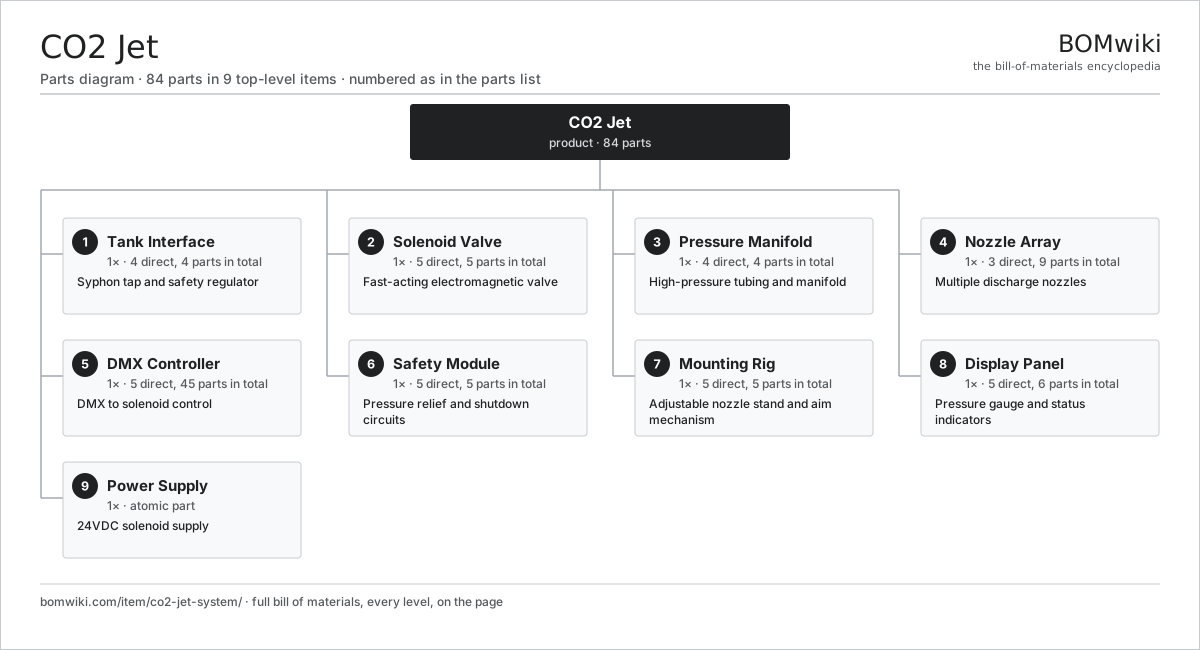
| # | Part | Qty | What it does |
|---|---|---|---|
| 1 | Tank Interface 4 parts | 1× | Syphon tap and safety regulator |
| 2 | Solenoid Valve 5 parts | 1× | Fast-acting electromagnetic valve |
| 3 | Pressure Manifold 4 parts | 1× | High-pressure tubing and manifold |
| 4 | Nozzle Array 3 parts | 1× | Multiple discharge nozzles |
| 5 | DMX Controller 5 parts | 1× | DMX to solenoid control |
| 6 | Safety Module 5 parts | 1× | Pressure relief and shutdown circuits |
| 7 | Mounting Rig 5 parts | 1× | Adjustable nozzle stand and aim mechanism |
| 8 | Display Panel 5 parts | 1× | Pressure gauge and status indicators |
| 9 | Power Supply | 1× | 24VDC solenoid supply |
3D model
No 3D model yet. Have a CAD file of this? Add a 3D model. STL renders right on this page; STEP, FreeCAD, and OpenSCAD sources are welcome too (openly licensed, like all 3D models on BOMwiki).
Build & assembly graph
expand / collapse · shared sub-assemblies converge · links to related products · est. labourTap an assembly to expand/collapse · tap a part to open it · use “Open page” for any node · drag to pan, scroll to zoom.
Bill of materials for CO2 Jet
9 top-level lines · 45 rows shown · 84 parts total · indented to 3 levels| # | Item / sub-assembly | Part no. | Qty/assy | Ext. qty | Parts | Type |
|---|---|---|---|---|---|---|
| 1 | Tank Interface 4 parts | co2-jet-system-tank-interface | 1× | 1 | 4 | assembly |
| 1.1 | Syphon Adapter | co2-jet-system-syphon-adapter | 1× | 1 | · | part |
| 1.2 | Pressure Regulator | co2-jet-system-safety-regulator | 1× | 1 | · | part |
| 1.3 | Pressure Gauge | co2-jet-system-regulator-gauge | 1× | 1 | · | part |
| 1.4 | Connector | connector | 1× | 1 | · | part |
| 2 | Solenoid Valve 5 parts | co2-jet-system-solenoid-valve | 1× | 1 | 5 | assembly |
| 2.1 | Valve Manifold | co2-jet-system-valve-body | 1× | 1 | · | part |
| 2.2 | Solenoid Coil | co2-jet-system-solenoid-coil | 1× | 1 | · | part |
| 2.3 | Valve Spool | co2-jet-system-valve-spool | 1× | 1 | · | part |
| 2.4 | Seal Kit | co2-jet-system-valve-seal-kit | 1× | 1 | · | part |
| 2.5 | Connector | connector | 1× | 1 | · | part |
| 3 | Pressure Manifold 4 parts | co2-jet-system-pressure-lines | 1× | 1 | 4 | assembly |
| 3.1 | Tubing | co2-jet-system-tube-stock | 1× | 1 | · | part |
| 3.2 | Fittings | co2-jet-system-line-fittings | 1× | 1 | · | part |
| 3.3 | Check Valve | co2-jet-system-check-valve | 1× | 1 | · | part |
| 3.4 | Isolation Block | co2-jet-system-isolation-block | 1× | 1 | · | part |
| 4 | Nozzle Array 3 parts | co2-jet-system-nozzle-array | 1× | 1 | 9 | assembly |
| 4.1 | CO2 Nozzle | co2-jet-system-nozzle | 4× | 4 | · | part |
| 4.2 | Nozzle Manifold | co2-jet-system-nozzle-manifold | 1× | 1 | · | part |
| 4.3 | Muffler Insert | co2-jet-system-muffler-insert | 4× | 4 | · | part |
| 5 | DMX Controller 5 parts | co2-jet-system-dmx-trigger-board | 1× | 1 | 45 | assembly |
| 5.1 | Bare PCB | pcb-bare | 1× | 1 | · | part |
| 5.2 | Microcontroller | mcu | 1× | 1 | · | part |
| 5.3 | Relay | relay | 1× | 1 | · | part |
| 5.4 | SMD Passive (R/C/L) | smd-passives | 40× | 40 | · | part |
| 5.5 | Connector | connector | 2× | 2 | · | part |
| 6 | Safety Module 5 parts | co2-jet-system-safety-module | 1× | 1 | 5 | assembly |
| 6.1 | Relief Valve | co2-jet-system-relief-valve | 1× | 1 | · | part |
| 6.2 | Burst Disk | co2-jet-system-burst-disk | 1× | 1 | · | part |
| 6.3 | Pressure Sensor | pressure-sensor | 1× | 1 | · | part |
| 6.4 | Temperature Interlock | co2-jet-system-temperature-interlock | 1× | 1 | · | part |
| 6.5 | Fail-Safe Solenoid | co2-jet-system-shutdown-solenoid | 1× | 1 | · | part |
| 7 | Mounting Rig 5 parts | co2-jet-system-mounting-rig | 1× | 1 | 5 | assembly |
| 7.1 | Stand Base | co2-jet-system-stand-base | 1× | 1 | · | part |
| 7.2 | Pan/Tilt Head | co2-jet-system-pan-tilt-head | 1× | 1 | · | part |
| 7.3 | Quick-Release Mount | co2-jet-system-quick-release | 1× | 1 | · | part |
| 7.4 | Fastener Set | fastener-set | 1× | 1 | · | part |
| 7.5 | Safety Cable | co2-jet-system-safety-cable | 1× | 1 | · | part |
| 8 | Display Panel 5 parts | co2-jet-system-display-panel | 1× | 1 | 6 | assembly |
| 8.1 | Panel Enclosure | co2-jet-system-panel-housing | 1× | 1 | · | part |
| 8.2 | Digital Gauge | co2-jet-system-display-gauge | 1× | 1 | · | part |
| 8.3 | Status LED | co2-jet-system-status-led | 2× | 2 | · | part |
| 8.4 | E-Stop Button | co2-jet-system-emergency-stop | 1× | 1 | · | part |
| 8.5 | Fastener Set | fastener-set | 1× | 1 | · | part |
| 9 | Power Supply | power-supply | 1× | 1 | · | part |
Something wrong in this list? Report a problem with this BOM.
Related products
same domain, ranked by shared parts Fog Machine
25 parts · shares 3 with this page
Fog Machine
25 parts · shares 3 with this page
 Stage Lighting Console
163 parts · shares 3 with this page
Stage Lighting Console
163 parts · shares 3 with this page
 Confetti Cannon
28 parts · shares 2 with this page
Confetti Cannon
28 parts · shares 2 with this page
 DMX Dimmer Rack
71 parts · shares 2 with this page
Studio Jib Arm
106 parts · shares 2 with this page
DMX Flame Machine
87 parts · shares 2 with this page
DMX Dimmer Rack
71 parts · shares 2 with this page
Studio Jib Arm
106 parts · shares 2 with this page
DMX Flame Machine
87 parts · shares 2 with this page
Sourcing: possible vendors
Browse the supplier directory → Prices, MOQ, and lead times are algorithmic estimates, not quotes, and not claims about these companies. Company mappings are curated by keyword; est. price band $50–$3k. How estimates work| Vendor | HQ | Specialty | MOQ | Lead time |
|---|---|---|---|---|
|
🇯🇵Sony
sony.com ↗
|
Tokyo, JP | Consumer electronics | 1,000 units | 8–12 wks |
| samsung.com ↗ | Suwon, KR | Electronics & displays | 1,000 units | 8–12 wks |
|
🇺🇸Harman
harman.com ↗
|
Stamford, US | Audio (JBL, AKG) | 1,000 units | 8–12 wks |
|
🇺🇸Bose
bose.com ↗
|
Framingham, US | Audio | 1,000 units | 8–12 wks |
| yamaha.com ↗ | Hamamatsu, JP | Audio & instruments | 1,000 units | 8–12 wks |
753-word article