Cold Heading Machine
ProductOverview
A cold heading machine is an automated fastener manufacturing tool that progressively forms bolt heads, rivets, and screws from wire stock without heat. The machine uncoils steel or brass wire, shears it into blanks, and transfers each blank through a series of forming dies powered by a mechanical drive system. Cold heading produces fasteners with high strength and excellent surface finish, making it essential for producing bolts, rivets, and screws at volumes exceeding 1000 parts per day.
Cold heading relies on plastic deformation of the blank to fill die cavities under high pressure. Unlike machining, which removes material, cold heading compresses and reshapes the blank, preserving material and producing stronger parts with fine grain flow. The process is economical because wire stock has minimal scrap and cycle times are brief, 30 to 120 parts per minute depending on size.
The typical machine has five to seven forming stations arranged radially or linearly. The wire feed system straightens and positions stock. The cutoff unit shears blanks to length with ±0.05 mm repeatability. Transfer fingers then pass each blank from one forming station to the next. At each station, a hardened die pair forges the blank into the desired shape. Finally, the knockout system ejects the finished fastener.
How it works
The machine cycle begins when the feed nose positions a length of wire against the cutoff blade. As the main drive rotates, a mechanical linkage actuates the blade, shearing the wire to the target blank length. The blank drops into a transfer pocket.
The transfer cam, driven by the main shaft, rotates and opens the transfer fingers. The fingers grip the blank and lift it into the first forming station. Here, the upper die descends and strikes the blank against the lower die, plastic-deforming the end into a head shape. Forming pressure ranges from 800 to 2000 MPa depending on material and head diameter.
After the first heading, the transfer cam closes the fingers and rotates again, advancing the blank to the next station. Larger fasteners may require two or three heading strokes to fill the die cavity completely and achieve the final profile. Each station applies incremental forming, progressively building the final head shape.
Once all heading operations are complete, the blank enters the knockout zone. The knockout actuator drives the knockout pin upward, ejecting the finished fastener from the lower die. The part falls into a collection chute.
The main drive, typically a 15 to 30 kW electric motor coupled through a gearbox to a flywheel, maintains synchronized rotation of all cams and linkages. The flywheel stores rotational inertia, providing peak power for the forming stroke without motor overload. A speed controller adjusts the operating speed from 30 to 120 parts per minute, matching the cycle rate to die capacity.
Die life and material flow
The heading dies are the machine's most critical wear item. Hardened to 48–52 HRC, they can form 50,000 to 150,000 parts before the cavity edges begin to dull and produce dimensional creep. At that point, the dies are removed and hand-honed or sent for professional resharpening. Complete die sets, upper and lower cavities, cost 800 to 3000 EUR depending on head complexity.
Wire is fed at ambient temperature, so the process is called "cold" heading. The blank does experience localized strain heating during forming, reaching 50–80 °C in severe cases, but remains far below recrystallization temperature. This cold work hardens the fastener, increasing tensile strength compared to the annealed wire stock.
Material loss is minimal: the sheared wire is cut precisely to blank length, and forming is lossless. Only the cutting operation produces scrap, a small slug from the shear. For materials like stainless steel or brass, which are expensive, this efficiency is a major cost advantage over machining.
Setup and changeover
Changing from one fastener size to another requires swapping the heading dies, feed nose, and sometimes the cutoff blade. A trained operator can accomplish a complete changeover in 30 to 60 minutes. The drive system remains unchanged; only the die cavities and some wear surfaces are replaced.
Speed adjustment is done by changing gearbox ratios or via a variable-frequency drive on modern machines. Older machines use a mechanical speed control that adjusts the active cam angle, reducing the number of active forming strokes per motor revolution.
Applications
Cold heading is the dominant process for fasteners under M16 (5 mm diameter). Annual global production exceeds 400 billion cold-headed bolts and screws. Standard applications include:
- Hex head bolts and socket head cap screws
- Carriage bolts and eye bolts
- Rivets and semi-tubular rivets
- Slotted wood screws and sheet metal screws
- Fasteners for automotive, aircraft, construction, and electrical equipment
Specialty forms include self-drilling screws (with flutes for sheet metal), security screws with proprietary head designs, and captive fasteners with wires or springs pre-attached.
Economics
A production machine costs 80,000 to 250,000 EUR installed. Annual material cost (wire stock) is typically 2–5 EUR per 1000 fasteners. Labor is minimal, one operator can monitor 1–2 machines. The process reaches economic efficiency at volumes exceeding 50,000 parts per part number per year. For commodity fasteners, economies of scale push volumes to 10 million parts per year per machine.
Cold Heading Machine parts and their functions
8 top-level parts · 40 parts in total · full bill of materials below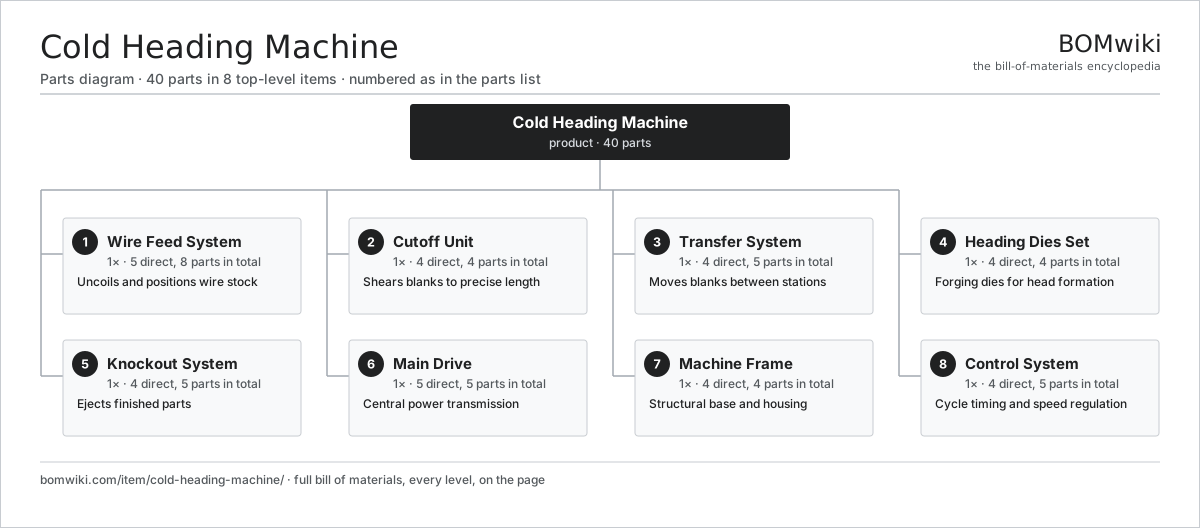
| # | Part | Qty | What it does |
|---|---|---|---|
| 1 | Wire Feed System 5 parts | 1× | Uncoils and positions wire stock |
| 2 | Cutoff Unit 4 parts | 1× | Shears blanks to precise length |
| 3 | Transfer System 4 parts | 1× | Moves blanks between stations |
| 4 | Heading Dies Set 4 parts | 1× | Forging dies for head formation |
| 5 | Knockout System 4 parts | 1× | Ejects finished parts |
| 6 | Main Drive 5 parts | 1× | Central power transmission |
| 7 | Machine Frame 4 parts | 1× | Structural base and housing |
| 8 | Control System 4 parts | 1× | Cycle timing and speed regulation |
3D model
No 3D model yet. Have a CAD file of this? Add a 3D model. STL renders right on this page; STEP, FreeCAD, and OpenSCAD sources are welcome too (openly licensed, like all 3D models on BOMwiki).
Build & assembly graph
expand / collapse · shared sub-assemblies converge · links to related products · est. labourTap an assembly to expand/collapse · tap a part to open it · use “Open page” for any node · drag to pan, scroll to zoom.
Bill of materials for Cold Heading Machine
8 top-level lines · 42 rows shown · 40 parts total · indented to 3 levels| # | Item / sub-assembly | Part no. | Qty/assy | Ext. qty | Parts | Type |
|---|---|---|---|---|---|---|
| 1 | Wire Feed System 5 parts | cold-heading-machine-wire-feed-system | 1× | 1 | 8 | assembly |
| 1.1 | Payoff Reel | cold-heading-machine-payoff-reel | 1× | 1 | · | part |
| 1.2 | Straightening Unit | cold-heading-machine-straightening-unit | 1× | 1 | · | part |
| 1.3 | Feed Nose | cold-heading-machine-feed-nose | 1× | 1 | · | part |
| 1.4 | Ball Bearing | ball-bearing | 4× | 4 | · | part |
| 1.5 | Wire Bundle | wire-bundle | 1× | 1 | · | part |
| 2 | Cutoff Unit 4 parts | cold-heading-machine-cutoff-unit | 1× | 1 | 4 | assembly |
| 2.1 | Cutoff Blade | cold-heading-machine-cutoff-blade | 1× | 1 | · | part |
| 2.2 | Blade Holder | cold-heading-machine-blade-holder | 1× | 1 | · | part |
| 2.3 | Cutoff Linkage | cold-heading-machine-cutoff-linkage | 1× | 1 | · | part |
| 2.4 | Fastener Set | fastener-set | 1× | 1 | · | part |
| 3 | Transfer System 4 parts | cold-heading-machine-transfer-system | 1× | 1 | 5 | assembly |
| 3.1 | Transfer Fingers | cold-heading-machine-transfer-fingers | 1× | 1 | · | part |
| 3.2 | Transfer Cam | cold-heading-machine-transfer-cam | 1× | 1 | · | part |
| 3.3 | Transfer Linkage | cold-heading-machine-transfer-linkage | 1× | 1 | · | part |
| 3.4 | Ball Bearing | ball-bearing | 2× | 2 | · | part |
| 4 | Heading Dies Set 4 parts | cold-heading-machine-heading-dies | 1× | 1 | 4 | assembly |
| 4.1 | Upper Die | cold-heading-machine-upper-die | 1× | 1 | · | part |
| 4.2 | Lower Die | cold-heading-machine-lower-die | 1× | 1 | · | part |
| 4.3 | Upper Die Holder | cold-heading-machine-die-holder-upper | 1× | 1 | · | part |
| 4.4 | Lower Die Holder | cold-heading-machine-die-holder-lower | 1× | 1 | · | part |
| 5 | Knockout System 4 parts | cold-heading-machine-knockout-system | 1× | 1 | 5 | assembly |
| 5.1 | Knockout Pin | cold-heading-machine-knockout-pin | 1× | 1 | · | part |
| 5.2 | Knockout Actuator | cold-heading-machine-knockout-actuator | 1× | 1 | · | part |
| 5.3 | Ball Bearing | ball-bearing | 1× | 1 | · | part |
| 5.4 | O-Ring Set | oring-set | 2× | 2 | · | part |
| 6 | Main Drive 5 parts | cold-heading-machine-main-drive | 1× | 1 | 5 | assembly |
| 6.1 | Electric Motor | cold-heading-machine-motor | 1× | 1 | · | part |
| 6.2 | Gearbox | cold-heading-machine-gearbox | 1× | 1 | · | part |
| 6.3 | Flywheel | cold-heading-machine-flywheel | 1× | 1 | · | part |
| 6.4 | Belt Pulley | cold-heading-machine-belt-pulley | 1× | 1 | · | part |
| 6.5 | Drive Belt | drive-belt | 1× | 1 | · | part |
| 7 | Machine Frame 4 parts | cold-heading-machine-machine-frame | 1× | 1 | 4 | assembly |
| 7.1 | Frame Base | cold-heading-machine-frame-base | 1× | 1 | · | part |
| 7.2 | Frame Uprights | cold-heading-machine-frame-uprights | 1× | 1 | · | part |
| 7.3 | Work Table | cold-heading-machine-work-table | 1× | 1 | · | part |
| 7.4 | Sheet Metal Panel | sheet-panel | 1× | 1 | · | part |
| 8 | Control System 4 parts | cold-heading-machine-control-system | 1× | 1 | 5 | assembly |
| 8.1 | Timing Cam | cold-heading-machine-timing-cam | 1× | 1 | · | part |
| 8.2 | Speed Controller | cold-heading-machine-speed-controller | 1× | 1 | · | part |
| 8.3 | Relay | relay | 2× | 2 | · | part |
| 8.4 | Pressure Sensor | pressure-sensor | 1× | 1 | · | part |
Something wrong in this list? Report a problem with this BOM.
Related products
same domain, ranked by shared parts Centrifugal Disc Finishing Machine
326 parts · shares 3 with this page
Centrifugal Disc Finishing Machine
326 parts · shares 3 with this page
 Crankshaft Grinder
511 parts · shares 3 with this page
Crankshaft Grinder
511 parts · shares 3 with this page
 Creep-Feed Grinder
571 parts · shares 3 with this page
Drag Finishing Machine
735 parts · shares 3 with this page
Creep-Feed Grinder
571 parts · shares 3 with this page
Drag Finishing Machine
735 parts · shares 3 with this page
Sourcing: possible vendors
Browse the supplier directory → Prices, MOQ, and lead times are algorithmic estimates, not quotes, and not claims about these companies. Company mappings are curated by keyword; est. price band $10k–$1M. How estimates work| Vendor | HQ | Specialty | MOQ | Lead time |
|---|---|---|---|---|
|
🇩🇪DMG MORI
dmgmori.com ↗
|
Bielefeld, DE | Machine tools | 5 units | 12–20 wks |
|
🇯🇵Mazak
mazak.com ↗
|
Oguchi, JP | Machine tools | 5 units | 12–20 wks |
| haascnc.com ↗ | Oxnard, US | CNC machine tools | 5 units | 12–20 wks |
|
🇯🇵Okuma
okuma.com ↗
|
Niwa, JP | Machine tools | 5 units | 12–20 wks |
|
🇩🇪Trumpf
trumpf.com ↗
|
Ditzingen, DE | Laser & sheet-metal machines | 5 units | 12–20 wks |
977-word article