Cold Spray System
ProductOverview
Cold spray is the newest thermal coating technology and uniquely operates below the melting point of the deposited material. Instead of melting powder (as in flame, arc, and plasma spray), cold spray heats compressed gas to 350–500°C and accelerates it through a de Laval converging-diverging nozzle to Mach 4+ velocity. Powder particles are injected into this supersonic stream, accelerated to 400–700 m/s, and impact a target surface so violently that they deform plastically and embed themselves through adiabatic shear instability, a form of mechanical bonding that does not require melting. The result is a coating with minimal oxidation, thermal distortion, or phase change, making it ideal for heat-sensitive materials, titanium alloys, and composite substrates.
The Gas Heater is the thermal source. A 2 L stainless steel pressure vessel houses three electric heating elements (5 kW total, 1.67 kW each). Nitrogen or helium compressed to 40 bar enters the vessel, where the resistance heaters warm the gas to 350–500°C depending on the desired particle velocity. A Temperature Sensor (platinum RTD) monitors outlet temperature; the Control Module MCU uses proportional heating to maintain setpoint within ±10°C. A Pressure Relief Valve safety valve pops at 45 bar to protect the vessel. The heated gas then flows through a Check Valve that prevents backflow during shutdown.
From the heater, the hot, pressurized gas enters the De Laval Nozzle, specifically a de Laval converging-diverging nozzle, the same principle as a rocket nozzle. The Nozzle Throat Section is a tungsten carbide bore that converges from 8 mm to 2 mm, accelerating the gas to sonic velocity (Mach 1 at the throat). The Nozzle Divergent Section section then expands from 2 mm to 6 mm, continuing isentropic expansion that further accelerates the gas to Mach 4+ (1500+ m/s) at the exit. A Nozzle Ceramic Liner of yttria-stabilized zirconia ceramic insulates the nozzle interior, allowing the core to operate at 500°C while keeping the exterior below 100°C for operator safety.
Powder particles are injected into the heated gas stream via the Powder Feeder. A Powder Hopper gravity-feeds powder to a rotating Feeder Auger, a variable-pitch screw controlled by a small Feeder Motor (24 V DC, 50 W). The auger rotates at 0–200 rpm, dispensing 5–20 g/min powder into the Injection Tube. This tangential inlet tube mixes fine powder particles (<50 µm diameter) into the heated gas stream immediately upstream of the nozzle throat. The particles then flow through the converging section, are accelerated in the expanding divergent section, and exit the nozzle at 400–700 m/s (depending on particle size, density, and material).
The key difference from other thermal spray methods is that particles remain solid and cool throughout the process. Powder heats by convection contact with hot gas, but the transit time through the nozzle (<10 milliseconds) is too brief for significant melting. Exit temperatures are typically <200°C, well below any material melting point. Particles strike the target surface at such high velocity (400–700 m/s is supersonic for solid particles) that they undergo adiabatic shear deformation: the kinetic energy at impact converts to plastic strain and local heating at the contact surface, causing particles to "weld" mechanically to the substrate and adjacent particles without bulk melting or oxidation.
Gas supply comes from the Gas Supply System. A shop compressor (or nitrogen bottle system) provides high-pressure nitrogen or helium. An Air Inlet Filter removes oil mist and water droplets that would contaminate the heater. A Pressure Regulator reduces inlet pressure to a stable 40 bar, and a Supply Pressure Gauge mechanical pressure indicator allows the operator to verify correct operation. A Tank Relief Valve tank-mounted relief valve protects the supply line if the main regulator fails.
Thermal management is critical to maintain nozzle longevity and ensure safe operation. The Cooling System circulates demineralized water at 15–20 L/min through jackets surrounding the Heater Pressure Vessel and the De Laval Nozzle. A Water Cooler (5 kW chiller) maintains inlet water at 15°C. A Cooling Pump vane pump delivers flow; a Coolant Thermostat proportional thermostat blends chiller output with return water to hold ±2°C setpoint. Without adequate cooling, the nozzle ceramic can crack and the heater vessel wall can degrade.
The Control Module manages the spray sequence. An Microcontroller verifies cooling water flow (via a flow sensor), then energizes three Heating Element cartridges via a Heating Contactor 3-phase contactor. The heater ramps to setpoint temperature (monitored by the Temperature Sensor RTD feedback). Once stable, the Control Module enables the Motor PWM Driver, driving the Feeder Motor at a fixed PWM duty cycle for steady powder flow. The operator grasps the Gun Handle Assembly, which houses a Trigger Valve solenoid that cuts gas flow to the nozzle when released. A Cooling Interlock mechanical switch prevents trigger operation unless cooling water is verified as flowing.
All interconnections use quick-disconnect hoses and sealed connectors. Water enters and exits via Water Hose quick-disconnects rated 40 bar. Gas inlet supplies 40 bar nitrogen via a standard industrial coupling. A shielded control cable routes heater temperature feedback and powder motor PWM from the control unit to the gun.
In industry, cold spray coats titanium and aluminum aerospace components without distortion. Turbine blades, landing gear, and airframe components tolerate only minimal thermal stress; cold spray eliminates the residual stress and metallurgical changes of traditional spray. Biomedical manufacturers apply hydroxyapatite and titanium coatings to implants while preserving the base substrate integrity. Composite manufacturers coat carbon fiber and fiberglass parts without matrix damage. Repair shops restore precision surfaces (bearings, guide ways, shafts) without annealing or dimensional change. Military applications include armor systems and precision electronic components where thermal distortion would be catastrophic.
How it works
- Shop compressed gas (nitrogen or helium) at high pressure enters the Gas Supply System. An Air Inlet Filter removes oil and moisture, and a Pressure Regulator reduces pressure to stable 40 bar downstream.
- The operator activates the Control Module MCU, which first verifies cooling water is flowing via a flow sensor. If water is flowing, the MCU energizes the Heating Contactor, applying 3-phase power to the three Heating Element cartridges.
- The Heating Element resistive heaters warm the gas inside the Heater Pressure Vessel pressure vessel. A Temperature Sensor platinum RTD continuously measures outlet temperature; the MCU adjusts contactor duty cycle to maintain 350–500°C setpoint within ±10°C.
- Heated gas exits the heater through a Check Valve and enters the De Laval Nozzle. The Nozzle Throat Section tungsten carbide converging section narrows bore from 8 mm to 2 mm, accelerating gas to Mach 1 (sonic velocity).
- The Nozzle Divergent Section section expands bore from 2 mm to 6 mm, isentropically expanding the gas and accelerating it further to Mach 4+ at the exit (1500+ m/s).
- Simultaneously, the MCU energizes the Motor PWM Driver, spinning the Feeder Motor at a steady duty cycle. The Feeder Auger rotating screw scoops powder from the Powder Hopper and dispenses 5–20 g/min into the Injection Tube.
- Fine powder particles (<50 µm) are mixed into the heated gas stream immediately upstream of the Nozzle Throat Section. Particles flow through the converging-diverging nozzle, remaining solid throughout (no melting, <10 ms transit time).
- Particles exit the nozzle at 400–700 m/s, depending on size and material. A typical aluminum powder exits at 600 m/s while a tungsten powder exits at 400 m/s.
- The operator holds the Gun Handle Assembly and aims the nozzle at the workpiece, maintaining 30–50 mm standoff distance (much closer than other spray methods). This minimizes in-flight particle deceleration by air drag.
- Particles strike the grit-blasted target surface at supersonic velocity. Kinetic energy converts to adiabatic shear deformation at the impact zone, causing particles to plastically deform and "cold weld" to the substrate.
- Multiple particle impacts build a dense coating layer (0.1–0.5 mm per pass), with mechanical bonding strength reaching 50–100 MPa depending on material and parameters.
- Throughout operation, the Cooling System circulates water at 15–20 L/min through the Heater Pressure Vessel and De Laval Nozzle; the Water Cooler chiller maintains inlet water at 15°C via the Coolant Thermostat thermostat.
- Releasing the operator trigger de-energizes the Trigger Valve solenoid, cutting gas flow to the nozzle. Powder feed stops within milliseconds as no gas carries particles forward.
- If cooling water flow drops below threshold, the Control Module MCU shuts down heater power and vents the system to safe pressure.
Cold Spray System parts and their functions
7 top-level parts · 33 parts in total · full bill of materials below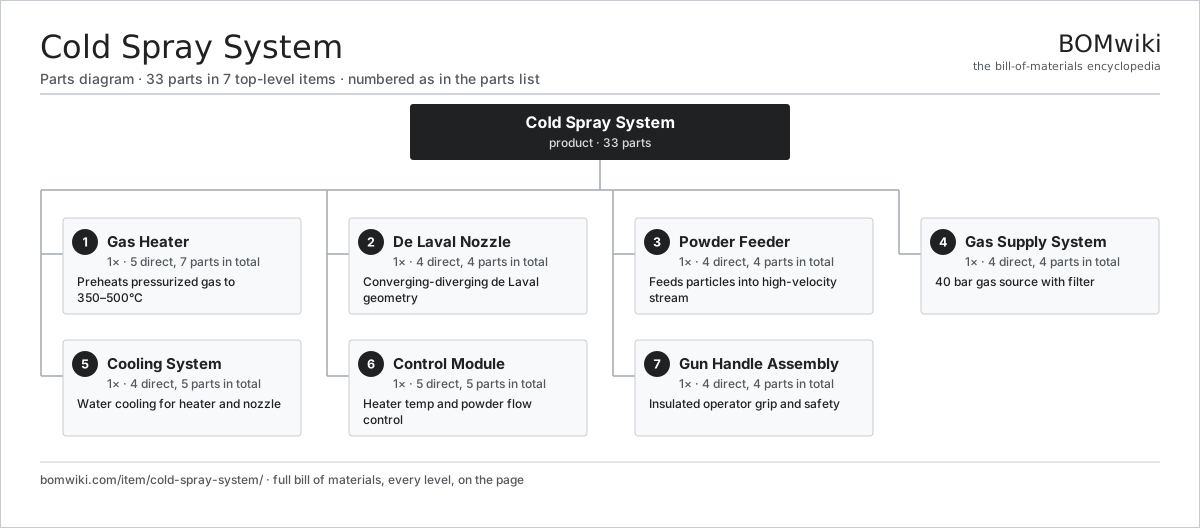
| # | Part | Qty | What it does |
|---|---|---|---|
| 1 | Gas Heater 5 parts | 1× | Preheats pressurized gas to 350–500°C |
| 2 | De Laval Nozzle 4 parts | 1× | Converging-diverging de Laval geometry |
| 3 | Powder Feeder 4 parts | 1× | Feeds particles into high-velocity stream |
| 4 | Gas Supply System 4 parts | 1× | 40 bar gas source with filter |
| 5 | Cooling System 4 parts | 1× | Water cooling for heater and nozzle |
| 6 | Control Module 5 parts | 1× | Heater temp and powder flow control |
| 7 | Gun Handle Assembly 4 parts | 1× | Insulated operator grip and safety |
3D model
No 3D model yet. Have a CAD file of this? Add a 3D model. STL renders right on this page; STEP, FreeCAD, and OpenSCAD sources are welcome too (openly licensed, like all 3D models on BOMwiki).
Build & assembly graph
expand / collapse · shared sub-assemblies converge · links to related products · est. labourTap an assembly to expand/collapse · tap a part to open it · use “Open page” for any node · drag to pan, scroll to zoom.
Bill of materials for Cold Spray System
7 top-level lines · 37 rows shown · 33 parts total · indented to 3 levels| # | Item / sub-assembly | Part no. | Qty/assy | Ext. qty | Parts | Type |
|---|---|---|---|---|---|---|
| 1 | Gas Heater 5 parts | cold-spray-system-gas-heater | 1× | 1 | 7 | assembly |
| 1.1 | Heater Pressure Vessel | cold-spray-system-heater-body | 1× | 1 | · | part |
| 1.2 | Heating Element | cold-spray-system-heating-element | 3× | 3 | · | part |
| 1.3 | Temperature Sensor | cold-spray-system-temperature-sensor | 1× | 1 | · | part |
| 1.4 | Pressure Relief Valve | cold-spray-system-pressure-relief | 1× | 1 | · | part |
| 1.5 | Check Valve | cold-spray-system-check-valve | 1× | 1 | · | part |
| 2 | De Laval Nozzle 4 parts | cold-spray-system-nozzle-assembly | 1× | 1 | 4 | assembly |
| 2.1 | Nozzle Throat Section | cold-spray-system-nozzle-throat | 1× | 1 | · | part |
| 2.2 | Nozzle Divergent Section | cold-spray-system-nozzle-divergent | 1× | 1 | · | part |
| 2.3 | Nozzle Ceramic Liner | cold-spray-system-nozzle-liner | 1× | 1 | · | part |
| 2.4 | Nozzle Mount Interface | cold-spray-system-nozzle-mount | 1× | 1 | · | part |
| 3 | Powder Feeder 4 parts | cold-spray-system-powder-feeder | 1× | 1 | 4 | assembly |
| 3.1 | Powder Hopper | cold-spray-system-hopper | 1× | 1 | · | part |
| 3.2 | Feeder Auger | cold-spray-system-feeder-auger | 1× | 1 | · | part |
| 3.3 | Feeder Motor | cold-spray-system-feeder-motor | 1× | 1 | · | part |
| 3.4 | Injection Tube | cold-spray-system-injection-tube | 1× | 1 | · | part |
| 4 | Gas Supply System 4 parts | cold-spray-system-compressor-supply | 1× | 1 | 4 | assembly |
| 4.1 | Air Inlet Filter | cold-spray-system-air-filter | 1× | 1 | · | part |
| 4.2 | Pressure Regulator | cold-spray-system-regulator | 1× | 1 | · | part |
| 4.3 | Supply Pressure Gauge | cold-spray-system-supply-gauge | 1× | 1 | · | part |
| 4.4 | Tank Relief Valve | cold-spray-system-safety-relief | 1× | 1 | · | part |
| 5 | Cooling System 4 parts | cold-spray-system-cooling-jacket | 1× | 1 | 5 | assembly |
| 5.1 | Water Cooler | cold-spray-system-cooler | 1× | 1 | · | part |
| 5.2 | Cooling Pump | cold-spray-system-pump | 1× | 1 | · | part |
| 5.3 | Water Hose | cold-spray-system-water-hose | 2× | 2 | · | part |
| 5.4 | Coolant Thermostat | cold-spray-system-temp-valve | 1× | 1 | · | part |
| 6 | Control Module 5 parts | cold-spray-system-control-unit | 1× | 1 | 5 | assembly |
| 6.1 | Bare PCB | pcb-bare | 1× | 1 | · | part |
| 6.2 | Microcontroller | mcu | 1× | 1 | · | part |
| 6.3 | Heating Contactor | cold-spray-system-heater-contactor | 1× | 1 | · | part |
| 6.4 | Motor PWM Driver | cold-spray-system-pwm-driver | 1× | 1 | · | part |
| 6.5 | Relay | relay | 1× | 1 | · | part |
| 7 | Gun Handle Assembly 4 parts | cold-spray-system-gun-handle | 1× | 1 | 4 | assembly |
| 7.1 | Grip Body | cold-spray-system-grip-body | 1× | 1 | · | part |
| 7.2 | Trigger Valve | cold-spray-system-trigger-valve | 1× | 1 | · | part |
| 7.3 | Cooling Interlock | cold-spray-system-safety-interlock | 1× | 1 | · | part |
| 7.4 | Fastener Set | fastener-set | 1× | 1 | · | part |
Something wrong in this list? Report a problem with this BOM.
Related products
same domain, ranked by shared parts All-Electric Injection Molding Machine
851 parts · shares 1 with this page
Automated Paint Spray Line
2,003 parts · shares 1 with this page
Ballpoint Pen Assembly Machine
51 parts · shares 1 with this page
Banbury Internal Mixer
64 parts · shares 1 with this page
Binder Jetting Printer
112 parts · shares 1 with this page
All-Electric Injection Molding Machine
851 parts · shares 1 with this page
Automated Paint Spray Line
2,003 parts · shares 1 with this page
Ballpoint Pen Assembly Machine
51 parts · shares 1 with this page
Banbury Internal Mixer
64 parts · shares 1 with this page
Binder Jetting Printer
112 parts · shares 1 with this page
Sourcing: possible vendors
Browse the supplier directory → Prices, MOQ, and lead times are algorithmic estimates, not quotes, and not claims about these companies. Company mappings are curated by keyword; est. price band $5k–$2M. How estimates work| Vendor | HQ | Specialty | MOQ | Lead time |
|---|---|---|---|---|
| atlascopco.com ↗ | Stockholm, SE | Compressors & industrial | 10 units | 12–20 wks |
|
🇦🇹Andritz
andritz.com ↗
|
Graz, AT | Process plants & machinery | 10 units | 12–20 wks |
| buhlergroup.com ↗ | Uzwil, CH | Food & materials processing | 10 units | 12–20 wks |
| gea.com ↗ | Düsseldorf, DE | Process technology | 10 units | 12–20 wks |
| mhi.com ↗ | Tokyo, JP | Heavy machinery | 10 units | 12–20 wks |
1,604-word article