Confetti Cannon
ProductOverview
Confetti cannons are pyrotechnic-free devices that use compressed gas to rapidly launch colorful confetti, streamers, and paper debris into a theater or venue space. Unlike traditional black-powder cannons, pneumatic confetti devices are safe for indoor use and can be triggered repeatedly without ammunition reloading. They are essential equipment for concert finales, awards ceremonies, sporting events, and large-scale theatrical productions.
The Confetti Cannon is a professional-grade pneumatic launcher designed for remote or cued triggering via DMX512 protocol. A pressurized CO2 or compressed-air reservoir stores energy between shots. When triggered, a solenoid valve opens and releases the pressurized gas through a Discharge Barrel, accelerating a measured charge of confetti to 60–80 mph and projecting it 30–50 feet across the venue.
Pressurization System
The Pressure Vessel is a 10-liter aluminum vessel rated for 150 psi continuous pressure. It is filled before each performance via a fill valve coupled to either a CO2 cartridge system (for small venues) or a central compressed-air compressor (for larger facilities). A Pressure Sensor mounted on the reservoir provides real-time feedback to the control electronics; if pressure drops below 100 psi during a show, the system alerts the operator that reserve shots are limited.
CO2 is preferred over compressed air because it is:
- Stored more compactly (10 liters of CO2 at 150 psi is equivalent to ~100 liters of air at atmospheric pressure).
- Less prone to moisture contamination, which can clog the solenoid valve.
- Consistent across multiple shots (air pressure decays faster as the compressor stops bleeding).
Discharge Valve and Flow Control
The Solenoid Valve and Regulator is a proportional solenoid valve with an integral Proportional Regulator. The solenoid spool is pilot-operated, meaning a small electrical coil triggers a pilot stage, which then opens the main spool hydraulically. This design allows smooth, repeatable discharge without harsh pressure spikes.
When the trigger signal is received, the solenoid energizes, opening the main spool. Pressurized gas flows from the Pressure Vessel through the valve body and accelerates the confetti toward the Discharge Barrel. A Pressure Relief Valve is set at 150 psi, venting any excess pressure that accumulates if the valve remains open too long or if the reservoir is over-filled.
Launch Mechanics
The Discharge Barrel is a 3-inch internal-diameter seamless steel tube, 18 inches long. Its upstream breech section has a smooth radius to minimize turbulence as confetti enters; the downstream section expands gradually into a Diverging Nozzle (cone-shaped diffuser) that slows and disperses the confetti stream as it exits.
When the solenoid opens, pressurized gas expands behind the confetti charge in the barrel, accelerating it from rest to 60–80 mph over the 18-inch barrel length. Exit velocity depends on:
- Reservoir pressure at the moment of firing (150 psi yields ~80 mph; 100 psi yields ~60 mph).
- Confetti mass and aerodynamic drag (lighter, streamier materials exit faster).
- Solenoid dwell time (longer dwell = more gas consumed, greater acceleration).
A typical shot lasts 2–3 seconds, consuming 15–25 liters of gas at operating pressure, and projects 500–750 grams of confetti across 30–50 feet before gravity and air resistance bring it to the ground or floor.
Confetti Loading and Feeding
The Loading Hopper uses a helical Auger Screw to meter confetti from a Hopper Cone into the launch barrel. Before each performance, stage crew fills the hopper with the desired confetti mix (paper streamers, metallic shards, biodegradable cellulose, colored tissue). The auger is driven by a small 12V DC motor controlled via PWM from the Control Electronics.
The Feed Gate Solenoid is a solenoid-driven slide that gates the auger inlet. During system idle, the gate is closed, preventing confetti from drifting into the barrel. When a shot is cued, the electronics:
- Open the feed gate (energizing the gate solenoid).
- Run the auger motor for 0.5–1.0 seconds, scooping ~750 grams of material into the barrel's breech.
- Close the feed gate.
- Wait 0.5 seconds (allowing materials to settle).
- Fire the discharge solenoid, expelling the confetti.
Safety Interlocks
The Safety Interlocks includes:
- Pressure Relief Valve: Vents at 150 psi if the solenoid valve jams open.
- Mechanical Safety Pin: A brass pin inserted through the solenoid body before the unit is handed to performers or loaded onto a rig, physically preventing the valve spool from moving. The pin must be removed by authorized crew before electrical operation.
- Watchdog Timer: The microcontroller in the Control Electronics has a hardware watchdog that closes all solenoids if the main processor halts or loses power.
These interlocks are essential because a jammed open solenoid could cause:
- Uncontrolled gas discharge, rupturing the reservoir.
- Projectile hazard if confetti is launched without an intended cue.
- Hearing damage from the abrupt gas discharge (gas velocity at the nozzle can exceed 150 mph locally).
Trigger Modes
The Control Electronics can be triggered by:
- DMX512 protocol: The console operator assigns the cannon to two channels (one for charge/prime, one for fire), allowing synchronized confetti effects with stage lighting and pyrotechnics.
- Wireless remote: Infrared or RF remote with 100-foot range, used when the cannon is mounted overhead and remote manual control is needed.
- Timer: Programmable countdown timer triggering at a fixed cue time during a show.
Typical Deployment
A concert finale uses three Confetti Cannon units mounted on stage-left, stage-right, and center-box trusses. Each is fed CO2 from a central 50-pound bulk tank via regulated distribution lines. During the final chorus, the lighting console operator triggers all three cannons simultaneously via DMX, creating a 30-second confetti shower across the entire venue. Stage crew refills the hoppers between songs and vents residual CO2 before striking the stage.
Environmental and Maintenance Notes
Professional-grade biodegradable confetti (starch-based) allows faster cleanup and is preferred at venues with strict sustainability requirements. Standard paper and plastic confetti remains in stage/venue pits and requires manual sweeping. The Solenoid Valve Body should be cleaned and dried after each performance to prevent mineral buildup from trace moisture in the gas supply; an inline desiccant filter on the reservoir fill line is recommended for high-use venues.
Confetti Cannon parts and their functions
6 top-level parts · 28 parts in total · full bill of materials below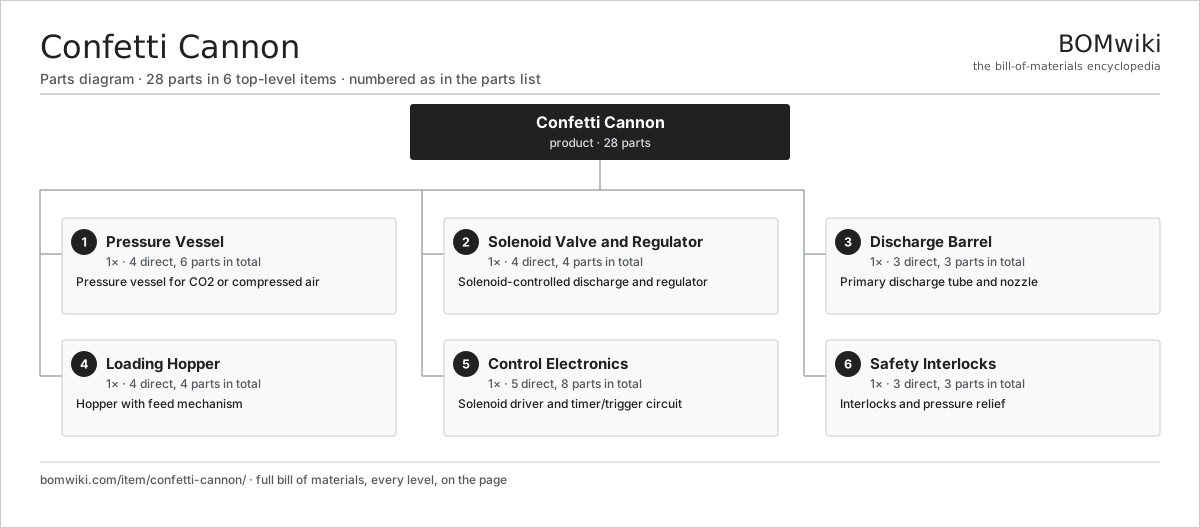
| # | Part | Qty | What it does |
|---|---|---|---|
| 1 | Pressure Vessel 4 parts | 1× | Pressure vessel for CO2 or compressed air |
| 2 | Solenoid Valve and Regulator 4 parts | 1× | Solenoid-controlled discharge and regulator |
| 3 | Discharge Barrel 3 parts | 1× | Primary discharge tube and nozzle |
| 4 | Loading Hopper 4 parts | 1× | Hopper with feed mechanism |
| 5 | Control Electronics 5 parts | 1× | Solenoid driver and timer/trigger circuit |
| 6 | Safety Interlocks 3 parts | 1× | Interlocks and pressure relief |
3D model
No 3D model yet. Have a CAD file of this? Add a 3D model. STL renders right on this page; STEP, FreeCAD, and OpenSCAD sources are welcome too (openly licensed, like all 3D models on BOMwiki).
Build & assembly graph
expand / collapse · shared sub-assemblies converge · links to related products · est. labourTap an assembly to expand/collapse · tap a part to open it · use “Open page” for any node · drag to pan, scroll to zoom.
Bill of materials for Confetti Cannon
6 top-level lines · 29 rows shown · 28 parts total · indented to 3 levels| # | Item / sub-assembly | Part no. | Qty/assy | Ext. qty | Parts | Type |
|---|---|---|---|---|---|---|
| 1 | Pressure Vessel 4 parts | confetti-cannon-reservoir | 1× | 1 | 6 | assembly |
| 1.1 | Tank Body | confetti-cannon-tank-body | 1× | 1 | · | part |
| 1.2 | Connector | connector | 3× | 3 | · | part |
| 1.3 | Pressure Sensor | pressure-sensor | 1× | 1 | · | part |
| 1.4 | Fastener Set | fastener-set | 1× | 1 | · | part |
| 2 | Solenoid Valve and Regulator 4 parts | confetti-cannon-valve-assembly | 1× | 1 | 4 | assembly |
| 2.1 | Solenoid Valve Body | confetti-cannon-solenoid-body | 1× | 1 | · | part |
| 2.2 | Relay | relay | 1× | 1 | · | part |
| 2.3 | Proportional Regulator | confetti-cannon-regulator | 1× | 1 | · | part |
| 2.4 | Fastener Set | fastener-set | 1× | 1 | · | part |
| 3 | Discharge Barrel 3 parts | confetti-cannon-launch-barrel | 1× | 1 | 3 | assembly |
| 3.1 | Barrel Tube | confetti-cannon-barrel-tube | 1× | 1 | · | part |
| 3.2 | Diverging Nozzle | confetti-cannon-diverging-nozzle | 1× | 1 | · | part |
| 3.3 | Fastener Set | fastener-set | 1× | 1 | · | part |
| 4 | Loading Hopper 4 parts | confetti-cannon-loading-chamber | 1× | 1 | 4 | assembly |
| 4.1 | Hopper Cone | confetti-cannon-hopper-body | 1× | 1 | · | part |
| 4.2 | Auger Screw | confetti-cannon-auger | 1× | 1 | · | part |
| 4.3 | Feed Gate Solenoid | confetti-cannon-feed-gate | 1× | 1 | · | part |
| 4.4 | Fastener Set | fastener-set | 1× | 1 | · | part |
| 5 | Control Electronics 5 parts | confetti-cannon-electronics | 1× | 1 | 8 | assembly |
| 5.1 | Bare PCB | pcb-bare | 1× | 1 | · | part |
| 5.2 | Microcontroller | mcu | 1× | 1 | · | part |
| 5.3 | Relay | relay | 2× | 2 | · | part |
| 5.4 | Power MOSFET | mosfet | 2× | 2 | · | part |
| 5.5 | Connector | connector | 2× | 2 | · | part |
| 6 | Safety Interlocks 3 parts | confetti-cannon-safety-system | 1× | 1 | 3 | assembly |
| 6.1 | Pressure Relief Valve | confetti-cannon-relief-valve | 1× | 1 | · | part |
| 6.2 | Safety Lock Pin | confetti-cannon-safety-pin | 1× | 1 | · | part |
| 6.3 | Pressure Sensor | pressure-sensor | 1× | 1 | · | part |
Something wrong in this list? Report a problem with this BOM.
Related products
same domain, ranked by shared parts DMX Dimmer Rack
71 parts · shares 3 with this page
DMX Dimmer Rack
71 parts · shares 3 with this page
 Stage Lighting Console
163 parts · shares 3 with this page
CO2 Jet
84 parts · shares 2 with this page
Stage Lighting Console
163 parts · shares 3 with this page
CO2 Jet
84 parts · shares 2 with this page
 Fog Machine
25 parts · shares 2 with this page
Studio Jib Arm
106 parts · shares 1 with this page
Active PA Speaker
602 parts · shares 1 with this page
Fog Machine
25 parts · shares 2 with this page
Studio Jib Arm
106 parts · shares 1 with this page
Active PA Speaker
602 parts · shares 1 with this page
Sourcing: possible vendors
Browse the supplier directory → Prices, MOQ, and lead times are algorithmic estimates, not quotes, and not claims about these companies. Company mappings are curated by keyword; est. price band $50–$3k. How estimates work| Vendor | HQ | Specialty | MOQ | Lead time |
|---|---|---|---|---|
|
🇯🇵Sony
sony.com ↗
|
Tokyo, JP | Consumer electronics | 1,000 units | 8–12 wks |
| samsung.com ↗ | Suwon, KR | Electronics & displays | 1,000 units | 8–12 wks |
|
🇺🇸Harman
harman.com ↗
|
Stamford, US | Audio (JBL, AKG) | 1,000 units | 8–12 wks |
|
🇺🇸Bose
bose.com ↗
|
Framingham, US | Audio | 1,000 units | 8–12 wks |
| yamaha.com ↗ | Hamamatsu, JP | Audio & instruments | 1,000 units | 8–12 wks |
1,054-word article