Counting Scale
ProductOverview
A counting scale is a specialized platform scale designed to count items by weight. Instead of displaying total weight, the scale divides the measured weight by the average weight of a single item (the "reference weight") to calculate and display the count. This technique is widely used in retail (bulk candy, loose hardware), manufacturing (component assembly, quality assurance), and warehousing (counting boxes or packages for inventory).
The key innovation is the "sample learning" function: an operator places a known number of items (typically 10 or 100) on the platform and presses a "Learn" button. The scale's CPU calculates the average unit weight from this sample and stores it. Thereafter, any additional weight on the platform is divided by this reference weight to show the count. This approach is far faster than manual counting and requires no external input once the reference is learned.
How It Works
The Weighing Platform is a rigid stainless steel plate mounted on a single Precision Load Cell, a precision compression cell rated Class A (±0.05% accuracy). When items are placed on the platform, their weight compresses the load cell, which outputs a proportional 4–20 mA analog current.
This current is fed to the Control & Signal Board, where a Signal Amplifier amplifies it to 0–5 V. A 24-bit ADC (24-bit delta-sigma converter) digitizes the analog signal at high resolution (typical noise floor ~1 mg for a 6 kg range).
The Main Processor (ARM Cortex-A8 or equivalent) performs the counting calculation. In normal operation:
Count = Total Weight (grams) ÷ Reference Weight per Item (grams)
During the learning phase, the operator places a known quantity of items on the platform (e.g., "10 fasteners") and presses the "Learn" key. The CPU measures the total weight, divides by the count, and stores the result. For example:
- Total weight of 10 fasteners: 85.3 grams
- Reference weight per fastener: 85.3 ÷ 10 = 8.53 grams
- User places 47 more fasteners on top → total 132.1 grams
- Displayed count: 132.1 ÷ 8.53 = ~15 pieces (rounded to nearest integer)
The Main Display Unit shows the count, total weight, and optionally the unit price and running total value if the Keypad Module is used to enter a price per item.
Accuracy & Stability
The accuracy of counting depends entirely on the consistency of the item's weight. If all items are identical (e.g., manufactured screws), accuracy is excellent: ±1 piece or ±0.5%. However, if items vary (e.g., natural nuts with size variation), the counting error accumulates. For example, if nuts range ±5% in weight, the count can be off by ±5 pieces per 100 items.
To mitigate this, many operators take multiple reference samples at different times and average the results. Some advanced systems offer "dynamic taring", the CPU learns trends in item weight over a shift and adjusts the reference weight automatically.
The Precision Load Cell is Class A (±0.05% linearity), which translates to ±0.3 grams on a 6 kg capacity scale. The 24-bit ADC adds negligible error (~0.001%) due to its high resolution. The dominant limitation is the variability of the items themselves.
Multi-Unit Pricing & Inventory
The Main Processor typically includes a database of 100–1000 items (SKUs). Each SKU can store:
- Reference weight per unit
- Unit price (if used for retail or tally)
- Item name or barcode
An optional barcode reader can be connected via the Communication Interface (RS-232 or USB) to automatically look up and load the reference weight for a scanned item. This eliminates the need to manually "learn" each product type and speeds up high-variety environments like a deli or candy counter.
The Main Display Unit can show running totals: "27 items @ $2.50 each = $67.50."
Dual Display Option
For retail or checkout environments, a Secondary Display can be connected to show the count to a customer or a secondary operator. This is typically a smaller 2–4 line LED or LCD segment display mounted on a pole or desk arm. The connection can be hardwired (RS-485 serial) up to 50 m away, or wireless (RF transmitter) for portability.
Platform & Mechanical Design
The Weighing Platform is minimal: a flat stainless steel plate (12 mm thickness for rigidity) bolted to a Load Cell Bracket that sits on top of the single load cell. Four Leveling Feet with adjustable leveling screws ensure the platform sits perfectly horizontal, critical for load cell accuracy.
The entire assembly is enclosed in a Protective Casing (stainless steel base and cover) that protects the load cell and control electronics from spills, dust, and handling damage.
Electrical & Control
The Main Processor is an ARM Cortex-A8 or equivalent ARM processor running embedded Linux or a real-time kernel. It includes:
- A/D conversion and filtering (removes noise from vibration or mechanical shock).
- Tare (zero) function: pressing "Tare" subtracts current weight from all future readings, useful for subtracting bowl or container weight.
- Peak hold: records the heaviest weight during a session.
- Data logging: many models log transaction history (count, time, operator ID) to internal flash or a connected USB drive.
The Keypad Module provides manual input: numeric entry for prices, mode switching between count/weight/price, and "Learn" to establish a new reference weight.
Optional communication interfaces include:
- RS-232: For legacy barcode readers or industrial equipment.
- USB: For data export to a PC or connection to modern peripherals.
- Ethernet: For integration with point-of-sale (POS) systems or inventory management software.
- Wireless RF: A transmitter module sends count/weight to a remote Remote Display Panel.
Power consumption is modest: 50–100 W on 230 V AC single-phase. Some models include an optional uninterruptible power supply (UPS) battery backup so counts are not lost if power is interrupted mid-operation.
Applications
- Retail: Bulk candy, nuts, flour, spices at a "pick and weigh" counter.
- Deli & Bakery: Counting portions of sliced meat, cheese, or pastries.
- Pharmacy: Counting tablets, capsules, or other unit-dose medications.
- Manufacturing: Component counting in assembly lines (fasteners, resistors, chips).
- Warehousing: Counting cases, boxes, or pallets for inventory verification.
- Precious Metals & Gems: Counting identical coins or gemstones.
- Waste Management: Counting sorted recyclable items.
Related Reading: Weighing Platform, Precision Load Cell, Main Processor, Main Display Unit.
Counting Scale parts and their functions
7 top-level parts · 21 parts in total · full bill of materials below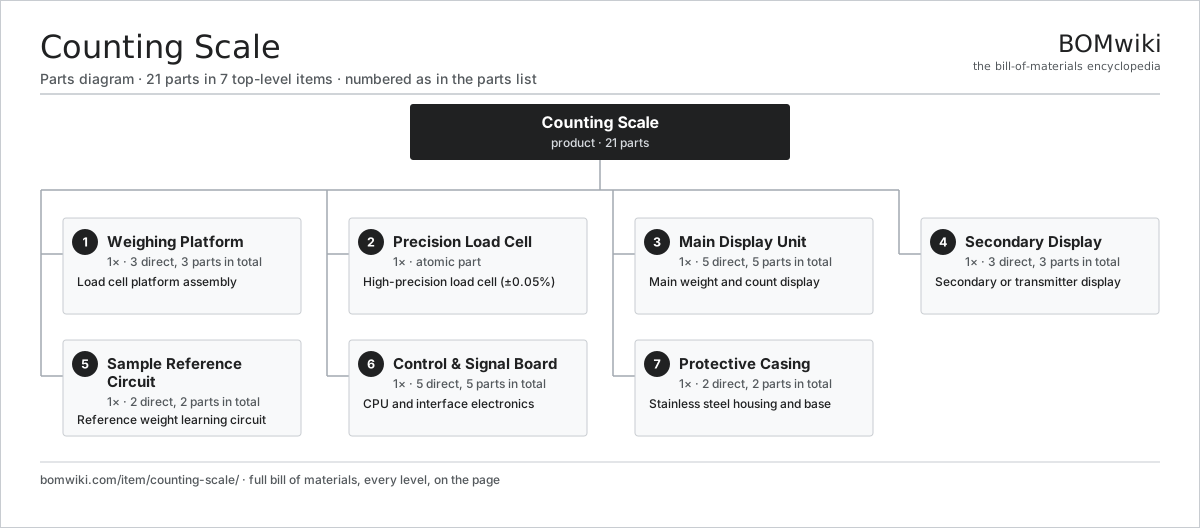
| # | Part | Qty | What it does |
|---|---|---|---|
| 1 | Weighing Platform 3 parts | 1× | Load cell platform assembly |
| 2 | Precision Load Cell | 1× | High-precision load cell (±0.05%) |
| 3 | Main Display Unit 5 parts | 1× | Main weight and count display |
| 4 | Secondary Display 3 parts | 1× | Secondary or transmitter display |
| 5 | Sample Reference Circuit 2 parts | 1× | Reference weight learning circuit |
| 6 | Control & Signal Board 5 parts | 1× | CPU and interface electronics |
| 7 | Protective Casing 2 parts | 1× | Stainless steel housing and base |
3D model
No 3D model yet. Have a CAD file of this? Add a 3D model. STL renders right on this page; STEP, FreeCAD, and OpenSCAD sources are welcome too (openly licensed, like all 3D models on BOMwiki).
Build & assembly graph
expand / collapse · shared sub-assemblies converge · links to related products · est. labourTap an assembly to expand/collapse · tap a part to open it · use “Open page” for any node · drag to pan, scroll to zoom.
Bill of materials for Counting Scale
7 top-level lines · 27 rows shown · 21 parts total · indented to 3 levels| # | Item / sub-assembly | Part no. | Qty/assy | Ext. qty | Parts | Type |
|---|---|---|---|---|---|---|
| 1 | Weighing Platform 3 parts | counting-scale-platform | 1× | 1 | 3 | assembly |
| 1.1 | Platform Top Plate | counting-scale-platform-plate | 1× | 1 | · | part |
| 1.2 | Load Cell Bracket | counting-scale-mounting-bracket | 1× | 1 | · | part |
| 1.3 | Leveling Feet | counting-scale-platform-feet | 1× | 1 | · | part |
| 2 | Precision Load Cell | counting-scale-load-cell | 1× | 1 | · | part |
| 3 | Main Display Unit 5 parts | counting-scale-display-main | 1× | 1 | 5 | assembly |
| 3.1 | Display Housing | counting-scale-display-housing | 1× | 1 | · | part |
| 3.2 | LCD Panel | counting-scale-lcd-unit | 1× | 1 | · | part |
| 3.3 | Main Processor | counting-scale-main-cpu | 1× | 1 | · | part |
| 3.4 | Keypad Module | counting-scale-keyboard | 1× | 1 | · | part |
| 3.5 | Internal Power Supply | counting-scale-power-supply | 1× | 1 | · | part |
| 4 | Secondary Display 3 parts | counting-scale-display-aux | 1× | 1 | 3 | assembly |
| 4.1 | Remote Display Panel | counting-scale-remote-display | 1× | 1 | · | part |
| 4.2 | Transmitter Module | counting-scale-transmitter-module | 1× | 1 | · | part |
| 4.3 | Remote Cable | counting-scale-remote-cable | 1× | 1 | · | part |
| 5 | Sample Reference Circuit 2 parts | counting-scale-sample-logic | 1× | 1 | 2 | assembly |
| 5.1 | Sample Comparator | counting-scale-sample-comparator | 1× | 1 | · | part |
| 5.2 | Counting Firmware | counting-scale-learning-firmware | 1× | 1 | · | part |
| 6 | Control & Signal Board 5 parts | counting-scale-control-board | 1× | 1 | 5 | assembly |
| 6.1 | Signal Amplifier | counting-scale-signal-amp | 1× | 1 | · | part |
| 6.2 | 24-bit ADC | counting-scale-adc-chip | 1× | 1 | · | part |
| 6.3 | Communication Interface | counting-scale-interface-ic | 1× | 1 | · | part |
| 6.4 | SMD Passive (R/C/L) | smd-passives | 1× | 1 | · | part |
| 6.5 | Bare PCB | pcb-bare | 1× | 1 | · | part |
| 7 | Protective Casing 2 parts | counting-scale-casing | 1× | 1 | 2 | assembly |
| 7.1 | Base Enclosure | counting-scale-base-cover | 1× | 1 | · | part |
| 7.2 | Cable Glands & Connectors | counting-scale-cable-glands | 1× | 1 | · | part |
Something wrong in this list? Report a problem with this BOM.
Related products
same domain, ranked by shared parts All-Electric Injection Molding Machine
851 parts · shares 1 with this page
Automated Paint Spray Line
2,003 parts · shares 1 with this page
Battery Formation System
57 parts · shares 1 with this page
Battery Pack Tester
45 parts · shares 1 with this page
Binder Jetting Printer
112 parts · shares 1 with this page
Blown Film Extrusion Line
436 parts · shares 1 with this page
All-Electric Injection Molding Machine
851 parts · shares 1 with this page
Automated Paint Spray Line
2,003 parts · shares 1 with this page
Battery Formation System
57 parts · shares 1 with this page
Battery Pack Tester
45 parts · shares 1 with this page
Binder Jetting Printer
112 parts · shares 1 with this page
Blown Film Extrusion Line
436 parts · shares 1 with this page
Sourcing: possible vendors
Browse the supplier directory → Prices, MOQ, and lead times are algorithmic estimates, not quotes, and not claims about these companies. Company mappings are curated by keyword; est. price band $5k–$2M. How estimates work| Vendor | HQ | Specialty | MOQ | Lead time |
|---|---|---|---|---|
| atlascopco.com ↗ | Stockholm, SE | Compressors & industrial | 10 units | 12–20 wks |
|
🇦🇹Andritz
andritz.com ↗
|
Graz, AT | Process plants & machinery | 10 units | 12–20 wks |
| buhlergroup.com ↗ | Uzwil, CH | Food & materials processing | 10 units | 12–20 wks |
| gea.com ↗ | Düsseldorf, DE | Process technology | 10 units | 12–20 wks |
| mhi.com ↗ | Tokyo, JP | Heavy machinery | 10 units | 12–20 wks |
1,074-word article