Drum Debarker
ProductOverview
A drum debarker removes bark from logs by tumbling them inside a rotating horizontal cylinder lined with abrasive ribs. It is typically the first processing step in a sawmill, preparing debarked logs for the headrig. The Drum Barrel is a steel cylinder (5–8 feet in diameter, 8–12 feet long) suspended at slight angle and rotated at 10–20 rpm by a Drive System. As the Drum Barrel turns, internal Lifting Ribs lift logs and drop them, abrading the bark off against the Drum Liner and other logs. Bark falls through the bottom, while debarked logs exit the other end onto a Discharge Conveyor.
Drum debarkers are preferred for high-volume, softer wood species (softwood logs) where bark removal is rapid and bark chunks are large enough to separate easily. The main challenge is that heavy logs require power, and drum maintenance (rib and liner wear) is continuous.
How it works
The Main Motor (typically 15–30 horsepower) drives a Reduction Gearbox, which steps down the motor speed by 20:1 to 50:1, yielding 10–20 rpm at the output. The gearbox output couples through a Shaft Coupling to a Sprocket Drive, a chain and Sprocket system, that delivers rotation to the Trunnion Shaft, the main axis of the Drum Barrel.
Logs are loaded onto the Infeed Chute or conveyed in via a Loader Conveyor. They roll into the rotating Drum Barrel and are immediately caught by the Lifting Ribs, lifting ribs (typically angle iron or steel bars bolted to the inside of the Drum Shell). As the drum rotates, these ribs periodically hoist logs to the top, then release them. The logs fall under gravity, impacting the opposite side of the drum, other logs, and the Drum Liner. This repeated impact and abrasion loosens and strips bark.
A typical cycle for a softwood log 12 inches in diameter and 12 feet long: 2–5 minutes of tumbling removes 90–95% of the bark. The debarked logs emerge from the Discharge Chute onto a Discharge Conveyor, usually tilted to direct logs toward the headrig or a deck. Bark, inner bark remnants, and wood fines fall from the discharge area and are collected by the Bark Removal system.
Drum construction and wear
The Drum Barrel consists of a steel Drum Shell (typically 3/8 inch wall thickness) with internal Lifting Ribs bolted on. The ribs are angled slightly to encourage logs toward the discharge end. The interior is lined with a Drum Liner, typically hardened steel, manganese steel, or resilient polyurethane, to reduce wear and absorb impact energy. Polyurethane liners are quieter and easier to install but wear faster than steel; steel liners are harder and last longer but are noisier.
The Drum Barrel is supported at the midpoint by a Trunnion Bearing, a large cylindrical bearing housed in a pillow block. The shaft is typically tilted 2–4 degrees so that logs naturally migrate toward the discharge end. End plates (flanges) seal the drum and guide logs.
Drum wear is continuous. The Drum Liner wears from impact; the Lifting Ribs corrode and lose their grip. A typical Drum Liner lasts 6–12 months under heavy use. Ribs are inspected and replaced annually. The Drum Shell itself, if properly protected, can last 10–20 years.
Debarking action
The effectiveness of bark removal depends on several factors:
Bark adhesion: Fresh-felled logs (high moisture) shed bark readily; seasoned or frozen logs are much harder to debark. Some mills spray logs with hot water to soften bark before debarking.
Log diameter: Small-diameter logs (under 8 inches) bounce around vigorously, resulting in efficient abrading. Large logs (over 20 inches) fall more massively and don't impact as frequently; they may require longer residence time or multiple passes.
Drum speed: Slower speeds (10–12 rpm) allow longer contact time but lower throughput. Faster speeds (18–20 rpm) increase impact but risk damaging logs or incomplete debarking.
Bark type: Softwoods with thin, peeling bark (pine, fir) debark easily in one pass. Hardwoods with adherent bark or thick bark (oak, hickory) are slower and may require longer residence or pretreatment.
Support systems
The Feed System coordinates infeed and discharge. A Loader Conveyor feeds logs into the Infeed Chute. The mill operator or an automated system releases logs into the drum in controlled batches to avoid overloading (which stalls the motor) or creating voids (which reduces efficiency).
The Bark Removal system evacuates bark and chips from under the drum. Typically, a Bark Conveyor (chain or belt) with a motor moves bark to a Bark Hopper. High-throughput mills chute bark directly to a chipper or hog fuel system.
Some mills spray logs entering the drum with water or steam. Water softens bark and reduces dust; steam (120–140°C) plasticizes bark for even easier shedding. A Control Panel times spray cycles and monitors drum motor current to detect jamming.
Maintenance
Daily checks: inspect Ball Bearings for grease supply, look for loose Lifting Ribs, remove any rocks or metal that may jam the drum.
Weekly: drain accumulated water from the drum base, check Drum Liner wear (any gouges below the surface), inspect the Drive Chain for slack or damaged links.
Monthly: measure Lifting Rib height (ribs wear flat over time), sample and assess bark quality (if bark is not separating, ribs may need replacement), inspect the pillow block for heat or abnormal noise.
Seasonally: replace Drum Liner sections if wear depth exceeds design thickness, replace worn Lifting Ribs before they break and damage the Drum Shell, rebuild or replace the Main Motor brushes or bearings after 5,000–10,000 operating hours.
Integration
In a mill workflow: incoming logs (from a deck) → drum debarker → headrig (primary breakdown) → edger (width trim) → resaw (further division) → kiln (dry) → planer (thickness) → sort and grade → package → ship.
Drum debarkers are also used downstream in some mills to remove planer shavings or to process bark into hog fuel. A single debarker typically feeds one headrig; larger mills run multiple debarkers in parallel.
Drum Debarker parts and their functions
7 top-level parts · 56 parts in total · full bill of materials below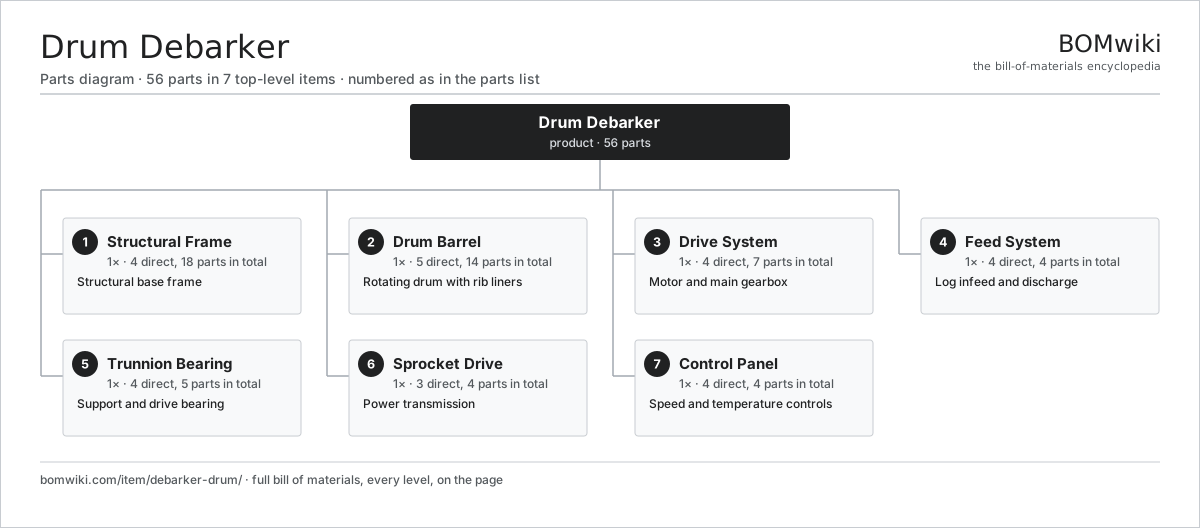
| # | Part | Qty | What it does |
|---|---|---|---|
| 1 | Structural Frame 4 parts | 1× | Structural base frame |
| 2 | Drum Barrel 5 parts | 1× | Rotating drum with rib liners |
| 3 | Drive System 4 parts | 1× | Motor and main gearbox |
| 4 | Feed System 4 parts | 1× | Log infeed and discharge |
| 5 | Trunnion Bearing 4 parts | 1× | Support and drive bearing |
| 6 | Sprocket Drive 3 parts | 1× | Power transmission |
| 7 | Control Panel 4 parts | 1× | Speed and temperature controls |
3D model
No 3D model yet. Have a CAD file of this? Add a 3D model. STL renders right on this page; STEP, FreeCAD, and OpenSCAD sources are welcome too (openly licensed, like all 3D models on BOMwiki).
Build & assembly graph
expand / collapse · shared sub-assemblies converge · links to related products · est. labourTap an assembly to expand/collapse · tap a part to open it · use “Open page” for any node · drag to pan, scroll to zoom.
Bill of materials for Drum Debarker
7 top-level lines · 38 rows shown · 56 parts total · indented to 3 levels| # | Item / sub-assembly | Part no. | Qty/assy | Ext. qty | Parts | Type |
|---|---|---|---|---|---|---|
| 1 | Structural Frame 4 parts | debarker-drum-frame | 1× | 1 | 18 | assembly |
| 1.1 | Frame Beam | debarker-drum-frame-beam | 4× | 4 | · | part |
| 1.2 | Cross Member | debarker-drum-frame-cross-member | 4× | 4 | · | part |
| 1.3 | Gusset Plate | debarker-drum-frame-gusset | 8× | 8 | · | part |
| 1.4 | Fastener Set | fastener-set | 2× | 2 | · | part |
| 2 | Drum Barrel 5 parts | debarker-drum-barrel | 1× | 1 | 14 | assembly |
| 2.1 | Drum Shell | debarker-drum-shell | 1× | 1 | · | part |
| 2.2 | Lifting Rib | debarker-drum-rib | 8× | 8 | · | part |
| 2.3 | Drum Liner | debarker-drum-liner | 1× | 1 | · | part |
| 2.4 | End Plate | debarker-drum-end-plate | 2× | 2 | · | part |
| 2.5 | Ball Bearing | ball-bearing | 2× | 2 | · | part |
| 3 | Drive System 4 parts | debarker-drum-drive-system | 1× | 1 | 7 | assembly |
| 3.1 | Main Motor | debarker-drum-motor | 1× | 1 | · | part |
| 3.2 | Reduction Gearbox | debarker-drum-gearbox | 1× | 1 | · | part |
| 3.3 | Shaft Coupling | debarker-drum-coupling | 1× | 1 | · | part |
| 3.4 | Sprocket Drive 3 parts | debarker-drum-sprocket-drive | 1× | 1 | 4 | assembly |
| 3.4.1 | Sprocket | debarker-drum-sprocket | 2× | 2 | · | part |
| 3.4.2 | Drive Chain | debarker-drum-chain | 1× | 1 | · | part |
| 3.4.3 | Chain Tensioner | debarker-drum-chain-tensioner | 1× | 1 | · | part |
| 4 | Feed System 4 parts | debarker-drum-feed-system | 1× | 1 | 4 | assembly |
| 4.1 | Infeed Chute | debarker-drum-feed-chute | 1× | 1 | · | part |
| 4.2 | Discharge Chute | debarker-drum-discharge-chute | 1× | 1 | · | part |
| 4.3 | Loader Conveyor | debarker-drum-loader-conveyor | 1× | 1 | · | part |
| 4.4 | Discharge Conveyor | debarker-drum-discharge-conveyor | 1× | 1 | · | part |
| 5 | Trunnion Bearing 4 parts | debarker-drum-trunnion-bearing | 1× | 1 | 5 | assembly |
| 5.1 | Trunnion Shaft | debarker-drum-trunnion-shaft | 1× | 1 | · | part |
| 5.2 | Pillow Block | debarker-drum-trunnion-housing | 1× | 1 | · | part |
| 5.3 | Ball Bearing | ball-bearing | 2× | 2 | · | part |
| 5.4 | Shaft Seal | debarker-drum-seal | 1× | 1 | · | part |
| 6 | Sprocket Drive 3 parts | debarker-drum-sprocket-drive | 1× | 1 | 4 | assembly |
| 6.1 | Sprocket | debarker-drum-sprocket | 2× | 2 | · | part |
| 6.2 | Drive Chain | debarker-drum-chain | 1× | 1 | · | part |
| 6.3 | Chain Tensioner | debarker-drum-chain-tensioner | 1× | 1 | · | part |
| 7 | Control Panel 4 parts | debarker-drum-control-panel | 1× | 1 | 4 | assembly |
| 7.1 | Microcontroller | mcu | 1× | 1 | · | part |
| 7.2 | Motor Drive | debarker-drum-vsd | 1× | 1 | · | part |
| 7.3 | Pressure Sensor | pressure-sensor | 1× | 1 | · | part |
| 7.4 | Bare PCB | pcb-bare | 1× | 1 | · | part |
Something wrong in this list? Report a problem with this BOM.
Sourcing: possible vendors
Browse the supplier directory → Prices, MOQ, and lead times are algorithmic estimates, not quotes, and not claims about these companies. Company mappings are curated by keyword; est. price band $5k–$2M. How estimates work| Vendor | HQ | Specialty | MOQ | Lead time |
|---|---|---|---|---|
| atlascopco.com ↗ | Stockholm, SE | Compressors & industrial | 10 units | 12–20 wks |
|
🇦🇹Andritz
andritz.com ↗
|
Graz, AT | Process plants & machinery | 10 units | 12–20 wks |
| buhlergroup.com ↗ | Uzwil, CH | Food & materials processing | 10 units | 12–20 wks |
| gea.com ↗ | Düsseldorf, DE | Process technology | 10 units | 12–20 wks |
| mhi.com ↗ | Tokyo, JP | Heavy machinery | 10 units | 12–20 wks |
1,091-word article