Decanter Centrifuge
ProductOverview
A decanter centrifuge separates suspended solids from a liquid continuously, replacing gravity settling that would take hours with a few seconds at several thousand g. Slurry flows in at one end; dewatered solids ("cake") discharge from one outlet and clarified liquid ("centrate") from another, around the clock. Decanters dewater municipal sewage sludge, clarify drilling mud, recover olive oil and fish meal, dewater calcium carbonate and coal fines, and concentrate everything in between, any duty where the solids settle under enhanced gravity and arrive continuously.
The machine is two rotors, one inside the other, turning the same direction at nearly the same speed. The outer rotor is the Bowl Assembly; the inner is the Scroll Conveyor, a screw conveyor that runs a few rpm faster or slower than the bowl. That small difference, the differential speed, enforced by the Differential Gearbox, is what moves settled solids out of the machine.
How it works
Feed slurry enters through the stationary Feed Pipe along the axis and lands in the Feed Chamber inside the scroll hub, where it is accelerated to bowl speed before passing through the Feed Port openings into the pond. The spinning Bowl Shell holds an annular layer of liquid against its wall; at 3,000 × g, particles that would take hours to settle in a tank reach the wall in seconds. Clarified liquid flows toward the cylindrical end and spills over the Weir Plate dams into the Centrate Chamber. The dam radius sets pond depth, the central process adjustment: a deep pond gives clearer centrate, a shallow pond gives drier cake by lengthening the dry beach.
Settled solids are ploughed the other way. Because the Scroll Flighting turns at a 2–40 rpm differential relative to the bowl, the helix continuously scrapes the sediment layer along the wall toward the Bowl Cone. On this conical beach the cake emerges from the pond, drains under full g-force for its last seconds in the machine, and exits through the carbide-bushed Solids Discharge Bushing ports into the Solids Hopper. The cone angle (8–20°) trades conveying reliability against cake dryness; soft sludges need flatter beaches and usually a flocculant dosed at the Polymer Injection Port to form scrollable flocs.
The differential drive
The defining mechanism is how the scroll is held at a controlled speed offset. The Main Drive belt-drives the bowl directly. The scroll is driven through the planetary Differential Gearbox whose housing rotates with the bowl: if the Pinion Shaft were held stationary, the scroll would turn at the bowl speed minus (bowl speed ÷ gearbox ratio). Modern machines put a four-quadrant Back-Drive Motor on that pinion, so the PLC can set any differential at will, and because conveying torque back-drives the pinion, the back motor often works as a generator, regenerating power into the DC bus of the main VFD.
Differential control is also the protection system. The Scroll Torque Sensor reading rises as the solids load in the bowl grows; the controller responds by raising differential speed to convey faster. If torque keeps climbing toward the limit, the machine cuts feed before the bowl plugs solid, a plugged decanter must be shoveled out by hand after a strip-down.
Mechanical design
A one-tonne rotor at 3,500 rpm stores serious energy, so the rotating parts are centrifugally cast duplex stainless, machined and balanced as an assembly to ISO 21940 grades. The bowl journals run in Main Bearing spherical roller bearings on cast Bearing Pedestal pillars, grease-dosed automatically by the Auto-Grease System; bearing temperature and a pair of Vibration Sensor accelerometers trip the machine on imbalance, the classic symptom of uneven cake buildup or flight wear. Everything abrasive touches carbide: Flight Wear Tile inserts on the flight edges, bushings at feed and solids ports. On abrasive duties like drilling mud these tiles, not the bearings, set the overhaul interval.
The whole rotating group sits inside the hinged Casing on a Base Frame carried by Vibration Isolator mounts, so residual imbalance shakes the machine a little and the building not at all.
Performance
A well-set decanter on polymer-conditioned municipal sludge produces 18–32 % dry-solids cake and centrate clean enough to return to the plant headworks, with specific energy around 1–2 kWh per cubic metre of feed. Capacity scales with pond surface area, which is why decanters are long (L/D of 3–4.5) rather than fat: length adds clarification area without the stress penalty of a larger diameter at speed.
Decanter Centrifuge parts and their functions
9 top-level parts · 172 parts in total · full bill of materials below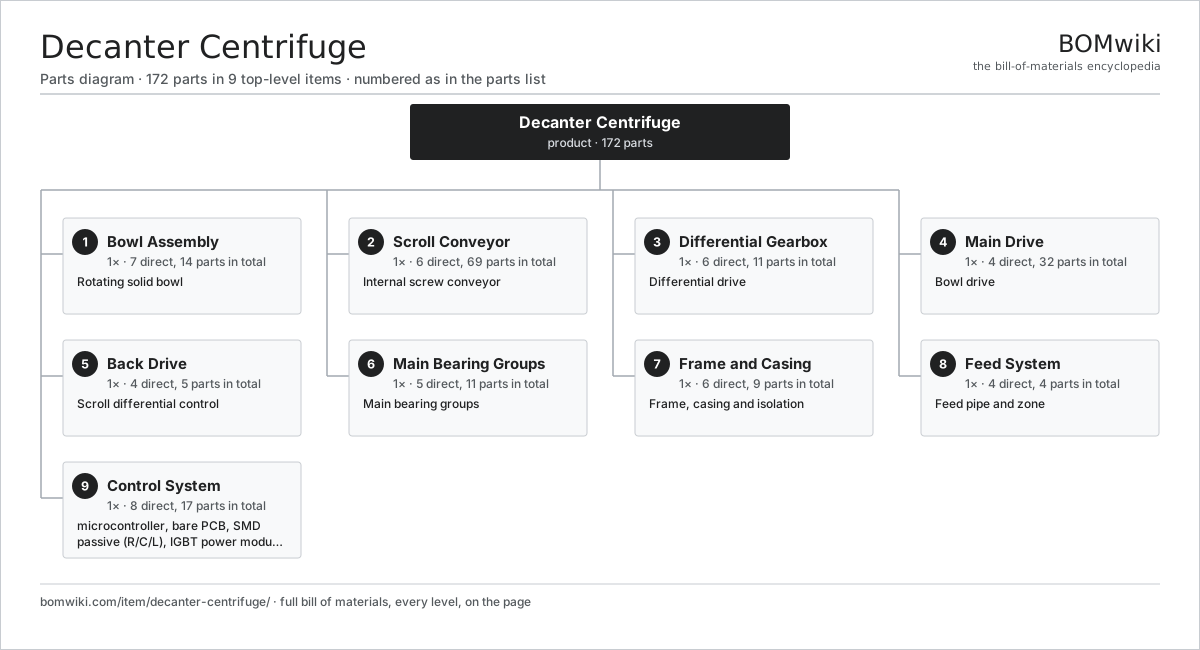
| # | Part | Qty | What it does |
|---|---|---|---|
| 1 | Bowl Assembly 7 parts | 1× | Rotating solid bowl |
| 2 | Scroll Conveyor 6 parts | 1× | Internal screw conveyor |
| 3 | Differential Gearbox 6 parts | 1× | Differential drive |
| 4 | Main Drive 4 parts | 1× | Bowl drive |
| 5 | Back Drive 4 parts | 1× | Scroll differential control |
| 6 | Main Bearing Groups 5 parts | 1× | Main bearing groups |
| 7 | Frame and Casing 6 parts | 1× | Frame, casing and isolation |
| 8 | Feed System 4 parts | 1× | Feed pipe and zone |
| 9 | Control System 8 parts | 1× | Dual-VFD PLC panel regulating bowl speed, differential and torque limits. |
3D model
No 3D model yet. Have a CAD file of this? Add a 3D model. STL renders right on this page; STEP, FreeCAD, and OpenSCAD sources are welcome too (openly licensed, like all 3D models on BOMwiki).
Build & assembly graph
expand / collapse · shared sub-assemblies converge · links to related products · est. labourTap an assembly to expand/collapse · tap a part to open it · use “Open page” for any node · drag to pan, scroll to zoom.
Bill of materials for Decanter Centrifuge
9 top-level lines · 63 rows shown · 172 parts total · indented to 3 levels| # | Item / sub-assembly | Part no. | Qty/assy | Ext. qty | Parts | Type |
|---|---|---|---|---|---|---|
| 1 | Bowl Assembly 7 parts | decanter-centrifuge-bowl | 1× | 1 | 14 | assembly |
| 1.1 | Bowl Shell | decanter-centrifuge-bowl-shell | 1× | 1 | · | part |
| 1.2 | Bowl Cone | decanter-centrifuge-bowl-cone | 1× | 1 | · | part |
| 1.3 | Bowl Head | decanter-centrifuge-bowl-head | 2× | 2 | · | part |
| 1.4 | Weir Plate | decanter-centrifuge-weir-plate | 4× | 4 | · | part |
| 1.5 | Solids Discharge Bushing | decanter-centrifuge-solids-bushing | 4× | 4 | · | part |
| 1.6 | O-Ring Set | oring-set | 1× | 1 | · | part |
| 1.7 | Fastener Set | fastener-set | 1× | 1 | · | part |
| 2 | Scroll Conveyor 6 parts | decanter-centrifuge-scroll | 1× | 1 | 69 | assembly |
| 2.1 | Scroll Hub | decanter-centrifuge-scroll-hub | 1× | 1 | · | part |
| 2.2 | Scroll Flighting | decanter-centrifuge-scroll-flight | 1× | 1 | · | part |
| 2.3 | Flight Wear Tile | decanter-centrifuge-wear-tile | 60× | 60 | · | part |
| 2.4 | Feed Chamber | decanter-centrifuge-feed-chamber | 1× | 1 | · | part |
| 2.5 | Feed Port | decanter-centrifuge-feed-port | 4× | 4 | · | part |
| 2.6 | Ball Bearing | ball-bearing | 2× | 2 | · | part |
| 3 | Differential Gearbox 6 parts | decanter-centrifuge-gearbox | 1× | 1 | 11 | assembly |
| 3.1 | Gearbox Housing | gearbox-housing | 1× | 1 | · | part |
| 3.2 | Planetary Gear Set | decanter-centrifuge-planetary-set | 2× | 2 | · | part |
| 3.3 | Pinion Shaft | decanter-centrifuge-pinion-shaft | 1× | 1 | · | part |
| 3.4 | Helical Gear Pair | gear-pair | 1× | 1 | · | part |
| 3.5 | Ball Bearing | ball-bearing | 4× | 4 | · | part |
| 3.6 | Oil Seal | oil-seal | 2× | 2 | · | part |
| 4 | Main Drive 4 parts | decanter-centrifuge-main-drive | 1× | 1 | 32 | assembly |
| 4.1 | Main Motor 4 parts | decanter-centrifuge-main-motor | 1× | 1 | 25 | assembly |
| 4.1.1 | Stator Assembly 3 parts + deeper › | stator-assembly | 1× | 1 | 3 | assembly |
| 4.1.2 | Rotor Assembly 4 parts + deeper › | rotor-assembly | 1× | 1 | 19 | assembly |
| 4.1.3 | Motor Housing | motor-housing | 1× | 1 | · | part |
| 4.1.4 | Ball Bearing | ball-bearing | 2× | 2 | · | part |
| 4.2 | Drive Belt | drive-belt | 5× | 5 | · | part |
| 4.3 | Bowl Pulley | decanter-centrifuge-bowl-pulley | 1× | 1 | · | part |
| 4.4 | Belt Guard | decanter-centrifuge-belt-guard | 1× | 1 | · | part |
| 5 | Back Drive 4 parts | decanter-centrifuge-back-drive | 1× | 1 | 5 | assembly |
| 5.1 | Back-Drive Motor | decanter-centrifuge-back-motor | 1× | 1 | · | part |
| 5.2 | Drive Belt | drive-belt | 2× | 2 | · | part |
| 5.3 | Encoder | encoder | 1× | 1 | · | part |
| 5.4 | Scroll Torque Sensor | decanter-centrifuge-torque-sensor | 1× | 1 | · | part |
| 6 | Main Bearing Groups 5 parts | decanter-centrifuge-bearings | 1× | 1 | 11 | assembly |
| 6.1 | Main Bearing | decanter-centrifuge-main-bearing | 2× | 2 | · | part |
| 6.2 | Bearing Pedestal | decanter-centrifuge-bearing-pedestal | 2× | 2 | · | part |
| 6.3 | Auto-Grease System | decanter-centrifuge-grease-system | 1× | 1 | · | part |
| 6.4 | Vibration Sensor | decanter-centrifuge-vibration-sensor | 2× | 2 | · | part |
| 6.5 | Oil Seal | oil-seal | 4× | 4 | · | part |
| 7 | Frame and Casing 6 parts | decanter-centrifuge-frame | 1× | 1 | 9 | assembly |
| 7.1 | Base Frame | decanter-centrifuge-base-frame | 1× | 1 | · | part |
| 7.2 | Casing | decanter-centrifuge-casing | 1× | 1 | · | part |
| 7.3 | Solids Hopper | decanter-centrifuge-solids-hopper | 1× | 1 | · | part |
| 7.4 | Centrate Chamber | decanter-centrifuge-liquid-chamber | 1× | 1 | · | part |
| 7.5 | Vibration Isolator | decanter-centrifuge-isolator | 4× | 4 | · | part |
| 7.6 | Fastener Set | fastener-set | 1× | 1 | · | part |
| 8 | Feed System 4 parts | decanter-centrifuge-feed-system | 1× | 1 | 4 | assembly |
| 8.1 | Feed Pipe | decanter-centrifuge-feed-pipe | 1× | 1 | · | part |
| 8.2 | Feed Seal | decanter-centrifuge-feed-seal | 1× | 1 | · | part |
| 8.3 | Polymer Injection Port | decanter-centrifuge-polymer-port | 1× | 1 | · | part |
| 8.4 | Pressure Sensor | pressure-sensor | 1× | 1 | · | part |
| 9 | Control System 8 parts | decanter-centrifuge-controls | 1× | 1 | 17 | assembly |
| 9.1 | Microcontroller | mcu | 1× | 1 | · | part |
| 9.2 | Bare PCB | pcb-bare | 1× | 1 | · | part |
| 9.3 | SMD Passive (R/C/L) | smd-passives | 1× | 1 | · | part |
| 9.4 | IGBT Power Module | igbt-module | 2× | 2 | · | part |
| 9.5 | LCD Panel | lcd-panel | 1× | 1 | · | part |
| 9.6 | Relay | relay | 4× | 4 | · | part |
| 9.7 | Connector | connector | 6× | 6 | · | part |
| 9.8 | Wire Bundle | wire-bundle | 1× | 1 | · | part |
Something wrong in this list? Report a problem with this BOM.
Related products
same domain, ranked by shared parts Continuous Galvanizing Line
1,296 parts · shares 21 with this page
Coil Coating Line
1,767 parts · shares 21 with this page
Continuous Galvanizing Line
1,296 parts · shares 21 with this page
Coil Coating Line
1,767 parts · shares 21 with this page
 Pellet Mill
105 parts · shares 21 with this page
Blown Film Extrusion Line
436 parts · shares 20 with this page
Cast Film Extrusion Line
406 parts · shares 20 with this page
Pellet Mill
105 parts · shares 21 with this page
Blown Film Extrusion Line
436 parts · shares 20 with this page
Cast Film Extrusion Line
406 parts · shares 20 with this page
Sourcing: possible vendors
Browse the supplier directory → Prices, MOQ, and lead times are algorithmic estimates, not quotes, and not claims about these companies. Company mappings are curated by keyword; est. price band $5k–$2M. How estimates work| Vendor | HQ | Specialty | MOQ | Lead time |
|---|---|---|---|---|
| atlascopco.com ↗ | Stockholm, SE | Compressors & industrial | 10 units | 12–20 wks |
|
🇦🇹Andritz
andritz.com ↗
|
Graz, AT | Process plants & machinery | 10 units | 12–20 wks |
| buhlergroup.com ↗ | Uzwil, CH | Food & materials processing | 10 units | 12–20 wks |
| gea.com ↗ | Düsseldorf, DE | Process technology | 10 units | 12–20 wks |
| mhi.com ↗ | Tokyo, JP | Heavy machinery | 10 units | 12–20 wks |
797-word article