Demand Response Controller
ProductOverview
A demand response controller is a networked relay bank deployed at commercial or industrial sites to shed non-critical electrical loads on command from a utility or grid operator. When a utility broadcasts a demand response signal, typically via OpenADR 2.0a or DNP3 protocol, the controller interprets the signal, checks its scheduling logic, and disconnects selected circuits within 500 milliseconds. This rapid load reduction helps the grid balance generation capacity during peak demand or renewable integration events, and sites earn participation incentives by reducing consumption during critical periods.
The unit is installed downstream of the main service panel and branches to branch circuit disconnects for HVAC, water heaters, pool pumps, and other deferrable loads. Each relay independently cuts power to its circuit, and a supercapacitor buffer ensures that the relay state is preserved even if the utility signal arrives during a voltage sag, preventing accidental reconnection.
Architecture
Signal Reception
The Utility Signal Receiver module decodes utility broadcasts in real time. Most utilities deploy either OpenADR 2.0a (client-server) or DNP3 (broadcast), but some still send proprietary RF signals. The RF/Cellular Modem includes both cellular and mesh radio options, so the controller can receive signals via LTE if hardwired Ethernet is unavailable, and can also relay signals to neighboring sites for redundancy.
Scheduling and Decision Logic
The Scheduling Engine runs a time-aware state machine on a dedicated Microcontroller. Each event broadcast carries a start time, end time, and signal level (light curtailment vs. hard shutdown). The scheduler applies site-specific rules: for example, "shed HVAC and pool pump but never water heater," or "defer load-shedding during 4–6 PM peak occupancy." Rules are provisioned via web API or local touch interface.
Relay Actuation
The Relay Bank Assembly houses six industrial-grade contactors, each rated for 30 A @ 240 VAC. The Relay Gate Drive Card supplies isolated 12 V gate pulses to energize the relay coils; de-energizing a coil spring-returns the contacts to open, cutting power to the load. Dual-pole relays ensure both hot legs are disconnected (important for equipment safety), and Thermal Fuses on each coil protect against stuck contactors.
Hold-Up and Redundancy
A Supercapacitor Bank bank (five series 3.3 V, 100 F cells) maintains the 24 V logic bus for up to 60 seconds if AC power is lost. This is critical: a utility signal often arrives during a voltage sag or brownout; if the relay driver loses power at that moment, capacitive discharge across the relay coil could cause a momentary reconnection, defeating the shedding action. The supercap holds the driver steady.
Network and Cellular
The Communications Module module bridges Ethernet to the OpenADR or DNP3 stack. If hardwired Ethernet is unavailable or drops, the Ethernet/LTE Interface falls back to LTE, providing 99.5% signal availability. Cellular data is low-bandwidth; a typical demand response event message is under 500 bytes.
Installation and Operation
A demand response controller is installed in the main electrical room, downstream of the utility meter but upstream of branch circuit breakers. Separate control wiring runs from the controller outputs to the load switches (disconnects) for each circuit. The Wall-Mount Enclosure is a NEMA 4X stainless cabinet mounted on the wall, protecting the internal relay bank, power supply, and network modem from dust and moisture.
On-site staff configure the Status and Override Panel, a seven-segment display and tactile buttons, to enable/disable circuits, test individual relays, and override the network control for maintenance. The display shows real-time relay state and the last received event timestamp, making it easy for technicians to troubleshoot connectivity.
Participation in a utility demand response program typically enrolls the controller in an aggregator's fleet management system. The aggregator receives signal broadcasts from the utility, filters events by geography and load type, and forwards relevant events to the customer's controller. Incentive payouts are calculated monthly based on the actual energy shed (metered at the main service) and the duration of the event.
Energy and Economics
A typical 6-circuit demand response installation can shed 40–80 kW of load (mixed HVAC, water heater, and pool equipment). Over a summer season (May–October), a site might participate in 20–40 demand response events, each lasting 1–4 hours, earning $2,000–$5,000 in incentive payments. The hardware and installation cost $8,000–$12,000, so break-even is 2–4 years; many utilities offer rebates that accelerate this.
The environmental benefit is indirect but significant: by reducing peak demand spikes, the grid avoids spinning up peaking plants (usually gas turbines with low efficiency) and can integrate more variable renewable energy. Aggregating thousands of small load reductions across a utility territory is nearly equivalent to deploying a new gas plant, but with near-zero CO₂ impact.
Standards and Compliance
Demand response controllers must comply with:
- IEEE 2030.5: OpenADR 2.0a signaling and security
- IEC 60730-2-2: Safety for automatic electrical controls
- UL 2089: Energy management devices
- ANSI C37.32: HVAC load profiles and shedding priorities
- State utility regulations: Each state defines the maximum number of events per summer and minimum recovery time between events
Testing labs verify that the relay actuation time is under 500 ms (critical for grid stability) and that the hold-up supercapacitor maintains voltage under worst-case transient loads.
Demand Response Controller parts and their functions
8 top-level parts · 73 parts in total · full bill of materials below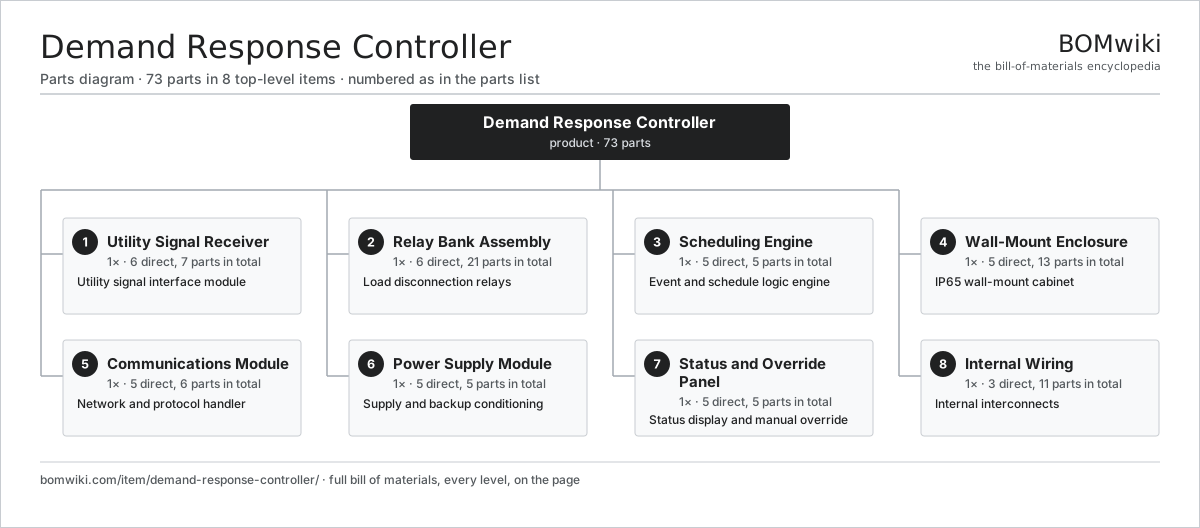
| # | Part | Qty | What it does |
|---|---|---|---|
| 1 | Utility Signal Receiver 6 parts | 1× | Utility signal interface module |
| 2 | Relay Bank Assembly 6 parts | 1× | Load disconnection relays |
| 3 | Scheduling Engine 5 parts | 1× | Event and schedule logic engine |
| 4 | Wall-Mount Enclosure 5 parts | 1× | IP65 wall-mount cabinet |
| 5 | Communications Module 5 parts | 1× | Network and protocol handler |
| 6 | Power Supply Module 5 parts | 1× | Supply and backup conditioning |
| 7 | Status and Override Panel 5 parts | 1× | Status display and manual override |
| 8 | Internal Wiring 3 parts | 1× | Internal interconnects |
3D model
No 3D model yet. Have a CAD file of this? Add a 3D model. STL renders right on this page; STEP, FreeCAD, and OpenSCAD sources are welcome too (openly licensed, like all 3D models on BOMwiki).
Build & assembly graph
expand / collapse · shared sub-assemblies converge · links to related products · est. labourTap an assembly to expand/collapse · tap a part to open it · use “Open page” for any node · drag to pan, scroll to zoom.
Bill of materials for Demand Response Controller
8 top-level lines · 48 rows shown · 73 parts total · indented to 3 levels| # | Item / sub-assembly | Part no. | Qty/assy | Ext. qty | Parts | Type |
|---|---|---|---|---|---|---|
| 1 | Utility Signal Receiver 6 parts | demand-response-controller-signal-receiver | 1× | 1 | 7 | assembly |
| 1.1 | RF/Cellular Modem | demand-response-controller-receiver-modem | 1× | 1 | · | part |
| 1.2 | Input Signal Conditioner | demand-response-controller-receiver-filter | 1× | 1 | · | part |
| 1.3 | Bare PCB | pcb-bare | 1× | 1 | · | part |
| 1.4 | SMD Passive (R/C/L) | smd-passives | 1× | 1 | · | part |
| 1.5 | Microcontroller | mcu | 1× | 1 | · | part |
| 1.6 | Connector | connector | 2× | 2 | · | part |
| 2 | Relay Bank Assembly 6 parts | demand-response-controller-relay-bank | 1× | 1 | 21 | assembly |
| 2.1 | Relay | relay | 6× | 6 | · | part |
| 2.2 | Relay Mounting Plate | demand-response-controller-relay-module | 1× | 1 | · | part |
| 2.3 | Relay Gate Drive Card | demand-response-controller-relay-driver | 1× | 1 | · | part |
| 2.4 | Power MOSFET | mosfet | 6× | 6 | · | part |
| 2.5 | Thermal Fuse | thermal-fuse | 6× | 6 | · | part |
| 2.6 | Sheet Metal Panel | sheet-panel | 1× | 1 | · | part |
| 3 | Scheduling Engine 5 parts | demand-response-controller-scheduler | 1× | 1 | 5 | assembly |
| 3.1 | Microcontroller | mcu | 1× | 1 | · | part |
| 3.2 | Real-Time Clock Module | demand-response-controller-rtc | 1× | 1 | · | part |
| 3.3 | Bare PCB | pcb-bare | 1× | 1 | · | part |
| 3.4 | SMD Passive (R/C/L) | smd-passives | 1× | 1 | · | part |
| 3.5 | Li-ion Cell, 18650 | li-cell-18650 | 1× | 1 | · | part |
| 4 | Wall-Mount Enclosure 5 parts | demand-response-controller-enclosure | 1× | 1 | 13 | assembly |
| 4.1 | Cabinet Frame | demand-response-controller-enclosure-body | 1× | 1 | · | part |
| 4.2 | DIN Rail | demand-response-controller-enclosure-din-rail | 3× | 3 | · | part |
| 4.3 | Fastener Set | fastener-set | 2× | 2 | · | part |
| 4.4 | Door Seal | demand-response-controller-gasket | 1× | 1 | · | part |
| 4.5 | Cable Entry Fitting | demand-response-controller-cable-glands | 6× | 6 | · | part |
| 5 | Communications Module 5 parts | demand-response-controller-comms | 1× | 1 | 6 | assembly |
| 5.1 | Ethernet/LTE Interface | demand-response-controller-net-modem | 1× | 1 | · | part |
| 5.2 | Bare PCB | pcb-bare | 1× | 1 | · | part |
| 5.3 | Microcontroller | mcu | 1× | 1 | · | part |
| 5.4 | SMD Passive (R/C/L) | smd-passives | 1× | 1 | · | part |
| 5.5 | Connector | connector | 2× | 2 | · | part |
| 6 | Power Supply Module 5 parts | demand-response-controller-power | 1× | 1 | 5 | assembly |
| 6.1 | Power Supply | power-supply | 1× | 1 | · | part |
| 6.2 | Supercapacitor Bank | demand-response-controller-supercap | 1× | 1 | · | part |
| 6.3 | PoE Power Extractor | demand-response-controller-poe-backup | 1× | 1 | · | part |
| 6.4 | SMD Passive (R/C/L) | smd-passives | 1× | 1 | · | part |
| 6.5 | Connector | connector | 1× | 1 | · | part |
| 7 | Status and Override Panel 5 parts | demand-response-controller-user-interface | 1× | 1 | 5 | assembly |
| 7.1 | LCD Panel | lcd-panel | 1× | 1 | · | part |
| 7.2 | Manual Override Button | demand-response-controller-button-assembly | 1× | 1 | · | part |
| 7.3 | Status Light Panel | demand-response-controller-led-array | 1× | 1 | · | part |
| 7.4 | Bare PCB | pcb-bare | 1× | 1 | · | part |
| 7.5 | SMD Passive (R/C/L) | smd-passives | 1× | 1 | · | part |
| 8 | Internal Wiring 3 parts | demand-response-controller-wiring-harness | 1× | 1 | 11 | assembly |
| 8.1 | Wire Bundle | wire-bundle | 2× | 2 | · | part |
| 8.2 | Connector | connector | 8× | 8 | · | part |
| 8.3 | Fastener Set | fastener-set | 1× | 1 | · | part |
Something wrong in this list? Report a problem with this BOM.
Related products
same domain, ranked by shared parts Smart Electrical Panel
133 parts · shares 6 with this page
Smart Electrical Panel
133 parts · shares 6 with this page
 Automatic Voltage Regulator
83 parts · shares 4 with this page
Automatic Voltage Regulator
83 parts · shares 4 with this page
 Industrial Battery Charger
71 parts · shares 4 with this page
Industrial Battery Charger
71 parts · shares 4 with this page
 Air-Insulated Substation Bay
1,329 parts · shares 4 with this page
Air-Insulated Substation Bay
1,329 parts · shares 4 with this page
 DC Fast Charger
1,097 parts · shares 4 with this page
DC Fast Charger
1,097 parts · shares 4 with this page
Sourcing: possible vendors
Browse the supplier directory → Prices, MOQ, and lead times are algorithmic estimates, not quotes, and not claims about these companies. Company mappings are curated by keyword; est. price band $5k–$50M. How estimates work| Vendor | HQ | Specialty | MOQ | Lead time |
|---|---|---|---|---|
| gevernova.com ↗ | Cambridge, US | Power generation | made to order | 20–40 wks |
| siemens-energy.com ↗ | Munich, DE | Power & grid | made to order | 20–40 wks |
| hitachienergy.com ↗ | Zurich, CH | Grid & transformers | made to order | 20–40 wks |
|
🇨🇭ABB
abb.com ↗
|
Zurich, CH | Electrification & automation | made to order | 20–40 wks |
| se.com ↗ | Rueil-Malmaison, FR | Electrical & automation | made to order | 20–40 wks |
908-word article