Die Bonder
ProductOverview
Die bonding is the first assembly step in semiconductor packaging, mechanically and electrically attaching the silicon die to a substrate or lead frame. The die bonder is an automated machine that dispenses epoxy adhesive (or solder) on the substrate surface, positions the die with precision alignment, applies pressure to achieve intimate contact, and initiates or completes the curing process. Proper die bonding ensures reliable mechanical attachment throughout the product lifetime, preventing die shift during subsequent assembly steps (wire bonding, molding) and maintaining thermal and electrical integrity in service.
Die attach technology must balance competing demands: strong adhesion to withstand mechanical shock and vibration, low stress to prevent die cracking from thermal cycling (−40 to +125 °C), good thermal conductivity for heat dissipation in high-power applications, and compatibility with downstream wire bonding and encapsulation processes. Epoxy adhesives dominate consumer and industrial applications; solder preforms are used in high-reliability aerospace and military modules where thermal cycling requirements are severe.
Epoxy Die Attach Process
The standard epoxy die bonding workflow is fully automated. The Wafer Handler loads a wafer or tray and indexes it under the Pick Head Assembly, where a vacuum collet selects a single die by applying suction through a 100–200 μm orifice. The vision system verifies die pickup, measuring corner-to-corner distance and tilt angle to confirm proper centering in the collet.
The pick head retracts vertically while the Substrate Stage simultaneously positions the substrate under the die. The Dispense System applies a defined pattern of epoxy paste, typically 1–4 dots ranging from 1 to 20 μL each, on the substrate surface. The paste is commonly underfilled epoxy modified with silica fillers for thermal conductivity and reduced stress. Careful dot placement ensures adequate adhesive coverage (typically 60–85% of die bottom area) without squeeze-out that could bridge to adjacent die or contaminate wire bond pads.
The die is lowered onto the epoxy at controlled speed (10–100 mm/sec), and the Bond Stage applies vertical force (0.5–5 kg) to wet the adhesive fully and drive out air bubbles. The force profile can be dynamic: soft initial contact (0.5 kg), hold at high force (2–5 kg) for 1–3 seconds, then release. This prevents die bounce and ensures void-free adhesive coverage. During this dwell, the platen may be heated to 50–100 °C to reduce epoxy viscosity and improve flow.
After the dwell, the pick head retracts and the substrate advances to the next die position, or if all die are bonded, the substrate is transported to the curing chamber. Most fabs run two cure profiles: (1) room-temperature ambient cure (24 hours) for throughput, or (2) thermal cure (80 °C for 1–2 hours) for faster material dispatch. The Environmental Control oven controls the cure ramp: slow heating (2–5 °C/min) to prevent outgassing and exotherm-induced stress, hold at peak temperature, then slow cool to room temperature to minimize warping.
Pick Head and Die Handling
The Pick Head Assembly is optimized for gentle, repeatable die pickup. The vacuum collet orifice diameter must be tuned to die size: too large an orifice leaks vacuum and loses die; too small restricts flow and deforms die edges. Many tools offer multiple collets for different die geometries. The collet surface is typically polished or plasma-treated to reduce stiction (static friction preventing release onto the substrate).
Die pickup from a wafer or tape requires isolation. The Wafer Handler positions the wafer under a pick-up station where a mechanical blade or vacuum wand separates the target die from its neighbors. For tape-and-reel die, an automated peeler lifts the tape backing to expose the die. Vision inspection after pickup detects missing die, tilted die (critical for high-density flip-chip), and contaminants. The vision system measures die placement tilt (typically <2°) and alerts the operator if pickup is marginal, preventing defective units from progressing to bonding.
Dispense System and Epoxy Management
The Dispense System is a precision syringe or positive-displacement pump. Stepper-motor-driven syringes are common and cost-effective; they deliver 1–50 μL per stroke with ±5% repeatability. More advanced systems use air-pressure or piston pumps enabling higher speeds (up to 5000 bonds per hour). Epoxy paste must be maintained at a specific viscosity, too thick and it won't flow evenly; too thin and air bubbles escape slowly. Temperature control of the syringe or reservoir to ±2 °C is often necessary, especially for formulations with high thermo-sensitivity.
Dispense nozzles wear over time as epoxy residue builds up and abrasive fillers erode the tungsten carbide tip. Worn nozzles dispense irregular volumes and poor geometry dots. Many systems integrate automatic nozzle cleaning stations using ultrasonic vibration or wipes; some switch nozzles every 10,000–50,000 dispenses. Nozzle orifice size ranges from 100 μm (fine dots) to 300 μm (bulk adhesive for large die).
Substrate Positioning and Alignment
The Substrate Stage achieves ±5–10 μm positional repeatability using ball screws and linear encoders. Repeatability is critical because each die must land on the same X, Y, Z coordinate relative to substrate fiducial marks (solder pads, printed targets, or etched alignment marks). The Vision System system detects substrate fiducials and die corners, computing offsets to correct stage position in real time. Modern systems run a brief vision calibration routine (1–2 minutes) at the start of each shift, measuring stage backlash and nozzle offset to maintain alignment accuracy.
For substrates with close-spaced die pads (e.g., high-pin-count BGAs with 0.8 mm pitch), positional repeatability directly translates to wire bond yield. Dies bonded 50 μm off-target may bond to the adjacent pad, causing electrical shorts or opens. Advanced tools achieve ±25 μm repeatability including stage drift over an 8-hour production run, critical for 0.5 mm die-to-die spacing common in power modules.
Thermal Curing and Stress Management
Epoxy cure is an exothermic reaction; uncontrolled heating creates high stress and risks die cracking. The Environmental Control oven controls the cure ramp at 2–5 °C/min, slow enough that heat diffuses through the epoxy and die without creating thermal gradients exceeding 5–10 °C. Vacuum or nitrogen purging during cure removes volatile condensation products and prevents oxidation (important for copper-filled epoxy).
Typical cure profiles follow this pattern: (1) room temperature ambient for 24 hours, or (2) 80 °C hold for 1 hour, (3) 120 °C ramp to 150 °C over 1 hour, (4) hold at 150 °C for 30 minutes, (5) slow cool to room temperature at 2 °C/min. Fast heating and high peak temperature are detrimental; they increase moisture absorption, internal stress, and cracking risk in brittle die materials (especially GaN and GaAs). Hydroscopic epoxy absorbs moisture during cure; maintaining low relative humidity (<10% RH) throughout curing prevents moisture ingress and subsequent delamination.
Material Selection for High Reliability
Epoxy formulations vary based on application. Silver-filled epoxy (5–80 wt% Ag powder) provides electrical conductivity, enabling direct connection to conductive substrates and eliminating need for separate solder or adhesive. Silica-filled epoxy (50–70 wt% SiO2) improves thermal conductivity and reduces shrinkage stress. Underfilled epoxy (lower filler content, lower modulus) minimizes mechanical stress on brittle die, essential for sub-100 μm die. Ductile epoxy (with elastomer modifiers) withstands thermal cycling better than brittle base resins.
For high-temperature applications (automotive, industrial), some systems use solder preforms (eutectic gold-silicon solder bonded at 350–450 °C) or hybrid die-attach materials (sintered silver). Solder preforms provide excellent thermal conductivity and temperature capability but require reflow ovens and inert atmosphere, increasing process complexity and cost.
Quality and Reliability Testing
Die bond quality is verified through multiple methods: (1) pull testing (destructive, sampling), measuring force required to separate die from substrate; (2) thermal cycling (−40 to +125 °C, 500–2000 cycles) to accelerate failure of marginal bonds; (3) X-ray imaging to detect voids and delamination; (4) acoustic microscopy (C-SAM) for subsurface void mapping. Production systems use inline vision inspection to flag obvious defects (missing epoxy, tilted die, foreign material), catching 90%+ of gross defects before downstream assembly.
Typical pull strength for epoxy die bonding is 20–50 MPa, equivalent to 5–25 kg force on a 5 mm × 5 mm die. Solder preforms achieve 30–70 MPa and higher. Die bonding defects account for approximately 5–10% of assembly yield loss if not controlled; inadequate pressure, contaminated surfaces, or incompatible epoxy formulations can reduce strength by 50%+ and cause latent failure.
Production Integration
Modern fabs integrate die bonders into fully automated assembly lines. Wafers flow directly from test into the loader; die are singulated, bonded, and wire-bonded in tandem. Batch curing ovens run multiple product types in parallel, segregated by cure profile. Some high-volume fabs run inline thermal-cure systems, curing die in-place on the substrate during wire bonding (using 80–150 °C heating) to overlap process steps and compress overall cycle time. This requires careful recipe tuning to ensure cure completion before final encapsulation.
Die Bonder parts and their functions
8 top-level parts · 44 parts in total · full bill of materials below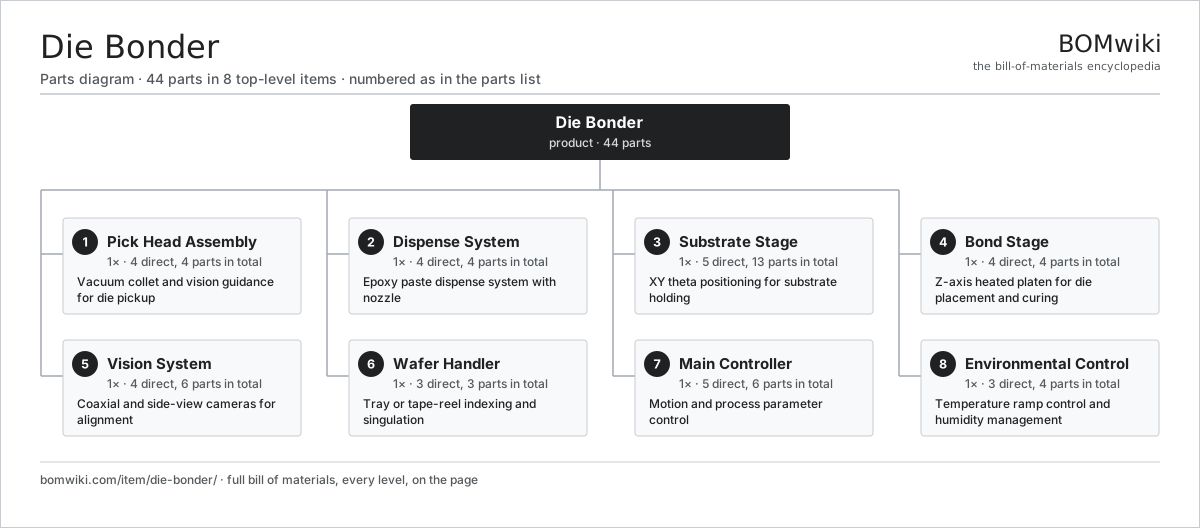
| # | Part | Qty | What it does |
|---|---|---|---|
| 1 | Pick Head Assembly 4 parts | 1× | Vacuum collet and vision guidance for die pickup |
| 2 | Dispense System 4 parts | 1× | Epoxy paste dispense system with nozzle |
| 3 | Substrate Stage 5 parts | 1× | XY theta positioning for substrate holding |
| 4 | Bond Stage 4 parts | 1× | Z-axis heated platen for die placement and curing |
| 5 | Vision System 4 parts | 1× | Coaxial and side-view cameras for alignment |
| 6 | Wafer Handler 3 parts | 1× | Tray or tape-reel indexing and singulation |
| 7 | Main Controller 5 parts | 1× | Motion and process parameter control |
| 8 | Environmental Control 3 parts | 1× | Temperature ramp control and humidity management |
3D model
No 3D model yet. Have a CAD file of this? Add a 3D model. STL renders right on this page; STEP, FreeCAD, and OpenSCAD sources are welcome too (openly licensed, like all 3D models on BOMwiki).
Build & assembly graph
expand / collapse · shared sub-assemblies converge · links to related products · est. labourTap an assembly to expand/collapse · tap a part to open it · use “Open page” for any node · drag to pan, scroll to zoom.
Bill of materials for Die Bonder
8 top-level lines · 40 rows shown · 44 parts total · indented to 3 levels| # | Item / sub-assembly | Part no. | Qty/assy | Ext. qty | Parts | Type |
|---|---|---|---|---|---|---|
| 1 | Pick Head Assembly 4 parts | die-bonder-pick-head | 1× | 1 | 4 | assembly |
| 1.1 | Vacuum Collet | die-bonder-collet | 1× | 1 | · | part |
| 1.2 | Pick Z-Motor | die-bonder-pick-motor | 1× | 1 | · | part |
| 1.3 | Coaxial Camera | die-bonder-vision-microscope | 1× | 1 | · | part |
| 1.4 | Vacuum Supply | die-bonder-vacuum-line | 1× | 1 | · | part |
| 2 | Dispense System 4 parts | die-bonder-dispenser | 1× | 1 | 4 | assembly |
| 2.1 | Syringe Assembly | die-bonder-syringe | 1× | 1 | · | part |
| 2.2 | Plunger Motor | die-bonder-plunger-motor | 1× | 1 | · | part |
| 2.3 | Dispensing Nozzle | die-bonder-nozzle | 1× | 1 | · | part |
| 2.4 | Dispense Mount Stage | die-bonder-mount-stage | 1× | 1 | · | part |
| 3 | Substrate Stage 5 parts | die-bonder-stage | 1× | 1 | 13 | assembly |
| 3.1 | Ball Screw | ball-screw | 2× | 2 | · | part |
| 3.2 | Encoder | encoder | 2× | 2 | · | part |
| 3.3 | Stage Chuck | die-bonder-stage-chuck | 1× | 1 | · | part |
| 3.4 | Ball Bearing | ball-bearing | 6× | 6 | · | part |
| 3.5 | Sheet Metal Panel | sheet-panel | 2× | 2 | · | part |
| 4 | Bond Stage 4 parts | die-bonder-bond-stage | 1× | 1 | 4 | assembly |
| 4.1 | Heater Platen | die-bonder-heater-platen | 1× | 1 | · | part |
| 4.2 | Heating Element | heating-element | 1× | 1 | · | part |
| 4.3 | Bond Stage Motor | die-bonder-z-servo | 1× | 1 | · | part |
| 4.4 | Platen Thermocouple | die-bonder-thermocouple | 1× | 1 | · | part |
| 5 | Vision System 4 parts | die-bonder-vision | 1× | 1 | 6 | assembly |
| 5.1 | CMOS Image Sensor | image-sensor | 2× | 2 | · | part |
| 5.2 | Lens Assembly | camera-lens | 2× | 2 | · | part |
| 5.3 | Coaxial Optics | die-bonder-coax-optics | 1× | 1 | · | part |
| 5.4 | LED Ring Light | die-bonder-led-ring | 1× | 1 | · | part |
| 6 | Wafer Handler 3 parts | die-bonder-wafer-handler | 1× | 1 | 3 | assembly |
| 6.1 | FOUP Dock | die-bonder-foup-dock | 1× | 1 | · | part |
| 6.2 | Die Separator | die-bonder-die-separator | 1× | 1 | · | part |
| 6.3 | Handler Arm | die-bonder-handler-arm | 1× | 1 | · | part |
| 7 | Main Controller 5 parts | die-bonder-controller | 1× | 1 | 6 | assembly |
| 7.1 | Main PLC | die-bonder-plc | 1× | 1 | · | part |
| 7.2 | Power Supply | power-supply | 2× | 2 | · | part |
| 7.3 | Motion Drivers | die-bonder-motion-drivers | 1× | 1 | · | part |
| 7.4 | Heater PID Controller | die-bonder-heater-controller | 1× | 1 | · | part |
| 7.5 | Bare PCB | pcb-bare | 1× | 1 | · | part |
| 8 | Environmental Control 3 parts | die-bonder-environment | 1× | 1 | 4 | assembly |
| 8.1 | Curing Oven | die-bonder-curing-oven | 1× | 1 | · | part |
| 8.2 | Humidity Sensor | die-bonder-rh-sensor | 1× | 1 | · | part |
| 8.3 | Relay | relay | 2× | 2 | · | part |
Something wrong in this list? Report a problem with this BOM.
Related products
same domain, ranked by shared parts Wire Bonder
44 parts · shares 8 with this page
SMT Stencil Printer
43 parts · shares 7 with this page
Wire Bonder
44 parts · shares 8 with this page
SMT Stencil Printer
43 parts · shares 7 with this page
 SMT Pick-and-Place Machine
60 parts · shares 7 with this page
SMT Pick-and-Place Machine
60 parts · shares 7 with this page
 Wafer Dicing Saw
44 parts · shares 7 with this page
Wafer Dicing Saw
44 parts · shares 7 with this page
 Mask Aligner
38 parts · shares 6 with this page
Mask Aligner
38 parts · shares 6 with this page
Sourcing: possible vendors
Browse the supplier directory → Prices, MOQ, and lead times are algorithmic estimates, not quotes, and not claims about these companies. Company mappings are curated by keyword; est. price band $5k–$2M. How estimates work| Vendor | HQ | Specialty | MOQ | Lead time |
|---|---|---|---|---|
| atlascopco.com ↗ | Stockholm, SE | Compressors & industrial | 10 units | 12–20 wks |
|
🇦🇹Andritz
andritz.com ↗
|
Graz, AT | Process plants & machinery | 10 units | 12–20 wks |
| buhlergroup.com ↗ | Uzwil, CH | Food & materials processing | 10 units | 12–20 wks |
| gea.com ↗ | Düsseldorf, DE | Process technology | 10 units | 12–20 wks |
| mhi.com ↗ | Tokyo, JP | Heavy machinery | 10 units | 12–20 wks |
1,525-word article