Guitar Multi-Effects Processor
ProductOverview
A guitar multi-effects processor condenses a pedalboard, amplifier, and speaker cabinet into one floor unit running digital signal processing. The player's guitar enters a high-impedance analog input, is converted to 24-bit digital, passes through a software-defined chain, compressor, drive, amp model, cabinet simulation, modulation, delay, reverb, and exits to a real amplifier, a full-range speaker, the PA, or headphones. The whole journey takes two to three milliseconds, below the threshold where a player feels disconnection from the instrument (roughly the acoustic delay of standing one metre from an amp).
The signal path begins analog
The Instrument Input matters more than its single transistor suggests. Passive guitar pickups are inductive sources whose resonant peak shifts with the load they see; a 1 MΩ JFET front end loads them exactly as a tube amp's grid would, which is why input impedance is audible before any processing occurs. Some units even vary input impedance per preset to mimic how specific vintage pedals loaded the pickup. The ADC/DAC converters are chosen for low group delay rather than headline dynamic range, conversion contributes under a millisecond each way of the latency budget.
Modeling inside the DSP
The DSP Engine Board is where the product lives or dies. One or two DSP Chip floating-point processors (the SHARC family dominates the high end) execute the chain at 48 kHz, and a preset's complexity is bounded by raw cycle count: every block, each drive, each delay tap, has a published or implicit CPU cost, and the editor refuses additions past about 8–16 blocks when the budget is spent.
Amp modeling is component-level circuit simulation: nonlinear state-space models of the tube stages, tone stack, and power-amp/transformer interaction, solved per sample. Cabinet and microphone behavior is handled differently, by convolution with measured impulse responses held in Delay RAM, typically 2048 points at 48 kHz, which captures the cabinet's frequency and phase response exactly. User-loadable IRs stored in Preset Flash became a de facto interchange format across competing brands. Delay lines and reverb tanks also live in the SDRAM, seconds deep. A host Microcontroller runs the UI, MIDI, and switch logic so the DSPs do nothing but audio.
Stage control
Everything below the screen is designed for feet in the dark. The Footswitch Array uses sealed Stomp Switches rated around a million presses, debounced in firmware, with LED Rings color-coding function and Scribble Strips, small OLEDs above each switch, showing per-preset assignments that once required masking tape. Switching is glitchless: preset changes crossfade or hold delay tails rather than dropping audio, a hard real-time requirement that shaped the dual-DSP architecture (one chip can render the old preset's tail while the other loads the new).
The Expression Pedal carries the wah and volume duties of a traditional board. A cast Treadle sweeps about 20° over a contactless Position Sensor, Hall-effect or optical, eliminating the scratchy potentiometer that defined (and degraded) analog wah pedals, with a Toe Switch under the toe stop toggling assignments and a Tension Adjuster holding mid-sweep positions. Editing happens on the Display & Edit UI: the chain drawn as blocks on an LCD Panel, parameters on Rotary Encoders or a Touch Digitizer, encoders survive boots and beer better than touch, so both persist.
Outputs for three destinations
The Audio I/O Section acknowledges that players use these units three ways. Into a traditional guitar amp, the Output Drivers' unbalanced outs carry the chain without cabinet simulation (the real cabinet provides it). Direct to the PA or studio, the balanced XLRs carry the full cab-simulated signal, the use that made modelers standard on professional stages, where consistent front-of-house tone beats a miked 100 W stack. For silent practice, the Headphone Amp is the feature that sells half the units. An analog Effects Loop splices cherished external pedals into the digital chain at any point, and USB Audio Interface streams wet and dry tracks to a DAW, with the dry track enabling later reamping.
Power and packaging
The Power Section must run sensitive analog stages centimetres from DSPs switching hundreds of megahertz. Low-noise Analog Rail Regulators LDOs and disciplined star grounding keep digital hash out of a signal path that may apply 60 dB of gain; audible hiss in this product class is a layout failure rather than a component choice. The Floor Enclosure's Top Deck, die-cast aluminum or 2 mm folded steel, takes full body weight on the switches, since deck flex false-triggers them.
The category's trajectory is straightforward: 1990s rack processors put effects in DSP, 2010s floor units added credible amp modeling, and current units are accepted on professional stages as amp replacements outright. The remaining argument is not fidelity, blind tests against the modeled amps are routinely failed, but feel, which is why the latency budget and the input stage still get the engineering attention.
Guitar Multi-Effects Processor parts and their functions
8 top-level parts · 70 parts in total · full bill of materials below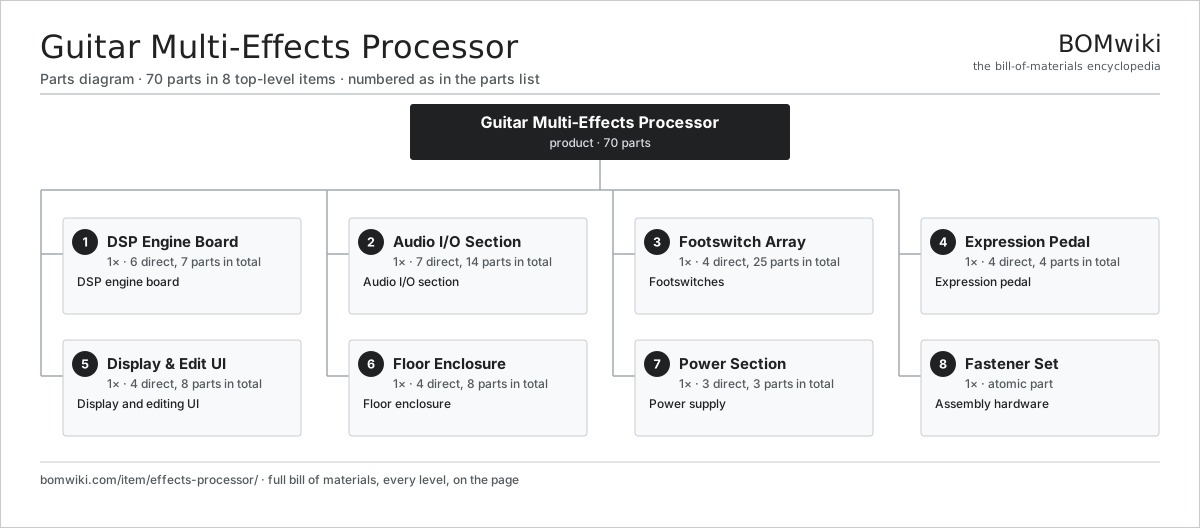
| # | Part | Qty | What it does |
|---|---|---|---|
| 1 | DSP Engine Board 6 parts | 1× | DSP engine board |
| 2 | Audio I/O Section 7 parts | 1× | Audio I/O section |
| 3 | Footswitch Array 4 parts | 1× | Footswitches |
| 4 | Expression Pedal 4 parts | 1× | Expression pedal |
| 5 | Display & Edit UI 4 parts | 1× | Display and editing UI |
| 6 | Floor Enclosure 4 parts | 1× | Floor enclosure |
| 7 | Power Section 3 parts | 1× | Power supply |
| 8 | Fastener Set | 1× | Assembly hardware |
3D model
No 3D model yet. Have a CAD file of this? Add a 3D model. STL renders right on this page; STEP, FreeCAD, and OpenSCAD sources are welcome too (openly licensed, like all 3D models on BOMwiki).
Build & assembly graph
expand / collapse · shared sub-assemblies converge · links to related products · est. labourTap an assembly to expand/collapse · tap a part to open it · use “Open page” for any node · drag to pan, scroll to zoom.
Bill of materials for Guitar Multi-Effects Processor
8 top-level lines · 40 rows shown · 70 parts total · indented to 3 levels| # | Item / sub-assembly | Part no. | Qty/assy | Ext. qty | Parts | Type |
|---|---|---|---|---|---|---|
| 1 | DSP Engine Board 6 parts | efx-dsp-board | 1× | 1 | 7 | assembly |
| 1.1 | DSP Chip | efx-dsp-chip | 2× | 2 | · | part |
| 1.2 | Microcontroller | mcu | 1× | 1 | · | part |
| 1.3 | Delay RAM | efx-dram | 1× | 1 | · | part |
| 1.4 | Preset Flash | efx-flash | 1× | 1 | · | part |
| 1.5 | Bare PCB | pcb-bare | 1× | 1 | · | part |
| 1.6 | SMD Passive (R/C/L) | smd-passives | 1× | 1 | · | part |
| 2 | Audio I/O Section 7 parts | efx-audio-io | 1× | 1 | 14 | assembly |
| 2.1 | Instrument Input | efx-instrument-input | 1× | 1 | · | part |
| 2.2 | ADC/DAC | efx-adc-dac | 1× | 1 | · | part |
| 2.3 | Output Drivers | efx-output-drivers | 1× | 1 | · | part |
| 2.4 | Effects Loop | efx-fx-loop | 1× | 1 | · | part |
| 2.5 | Headphone Amp | efx-headphone-amp | 1× | 1 | · | part |
| 2.6 | USB Audio Interface | efx-usb-audio | 1× | 1 | · | part |
| 2.7 | Connector | connector | 8× | 8 | · | part |
| 3 | Footswitch Array 4 parts | efx-footswitch-array | 1× | 1 | 25 | assembly |
| 3.1 | Stomp Switches | efx-stomp-switches | 8× | 8 | · | part |
| 3.2 | LED Rings | efx-led-rings | 8× | 8 | · | part |
| 3.3 | Scribble Strips | efx-scribble-strips | 8× | 8 | · | part |
| 3.4 | Switch Matrix Board | efx-switch-board | 1× | 1 | · | part |
| 4 | Expression Pedal 4 parts | efx-expression-pedal | 1× | 1 | 4 | assembly |
| 4.1 | Treadle | efx-treadle | 1× | 1 | · | part |
| 4.2 | Position Sensor | efx-position-sensor | 1× | 1 | · | part |
| 4.3 | Toe Switch | efx-toe-switch | 1× | 1 | · | part |
| 4.4 | Tension Adjuster | efx-friction-adjust | 1× | 1 | · | part |
| 5 | Display & Edit UI 4 parts | efx-display-ui | 1× | 1 | 8 | assembly |
| 5.1 | LCD Panel | lcd-panel | 1× | 1 | · | part |
| 5.2 | Touch Digitizer | touch-digitizer | 1× | 1 | · | part |
| 5.3 | Rotary Encoders | efx-rotary-encoders | 5× | 5 | · | part |
| 5.4 | UI Board | efx-ui-board | 1× | 1 | · | part |
| 6 | Floor Enclosure 4 parts | efx-enclosure | 1× | 1 | 8 | assembly |
| 6.1 | Top Deck | efx-top-chassis | 1× | 1 | · | part |
| 6.2 | Sheet Metal Panel | sheet-panel | 1× | 1 | · | part |
| 6.3 | End Guards | efx-end-guards | 2× | 2 | · | part |
| 6.4 | Rubber Feet | efx-rubber-feet | 4× | 4 | · | part |
| 7 | Power Section 3 parts | efx-power-section | 1× | 1 | 3 | assembly |
| 7.1 | Power Supply | power-supply | 1× | 1 | · | part |
| 7.2 | Analog Rail Regulators | efx-analog-rails | 1× | 1 | · | part |
| 7.3 | EMI Filter | efx-inrush-filter | 1× | 1 | · | part |
| 8 | Fastener Set | fastener-set | 1× | 1 | · | part |
Something wrong in this list? Report a problem with this BOM.
Related products
same domain, ranked by shared parts Digital Piano
689 parts · shares 6 with this page
Digital Piano
689 parts · shares 6 with this page
 Electronic Drum Kit
336 parts · shares 6 with this page
Electronic Drum Kit
336 parts · shares 6 with this page
 Guitar Amplifier
439 parts · shares 6 with this page
Guitar Amplifier
439 parts · shares 6 with this page
 Synthesizer
425 parts · shares 6 with this page
Synthesizer
425 parts · shares 6 with this page
 Pipe Organ
12,901 parts · shares 4 with this page
Pipe Organ
12,901 parts · shares 4 with this page
 Theremin
47 parts · shares 4 with this page
Theremin
47 parts · shares 4 with this page
Sourcing: possible vendors
Browse the supplier directory → Prices, MOQ, and lead times are algorithmic estimates, not quotes, and not claims about these companies. Company mappings are curated by keyword; est. price band $50–$5k. How estimates work| Vendor | HQ | Specialty | MOQ | Lead time |
|---|---|---|---|---|
| yamaha.com ↗ | Hamamatsu, JP | Audio & instruments | 200 units | 8–14 wks |
|
🇺🇸Fender
fender.com ↗
|
Los Angeles, US | Guitars & amps | 200 units | 8–14 wks |
|
🇺🇸Gibson
gibson.com ↗
|
Nashville, US | Guitars | 200 units | 8–14 wks |
|
🇯🇵Roland
roland.com ↗
|
Hamamatsu, JP | Electronic instruments | 200 units | 8–14 wks |
| steinway.com ↗ | New York, US | Pianos | 200 units | 8–14 wks |
846-word article