Electric Grain Mill
ProductOverview
An electric grain mill is a benchtop device grinding various grains, barley, corn, wheat, oats, from whole kernels into flour or meal. Unlike commercial roller mills (industrial-scale, fixed grain types), countertop electric mills offer flexible fineness control and self-contained operation. Homebrewers use them to crack malted barley before brewing; artisans mill heirloom grains for sourdough; commercial kitchens grind fresh spice blends and whole-grain flours on-demand.
The core mechanism is a pair of rotating burr-pattern millstones, typically 100 mm diameter, adjustable from 0.1 mm (fine flour) to 2 mm (coarse grist). A brushless DC motor, geared down via a worm transmission, rotates the upper stone at 1000–1500 rpm. The Grain Feed Hopper feeds grain into the center, gravity-driven or metered via an Hopper Feed Gate. Grain is crushed between the rotating and fixed stones, and fragments spiral outward due to centrifugal force and furrow patterns, exiting via a Flour Collection Chute into a collection vessel.
How It Works
Motor and Gear Reduction
The Brushless Motor is a brushless DC motor operating at 24V–48V internally, drawing AC input via a Power Supply Module converter. Variable-speed control is achieved through PWM modulation on the PWM Speed Controller: reducing the duty cycle from 100% to 50% smoothly decreases motor speed and milling torque.
The motor output shaft (≈3000 rpm unloaded) drives the Worm Drive Shaft, a hardened steel screw engaging the Worm Wheel Gear bronze gear. The worm-wheel, with 40–50 teeth, provides a fixed 5:1 speed reduction. The output Output Shaft thus rotates at ≈600–1500 rpm depending on PWM setting. A Motor-Gearbox Coupling elastomer connector isolates shock loads and compensates for minor misalignment.
Milling Action and Burr Pattern
The upper Upper Rotating Millstone, keyed to the output shaft, rotates against a fixed lower Lower Fixed Millstone. Both stones have radial furrow patterns, angled grooves spiraling outward from the center bore.
Grain fed through the Hopper-to-Millstone Chute enters the bore (center hole) at low velocity. As the upper stone rotates, friction accelerates grain particles, pushing them radially outward. The stone surfaces, burr-pattern or ceramic composite, crack and shear each kernel. As particles move outward, they encounter increasingly coarse grinding surfaces, further reducing size. The stone separation gap (adjustable 0.1–2 mm via Stone-Gap Adjustment) controls the final particle size: 0.1 mm yields flour; 1 mm yields meal; 2 mm yields cracked grain.
The Millstone Carrier Ring mounts the upper stone and bears all rotational and grinding loads via angular-contact Ball Bearing sets at front and back.
Feed Control and Consistency
Manual mills require continuous hand-cranking; electric mills operate hands-free. The Hopper Feed Gate, either a spring-loaded baffle or motorized flapper, controls how quickly grain drops from the Hopper Body (2–5 kg capacity) into the millstone bore.
A fully open gate allows 20 kg/hour throughput; a nearly closed gate reduces flow to 5 kg/hour. Slow feed increases grinding time per kernel, producing finer, more consistent flour but slower throughput. Fast feed risks overloading the stones, causing stalling or jamming. Experienced millers adjust the gate based on grain type: soft grains (wheat) tolerate faster feeds; hard grains (dried corn) need slower feeds to avoid thermal stress.
Particle Collection and Dust Management
Ground flour and meal are thrown centrifugally from the millstone perimeter into the Flour Discharge Chute, a curved stainless deflector redirecting particles downward and outward. A flexible Dust Collection Cone, silicone or fabric, catches flour, reducing airborne scatter. Most of the product exits into a collection container; some fine dust escapes into the environment (typical for milling without a vacuum system).
Adjustable Fineness via Lead-Screw
The Stone-Gap Adjustment uses a fine-pitch Lead Screw (M10 or M12 with 2–3 mm pitch) rotating horizontally. As the screw turns, a captive nut on the Millstone Carrier Ring moves vertically, raising or lowering the upper stone relative to the fixed lower stone. Each full rotation of the lead-screw moves the carrier ≈2 mm.
Manual adjustment: The user turns a dial or knob linked to the screw, watching a Stone-Gap Position Sensor (potentiometer or encoder) display on the Control Interface & Variator LCD showing the current stone gap. Typical workflow: set the gap to 0.5 mm, run the mill, and feed a test batch, observing particle size in the collection vessel. Fine-tune by quarter-turns until the desired texture is reached.
Motorized adjustment: Advanced mills include a Fineness-Adjustment Motor (stepper motor) controlled via the Control Keypad. Presets can be stored (e.g., "flour" at 0.1 mm, "coarse meal" at 1.5 mm), and the operator selects the preset via button, saving setup time.
Thermal Management and Safety
The Gearbox Housing contains the worm gear pair, lubricated with food-grade mineral oil. Friction during high-speed milling generates heat. The Enclosure Shell, a cast-aluminum or steel enclosure with internal acoustic padding, contains this heat, and a Cooling Fan draws cooling airflow through the gearbox.
A Thermal Monitor (NTC thermistor or PT100 probe) in the gearbox housing monitors temperature. If temperature exceeds ≈80°C (risk of oil degradation and stone thermal cracking), the Control Interface & Variator MCU halts the motor. The operator must wait 15–30 minutes for the mill to cool before resuming.
Continuous milling for >2 hours risks gearbox overheating; professional use typically cycles: 20 minutes milling, 5–10 minute cool-down.
Grain Types and Milling Characteristics
Malted barley (homebrew standard): Hard, endosperm-rich grain yielding coarse grist (1–2 mm) for brewing. Milling time ≈10–15 minutes for 2 kg.
Wheat and soft grains: Lower hardness, finer flour yield in less time (8–12 minutes for 2 kg).
Dried corn: Hard endosperm, abrasive. Requires slow feed and frequent cooling breaks. Risk of stone degradation.
Spices (dried: pepper, cinnamon, cloves): Lower mass, high oil content, aromatic. Very short cycles (2–5 minutes for 100 g) to prevent heat damage and aroma loss.
Design and Maintenance
The Gearbox Housing enclosure is sealed with labyrinth oil seals on the output shaft, preventing grain dust from contaminating the gear lubrication. A Lock Nut on the lead-screw prevents vibration from drifting the stone gap during operation.
Maintenance: Check worm-gear oil every 50 operating hours (visual inspection for color/viscosity change). Replace if darkened or contaminated. Millstone surfaces, though wear-resistant, eventually become dull after ≈300–500 hours of continuous use, reducing fineness sharpness. Replacement stones cost ≈30% of the mill's initial price.
The Base & Vibration Isolation base with Elastomer Isolation Feet elastomer dampers isolates vibration, typically reducing transmitted vibration to the countertop by 60–70%.
Design Variants
Wet-grind mills: Similar mechanism but with water injection, for spice pastes and chutneys. Stones run slower (500–800 rpm) to prevent paste overheating and preserve volatile flavor compounds.
Countable-batch mills: Integrated weight sensors on the output hopper, allowing the Control Interface & Variator to halt milling once a target output mass is reached (e.g., stop at 5 kg flour).
Commercial-grade mills: Heavy-duty Upper Rotating Millstone and Lower Fixed Millstone ceramic burrs rated for ≥50,000 operating hours, 3–5 HP motors, and automatic feed systems with ingredient hoppers.
Electric Grain Mill parts and their functions
9 top-level parts · 39 parts in total · full bill of materials below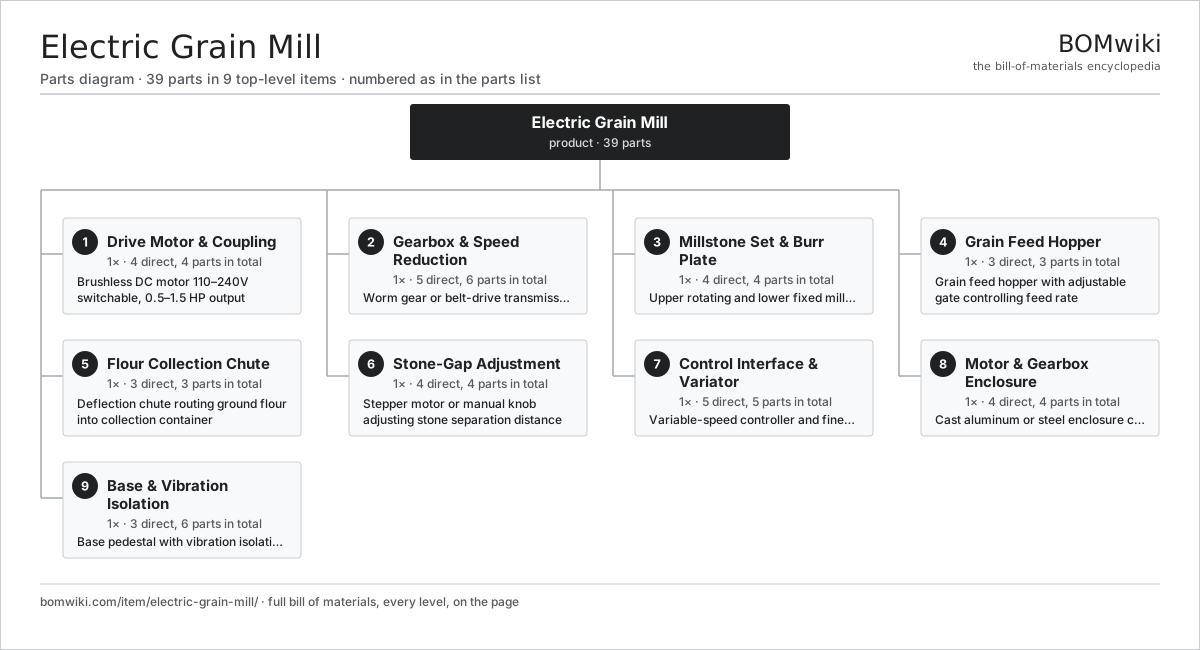
| # | Part | Qty | What it does |
|---|---|---|---|
| 1 | Drive Motor & Coupling 4 parts | 1× | Brushless DC motor 110–240V switchable, 0.5–1.5 HP output |
| 2 | Gearbox & Speed Reduction 5 parts | 1× | Worm gear or belt-drive transmission reducing motor speed to 1000–1500 rpm milling head |
| 3 | Millstone Set & Burr Plate 4 parts | 1× | Upper rotating and lower fixed millstones, ceramic or burr pattern |
| 4 | Grain Feed Hopper 3 parts | 1× | Grain feed hopper with adjustable gate controlling feed rate |
| 5 | Flour Collection Chute 3 parts | 1× | Deflection chute routing ground flour into collection container |
| 6 | Stone-Gap Adjustment 4 parts | 1× | Stepper motor or manual knob adjusting stone separation distance |
| 7 | Control Interface & Variator 5 parts | 1× | Variable-speed controller and fineness-setting interface |
| 8 | Motor & Gearbox Enclosure 4 parts | 1× | Cast aluminum or steel enclosure containing motor and gearbox, sound dampening |
| 9 | Base & Vibration Isolation 3 parts | 1× | Base pedestal with vibration isolation feet |
3D model
No 3D model yet. Have a CAD file of this? Add a 3D model. STL renders right on this page; STEP, FreeCAD, and OpenSCAD sources are welcome too (openly licensed, like all 3D models on BOMwiki).
Build & assembly graph
expand / collapse · shared sub-assemblies converge · links to related products · est. labourTap an assembly to expand/collapse · tap a part to open it · use “Open page” for any node · drag to pan, scroll to zoom.
Bill of materials for Electric Grain Mill
9 top-level lines · 44 rows shown · 39 parts total · indented to 3 levels| # | Item / sub-assembly | Part no. | Qty/assy | Ext. qty | Parts | Type |
|---|---|---|---|---|---|---|
| 1 | Drive Motor & Coupling 4 parts | electric-grain-mill-motor | 1× | 1 | 4 | assembly |
| 1.1 | Brushless Motor | electric-grain-mill-motor-body | 1× | 1 | · | part |
| 1.2 | PWM Speed Controller | electric-grain-mill-pwm-controller | 1× | 1 | · | part |
| 1.3 | Power Supply Module | electric-grain-mill-power-supply | 1× | 1 | · | part |
| 1.4 | Motor-Gearbox Coupling | electric-grain-mill-motor-coupling | 1× | 1 | · | part |
| 2 | Gearbox & Speed Reduction 5 parts | electric-grain-mill-gearbox | 1× | 1 | 6 | assembly |
| 2.1 | Worm Drive Shaft | electric-grain-mill-worm-shaft | 1× | 1 | · | part |
| 2.2 | Worm Wheel Gear | electric-grain-mill-worm-wheel | 1× | 1 | · | part |
| 2.3 | Gearbox Housing | electric-grain-mill-gearbox-housing | 1× | 1 | · | part |
| 2.4 | Output Shaft | electric-grain-mill-output-shaft | 1× | 1 | · | part |
| 2.5 | Ball Bearing | ball-bearing | 2× | 2 | · | part |
| 3 | Millstone Set & Burr Plate 4 parts | electric-grain-mill-millstone-pair | 1× | 1 | 4 | assembly |
| 3.1 | Upper Rotating Millstone | electric-grain-mill-upper-stone | 1× | 1 | · | part |
| 3.2 | Lower Fixed Millstone | electric-grain-mill-lower-stone | 1× | 1 | · | part |
| 3.3 | Millstone Carrier Ring | electric-grain-mill-stone-carrier | 1× | 1 | · | part |
| 3.4 | Particle Shroud | electric-grain-mill-particle-deflector | 1× | 1 | · | part |
| 4 | Grain Feed Hopper 3 parts | electric-grain-mill-hopper | 1× | 1 | 3 | assembly |
| 4.1 | Hopper Body | electric-grain-mill-hopper-body | 1× | 1 | · | part |
| 4.2 | Hopper Feed Gate | electric-grain-mill-hopper-gate | 1× | 1 | · | part |
| 4.3 | Hopper-to-Millstone Chute | electric-grain-mill-hopper-chute-connector | 1× | 1 | · | part |
| 5 | Flour Collection Chute 3 parts | electric-grain-mill-chute | 1× | 1 | 3 | assembly |
| 5.1 | Flour Discharge Chute | electric-grain-mill-chute-guide | 1× | 1 | · | part |
| 5.2 | Dust Collection Cone | electric-grain-mill-collection-cone | 1× | 1 | · | part |
| 5.3 | Connector | connector | 1× | 1 | · | part |
| 6 | Stone-Gap Adjustment 4 parts | electric-grain-mill-adjustment-mechanism | 1× | 1 | 4 | assembly |
| 6.1 | Fineness-Adjustment Motor | electric-grain-mill-adjustment-motor | 1× | 1 | · | part |
| 6.2 | Lead Screw | electric-grain-mill-lead-screw | 1× | 1 | · | part |
| 6.3 | Lock Nut | electric-grain-mill-lock-nut | 1× | 1 | · | part |
| 6.4 | Stone-Gap Position Sensor | electric-grain-mill-position-sensor | 1× | 1 | · | part |
| 7 | Control Interface & Variator 5 parts | electric-grain-mill-controller | 1× | 1 | 5 | assembly |
| 7.1 | LCD Panel | lcd-panel | 1× | 1 | · | part |
| 7.2 | Control Keypad | electric-grain-mill-keypad | 1× | 1 | · | part |
| 7.3 | Thermal Monitor | electric-grain-mill-temperature-sensor | 1× | 1 | · | part |
| 7.4 | Bare PCB | pcb-bare | 1× | 1 | · | part |
| 7.5 | SMD Passive (R/C/L) | smd-passives | 1× | 1 | · | part |
| 8 | Motor & Gearbox Enclosure 4 parts | electric-grain-mill-housing | 1× | 1 | 4 | assembly |
| 8.1 | Enclosure Shell | electric-grain-mill-housing-body | 1× | 1 | · | part |
| 8.2 | Acoustic Padding | electric-grain-mill-sound-liner | 1× | 1 | · | part |
| 8.3 | Cooling Fan | electric-grain-mill-ventilation-fan | 1× | 1 | · | part |
| 8.4 | Fastener Set | fastener-set | 1× | 1 | · | part |
| 9 | Base & Vibration Isolation 3 parts | electric-grain-mill-frame | 1× | 1 | 6 | assembly |
| 9.1 | Frame Structure | electric-grain-mill-frame-legs | 1× | 1 | · | part |
| 9.2 | Elastomer Isolation Feet | electric-grain-mill-isolation-feet | 4× | 4 | · | part |
| 9.3 | Fastener Set | fastener-set | 1× | 1 | · | part |
Something wrong in this list? Report a problem with this BOM.
Related products
same domain, ranked by shared parts Bread Machine
162 parts · shares 3 with this page
Bread Machine
162 parts · shares 3 with this page
 Chocolate Melanger
32 parts · shares 3 with this page
Chocolate Melanger
32 parts · shares 3 with this page
 Compressor Ice Cream Maker
248 parts · shares 3 with this page
Compressor Ice Cream Maker
248 parts · shares 3 with this page
 Electric Pasta Maker
63 parts · shares 3 with this page
Electric Pasta Maker
63 parts · shares 3 with this page
 High-Speed Blender
158 parts · shares 3 with this page
High-Speed Blender
158 parts · shares 3 with this page
 Sous Vide Immersion Circulator
294 parts · shares 3 with this page
Sous Vide Immersion Circulator
294 parts · shares 3 with this page
Sourcing: possible vendors
Browse the supplier directory → Prices, MOQ, and lead times are algorithmic estimates, not quotes, and not claims about these companies. Company mappings are curated by keyword; est. price band $20–$600. How estimates work| Vendor | HQ | Specialty | MOQ | Lead time |
|---|---|---|---|---|
|
🇦🇺Breville
breville.com ↗
|
Sydney, AU | Kitchen appliances | 2,000 units | 6–10 wks |
| groupeseb.com ↗ | Écully, FR | Cookware & small appliances | 2,000 units | 6–10 wks |
| hamiltonbeach.com ↗ | Glen Allen, US | Small appliances | 2,000 units | 6–10 wks |
| panasonic.com ↗ | Osaka, JP | Electronics & appliances | 2,000 units | 6–10 wks |
|
🇨🇳Midea
midea.com ↗
|
Foshan, CN | Home appliances | 2,000 units | 6–10 wks |
1,285-word article