Electrode Calendering Machine
ProductOverview
An electrode calendering machine compresses coated electrode foil between two precision-ground rolls under controlled hydraulic pressure, reducing thickness and increasing density. Calendering is a post-coating finishing step that improves electrode performance: denser electrodes have better electronic conductivity (shorter diffusion paths), reduced electrolyte wetting time, and improved cycle life.
Calendering applies typically 100–300 bar nip pressure, compressing the active material coating by 10–50%, converting a soft, porous structure into a denser, mechanically robust film. The process is performed on coated anode and cathode foil before it enters the Cell Winding Machine.
Industrial calenders operate at web speeds of 100–500 m/min, producing kilometers of finished electrode per day. Real-time gap sensing and load-cell feedback maintain thickness uniformity within ±5 microns, critical for capacity consistency across cells.
How It Works
Coated electrode foil exits the Electrode Coating Machine at 50–300 microns wet coating thickness, or 10–100 microns dry. This foil unwinds via the Unwinding & Supply, driven by a servo motor maintaining ±1% web tension via a load-cell dancer.
The foil web is guided through the Web Guidance & Centering into the nip formed by two precision Calender Roll Assembly rolls (upper and lower). Both rolls are hardened steel or polyurethane-coated, 300–500 mm diameter, precision-ground to <0.01 mm total indicator runout (TIR).
A Hydraulic Pressure Control hydraulic circuit applies load to the upper roll via a proportional valve. The Hydraulic Gear Pump (gear pump, ~20 cc/rev) pressurizes oil to the upper roll bearing pedestals at 10–500 bar. A Proportional Directional Valve modulates pressure in real-time based on feedback.
A Gap & Thickness Measurement (capacitive displacement transducer) mounted near the nip measures the roll gap continuously. The gap correlates directly to compressed foil thickness. Software in the Control & Sequencing PLC PLC compares measured gap to a setpoint (e.g., 20 microns final dry thickness) and adjusts proportional valve command every 100 ms, maintaining ±10 micron accuracy.
The Roll Cooling Circuit circulates chilled water (25–35°C) through internal cavities in both roll sleeves. Calender rolls generate heat from friction and material deformation; cooling prevents temperature rise above 50°C, which would degrade binder polymer and active material crystal structure.
As foil passes through the nip at 100–500 m/min, the compressive stress densifies the porous electrode coating. Particles bond more intimately, and the coating becomes flatter and more uniform. After exiting the nip, the Rewinding & Takeup motor winds the calendered foil onto a rewind spool, with load-cell tension control compensating for growing roll diameter.
Physical Compression and Density Increase
Electrode coatings are initially porous (40–60% void fraction). Calendering compresses the void structure, increasing solid density. A 15 mg/cm² cathode coating may compress from ~2.0 mg/mm³ apparent density to ~2.5 mg/mm³ after calendering, a 25% density increase.
Thinner, denser electrodes reduce:
- Ionic transport distance: Lithium-ion diffusion time through the coating drops by square of thickness ratio.
- Ohmic drop: Electronic conductivity through the dense film improves.
- Electrolyte wetting time: Denser coatings imbibe electrolyte faster, reducing initial impedance.
Trade-off: Over-compaction (>400 bar) fractures active material particles or delaminates coating from foil, causing open-circuit failures.
Roll Materials and Thermal Management
Hardened steel rolls (58–62 HRC) are the baseline, durable and cost-effective. Polyurethane- or epoxy-coated rolls (Shore D 85–95) reduce electrode sticking and may provide slight damping. Coated rolls cost 2–3× more but extend maintenance intervals.
Roll temperature control is critical. Without cooling, friction heat raises roll surface temperature to 80–120°C, softening binder and inducing crystalline phase changes in active materials (e.g., layered oxide rearrangement). Water cooling at 25–35°C and low-speed operation keep foil and roll below 50°C.
A Proportional Temperature Valve 3-way proportional valve modulates coolant bypass to maintain setpoint ±2°C. Coolant flow is 2–5 m³/h per roll; higher speeds (>300 m/min) require larger chiller capacity (10–15 kW).
Gap Control and Thickness Feedback
The Gap & Thickness Measurement capacitive probe measures the distance between roll surfaces (gap). Typical gaps are 20–100 microns; foil thickness in the nip is approximately gap + foil thickness (10–30 microns). After exiting, foil rebounds elastically ~10–20%, so final thickness is gap - 10 microns.
Closed-loop control adjusts nip pressure in real-time to hold gap setpoint. At 100 m/min web speed with 100 ms control loop, pressure adjustments are made ~3 cm downstream of the measurement point, fast enough to suppress thickness ripple but slow enough to avoid hunting.
Web Alignment and Centering
The electrode-calendering-machine-edge-guide pair of motorized rollers with inductive edge sensors steer the web centerline through the nip. A Edge Alignment Stepper stepper adjusts roller tilt to keep web edges within ±2 mm of centerline. Misaligned webs cause uneven pressure distribution and wavy finished thickness.
Multi-Pass and Staged Compression
Some production lines use two-stage calendering: first pass at 200 bar (moderate compression), cool-down dwell, second pass at 300 bar (final compression). Two-pass reduces shock to the electrode and enables use of thicker initial coatings (which are faster to apply).
Single-pass calenders (most common) apply full pressure in one go, 300–400 m/min, sacrificing some fine-tuning for throughput.
Maintenance and Wear
Calender roll surfaces degrade from particle embedment and mechanical wear. Inspection every 3–6 months using replica tape or laser profilometry detects wear >0.05 mm. Roll resurfacing (grinding and honing) is performed annually or per 500 operating hours; full roll replacement is needed every 3–5 years.
Proportional valve spools and seal-rings are replaced every 2–3 years. Bearing maintenance (grease purging, temperature monitoring) occurs quarterly.
Electrode Calendering Machine parts and their functions
8 top-level parts · 49 parts in total · full bill of materials below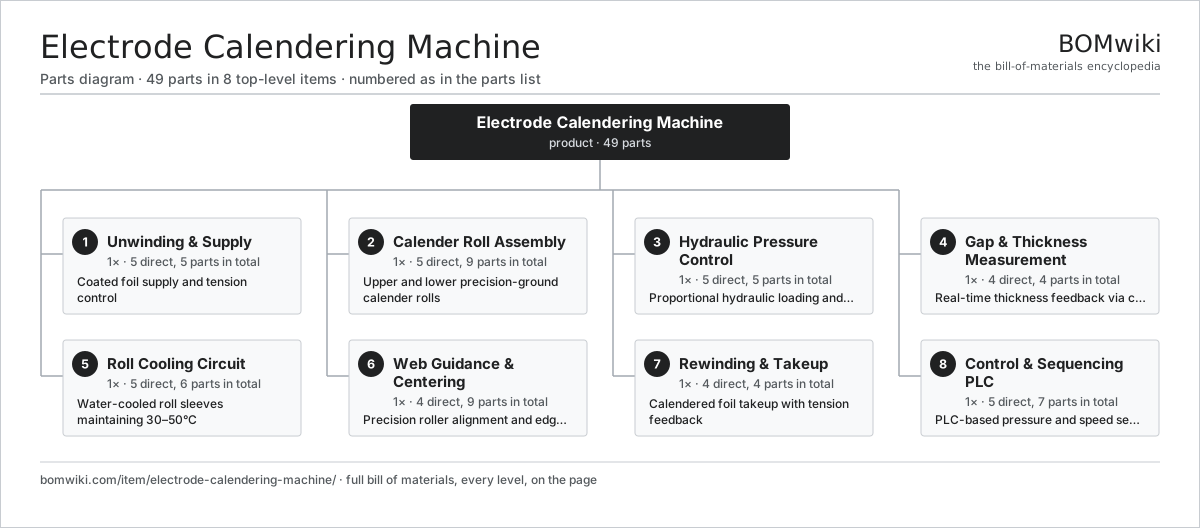
| # | Part | Qty | What it does |
|---|---|---|---|
| 1 | Unwinding & Supply 5 parts | 1× | Coated foil supply and tension control |
| 2 | Calender Roll Assembly 5 parts | 1× | Upper and lower precision-ground calender rolls |
| 3 | Hydraulic Pressure Control 5 parts | 1× | Proportional hydraulic loading and nip control |
| 4 | Gap & Thickness Measurement 4 parts | 1× | Real-time thickness feedback via capacitive gauge |
| 5 | Roll Cooling Circuit 5 parts | 1× | Water-cooled roll sleeves maintaining 30–50°C |
| 6 | Web Guidance & Centering 4 parts | 1× | Precision roller alignment and edge steering |
| 7 | Rewinding & Takeup 4 parts | 1× | Calendered foil takeup with tension feedback |
| 8 | Control & Sequencing PLC 5 parts | 1× | PLC-based pressure and speed sequencing |
3D model
No 3D model yet. Have a CAD file of this? Add a 3D model. STL renders right on this page; STEP, FreeCAD, and OpenSCAD sources are welcome too (openly licensed, like all 3D models on BOMwiki).
Build & assembly graph
expand / collapse · shared sub-assemblies converge · links to related products · est. labourTap an assembly to expand/collapse · tap a part to open it · use “Open page” for any node · drag to pan, scroll to zoom.
Bill of materials for Electrode Calendering Machine
8 top-level lines · 45 rows shown · 49 parts total · indented to 3 levels| # | Item / sub-assembly | Part no. | Qty/assy | Ext. qty | Parts | Type |
|---|---|---|---|---|---|---|
| 1 | Unwinding & Supply 5 parts | electrode-calendering-machine-unwinding-section | 1× | 1 | 5 | assembly |
| 1.1 | Unwinding Servo Motor | electrode-calendering-machine-unwinding-motor | 1× | 1 | · | part |
| 1.2 | Tension Dancer Roller | electrode-calendering-machine-dancer-roller | 1× | 1 | · | part |
| 1.3 | Web Tension Load-Cell | electrode-calendering-machine-tension-sensor | 1× | 1 | · | part |
| 1.4 | Edge Alignment Stepper | electrode-calendering-machine-edge-guide-motor | 1× | 1 | · | part |
| 1.5 | Encoder | encoder | 1× | 1 | · | part |
| 2 | Calender Roll Assembly 5 parts | electrode-calendering-machine-roll-pair | 1× | 1 | 9 | assembly |
| 2.1 | Upper Calender Roll | electrode-calendering-machine-upper-roll | 1× | 1 | · | part |
| 2.2 | Lower Calender Roll | electrode-calendering-machine-lower-roll | 1× | 1 | · | part |
| 2.3 | Calender Roll Bearing | electrode-calendering-machine-roll-bearing | 4× | 4 | · | part |
| 2.4 | Roll Pedestal Housing | electrode-calendering-machine-bearing-housing | 2× | 2 | · | part |
| 2.5 | Fastener Set | fastener-set | 1× | 1 | · | part |
| 3 | Hydraulic Pressure Control 5 parts | electrode-calendering-machine-pressure-system | 1× | 1 | 5 | assembly |
| 3.1 | Hydraulic Gear Pump | electrode-calendering-machine-hydraulic-pump | 1× | 1 | · | part |
| 3.2 | Proportional Directional Valve | electrode-calendering-machine-proportional-valve | 1× | 1 | · | part |
| 3.3 | Pilot-Operated Relief Valve | electrode-calendering-machine-pressure-relief | 1× | 1 | · | part |
| 3.4 | Hydro-Pneumatic Accumulator | electrode-calendering-machine-accumulator | 1× | 1 | · | part |
| 3.5 | Pressure Sensor | pressure-sensor | 1× | 1 | · | part |
| 4 | Gap & Thickness Measurement 4 parts | electrode-calendering-machine-gap-sensor | 1× | 1 | 4 | assembly |
| 4.1 | Capacitive Gap Sensor | electrode-calendering-machine-gap-probe | 1× | 1 | · | part |
| 4.2 | Gap Signal Amplifier PCB | electrode-calendering-machine-signal-conditioner | 1× | 1 | · | part |
| 4.3 | Bare PCB | pcb-bare | 1× | 1 | · | part |
| 4.4 | SMD Passive (R/C/L) | smd-passives | 1× | 1 | · | part |
| 5 | Roll Cooling Circuit 5 parts | electrode-calendering-machine-cooling-system | 1× | 1 | 6 | assembly |
| 5.1 | Water Chiller | electrode-calendering-machine-chiller-unit | 1× | 1 | · | part |
| 5.2 | Proportional Temperature Valve | electrode-calendering-machine-thermostatic-valve | 1× | 1 | · | part |
| 5.3 | Coolant Circulation Pump | electrode-calendering-machine-coolant-pump | 1× | 1 | · | part |
| 5.4 | Pressure Sensor | pressure-sensor | 1× | 1 | · | part |
| 5.5 | Connector | connector | 2× | 2 | · | part |
| 6 | Web Guidance & Centering 4 parts | electrode-calendering-machine-web-guide | 1× | 1 | 9 | assembly |
| 6.1 | Web Guide Roller | electrode-calendering-machine-guide-roller | 2× | 2 | · | part |
| 6.2 | Guide Roller Bearing | electrode-calendering-machine-guide-bearing | 4× | 4 | · | part |
| 6.3 | Web Edge Detector | electrode-calendering-machine-edge-sensor | 2× | 2 | · | part |
| 6.4 | Encoder | encoder | 1× | 1 | · | part |
| 7 | Rewinding & Takeup 4 parts | electrode-calendering-machine-rewinding-section | 1× | 1 | 4 | assembly |
| 7.1 | Rewind Servo Motor | electrode-calendering-machine-rewind-motor | 1× | 1 | · | part |
| 7.2 | Rewind Tension Regulator | electrode-calendering-machine-rewind-tension-controller | 1× | 1 | · | part |
| 7.3 | Tension Dancer Roller | electrode-calendering-machine-dancer-roller | 1× | 1 | · | part |
| 7.4 | Encoder | encoder | 1× | 1 | · | part |
| 8 | Control & Sequencing PLC 5 parts | electrode-calendering-machine-control-panel | 1× | 1 | 7 | assembly |
| 8.1 | Microcontroller | mcu | 1× | 1 | · | part |
| 8.2 | Proportional Solenoid Driver | electrode-calendering-machine-proportional-amplifier | 1× | 1 | · | part |
| 8.3 | Control Touchscreen HMI | electrode-calendering-machine-hmi-display | 1× | 1 | · | part |
| 8.4 | Power Supply | power-supply | 2× | 2 | · | part |
| 8.5 | Relay | relay | 2× | 2 | · | part |
Something wrong in this list? Report a problem with this BOM.
Related products
same domain, ranked by shared parts DMLS/SLM Printer
68 parts · shares 6 with this page
Electrocoating Line
2,977 parts · shares 6 with this page
DMLS/SLM Printer
68 parts · shares 6 with this page
Electrocoating Line
2,977 parts · shares 6 with this page
Sourcing: possible vendors
Browse the supplier directory → Prices, MOQ, and lead times are algorithmic estimates, not quotes, and not claims about these companies. Company mappings are curated by keyword; est. price band $5k–$2M. How estimates work| Vendor | HQ | Specialty | MOQ | Lead time |
|---|---|---|---|---|
| atlascopco.com ↗ | Stockholm, SE | Compressors & industrial | 10 units | 12–20 wks |
|
🇦🇹Andritz
andritz.com ↗
|
Graz, AT | Process plants & machinery | 10 units | 12–20 wks |
| buhlergroup.com ↗ | Uzwil, CH | Food & materials processing | 10 units | 12–20 wks |
| gea.com ↗ | Düsseldorf, DE | Process technology | 10 units | 12–20 wks |
| mhi.com ↗ | Tokyo, JP | Heavy machinery | 10 units | 12–20 wks |
985-word article