Electrode Coating Machine
ProductOverview
An electrode coating machine is a continuous web processor that applies a slurry of active material (lithium metal oxides, graphite, or silicon compounds) onto aluminum or copper foil with micron-level uniformity. The system unwinds jumbo coils of base foil, directs the web through a precision slot-die head that deposits a wet coating layer 50–300 microns thick, then subjects the coated web to a staged thermal drying profile before rewinding.
Slot-die coating achieves superior coating uniformity (±5% thickness variation across web width) compared to earlier blade or spray methods, reducing waste and enabling thinner active material loadings, critical for high energy-density battery cells. The machine is foundational to roll-to-roll battery electrode manufacturing, used in both lab-scale R&D (600 mm widths) and full-scale production lines (2000+ mm widths).
How It Works
A Foil Unwinding Section motor pulls aluminum or copper foil from a jumbo roll, with a Dancer Tension Roller and Tension Control Module maintaining ±2% web tension. The Web Guidance System guides the foil centerline and edge position via precision rubber-coated rollers and a motorized alignment stage.
The slurry, a homogeneous suspension of cathode oxide particles (NMC, LFP) or anode graphite in N-methyl-2-pyrrolidone (NMP) or aqueous binder, is stored in a feed tank. A Slurry Supply & Metering gear pump meters slurry at 0.5–5 mL/cm/min, with a Pulsation Damper Tank smoothing pump ripple before the Slot-Die Coating Head.
The Slot-Die Coating Head is a precision-machined aluminum or ductile iron manifold with internal distribution channels and a knife-edge slot opening (50–200 microns). The manifold is heated to 40–60°C via a Heated Water Jacket water loop, maintaining slurry viscosity and flow stability. Slurry exits the slot in a thin curtain that lands on the moving foil directly below. The die back-pressure (0.5–2 bar) is monitored by a Die Backpressure Transducer for real-time flow diagnostics.
Once coated, the wet web (still 50–300 microns thick) enters the Multi-Zone Drying Oven. A three-zone drying profile is typical:
- Infrared (Flash-off) Zone: 2–4 kW Infrared Heater Array radiating 500–800°C heats the foil surface rapidly, evaporating bulk solvent in seconds.
- Convection (Main Drying) Zone: A Convection Heating Element (5–10 kW) and Blower Motor circulate hot air (150–250°C) through the web, removing residual moisture and solvent over 2–5 meters of dwell.
- Cooling Zone: Ambient air cools the coated foil to handle temperature before rewind.
Humidity is managed by Exhaust Damper Gate gates modulating exhaust airflow. Over-drying risks binder decomposition; under-drying leaves residual solvent that degrades cycle life.
The Online Thickness Measurement, either X-ray fluorescence (XRF) or beta-ray absorption, measures dry coating mass per unit area in real-time (mg/cm²). This feedback adjusts the Slurry Supply & Metering pump speed to hold thickness within ±5%. Without closed-loop thickness control, feedstock cost and cell performance vary shift-to-shift.
Finally, the Foil Rewinding Section motor winds the coated foil onto a rewind spool, with Rewind Tension Controller feedback maintaining constant tension as the roll diameter grows (tension must drop as diameter increases to avoid foil yield).
A Control & Safety Panel hosts a Mitsubishi or Siemens PLC, servo amplifiers, and a 10–15 inch HMI touchscreen. Operators set speed (m/min), slurry pump rate (mL/min), zone temperatures, and target dry-weight (mg/cm²). The PLC closes servo loops and logs coating parameters every second.
Coating Material and Rheology
Cathode slurries (NMC, LFP, LNMO) are typically 60–70 wt% solid loading in NMP with 5–15 wt% binder (PVDF or aqueous acrylic). Viscosity ranges 500–10,000 cP depending on solid size and loading. Anode slurries (graphite, silicon) use similar binders and viscosity windows.
Slot-die coaters excel at thixotropic or pseudoplastic slurries (apparent viscosity decreases under shear). As slurry exits the slot, shear-thinning maintains a smooth meniscus and coating edge uniformity. Poor rheology (Newtonian or high shear-thickening) leads to ribbing or edge beads.
Thickness Measurement and Feedback
XRF gauges are non-destructive and real-time. They measure elemental fluorescence (e.g., Ni, Co, Fe from cathode oxides) correlating to coating mass. XRF is industry-standard but capital-intensive (40–100 kEUR instrument). Beta-ray absorption (Ni-63 or I-204 sources) is cheaper but faces regulatory restrictions in some regions and requires shielding.
Closed-loop feedback adjusts pump flow by ±10–20% around setpoint without stopping the line. A 5–10 second control lag is typical; faster response requires larger accumulator dampers.
Substrate and Quality Targets
Aluminum foil (anode, 10–20 microns, 99.99% purity) or copper foil (cathode, typically avoided due to redox, but some advanced designs use it). Foil surfaces must be clean and dry before coating, surface oxidation or water promotes adhesion failure or binder segregation.
Target dry-weight is 5–15 mg/cm² for anode, 10–20 mg/cm² for cathode. Excess coating raises resistance and swelling; too little reduces capacity.
Drying Kinetics and Solvent Removal
NMP boils at 202°C. In the IR zone, surface temperature spikes to 150–200°C, evaporating 60–80% of solvent in 1–2 seconds. The convection zone removes residual solvent over 1–3 minutes. Binder (PVDF) begins to sinter above 180°C, fusing particles to the foil. Final moisture (<0.1%) is critical, excess water triggers hydrolysis of lithium salts during cell assembly.
Production Variants
Lab coaters (600 mm width) operate at 10–50 m/min for development. Production lines (1500–3000 mm) run 100–300 m/min, coating multiple foil sides in some designs (dual-headed). Semi-continuous batch coaters exist but are less economical.
Safety and Maintenance
NMP is a health-hazard (reproductive toxin); enclosed coating and oven areas with local exhaust and fume recovery are required. Slot-die manifolds must be purged with solvent (NMP or acetone) if left idle >4 hours to prevent slurry hardening. Heater elements degrade and require replacement every 2–5 years depending on temperature and dwell time.
Electrode Coating Machine parts and their functions
8 top-level parts · 52 parts in total · full bill of materials below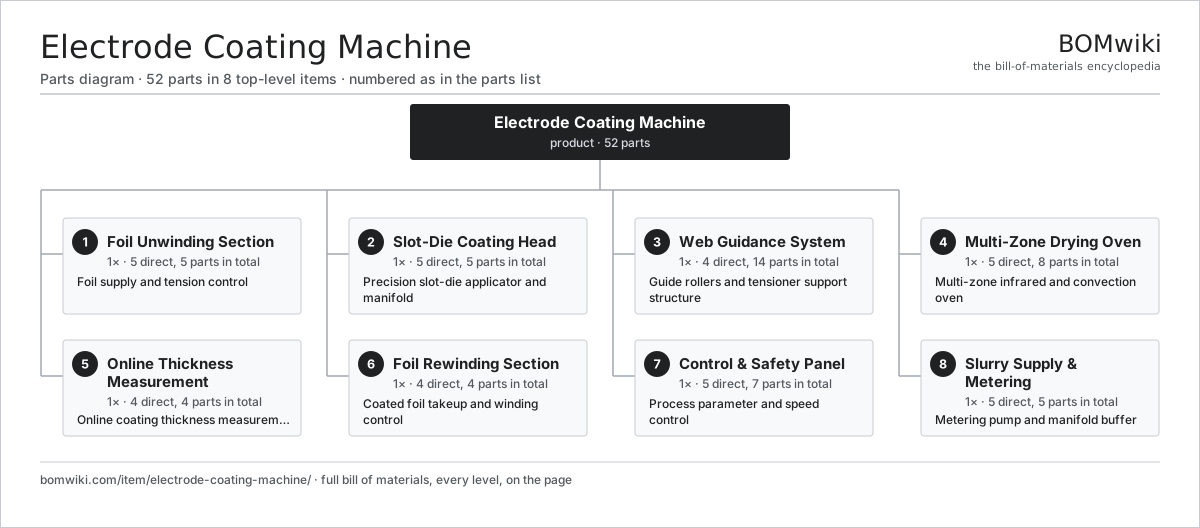
| # | Part | Qty | What it does |
|---|---|---|---|
| 1 | Foil Unwinding Section 5 parts | 1× | Foil supply and tension control |
| 2 | Slot-Die Coating Head 5 parts | 1× | Precision slot-die applicator and manifold |
| 3 | Web Guidance System 4 parts | 1× | Guide rollers and tensioner support structure |
| 4 | Multi-Zone Drying Oven 5 parts | 1× | Multi-zone infrared and convection oven |
| 5 | Online Thickness Measurement 4 parts | 1× | Online coating thickness measurement |
| 6 | Foil Rewinding Section 4 parts | 1× | Coated foil takeup and winding control |
| 7 | Control & Safety Panel 5 parts | 1× | Process parameter and speed control |
| 8 | Slurry Supply & Metering 5 parts | 1× | Metering pump and manifold buffer |
3D model
No 3D model yet. Have a CAD file of this? Add a 3D model. STL renders right on this page; STEP, FreeCAD, and OpenSCAD sources are welcome too (openly licensed, like all 3D models on BOMwiki).
Build & assembly graph
expand / collapse · shared sub-assemblies converge · links to related products · est. labourTap an assembly to expand/collapse · tap a part to open it · use “Open page” for any node · drag to pan, scroll to zoom.
Bill of materials for Electrode Coating Machine
8 top-level lines · 45 rows shown · 52 parts total · indented to 3 levels| # | Item / sub-assembly | Part no. | Qty/assy | Ext. qty | Parts | Type |
|---|---|---|---|---|---|---|
| 1 | Foil Unwinding Section 5 parts | electrode-coating-machine-unwinding-section | 1× | 1 | 5 | assembly |
| 1.1 | Unwinding Servo Motor | electrode-coating-machine-spindle-motor | 1× | 1 | · | part |
| 1.2 | Dancer Tension Roller | electrode-coating-machine-dancer-roller | 1× | 1 | · | part |
| 1.3 | Tension Control Module | electrode-coating-machine-tension-controller | 1× | 1 | · | part |
| 1.4 | Encoder | encoder | 1× | 1 | · | part |
| 1.5 | Pressure Sensor | pressure-sensor | 1× | 1 | · | part |
| 2 | Slot-Die Coating Head 5 parts | electrode-coating-machine-slot-die-head | 1× | 1 | 5 | assembly |
| 2.1 | Slot-Die Manifold Block | electrode-coating-machine-die-body | 1× | 1 | · | part |
| 2.2 | Heated Water Jacket | electrode-coating-machine-thermal-jacket | 1× | 1 | · | part |
| 2.3 | Slot-Die Lip Shim | electrode-coating-machine-die-lip | 1× | 1 | · | part |
| 2.4 | Die Backpressure Transducer | electrode-coating-machine-pressure-sensor-die | 1× | 1 | · | part |
| 2.5 | Connector | connector | 1× | 1 | · | part |
| 3 | Web Guidance System 4 parts | electrode-coating-machine-web-path | 1× | 1 | 14 | assembly |
| 3.1 | Web Guide Roller | electrode-coating-machine-guide-roller | 4× | 4 | · | part |
| 3.2 | Roller Support Bearing | electrode-coating-machine-roller-bearing | 8× | 8 | · | part |
| 3.3 | Edge Alignment Actuator | electrode-coating-machine-alignment-stage | 1× | 1 | · | part |
| 3.4 | Fastener Set | fastener-set | 1× | 1 | · | part |
| 4 | Multi-Zone Drying Oven 5 parts | electrode-coating-machine-drying-system | 1× | 1 | 8 | assembly |
| 4.1 | Infrared Heater Array | electrode-coating-machine-ir-heater-bank | 1× | 1 | · | part |
| 4.2 | Convection Heating Element | electrode-coating-machine-convection-heater | 1× | 1 | · | part |
| 4.3 | Blower Motor | blower-motor | 1× | 1 | · | part |
| 4.4 | Zone Temperature Thermocouple | electrode-coating-machine-temperature-sensor | 3× | 3 | · | part |
| 4.5 | Exhaust Damper Gate | electrode-coating-machine-damper-valve | 2× | 2 | · | part |
| 5 | Online Thickness Measurement 4 parts | electrode-coating-machine-thickness-gauge | 1× | 1 | 4 | assembly |
| 5.1 | XRF Gauge Sensor Head | electrode-coating-machine-gauge-head | 1× | 1 | · | part |
| 5.2 | Gauge Signal Processor | electrode-coating-machine-gauge-electronics | 1× | 1 | · | part |
| 5.3 | Bare PCB | pcb-bare | 1× | 1 | · | part |
| 5.4 | Pressure Sensor | pressure-sensor | 1× | 1 | · | part |
| 6 | Foil Rewinding Section 4 parts | electrode-coating-machine-rewinding-section | 1× | 1 | 4 | assembly |
| 6.1 | Rewind Servo Motor | electrode-coating-machine-rewind-motor | 1× | 1 | · | part |
| 6.2 | Rewind Tension Controller | electrode-coating-machine-rewind-tension-controller | 1× | 1 | · | part |
| 6.3 | Dancer Tension Roller | electrode-coating-machine-dancer-roller | 1× | 1 | · | part |
| 6.4 | Encoder | encoder | 1× | 1 | · | part |
| 7 | Control & Safety Panel 5 parts | electrode-coating-machine-control-panel | 1× | 1 | 7 | assembly |
| 7.1 | Microcontroller | mcu | 1× | 1 | · | part |
| 7.2 | Industrial Touchscreen HMI | electrode-coating-machine-hmi-touchscreen | 1× | 1 | · | part |
| 7.3 | AC Servo Drive Amplifier | electrode-coating-machine-servo-drive | 2× | 2 | · | part |
| 7.4 | Power Supply | power-supply | 1× | 1 | · | part |
| 7.5 | Relay | relay | 2× | 2 | · | part |
| 8 | Slurry Supply & Metering 5 parts | electrode-coating-machine-slurry-feed | 1× | 1 | 5 | assembly |
| 8.1 | Positive Displacement Feed Pump | electrode-coating-machine-feed-pump | 1× | 1 | · | part |
| 8.2 | Feed Pump Motor | electrode-coating-machine-pump-motor | 1× | 1 | · | part |
| 8.3 | Pulsation Damper Tank | electrode-coating-machine-damper-vessel | 1× | 1 | · | part |
| 8.4 | Pressure Relief Valve | electrode-coating-machine-pressure-relief | 1× | 1 | · | part |
| 8.5 | Connector | connector | 1× | 1 | · | part |
Something wrong in this list? Report a problem with this BOM.
Related products
same domain, ranked by shared parts Brush Making Machine
50 parts · shares 6 with this page
Brush Making Machine
50 parts · shares 6 with this page
 Chalk Extrusion Machine
47 parts · shares 6 with this page
Crayon Molding Machine
56 parts · shares 6 with this page
Chalk Extrusion Machine
47 parts · shares 6 with this page
Crayon Molding Machine
56 parts · shares 6 with this page
 DMLS/SLM Printer
68 parts · shares 6 with this page
Electron Beam PBF
128 parts · shares 6 with this page
DMLS/SLM Printer
68 parts · shares 6 with this page
Electron Beam PBF
128 parts · shares 6 with this page
Sourcing: possible vendors
Browse the supplier directory → Prices, MOQ, and lead times are algorithmic estimates, not quotes, and not claims about these companies. Company mappings are curated by keyword; est. price band $5k–$2M. How estimates work| Vendor | HQ | Specialty | MOQ | Lead time |
|---|---|---|---|---|
| atlascopco.com ↗ | Stockholm, SE | Compressors & industrial | 10 units | 12–20 wks |
|
🇦🇹Andritz
andritz.com ↗
|
Graz, AT | Process plants & machinery | 10 units | 12–20 wks |
| buhlergroup.com ↗ | Uzwil, CH | Food & materials processing | 10 units | 12–20 wks |
| gea.com ↗ | Düsseldorf, DE | Process technology | 10 units | 12–20 wks |
| mhi.com ↗ | Tokyo, JP | Heavy machinery | 10 units | 12–20 wks |
1,054-word article