Electrolysis Machine
ProductOverview
Electrolysis is the only hair-removal method the US FDA permits to be described as permanent, and the electrolysis machine (professionally, an epilator) is the instrument that performs it. A sterile Electrolysis Probe of 0.05–0.15 mm diameter, finer than the hair itself, is slid into a follicle alongside the hair shaft without piercing skin, and energy delivered through the probe destroys the dermal papilla and stem-cell region at the follicle base. Treated follicles cannot regrow hair; clearing an area takes repeated sessions because follicles cycle and only actively growing ones respond reliably.
Three modalities share the machine, and most modern units provide all three. Galvanic electrolysis, the 1875 original, passes DC through the follicle; thermolysis (introduced in the 1920s) heats it with RF; the blend method applies both at once.
Galvanic mode
The Galvanic DC Module is a precision constant-current source delivering 0.1–2 mA DC with the probe as cathode. Current through the saline tissue fluid electrolyses water and salt, generating sodium hydroxide (lye) around the probe tip, a chemical, not thermal, destruction. Dose is genuinely coulombic, so the Current Monitor integrates milliamp-seconds, the "units of lye" figure electrologists set per hair diameter and depth: a coarse terminal hair needs roughly 60–80 mA·s, delivered as, say, 1.5 mA for 45 seconds. The circuit closes through the client's body to the Return Electrode, a stainless bar held in the hand, where the same current spreads over a large area at harmless density. The built-in Lead Continuity Tester alarms on an open return circuit, because galvanic delivery fails silently otherwise, and a Polarity Relay briefly reverses polarity after the pulse to strip electrolytic deposits off the probe. Galvanic mode is the most reliable killer of distorted follicles but the slowest, which motivated everything that followed.
Thermolysis and blend
In thermolysis the RF Generator drives the probe with 13.56 MHz RF, an ISM frequency, so the RF Oscillator needs no licence and emissions fit the allocated band. Tissue around the tip absorbs the field dielectrically and heats; a burst from the RF Power Amplifier of a few watts coagulates the papilla in tenths of a second, or in the "flash" technique a higher-power pulse of a few milliseconds does it faster than heat can conduct to surrounding skin. The Tuning Network holds delivered power roughly constant as probe-to-tissue impedance varies follicle to follicle, and the Output Isolation Transformer isolates the patient circuit from mains-referenced electronics as IEC 60601-1 requires of a Type BF applied part. Insulated probes confine current to the exposed tip, keeping the heating zone at the follicle base rather than near the skin surface.
The blend method applies RF and galvanic simultaneously: heat accelerates the lye reaction several-fold, so blend approaches thermolysis speed while keeping the chemical action that clears curved and distorted follicles. Blend settings trade the two doses against each other, which is the main reason the Control Panel stores programs, its Microcontroller keeps per-area, per-hair-type recipes recalled on the LCD Panel and trimmed with the Intensity Encoder between insertions.
Operator workflow
A session is thousands of identical micro-operations: stretch the skin, insert the probe to follicle depth, deliver the pulse, lift the released hair out with forceps. Both hands are permanently occupied, so the timed pulse is triggered by the Footswitch Assembly; its Pedal Switch is specified for over a million cycles because a practice can treat several hundred follicles an hour. The Probe Handpiece is balanced like a pen, its Probe Chuck taking probe sizes 2–6 (matched to hair diameter), and probes are single-use sterile items, the field moved permanently away from reusable needles for bloodborne-pathogen reasons, and several jurisdictions mandate it. Audible tones from the Speaker mark pulse start and end so the operator's eyes never leave the insertion site.
Safety and regulation
The machine touches a client with an intentionally current-carrying needle, so the engineering burden is isolation and dose control rather than power. Patient connections are galvanically isolated, leakage limits follow IEC 60601-1, and maximum outputs are small: 10 W RF and 2 mA DC. In the US the needle epilator is FDA Class I; practitioner licensing, not device clearance, is the main regulatory layer, with most states requiring a licensed electrologist. Contrast with laser and IPL: those target melanin photothermally and are merely "permanent reduction", electrolysis works on any hair colour, including the white and red hair lasers cannot treat, follicle by follicle.
Electrolysis Machine parts and their functions
9 top-level parts · 97 parts in total · full bill of materials below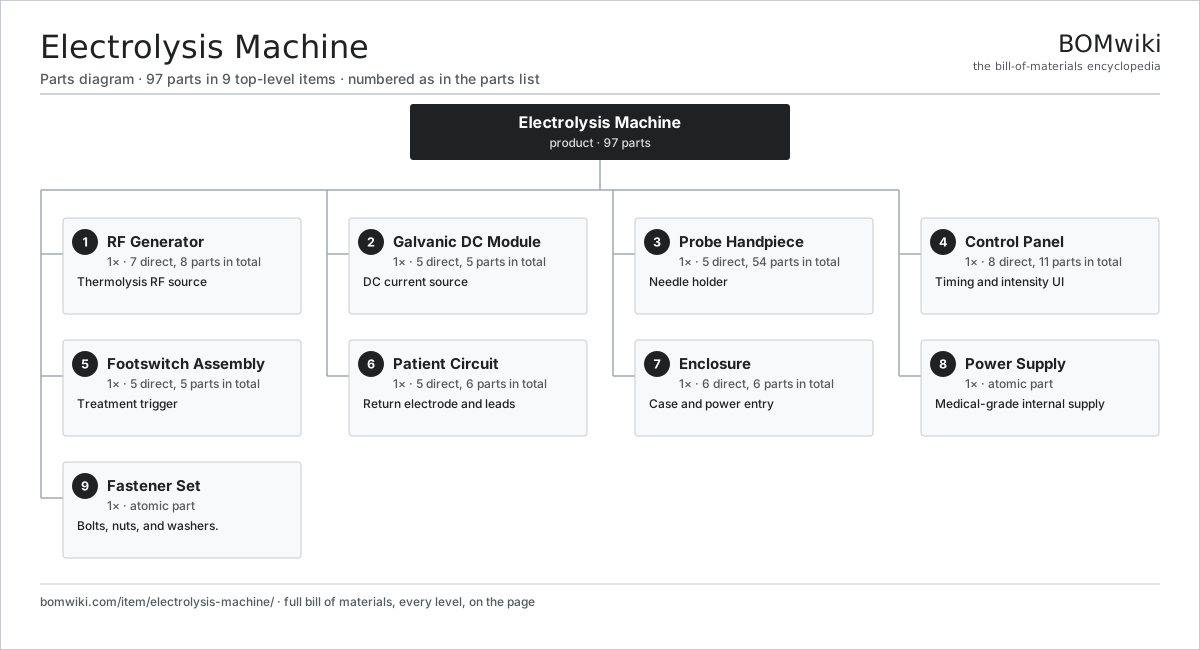
| # | Part | Qty | What it does |
|---|---|---|---|
| 1 | RF Generator 7 parts | 1× | Thermolysis RF source |
| 2 | Galvanic DC Module 5 parts | 1× | DC current source |
| 3 | Probe Handpiece 5 parts | 1× | Needle holder |
| 4 | Control Panel 8 parts | 1× | Timing and intensity UI |
| 5 | Footswitch Assembly 5 parts | 1× | Treatment trigger |
| 6 | Patient Circuit 5 parts | 1× | Return electrode and leads |
| 7 | Enclosure 6 parts | 1× | Case and power entry |
| 8 | Power Supply | 1× | Medical-grade internal supply |
| 9 | Fastener Set | 1× | Bolts, nuts, and washers. |
3D model
No 3D model yet. Have a CAD file of this? Add a 3D model. STL renders right on this page; STEP, FreeCAD, and OpenSCAD sources are welcome too (openly licensed, like all 3D models on BOMwiki).
Build & assembly graph
expand / collapse · shared sub-assemblies converge · links to related products · est. labourTap an assembly to expand/collapse · tap a part to open it · use “Open page” for any node · drag to pan, scroll to zoom.
Bill of materials for Electrolysis Machine
9 top-level lines · 50 rows shown · 97 parts total · indented to 3 levels| # | Item / sub-assembly | Part no. | Qty/assy | Ext. qty | Parts | Type |
|---|---|---|---|---|---|---|
| 1 | RF Generator 7 parts | electrolysis-machine-rf-generator | 1× | 1 | 8 | assembly |
| 1.1 | RF Oscillator | electrolysis-machine-rf-oscillator | 1× | 1 | · | part |
| 1.2 | RF Power Amplifier | electrolysis-machine-rf-amplifier | 1× | 1 | · | part |
| 1.3 | Output Isolation Transformer | electrolysis-machine-output-transformer | 1× | 1 | · | part |
| 1.4 | Tuning Network | electrolysis-machine-tuning-network | 1× | 1 | · | part |
| 1.5 | Power MOSFET | mosfet | 2× | 2 | · | part |
| 1.6 | SMD Passive (R/C/L) | smd-passives | 1× | 1 | · | part |
| 1.7 | Bare PCB | pcb-bare | 1× | 1 | · | part |
| 2 | Galvanic DC Module 5 parts | electrolysis-machine-galvanic-module | 1× | 1 | 5 | assembly |
| 2.1 | Precision Current Source | electrolysis-machine-current-source | 1× | 1 | · | part |
| 2.2 | Current Monitor | electrolysis-machine-current-monitor | 1× | 1 | · | part |
| 2.3 | Polarity Relay | electrolysis-machine-polarity-relay | 1× | 1 | · | part |
| 2.4 | Bare PCB | pcb-bare | 1× | 1 | · | part |
| 2.5 | SMD Passive (R/C/L) | smd-passives | 1× | 1 | · | part |
| 3 | Probe Handpiece 5 parts | electrolysis-machine-probe-handpiece | 1× | 1 | 54 | assembly |
| 3.1 | Electrolysis Probe | electrolysis-machine-probe | 50× | 50 | · | part |
| 3.2 | Probe Chuck | electrolysis-machine-probe-chuck | 1× | 1 | · | part |
| 3.3 | Handpiece Body | electrolysis-machine-handpiece-body | 1× | 1 | · | part |
| 3.4 | Handpiece Cable | electrolysis-machine-handpiece-cable | 1× | 1 | · | part |
| 3.5 | Connector | connector | 1× | 1 | · | part |
| 4 | Control Panel 8 parts | electrolysis-machine-control-panel | 1× | 1 | 11 | assembly |
| 4.1 | Bare PCB | pcb-bare | 1× | 1 | · | part |
| 4.2 | Microcontroller | mcu | 1× | 1 | · | part |
| 4.3 | LCD Panel | lcd-panel | 1× | 1 | · | part |
| 4.4 | Touch Digitizer | touch-digitizer | 1× | 1 | · | part |
| 4.5 | Intensity Encoder | electrolysis-machine-rotary-encoder | 1× | 1 | · | part |
| 4.6 | Speaker | speaker | 1× | 1 | · | part |
| 4.7 | SMD Passive (R/C/L) | smd-passives | 1× | 1 | · | part |
| 4.8 | Connector | connector | 4× | 4 | · | part |
| 5 | Footswitch Assembly 5 parts | electrolysis-machine-footswitch | 1× | 1 | 5 | assembly |
| 5.1 | Pedal Housing | electrolysis-machine-pedal-housing | 1× | 1 | · | part |
| 5.2 | Pedal Switch | electrolysis-machine-pedal-switch | 1× | 1 | · | part |
| 5.3 | Pedal Cable | electrolysis-machine-pedal-cable | 1× | 1 | · | part |
| 5.4 | Coil Spring | coil-spring | 1× | 1 | · | part |
| 5.5 | Connector | connector | 1× | 1 | · | part |
| 6 | Patient Circuit 5 parts | electrolysis-machine-patient-circuit | 1× | 1 | 6 | assembly |
| 6.1 | Return Electrode | electrolysis-machine-return-electrode | 1× | 1 | · | part |
| 6.2 | Electrode Lead | electrolysis-machine-electrode-lead | 1× | 1 | · | part |
| 6.3 | Lead Continuity Tester | electrolysis-machine-lead-tester | 1× | 1 | · | part |
| 6.4 | Connector | connector | 2× | 2 | · | part |
| 6.5 | Wire Bundle | wire-bundle | 1× | 1 | · | part |
| 7 | Enclosure 6 parts | electrolysis-machine-enclosure | 1× | 1 | 6 | assembly |
| 7.1 | Case Shell | electrolysis-machine-case-shell | 1× | 1 | · | part |
| 7.2 | Sheet Metal Panel | sheet-panel | 1× | 1 | · | part |
| 7.3 | Front Bezel | electrolysis-machine-front-bezel | 1× | 1 | · | part |
| 7.4 | Mains Inlet | electrolysis-machine-mains-inlet | 1× | 1 | · | part |
| 7.5 | Wire Bundle | wire-bundle | 1× | 1 | · | part |
| 7.6 | Probe Tray | electrolysis-machine-probe-tray | 1× | 1 | · | part |
| 8 | Power Supply | power-supply | 1× | 1 | · | part |
| 9 | Fastener Set | fastener-set | 1× | 1 | · | part |
Something wrong in this list? Report a problem with this BOM.
Related products
same domain, ranked by shared parts Electric Massage Table
180 parts · shares 4 with this page
Electric Massage Table
180 parts · shares 4 with this page
 IPL Hair Removal Device
175 parts · shares 4 with this page
UV/LED Nail Lamp
81 parts · shares 3 with this page
Cryolipolysis Machine
58 parts · shares 3 with this page
IPL Hair Removal Device
175 parts · shares 4 with this page
UV/LED Nail Lamp
81 parts · shares 3 with this page
Cryolipolysis Machine
58 parts · shares 3 with this page
Sourcing: possible vendors
Browse the supplier directory → Prices, MOQ, and lead times are algorithmic estimates, not quotes, and not claims about these companies. Company mappings are curated by keyword; est. price band $15–$500. How estimates work| Vendor | HQ | Specialty | MOQ | Lead time |
|---|---|---|---|---|
| philips.com ↗ | Amsterdam, NL | Grooming & care | 2,000 units | 6–10 wks |
|
🇩🇪Braun
braun.com ↗
|
Kronberg, DE | Grooming (P&G) | 2,000 units | 6–10 wks |
|
🇺🇸Conair
conair.com ↗
|
Stamford, US | Personal care appliances | 2,000 units | 6–10 wks |
|
🇬🇧Dyson
dyson.com ↗
|
Malmesbury, GB | Vacuums & hair care | 2,000 units | 6–10 wks |
| panasonic.com ↗ | Osaka, JP | Electronics & appliances | 2,000 units | 6–10 wks |
790-word article