Emulsion Reactor
ProductOverview
An emulsion polymerization reactor is a batch vessel for synthesizing water-based polymer latexes. Unlike bulk polymerization (used in adhesives and coatings, where monomer is the continuous phase), emulsion polymerization disperses monomer as tiny droplets in water with surfactants (emulsifiers) and initiates polymerization in-situ, creating fine polymer particles (0.1–1 micron diameter).
Latexes are used in paints, coatings, adhesives, textiles, and paper industries. The process yields uniform, colloidally stable dispersions with high conversion (95%+) and low viscosity (easily pumpable at high solids).
How it works
The Jacketed Reactor Vessel is pre-charged with water, emulsifier, and seed latex (optional, for particle size control). The Heating and Cooling System system brings the charge to reaction start temperature (typically 70–80°C). The Variable-Speed Mixer low-speed paddle (20–40 rpm) maintains gentle circulation without breaking latex particles.
A pre-emulsified monomer (e.g., styrene emulsion: 50% styrene, 50% water with surfactant) is fed from an external drum via Monomer Emulsion Feeder pump. The PLC and Recipe Automation PLC manages the feed rate (e.g., 0–5 L/min) and timing. As monomer enters the aqueous phase, it partitions into existing latex particles (if seed present) or nucleates new particles (if no seed).
An aqueous initiator solution (e.g., potassium persulfate, APS) is fed separately via Initiator/Catalyst System pump. Initiators are water-soluble and trigger free-radical polymerization at the particle surface and in the aqueous phase.
The reaction is highly exothermic (~150 cal/g monomer). The Thermostat monitors RTD Thermowell RTD and modulates Chiller Unit cooling via proportional valve, maintaining ±1°C setpoint. Any temperature rise above setpoint triggers Runaway Cutoff Solenoid solenoid to emergency-dump cooling.
Water and byproducts evaporate overhead; the Overhead Condenser (water-cooled) condenses water vapor, and the Condenser Trap collects condensate for measurement. Conversion is tracked by distillate accumulation and monomer feed time.
At the end of monomer feed (typically 3–4 hours), a final initiator boost is added to push conversion above 95%. The batch cools and is drained via Bottom Discharge Valve into collection tanks.
Key subsystems
Reactor design: The Main Reactor Cylinder is stainless steel 304 or 316L, ASME-rated to 3 bar gauge. The integral Heat-Transfer Jacket is connected to a separate Electric Heater (electric immersion or steam) and Chiller Unit (refrigeration chiller). Jacket Pump maintains 50–200 L/min through the jacket at 5 bar.
Agitation: The Agitator Blade is a low-speed paddle (not anchor, which would shear latex particles). Speed is 20–100 rpm depending on particle size target: slower speeds preserve large particles; faster speeds enhance mixing. The Variable-Frequency Drive allows gradual speed ramps to avoid sudden viscosity changes.
Monomer feed: The Monomer Emulsion Feeder pump (gear or piston, 0.5–20 L/min) is driven by a variable-speed Pump Drive Motor. A Monomer Flow Meter provides visual confirmation of flow rate. The Feed Filter (10 micron) prevents grit from damaging the pump. The feed schedule is critical: slow initial feed (0.1–0.5 L/min) allows particle nucleation; mid-feed faster (3–5 L/min); final feed tapered to near-zero.
Initiator feed: The Initiator/Catalyst System pump is ultra-small displacement (0.01–1 L/min) for precise catalyst control. Initiators in emulsion polymerization are water-soluble (potassium persulfate, sodium persulfate, APS redox pairs). The Initiator Flow Meter allows manual flow setting; the PLC and Recipe Automation PLC can automate pulsed additions via Initiator Solenoid.
Overhead condensing: The Overhead Condenser is essential: as monomer evaporates and water is released, overhead pressure and temperature rise. Water-cooled condenser removes heat and condenses overhead (typically 5–30 kg/h water removed). The Condenser Trap collects distillate; by weight, this indicates monomer feed completion. A Vent Condenser on the atmospheric vent line prevents monomer vapor escape.
Pressure control: The Pressure Relief Valve (1–3 bar setpoint) vents excess pressure from monomer vapor. A Rupture Disc provides redundant relief at 1.5× main relief.
Control automation: The PLC and Recipe Automation PLC executes detailed recipes:
- Temperature profile (e.g., 70°C hold 30 min, ramp to 80°C over 60 min, hold at 80°C for 180 min)
- Monomer feed schedule (e.g., 0.5 L/min for 30 min, then ramp to 5 L/min over 90 min, hold 5 L/min for 90 min, then taper to zero)
- Initiator additions (e.g., 0.1 L/min constant, with booster pulses at 80% and 100% monomer feed)
- Dwell time and cooling ramp
The Touchscreen HMI allows recipe editing with graphical displays and trending of temperature, pressure, and feed rates.
Materials and construction
Vessel: Stainless steel 304 or 316L, polished interior to 20 µin Ra (minimizes latex particle adhesion and aids cleanout). Hemispherical bottom reduces holdup.
Agitator: Stainless steel paddle blade with fine edge (radius <0.5 mm) to minimize shear. Some designs use multiple shorter paddles (disk turbine-like) for improved mixing while keeping shear moderate.
Seals: Mechanical dual seals (back-to-back) at shaft exit, with Viton or PTFE springs. Emulsion chemistry (surfactants, solvents) can swell elastomers; PTFE is preferred.
Pumps: Monomer pump impellers are hardened steel or bronze; initiator pump is typically stainless with soft packing or mechanical seal (low speed tolerates simple sealing).
Temperature measurement: Pt100 RTD probes (0–120°C range) in sealed RTD Thermowell wells, fed to Touchscreen HMI via 4–20 mA transmitter.
Operating procedure
- Pre-charge Main Reactor Cylinder with deionized water (e.g., 400 kg for 500 L reactor).
- Add emulsifier (0.5–2% by monomer weight, e.g., sodium lauryl sulfate) and seed latex if desired.
- Close Reactor Top Lid; tighten bolts evenly.
- Start Jacket Pump; verify jacket pressure and Temperature Display.
- Load recipe on Touchscreen HMI: start temp 70°C, monomer feed profile, initiator dose schedule.
- Start Electric Heater; allow charge to reach 70°C (30–60 minutes).
- Start Variable-Speed Mixer at 20–30 rpm.
- When Temperature Display shows 70°C stable, start monomer feed pump and initiator pump per recipe.
- Monitor Touchscreen HMI: temperature should not exceed setpoint ±1°C. If temperature rises, PLC activates Chiller Unit.
- Verify Monomer Flow Meter and Initiator Flow Meter flows match recipe.
- Periodically sample outlet of Condenser Trap to verify monomer recovery (should be <1% of feed).
- At end of monomer feed, boost initiator via Initiator Solenoid pulse.
- Allow reaction to dwell 30–60 minutes at final temperature (e.g., 80°C) to complete polymerization.
- Cool batch to discharge temperature (~50°C) over 60–90 minutes via Chiller Unit.
- Open Bottom Discharge Valve; gravity-drain latex into collection tanks.
- Measure final latex solids content (drying oven method); target 40–60% solids depending on formulation.
- Flush reactor with warm DI water; run Variable-Speed Mixer 10 minutes to rinse.
Quality metrics
Conversion: Measured by monomer loss (weight of monomer fed minus unreacted monomer in condensate). Target >95% conversion; incomplete conversion leaves residual monomer, which affects film properties.
Particle size: Measured by dynamic light scattering (DLS) or electron microscopy. Typical range 0.05–1 micron depending on formula. Seed latex use gives narrower size distribution; no-seed batches have broader distribution.
Viscosity: Stable latexes at 50% solids have Brookfield viscosity 50–500 cP depending on particle size and solids. High-solids formulations (60%) are more viscous; low-solids (30%) are thin.
Stability: Checked by minimal creaming (settling) and zero gelling over 6 months. Unstable latexes coagulate or separate within weeks of manufacture.
Variants
Redox-initiated systems: Addition of reducing agents (e.g., sodium formaldehyde sulfoxylate) to peroxide initiators enables polymerization at room temperature, used for fast-cure adhesives.
Two-stage reactors: Some recipes use a second reactor vessel to "grow" latex particles from first-stage seed latex, improving particle size control.
Mini-emulsion processes: Using oil-soluble monomers and oil-soluble initiators in water-in-oil emulsions, producing latex of controlled particle size independent of agitation.
Continuous emulsion polymerization: Stirred-tank reactors in series (or tubular reactors with long residence times) producing latex continuously (higher throughput, lower capital cost).
Emulsion Reactor parts and their functions
8 top-level parts · 48 parts in total · full bill of materials below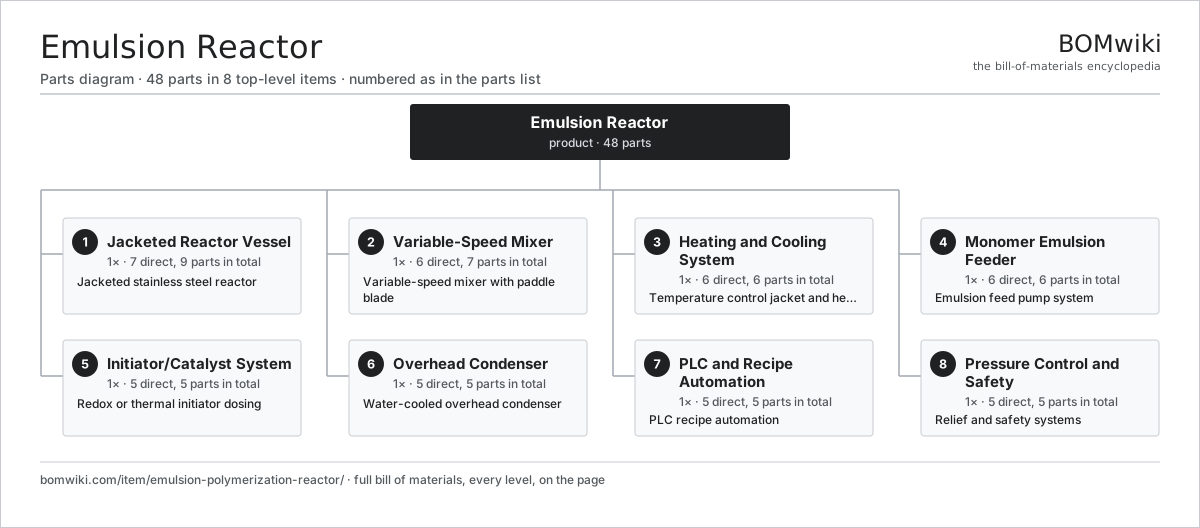
| # | Part | Qty | What it does |
|---|---|---|---|
| 1 | Jacketed Reactor Vessel 7 parts | 1× | Jacketed stainless steel reactor |
| 2 | Variable-Speed Mixer 6 parts | 1× | Variable-speed mixer with paddle blade |
| 3 | Heating and Cooling System 6 parts | 1× | Temperature control jacket and heater |
| 4 | Monomer Emulsion Feeder 6 parts | 1× | Emulsion feed pump system |
| 5 | Initiator/Catalyst System 5 parts | 1× | Redox or thermal initiator dosing |
| 6 | Overhead Condenser 5 parts | 1× | Water-cooled overhead condenser |
| 7 | PLC and Recipe Automation 5 parts | 1× | PLC recipe automation |
| 8 | Pressure Control and Safety 5 parts | 1× | Relief and safety systems |
3D model
No 3D model yet. Have a CAD file of this? Add a 3D model. STL renders right on this page; STEP, FreeCAD, and OpenSCAD sources are welcome too (openly licensed, like all 3D models on BOMwiki).
Build & assembly graph
expand / collapse · shared sub-assemblies converge · links to related products · est. labourTap an assembly to expand/collapse · tap a part to open it · use “Open page” for any node · drag to pan, scroll to zoom.
Bill of materials for Emulsion Reactor
8 top-level lines · 53 rows shown · 48 parts total · indented to 3 levels| # | Item / sub-assembly | Part no. | Qty/assy | Ext. qty | Parts | Type |
|---|---|---|---|---|---|---|
| 1 | Jacketed Reactor Vessel 7 parts | emulsion-polymerization-reactor-vessel | 1× | 1 | 9 | assembly |
| 1.1 | Main Reactor Cylinder | emulsion-polymerization-reactor-main-shell | 1× | 1 | · | part |
| 1.2 | Heat-Transfer Jacket | emulsion-polymerization-reactor-jacket | 1× | 1 | · | part |
| 1.3 | Reactor Top Lid | emulsion-polymerization-reactor-lid | 1× | 1 | · | part |
| 1.4 | Bottom Discharge Valve | emulsion-polymerization-reactor-bottom-outlet | 1× | 1 | · | part |
| 1.5 | RTD Thermowell | emulsion-polymerization-reactor-thermometer-pocket | 1× | 1 | · | part |
| 1.6 | Level Indicator | emulsion-polymerization-reactor-sight-glass | 1× | 1 | · | part |
| 1.7 | O-Ring Set | oring-set | 3× | 3 | · | part |
| 2 | Variable-Speed Mixer 6 parts | emulsion-polymerization-reactor-agitator | 1× | 1 | 7 | assembly |
| 2.1 | Main Drive Motor | emulsion-polymerization-reactor-motor | 1× | 1 | · | part |
| 2.2 | Variable-Frequency Drive | emulsion-polymerization-reactor-vfd | 1× | 1 | · | part |
| 2.3 | Speed-Reduction Gearbox | emulsion-polymerization-reactor-gearbox | 1× | 1 | · | part |
| 2.4 | Agitator Blade | emulsion-polymerization-reactor-agitator-blade | 1× | 1 | · | part |
| 2.5 | Ball Bearing | ball-bearing | 2× | 2 | · | part |
| 2.6 | Oil Seal | oil-seal | 1× | 1 | · | part |
| 3 | Heating and Cooling System 6 parts | emulsion-polymerization-reactor-heating | 1× | 1 | 6 | assembly |
| 3.1 | Electric Heater | emulsion-polymerization-reactor-heater-unit | 1× | 1 | · | part |
| 3.2 | Chiller Unit | emulsion-polymerization-reactor-cooler-unit | 1× | 1 | · | part |
| 3.3 | Jacket Pump | emulsion-polymerization-reactor-circulation-pump | 1× | 1 | · | part |
| 3.4 | Jacket Relief Valve | emulsion-polymerization-reactor-jacket-relief | 1× | 1 | · | part |
| 3.5 | Thermostat | emulsion-polymerization-reactor-temperature-controller | 1× | 1 | · | part |
| 3.6 | Temperature Display | emulsion-polymerization-reactor-thermometer-display | 1× | 1 | · | part |
| 4 | Monomer Emulsion Feeder 6 parts | emulsion-polymerization-reactor-monomer-feed | 1× | 1 | 6 | assembly |
| 4.1 | Monomer Feed Pump | emulsion-polymerization-reactor-monomer-pump | 1× | 1 | · | part |
| 4.2 | Pump Drive Motor | emulsion-polymerization-reactor-monomer-motor | 1× | 1 | · | part |
| 4.3 | Monomer Solenoid | emulsion-polymerization-reactor-monomer-solenoid | 1× | 1 | · | part |
| 4.4 | Feed Filter | emulsion-polymerization-reactor-monomer-filter | 1× | 1 | · | part |
| 4.5 | Monomer Flow Meter | emulsion-polymerization-reactor-monomer-rotameter | 1× | 1 | · | part |
| 4.6 | Monomer Check Valve | emulsion-polymerization-reactor-monomer-check-valve | 1× | 1 | · | part |
| 5 | Initiator/Catalyst System 5 parts | emulsion-polymerization-reactor-initiator-feed | 1× | 1 | 5 | assembly |
| 5.1 | Initiator Pump | emulsion-polymerization-reactor-initiator-pump | 1× | 1 | · | part |
| 5.2 | Initiator Motor | emulsion-polymerization-reactor-initiator-motor | 1× | 1 | · | part |
| 5.3 | Initiator Flow Meter | emulsion-polymerization-reactor-initiator-rotameter | 1× | 1 | · | part |
| 5.4 | Initiator Solenoid | emulsion-polymerization-reactor-initiator-solenoid | 1× | 1 | · | part |
| 5.5 | Initiator Feed Tank | emulsion-polymerization-reactor-initiator-tank | 1× | 1 | · | part |
| 6 | Overhead Condenser 5 parts | emulsion-polymerization-reactor-condenser | 1× | 1 | 5 | assembly |
| 6.1 | Water Condenser | emulsion-polymerization-reactor-condenser-coil | 1× | 1 | · | part |
| 6.2 | Vapor Column | emulsion-polymerization-reactor-distillation-column | 1× | 1 | · | part |
| 6.3 | Condenser Trap | emulsion-polymerization-reactor-receiver-bottle | 1× | 1 | · | part |
| 6.4 | Overhead Thermometer | emulsion-polymerization-reactor-condenser-thermometer | 1× | 1 | · | part |
| 6.5 | Condenser Check Valve | emulsion-polymerization-reactor-condenser-check-valve | 1× | 1 | · | part |
| 7 | PLC and Recipe Automation 5 parts | emulsion-polymerization-reactor-controls | 1× | 1 | 5 | assembly |
| 7.1 | Logic Controller | emulsion-polymerization-reactor-plc | 1× | 1 | · | part |
| 7.2 | Touchscreen HMI | emulsion-polymerization-reactor-hmi-panel | 1× | 1 | · | part |
| 7.3 | RTD Input Module | emulsion-polymerization-reactor-rtd-module | 1× | 1 | · | part |
| 7.4 | Analog Output Module | emulsion-polymerization-reactor-analog-output | 1× | 1 | · | part |
| 7.5 | Safety Relay | emulsion-polymerization-reactor-safety-relay | 1× | 1 | · | part |
| 8 | Pressure Control and Safety 5 parts | emulsion-polymerization-reactor-pressure-venting | 1× | 1 | 5 | assembly |
| 8.1 | Pressure Relief Valve | emulsion-polymerization-reactor-pressure-relief | 1× | 1 | · | part |
| 8.2 | Rupture Disc | emulsion-polymerization-reactor-rupture-disc | 1× | 1 | · | part |
| 8.3 | Vent Condenser | emulsion-polymerization-reactor-vent-condenser | 1× | 1 | · | part |
| 8.4 | Pressure Transducer | emulsion-polymerization-reactor-pressure-transducer | 1× | 1 | · | part |
| 8.5 | Runaway Cutoff Solenoid | emulsion-polymerization-reactor-thermal-runaway-cutoff | 1× | 1 | · | part |
Something wrong in this list? Report a problem with this BOM.
Related products
same domain, ranked by shared parts Continuous Galvanizing Line
1,296 parts · shares 3 with this page
Continuous Galvanizing Line
1,296 parts · shares 3 with this page
 Decanter Centrifuge
172 parts · shares 3 with this page
Decanter Centrifuge
172 parts · shares 3 with this page
Sourcing: possible vendors
Browse the supplier directory → Prices, MOQ, and lead times are algorithmic estimates, not quotes, and not claims about these companies. Company mappings are curated by keyword; est. price band $5k–$2M. How estimates work| Vendor | HQ | Specialty | MOQ | Lead time |
|---|---|---|---|---|
| atlascopco.com ↗ | Stockholm, SE | Compressors & industrial | 10 units | 12–20 wks |
|
🇦🇹Andritz
andritz.com ↗
|
Graz, AT | Process plants & machinery | 10 units | 12–20 wks |
| buhlergroup.com ↗ | Uzwil, CH | Food & materials processing | 10 units | 12–20 wks |
| gea.com ↗ | Düsseldorf, DE | Process technology | 10 units | 12–20 wks |
| mhi.com ↗ | Tokyo, JP | Heavy machinery | 10 units | 12–20 wks |
1,473-word article