Equine Surgery Table
ProductOverview
Equine surgery tables are motorized platforms designed to safely position 300–600 kg horses during prolonged surgical procedures ranging from orthopedic repair to abdominal exploration. Unlike portable veterinary examination tables, these surgical tables integrate hydraulic lifting, tilt capability, sophisticated positioning restraints, and full integration with overhead patient-handling gantry systems common in modern equine surgical suites.
The Equine Surgery Table operates via a Hydraulic Lift and Tilt System that propels the Surgical Surface and Mounting upward for optimal surgical ergonomics. Once lifted, the table can tilt anterior-posterior (Trendelenburg position aids abdominal drainage; reverse position suits neurological recovery). The Positioning and Restraint Accessories system of restraint straps and support blocks immobilizes the unconscious patient in any desired orientation without slippage. All motor-driven functions are controlled via an emergency-stop-equipped control pendant, and the table's Safety and Monitoring load cell continuously monitors patient weight, alarming if weight exceeds capacity.
Base Frame and Structural Design
The Base Frame and Wheelbase is a welded steel frame engineered for 500 kg vertical load distribution. The main Main I-Beam I-beam (3 m long) forms the spine of the table; two Side Bracing Beam tubes provide lateral cross-bracing, resisting torsional stress during asymmetric limb manipulation. The Lift Column (a telescoping Lift Cylinder) is bolted vertically in the center of the frame, driven by hydraulic pressure to raise and lower the surgical surface.
Four Wheel Assembly casters (500 kg capacity each) mounted on the base frame allow the entire 1.2-ton assembly to roll smoothly into the operating suite. Each caster features a foot-actuated brake lock, preventing unintended drift when the table is positioned. The total wheelbase is approximately 3 m long × 1.5 m wide, requiring adequate aisle space in facility layout.
Hydraulic Lift and Tilt Mechanism
The Hydraulic Lift and Tilt System comprises a 2 kW Blower Motor driving a swashplate Hydraulic Pump at 1400 rpm. At this speed, the pump delivers 28 liters/minute at 200 bar, sufficient to lift a 600 kg patient 0.8 m in approximately 15 seconds. The Lift Cylinder (80 mm bore, 300 mm stroke, double-acting) converts pump pressure into vertical motion via a piston rod extending upward into the table base.
Tilt is achieved via two smaller Tilt Cylinder mounted at the anterior and posterior ends of the table. These proportional-control cylinders (responsive to solenoid command) allow the Control Panel operator to dial ±15° Trendelenburg angle smoothly. The Pressure Relief Valve valve (200 bar cracking pressure) protects the system if an obstruction blocks cylinder travel or if the operator attempts to lift beyond maximum load.
All Hydraulic Hose Assembly connections use high-pressure SAE 100R13 fiber-braid tubing rated to 350 bar working pressure, with JIC 37° fittings ensuring no leakage under dynamic pressure cycling. Pressure Sensor transducers on the pump inlet and lift line feed back to the safety controller, which sounds an alarm if pressure exceeds 210 bar (overpressure) or drops below 50 bar (low pump output), indicating a fault.
Surgical Surface and Padding
The Surgical Surface and Mounting subframe is a precision-welded steel platform 2.5 m × 1.5 m, bolted rigidly to the lift cylinder piston rod. This ensures zero play during surgery; any deflection would compromise surgeon ergonomics and patient stability. The subframe top surface is covered by high-density Foam Surgical Pad (150 mm thick, 60 kg/m³ closed-cell polyethylene), providing impact absorption while remaining firm enough to support standing surgical teams.
The foam is sealed under seamless Surgical Surface Cover vinyl upholstery bonded along the seams and reinforced at corners with autoclavable reinforcement patches. This cover is fluid-resistant (withstanding spill of saline, iodine, blood, and anesthetic gases) and can be wiped clean with quaternary ammonium disinfectant between cases or autoclaved if contaminated. Color-coded covers (teal, yellow, blue) help identify tables in multi-table surgical suites and provide visual contrast during surgical photography.
Four Positioning Rail stainless steel T-slot rails (40 × 40 mm profile) run the length of the table surface, spaced 0.5 m apart. These rails allow surgeons to position accessory brackets, arm supports, light booms, and instrument trays anywhere along the table without drilling new holes.
Positioning and Restraint System
Once a horse is anesthetized and lifted onto the table, the Positioning and Restraint Accessories system immobilizes the patient in dorsal, lateral, or ventral recumbency as the procedure requires. Two Body Restraint Strap (10 cm padded nylon webbing) cross the chest and flank, fastened to lateral rails with quick-release buckles. These prevent rolling if the table tilts unexpectedly.
Four Limb Support Strap support the forelimbs and hind limbs, positioning them in extension or abduction depending on surgical access. Each strap terminates in a D-ring bolted to the table frame, allowing fine adjustment via carabiners. Foam Positioning Block (30 × 20 × 15 cm wedges) are positioned under the patient's neck, axillae, and hindquarters to maintain joint alignment and prevent pressure necrosis on bony prominences during long procedures (6+ hours).
A removable Head Support Cradle cradle (foam-lined) supports the horse's head and neck, preventing rotation that would kink the endotracheal tube. The head holder also protects the eye from accidental contact with surgical instruments or drapes.
Hoist Interface and Loading
A major feature is the integration with overhead Hoist Coupling System. Four Lifting Lug (welded steel lifting eyes, 5000 kg safe working load each) are mounted at the table's four corners. These lugs connect to a Quick Coupler hydraulic coupler (ISO 4401 flat-face design), which couples the table's hydraulic system to the overhead gantry hoist.
When a patient enters the surgical suite, the gantry hoist (a separate overhead system with slings) lifts the horse via its body sling and positioning straps. The hoist operator aligns the horse directly over the surgical table, descends the sling until the patient rests on the padded surface, and then disconnects the sling via a release latch. The Quick Coupler allows the table's hydraulic pump to independently power lift/tilt without the hoist. Safety Pin stainless steel locking pins secure the lugs against accidental uncoupling.
This loading procedure eliminates manual handlers lifting horses (injury risk) and allows precise, controlled patient positioning without injury to table padding or animal skin.
Electrical Control and Safety
The Electrical Power and Control control system operates at two voltage levels: 110–240 VAC mains power for the 2 kW pump Blower Motor, and 24 VDC for logic and solenoid control. A wall-mounted or pendant Control Panel provides up/down lift buttons (momentary contact), tilt buttons, and a rotary speed potentiometer allowing the surgeon to adjust lift speed (fast for initial patient placement, slow for fine height adjustment). A prominent red Emergency Stop Button mushroom button (40 mm diameter) de-energizes all solenoid valves and stops the pump motor instantly if an emergency occurs.
The Proportional Valve solenoid directives (lift and tilt) are controlled by the pendant operator, fed through shielded multi-conductor Wire Bundle cable running inside cable trays throughout the operating room. The 24 VDC Power Supply module powers the solenoid coils and sensor interfaces, isolated from mains AC noise by isolation transformers.
Safety is paramount: a Relay safety module implements dual-channel logic confirming that the emergency stop button remains latched and unsurpassed operator commands. If either condition fails, the solenoid outputs are de-energized, holding the table at its current position (hydraulic pilot check valves prevent unintended descent).
Load Monitoring and Overpressure Protection
A Load Cell (5000 kg capacity compression sensor, ±0.1% accuracy) is mounted under the table top on the lift cylinder rod. This sensor continuously measures patient weight. If the displayed weight exceeds the patient's pre-operative baseline by >10% (indicating patient slippage or sling entanglement), the control panel displays a visual alarm and audible tone.
Two Position Sensor linear potentiometric transducers (mounted on the lift and tilt cylinders) provide real-time feedback of table height and angle. This information is displayed on the control panel, and alarms trigger if the table height exceeds safe operating range (e.g., if the cylinder extends beyond its designed 300 mm stroke).
The Pressure Relief Valve valve protects the hydraulic circuit: if pressure exceeds 200 bar (indicating a blocked hose or closed valve), the relief cracks, venting excess flow back to the reservoir, preventing hose rupture or pump cavitation damage.
Clinical Use and Maintenance
Before each case, the surgical team performs a five-minute checkout: visual inspection of hydraulic hoses for leaks or cracks, confirmation that all positioning straps are clean and functioning, test-cycle of the lift and tilt motors through full range, and verification that emergency stop works by pressing the button (motor should stop instantly). Hydraulic fluid level is checked weekly via the transparent sight-glass on the reservoir; recommended fluid is ISO VG 46 anti-wear hydraulic oil, changed annually or when fluid analysis indicates contamination.
The foam surgical pad naturally compresses over 3–5 years of use and should be replaced to maintain optimal shock absorption. The vinyl cover should be replaced if tears exceed 5 cm or if disinfection cannot remove staining. Hoist lugs are visually inspected annually for weld cracks. Load cell calibration is verified semi-annually using a certified weight test (500 kg and 1000 kg test blocks placed on the table).
A fully operational equine surgery table enables safe, ergonomic access to the patient and integration with modern intra-operative imaging (ultrasound, fluoroscopy) mounted on the table rails, contributing significantly to surgical outcomes and surgeon safety in large animal veterinary orthopedic and exploratory procedures.
Equine Surgery Table parts and their functions
7 top-level parts · 98 parts in total · full bill of materials below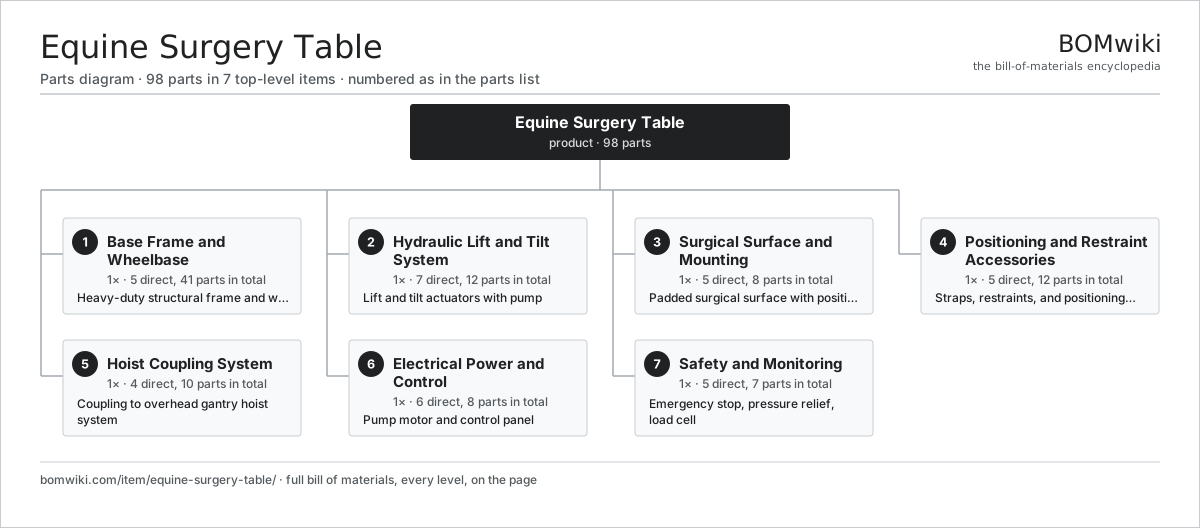
| # | Part | Qty | What it does |
|---|---|---|---|
| 1 | Base Frame and Wheelbase 5 parts | 1× | Heavy-duty structural frame and wheelbase |
| 2 | Hydraulic Lift and Tilt System 7 parts | 1× | Lift and tilt actuators with pump |
| 3 | Surgical Surface and Mounting 5 parts | 1× | Padded surgical surface with positioning rails |
| 4 | Positioning and Restraint Accessories 5 parts | 1× | Straps, restraints, and positioning blocks |
| 5 | Hoist Coupling System 4 parts | 1× | Coupling to overhead gantry hoist system |
| 6 | Electrical Power and Control 6 parts | 1× | Pump motor and control panel |
| 7 | Safety and Monitoring 5 parts | 1× | Emergency stop, pressure relief, load cell |
3D model
No 3D model yet. Have a CAD file of this? Add a 3D model. STL renders right on this page; STEP, FreeCAD, and OpenSCAD sources are welcome too (openly licensed, like all 3D models on BOMwiki).
Build & assembly graph
expand / collapse · shared sub-assemblies converge · links to related products · est. labourTap an assembly to expand/collapse · tap a part to open it · use “Open page” for any node · drag to pan, scroll to zoom.
Bill of materials for Equine Surgery Table
7 top-level lines · 49 rows shown · 98 parts total · indented to 3 levels| # | Item / sub-assembly | Part no. | Qty/assy | Ext. qty | Parts | Type |
|---|---|---|---|---|---|---|
| 1 | Base Frame and Wheelbase 5 parts | equine-surgery-table-base | 1× | 1 | 41 | assembly |
| 1.1 | Main I-Beam | equine-surgery-table-base-mainbeam | 1× | 1 | · | part |
| 1.2 | Side Bracing Beam | equine-surgery-table-base-sidebeam | 2× | 2 | · | part |
| 1.3 | Lift Column | equine-surgery-table-base-column | 1× | 1 | · | part |
| 1.4 | Wheel Assembly 5 parts | wheel-assembly | 4× | 4 | 9 | assembly |
| 1.4.1 | Alloy Wheel | alloy-wheel | 1× | 4 | · | part |
| 1.4.2 | Tire | tire | 1× | 4 | · | part |
| 1.4.3 | TPMS Sensor | tpms-sensor | 1× | 4 | · | part |
| 1.4.4 | Lug Nut | lug-nut | 5× | 20 | · | part |
| 1.4.5 | Valve Stem | valve-stem | 1× | 4 | · | part |
| 1.5 | Fastener Set | fastener-set | 1× | 1 | · | part |
| 2 | Hydraulic Lift and Tilt System 7 parts | equine-surgery-table-hydraulic-system | 1× | 1 | 12 | assembly |
| 2.1 | Blower Motor | blower-motor | 1× | 1 | · | part |
| 2.2 | Hydraulic Pump | equine-surgery-table-hydraulic-pump | 1× | 1 | · | part |
| 2.3 | Lift Cylinder | equine-surgery-table-lift-cylinder | 1× | 1 | · | part |
| 2.4 | Tilt Cylinder | equine-surgery-table-tilt-cylinder | 2× | 2 | · | part |
| 2.5 | Pressure Relief Valve | equine-surgery-table-pressure-relief | 1× | 1 | · | part |
| 2.6 | Hydraulic Hose Assembly | equine-surgery-table-hydraulic-hose | 4× | 4 | · | part |
| 2.7 | Pressure Sensor | pressure-sensor | 2× | 2 | · | part |
| 3 | Surgical Surface and Mounting 5 parts | equine-surgery-table-top | 1× | 1 | 8 | assembly |
| 3.1 | Top Subframe | equine-surgery-table-top-subframe | 1× | 1 | · | part |
| 3.2 | Foam Surgical Pad | equine-surgery-table-top-foam | 1× | 1 | · | part |
| 3.3 | Surgical Surface Cover | equine-surgery-table-top-cover | 1× | 1 | · | part |
| 3.4 | Positioning Rail | equine-surgery-table-rail | 4× | 4 | · | part |
| 3.5 | Fastener Set | fastener-set | 1× | 1 | · | part |
| 4 | Positioning and Restraint Accessories 5 parts | equine-surgery-table-positioning | 1× | 1 | 12 | assembly |
| 4.1 | Body Restraint Strap | equine-surgery-table-body-strap | 2× | 2 | · | part |
| 4.2 | Limb Support Strap | equine-surgery-table-limb-strap | 4× | 4 | · | part |
| 4.3 | Positioning Block | equine-surgery-table-positioning-block | 4× | 4 | · | part |
| 4.4 | Head Support Cradle | equine-surgery-table-head-holder | 1× | 1 | · | part |
| 4.5 | Fastener Set | fastener-set | 1× | 1 | · | part |
| 5 | Hoist Coupling System 4 parts | equine-surgery-table-hoist-interface | 1× | 1 | 10 | assembly |
| 5.1 | Lifting Lug | equine-surgery-table-hoist-lug | 4× | 4 | · | part |
| 5.2 | Quick Coupler | equine-surgery-table-quick-disconnect | 1× | 1 | · | part |
| 5.3 | Safety Pin | equine-surgery-table-safety-pin | 4× | 4 | · | part |
| 5.4 | Fastener Set | fastener-set | 1× | 1 | · | part |
| 6 | Electrical Power and Control 6 parts | equine-surgery-table-electrical | 1× | 1 | 8 | assembly |
| 6.1 | Blower Motor | blower-motor | 1× | 1 | · | part |
| 6.2 | Control Panel | equine-surgery-table-control-panel | 1× | 1 | · | part |
| 6.3 | Proportional Valve | equine-surgery-table-proportional-valve | 2× | 2 | · | part |
| 6.4 | Relay | relay | 2× | 2 | · | part |
| 6.5 | Power Supply | power-supply | 1× | 1 | · | part |
| 6.6 | Wire Bundle | wire-bundle | 1× | 1 | · | part |
| 7 | Safety and Monitoring 5 parts | equine-surgery-table-safety | 1× | 1 | 7 | assembly |
| 7.1 | Load Cell | equine-surgery-table-load-cell | 1× | 1 | · | part |
| 7.2 | Emergency Stop Button | equine-surgery-table-emergency-stop | 1× | 1 | · | part |
| 7.3 | Pressure Sensor | pressure-sensor | 2× | 2 | · | part |
| 7.4 | Position Sensor | equine-surgery-table-position-sensor | 2× | 2 | · | part |
| 7.5 | Bare PCB | pcb-bare | 1× | 1 | · | part |
Something wrong in this list? Report a problem with this BOM.
Related products
same domain, ranked by shared parts Large Animal Anesthesia Machine
75 parts · shares 8 with this page
Veterinary ICU Cage
293 parts · shares 5 with this page
Large Animal Anesthesia Machine
75 parts · shares 8 with this page
Veterinary ICU Cage
293 parts · shares 5 with this page
 Dental Oil-Free Compressor
208 parts · shares 4 with this page
Dental Oil-Free Compressor
208 parts · shares 4 with this page
 Dental X-Ray Unit
113 parts · shares 3 with this page
Dental Autoclave (Class B)
305 parts · shares 3 with this page
Dental X-Ray Unit
113 parts · shares 3 with this page
Dental Autoclave (Class B)
305 parts · shares 3 with this page
Sourcing: possible vendors
Browse the supplier directory → Prices, MOQ, and lead times are algorithmic estimates, not quotes, and not claims about these companies. Company mappings are curated by keyword; est. price band $200–$200k. How estimates work| Vendor | HQ | Specialty | MOQ | Lead time |
|---|---|---|---|---|
| dentsplysirona.com ↗ | Charlotte, US | Dental equipment | 100 units | 10–16 wks |
|
🇺🇸Envista
envistaco.com ↗
|
Brea, US | Dental (KaVo, Nobel) | 100 units | 10–16 wks |
|
🇫🇮Planmeca
planmeca.com ↗
|
Helsinki, FI | Dental units & imaging | 100 units | 10–16 wks |
|
🇺🇸A-dec
a-dec.com ↗
|
Newberg, US | Dental chairs & delivery | 100 units | 10–16 wks |
|
🇺🇸Midmark
midmark.com ↗
|
Versailles, US | Medical & veterinary equipment | 100 units | 10–16 wks |
1,673-word article