EV Load Management Controller
ProductOverview
An EV load controller dynamically adjusts the power drawn by an electric vehicle charger in response to real-time grid conditions, renewable energy availability, or time-of-use pricing. Unlike a standard charger that draws maximum available current from the moment you plug in, a load controller reduces charging speed during peak grid demand or when local solar production is low, then accelerates charging during off-peak hours or when solar is abundant.
This intelligent modulation achieves three goals: it reduces stress on residential electrical service (avoiding the need for expensive utility panel upgrades), maximizes utilization of rooftop solar generation, and allows EV owners to shift charging to cheaper time-of-use periods, typically saving $200–$500/year.
Architecture
Current Sensing and Feedback
The Current Sensing Module module clamps around the charger's input line with a split-core Split-Core Current Transformer, a flexible current transformer that avoids disconnecting the circuit. The CT secondary winding feeds a Transimpedance Amplifier IC, a precision transimpedance amplifier that converts current to voltage with sub-millisecond response. This allows the controller to detect charger current draw and confirm that the power adjustment command actually took effect.
Grid and Tariff Signals
The Panel Backplate Interface module sits downstream of the utility meter, optionally tapping the meter's output pulse or measuring grid voltage via a Meter Voltage Tap. Many modern utilities broadcast grid frequency as a demand signal: when frequency drops below 50 Hz (in Europe) or 60 Hz (in North America), the grid is stressed, and a load controller should reduce consumption. The Grid Frequency Detector continuously measures grid frequency with ±0.01 Hz precision, enabling sub-second response.
Control Output
The Charger Control Output generates the actual control signal. Most Level 2 chargers conform to SAE J1772, which uses a 0–10 V or PWM pilot signal on a dedicated pin to tell the charger how much current to draw. The PWM Output Stage generates this signal, modulating duty cycle from 10% (6 A minimum) to 90% (48 A typical), with 100 ms response time. Newer chargers support CAN bus (ISO 11898-2), in which case the CAN Interface IC issues SAE J1939 commands like "charge at 20 A" directly.
Scheduling and Optimization
The Control Logic Processor, a real-time ARM microcontroller, runs the optimization algorithm. It compares three signals:
- Grid frequency: If frequency is below nominal, reduce charger current by 20%.
- Solar forecast and current generation: If rooftop solar is producing > 5 kW and the battery is below 90%, accelerate charger to 32 A.
- Time-of-use tariff: Between midnight and 6 AM (off-peak), charge at full power. Between 4 PM and 9 PM (peak), reduce to 16 A.
The processor weighs these signals using a weighted priority algorithm, computing an optimal current setpoint every 100 ms. The Wireless Communications module receives tariff updates and solar forecasts from the cloud every 15 minutes, and the Real-Time Clock Module (real-time clock) tracks time-of-use periods even if Wi-Fi is down.
Power Supply and Holdup
The Power Supply Module is an isolated 12 VDC converter, accepting either 120/240 VAC service panel power or 24 VDC from a solar inverter. A Energy Storage Capacitor bank (two 3.3 V, 100 F supercapacitors in series) provides 30-second hold-up during AC dropout, ensuring that the PWM pilot signal remains continuous even during brief grid interruptions, critical for charger safety.
Installation and Integration
An EV load controller is installed on a 35 mm DIN rail in the main panel or in a sub-panel next to the charger breaker. It requires three connections:
- Current input: The split-core CT clamps around one leg of the charger's 2-pole breaker.
- Pilot output: A shielded wire runs from the controller to the charger's J1772 pilot pin (or CAN/RS-485 for networked chargers).
- Power input: 120 V or 240 V from an adjacent circuit breaker, or 24 V auxiliary from the solar inverter.
Wireless configuration is via smartphone app: the controller broadcasts its own Wi-Fi SSID during first power-up, the homeowner provides their home Wi-Fi credentials, and the app downloads the tariff schedule and solar forecast API keys. Most installers complete the setup in under 30 minutes.
Energy and Economic Impact
A typical installation delivers:
- Load balancing: Prevents tripping the main panel breaker by limiting charger to 30 A instead of the typical 48 A, deferring a $3,000 panel upgrade.
- Solar maximization: If a home has a 8 kW solar array, the controller delays charging until midday (peak solar output), using 50–70% of the charge energy from self-generation.
- Time-of-use savings: If the utility charges $0.18/kWh peak and $0.08/kWh off-peak, shifting a 40 kWh weekly charge to off-peak saves $2/week or ~$100/year.
Over a 15-year EV lifespan and assuming two batteries, total savings are $1,500–$3,000, with a hardware and installation cost of $500–$1,200. Payback is 2–4 years, and many utilities offer $300–$500 rebates.
Standards and Interoperability
EV load controllers must comply with:
- SAE J1772: Standard pilot signal protocol for Level 1 and Level 2 charging.
- ISO 11898-2: CAN bus physical layer for networked chargers.
- IEEE 1815 DNP3: Optional grid signal interpretation (some utilities broadcast demand via DNP3).
- IEC 61851-1: General safety and interoperability of EV charging systems.
- UL 2089: Energy management device safety.
The controller must also respect charger firmware limits; for example, if a charger is firmware-locked to never exceed 30 A, the controller respects this and never commands higher current regardless of available capacity.
Grid Stability and Demand Response
When thousands of EV load controllers are deployed across a utility service territory, their aggregate effect becomes significant. As frequency drops (indicating grid stress), all controllers simultaneously reduce charger current, instantly reducing EV charging load by 10–30%. This provides inertia similar to physical spinning reserve, stabilizing the grid without requiring new peaking plants.
Many grid operators are developing "vehicle-to-grid" (V2G) platforms where EVs with bidirectional chargers don't just modulate charging, they discharge energy back to the grid during peak demand. A load controller forms the foundation for this future capability.
EV Load Management Controller parts and their functions
8 top-level parts · 36 parts in total · full bill of materials below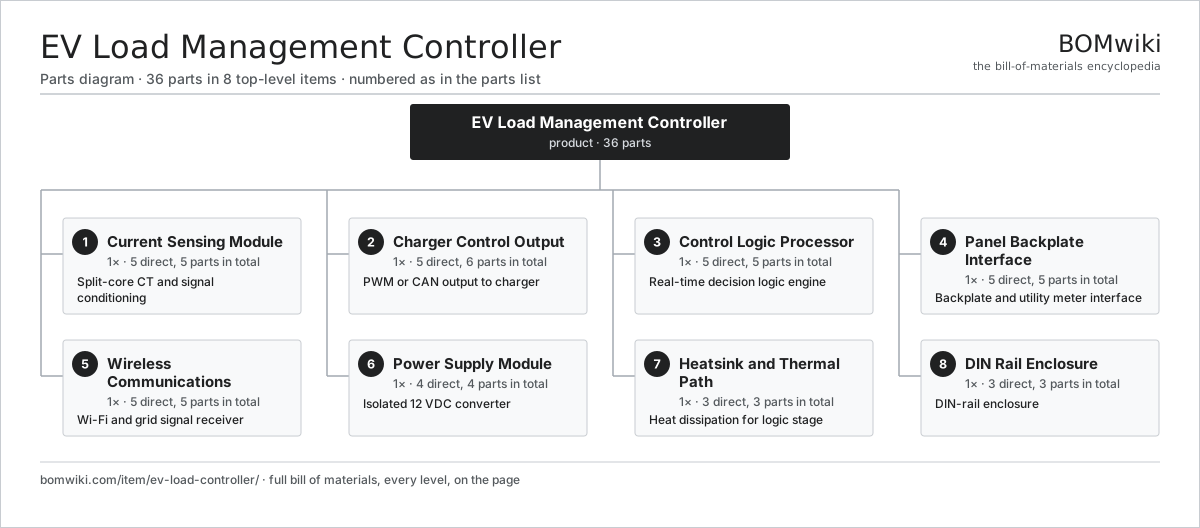
| # | Part | Qty | What it does |
|---|---|---|---|
| 1 | Current Sensing Module 5 parts | 1× | Split-core CT and signal conditioning |
| 2 | Charger Control Output 5 parts | 1× | PWM or CAN output to charger |
| 3 | Control Logic Processor 5 parts | 1× | Real-time decision logic engine |
| 4 | Panel Backplate Interface 5 parts | 1× | Backplate and utility meter interface |
| 5 | Wireless Communications 5 parts | 1× | Wi-Fi and grid signal receiver |
| 6 | Power Supply Module 4 parts | 1× | Isolated 12 VDC converter |
| 7 | Heatsink and Thermal Path 3 parts | 1× | Heat dissipation for logic stage |
| 8 | DIN Rail Enclosure 3 parts | 1× | DIN-rail enclosure |
3D model
No 3D model yet. Have a CAD file of this? Add a 3D model. STL renders right on this page; STEP, FreeCAD, and OpenSCAD sources are welcome too (openly licensed, like all 3D models on BOMwiki).
Build & assembly graph
expand / collapse · shared sub-assemblies converge · links to related products · est. labourTap an assembly to expand/collapse · tap a part to open it · use “Open page” for any node · drag to pan, scroll to zoom.
Bill of materials for EV Load Management Controller
8 top-level lines · 43 rows shown · 36 parts total · indented to 3 levels| # | Item / sub-assembly | Part no. | Qty/assy | Ext. qty | Parts | Type |
|---|---|---|---|---|---|---|
| 1 | Current Sensing Module 5 parts | ev-load-controller-current-sense | 1× | 1 | 5 | assembly |
| 1.1 | Split-Core Current Transformer | ev-load-controller-ct-clamp | 1× | 1 | · | part |
| 1.2 | Bare PCB | pcb-bare | 1× | 1 | · | part |
| 1.3 | SMD Passive (R/C/L) | smd-passives | 1× | 1 | · | part |
| 1.4 | Transimpedance Amplifier IC | ev-load-controller-amplifier | 1× | 1 | · | part |
| 1.5 | Connector | connector | 1× | 1 | · | part |
| 2 | Charger Control Output 5 parts | ev-load-controller-charger-interface | 1× | 1 | 6 | assembly |
| 2.1 | PWM Output Stage | ev-load-controller-pwm-driver | 1× | 1 | · | part |
| 2.2 | CAN Interface IC | ev-load-controller-can-transceiver | 1× | 1 | · | part |
| 2.3 | Bare PCB | pcb-bare | 1× | 1 | · | part |
| 2.4 | SMD Passive (R/C/L) | smd-passives | 1× | 1 | · | part |
| 2.5 | Connector | connector | 2× | 2 | · | part |
| 3 | Control Logic Processor 5 parts | ev-load-controller-processor | 1× | 1 | 5 | assembly |
| 3.1 | Microcontroller | mcu | 1× | 1 | · | part |
| 3.2 | Real-Time Clock Module | ev-load-controller-rtc | 1× | 1 | · | part |
| 3.3 | Bare PCB | pcb-bare | 1× | 1 | · | part |
| 3.4 | SMD Passive (R/C/L) | smd-passives | 1× | 1 | · | part |
| 3.5 | Li-ion Cell, 18650 | li-cell-18650 | 1× | 1 | · | part |
| 4 | Panel Backplate Interface 5 parts | ev-load-controller-panel-integration | 1× | 1 | 5 | assembly |
| 4.1 | Meter Voltage Tap | ev-load-controller-voltage-divider | 1× | 1 | · | part |
| 4.2 | Grid Frequency Detector | ev-load-controller-zero-cross-detector | 1× | 1 | · | part |
| 4.3 | Bare PCB | pcb-bare | 1× | 1 | · | part |
| 4.4 | SMD Passive (R/C/L) | smd-passives | 1× | 1 | · | part |
| 4.5 | Fastener Set | fastener-set | 1× | 1 | · | part |
| 5 | Wireless Communications 5 parts | ev-load-controller-wireless | 1× | 1 | 5 | assembly |
| 5.1 | Wi-Fi 2.4 GHz Radio | ev-load-controller-wifi-module | 1× | 1 | · | part |
| 5.2 | LTE Cat-M1 Modem | ev-load-controller-cellular-option | 1× | 1 | · | part |
| 5.3 | Bare PCB | pcb-bare | 1× | 1 | · | part |
| 5.4 | SMD Passive (R/C/L) | smd-passives | 1× | 1 | · | part |
| 5.5 | Connector | connector | 1× | 1 | · | part |
| 6 | Power Supply Module 4 parts | ev-load-controller-power-supply | 1× | 1 | 4 | assembly |
| 6.1 | Power Supply | power-supply | 1× | 1 | · | part |
| 6.2 | Energy Storage Capacitor | ev-load-controller-supercap | 1× | 1 | · | part |
| 6.3 | SMD Passive (R/C/L) | smd-passives | 1× | 1 | · | part |
| 6.4 | Connector | connector | 1× | 1 | · | part |
| 7 | Heatsink and Thermal Path 3 parts | ev-load-controller-thermal-sink | 1× | 1 | 3 | assembly |
| 7.1 | Extruded Heatsink | ev-load-controller-heatsink | 1× | 1 | · | part |
| 7.2 | Thermal Interface Material | ev-load-controller-thermal-compound | 1× | 1 | · | part |
| 7.3 | Fastener Set | fastener-set | 1× | 1 | · | part |
| 8 | DIN Rail Enclosure 3 parts | ev-load-controller-housing | 1× | 1 | 3 | assembly |
| 8.1 | Plastic Module Housing | ev-load-controller-case | 1× | 1 | · | part |
| 8.2 | DIN Rail Fastener | ev-load-controller-din-clip | 1× | 1 | · | part |
| 8.3 | Fastener Set | fastener-set | 1× | 1 | · | part |
Something wrong in this list? Report a problem with this BOM.
Related products
same domain, ranked by shared parts Demand Response Controller
73 parts · shares 2 with this page
Active Harmonic Filter
81 parts · shares 1 with this page
Demand Response Controller
73 parts · shares 2 with this page
Active Harmonic Filter
81 parts · shares 1 with this page
 Air-Insulated Substation Bay
1,329 parts · shares 1 with this page
Bottom Ash Handling System
1,782 parts · shares 1 with this page
Air-Insulated Substation Bay
1,329 parts · shares 1 with this page
Bottom Ash Handling System
1,782 parts · shares 1 with this page
 Circuit-Level Energy Monitor
57 parts · shares 1 with this page
Circuit-Level Energy Monitor
57 parts · shares 1 with this page
 Coal Pulverizer Mill
313 parts · shares 1 with this page
Coal Pulverizer Mill
313 parts · shares 1 with this page
Sourcing: possible vendors
Browse the supplier directory → Prices, MOQ, and lead times are algorithmic estimates, not quotes, and not claims about these companies. Company mappings are curated by keyword; est. price band $5k–$50M. How estimates work| Vendor | HQ | Specialty | MOQ | Lead time |
|---|---|---|---|---|
| gevernova.com ↗ | Cambridge, US | Power generation | made to order | 20–40 wks |
| siemens-energy.com ↗ | Munich, DE | Power & grid | made to order | 20–40 wks |
| hitachienergy.com ↗ | Zurich, CH | Grid & transformers | made to order | 20–40 wks |
|
🇨🇭ABB
abb.com ↗
|
Zurich, CH | Electrification & automation | made to order | 20–40 wks |
| se.com ↗ | Rueil-Malmaison, FR | Electrical & automation | made to order | 20–40 wks |
1,072-word article