Exercise Book Machine
ProductOverview
Exercise book machines produce ruled notebooks and notepads by continuously feeding paper rolls through multiple processing stages: ruling (printing lines and margins), folding (creasing and folding into signatures), stitching (saddle-stitching folded signatures), trimming (cutting edges to final size), cover insertion (wrapping pre-printed covers), and stacking (collating finished books). These machines combine printing, mechanical folding, pneumatic stitching, and precision trimming to deliver finished books at rates of 60–150 units per minute with consistent ruling alignment, fold quality, and trim accuracy.
How It Works
Paper Feed and Tension Control
The Paper Reel Feed System system feeds continuous paper rolls. A Unwind Spindle Motor motor with torque brake unwinds the paper at synchronized speed. A Paper Tension Dancer Arm weighted dancer lever maintains constant paper tension (±10%), accommodating variations in web drag as the roll diameter decreases. Precision Paper Guide Roller units (±0.1 mm runout) center the paper web, preventing side-drift. An Encoder senses paper speed and provides feedback to the master PLC for synchronization across all downstream operations.
Ruling and Line Printing
The Ruling and Printing Unit unit is typically a flexographic or rotogravure press that applies evenly-spaced ruled lines and margin markings to the continuous paper web. An Ink Pump circulates ink onto an Engraved Rule Roller (precision-engraved with 5 mm or 7 mm line pitch). As the paper web passes over an Impression Drum (elastomeric, 1–2 mm deflection), the lines are impressed onto the paper surface with consistent registration. An Encoder monitors registration and triggers solenoid adjustments if line alignment drifts more than ±0.5 mm.
Folding and Crease Setting
The Folding Unit unit creates signature sheets by folding the continuous ruled paper at regular intervals. A Fold Guide Blade (knife-edge or V-shaped block) directs the paper web to a center-fold position with ±1 mm tolerance. A Heated Crease Roller (heated to 60–80 °C) presses the fold line, creating a sharp crease and improving fold consistency. Folded signatures exit the folder and are conveyed via low-friction Fold Transport Roller units to the stitching station.
Fold frequency determines signature size (number of pages per fold). For a 32-page signature, the paper is folded twice; for 16-page, once.
Saddle Stitching
At the Wire Stitching Unit station, folded signatures are collected and aligned on a Saddle Stitcher Table (rotating or reciprocating saddle table). Once the correct number of signatures (determined by target book page count) are stacked and aligned, a Signature Clamping Block pneumatic block compresses them tightly. A Stitching Head and Anvil (pneumatic punch) drives Wire Feed and Cutter staples or wire through the center fold at 1–5 bar force. The Pressure Sensor monitors punch pressure; under-driven stitches cause loose binding, while over-driven stitches may tear the paper fold.
Trimming
The Edge Trimming Station station removes folded edges and rough margins. A Trimmer Spindle (500–2000 rpm) rotates hardened-steel Trimming Blade Set that trim the head (top), fore-edge (open side), and tail (bottom) of stitched books to finished dimensions (±1 mm tolerance). A Trimmer Fence and Stop precision fence controls trim height; a Chip Vacuum evacuates paper dust and chips. An Encoder monitors blade wear; dull blades produce rough edges and must be replaced every 100,000–500,000 books.
Cover Insertion and Wrapping
Pre-printed covers are fed via a Cover Stock Magazine (stack or roll of cardstock). A Cover Pick-and-Place Arm vacuum or mechanical arm positions one cover per cycle onto the stitched and trimmed book block. A Adhesive Applicator applies hot-melt or water-based adhesive along the spine. Precision Wrap Pressure Roller units press the cover around the book block, wrapping and sealing it with uniform pressure. For saddle-stitched books, the cover often wraps around the entire spine (called "self-cover" style) or is glued along the spine margin (called "tip-in").
Collection and Stacking
Finished books are discharged onto a Collection Conveyor conveyor moving at 30–100 books/minute. A Pneumatic or Servo Stacking Arm (pneumatic or servo-driven) retrieves books and stacks them vertically onto a Stacking Platform or Pallet (motorized or gravity-fed pallet). The platform rises as the stack grows, allowing the arm to maintain consistent gripper height. An Encoder counts books and signals the platform to lower or rotate when the target stack height (typically 100–500 books) is reached.
Master Synchronization
The Control and Synchronization PLC is the master synchronizer. An Microcontroller with multiple VFD outputs controls:
- Unwind motor speed (via Encoder feedback from paper tension)
- Print unit registration and speed (via Encoder from rule roller)
- Fold guide position and crease-roller dwell (via position feedback)
- Stitch head timing and punch frequency (via signature count and cycle timer)
- Trimmer blade spindle activation and indexing
- Cover feeder and wrap-roller speed
- Stacker arm motion and pallet positioning
All operations are chained with mechanical or electronic interlocks; if the stitcher is busy, the folder feed is paused to prevent signature backup.
Engineering Considerations
Paper Web Tension Stability: Under-tension causes registration drift and fold misalignment; over-tension stretches the web and distorts ruling lines. The dancer arm must respond within 1–2 seconds to load changes.
Fold Consistency: Paper moisture content affects creasing behavior. Low-moisture paper (5–8%) creases sharply but is brittle; high-moisture paper (>12%) is soft but creases poorly. Paper conditioning (24-hour equilibration in controlled humidity) before running is often required.
Stitching Force: Over-aggressive punch force tears the fold; under-force leaves loose stitches. Punch force must be calibrated per paper weight (70 gsm vs. 100 gsm).
Trimming Blade Wear: Continuous blade contact with paper and ink dulls the edge. Dull blades produce rough, feathered edges instead of clean cuts. Blade replacement intervals (every 100,000–500,000 books) must be strictly observed.
Registration and Sync: All stations must be precisely synchronized. A 1-second drift in fold position can cause stitches to miss the fold or drift to the side, requiring manual line-up correction.
Production Metrics
A typical 4-signature (16-page) A5 exercise book at 100 books/minute yields 6000 books/hour. Each book requires 4 folding operations, 4 stitches, and 3 trimming cuts (head, fore-edge, tail). Power consumption is 15–25 kW, with the print unit (inking system and roller pressure) accounting for 40% of demand. Paper waste (trim scrap, registration pulls, fold rejects) typically runs 2–5% of input.
Exercise Book Machine parts and their functions
8 top-level parts · 53 parts in total · full bill of materials below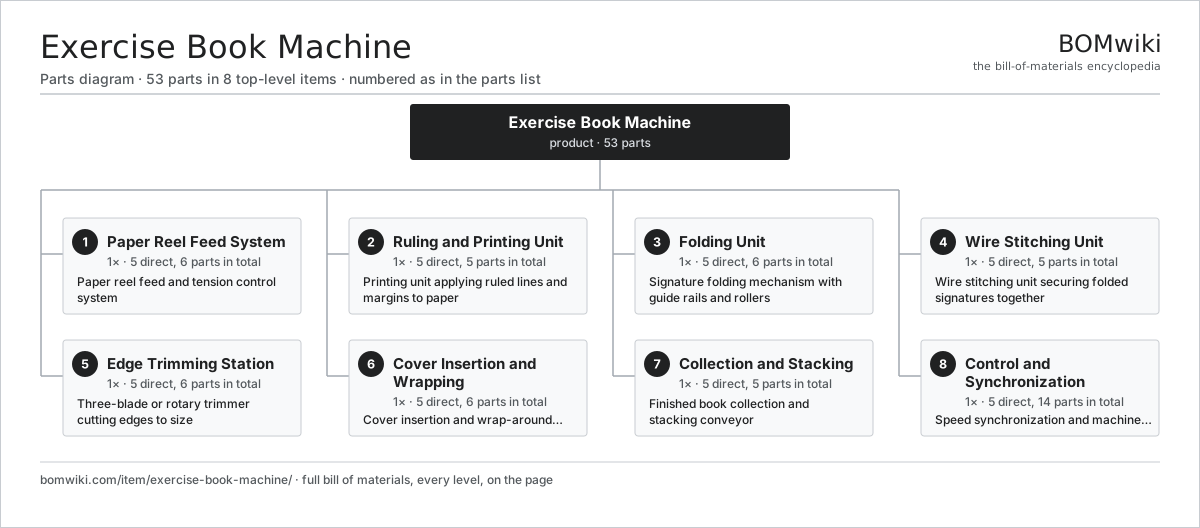
| # | Part | Qty | What it does |
|---|---|---|---|
| 1 | Paper Reel Feed System 5 parts | 1× | Paper reel feed and tension control system |
| 2 | Ruling and Printing Unit 5 parts | 1× | Printing unit applying ruled lines and margins to paper |
| 3 | Folding Unit 5 parts | 1× | Signature folding mechanism with guide rails and rollers |
| 4 | Wire Stitching Unit 5 parts | 1× | Wire stitching unit securing folded signatures together |
| 5 | Edge Trimming Station 5 parts | 1× | Three-blade or rotary trimmer cutting edges to size |
| 6 | Cover Insertion and Wrapping 5 parts | 1× | Cover insertion and wrap-around mechanism |
| 7 | Collection and Stacking 5 parts | 1× | Finished book collection and stacking conveyor |
| 8 | Control and Synchronization 5 parts | 1× | Speed synchronization and machine sequencing |
3D model
No 3D model yet. Have a CAD file of this? Add a 3D model. STL renders right on this page; STEP, FreeCAD, and OpenSCAD sources are welcome too (openly licensed, like all 3D models on BOMwiki).
Build & assembly graph
expand / collapse · shared sub-assemblies converge · links to related products · est. labourTap an assembly to expand/collapse · tap a part to open it · use “Open page” for any node · drag to pan, scroll to zoom.
Bill of materials for Exercise Book Machine
8 top-level lines · 48 rows shown · 53 parts total · indented to 3 levels| # | Item / sub-assembly | Part no. | Qty/assy | Ext. qty | Parts | Type |
|---|---|---|---|---|---|---|
| 1 | Paper Reel Feed System 5 parts | exercise-book-machine-reel | 1× | 1 | 6 | assembly |
| 1.1 | Unwind Spindle Motor | exercise-book-machine-reel-spindle | 1× | 1 | · | part |
| 1.2 | Paper Tension Dancer Arm | exercise-book-machine-tension-arm | 1× | 1 | · | part |
| 1.3 | Paper Guide Roller | exercise-book-machine-guide-roller | 2× | 2 | · | part |
| 1.4 | Encoder | encoder | 1× | 1 | · | part |
| 1.5 | Pressure Sensor | pressure-sensor | 1× | 1 | · | part |
| 2 | Ruling and Printing Unit 5 parts | exercise-book-machine-ruling | 1× | 1 | 5 | assembly |
| 2.1 | Flexographic or Offset Print Unit | exercise-book-machine-print-head | 1× | 1 | · | part |
| 2.2 | Engraved Rule Roller | exercise-book-machine-rule-roller | 1× | 1 | · | part |
| 2.3 | Impression Drum | exercise-book-machine-impression-drum | 1× | 1 | · | part |
| 2.4 | Ink Pump | exercise-book-machine-ink-pump | 1× | 1 | · | part |
| 2.5 | Encoder | encoder | 1× | 1 | · | part |
| 3 | Folding Unit 5 parts | exercise-book-machine-folder | 1× | 1 | 6 | assembly |
| 3.1 | Heated Crease Roller | exercise-book-machine-crease-roller | 1× | 1 | · | part |
| 3.2 | Fold Guide Blade | exercise-book-machine-fold-guide | 1× | 1 | · | part |
| 3.3 | Fold Transport Roller | exercise-book-machine-folder-roller | 2× | 2 | · | part |
| 3.4 | Encoder | encoder | 1× | 1 | · | part |
| 3.5 | Heating Element | heating-element | 1× | 1 | · | part |
| 4 | Wire Stitching Unit 5 parts | exercise-book-machine-stitch | 1× | 1 | 5 | assembly |
| 4.1 | Saddle Stitcher Table | exercise-book-machine-signature-table | 1× | 1 | · | part |
| 4.2 | Stitching Head and Anvil | exercise-book-machine-stitch-head | 1× | 1 | · | part |
| 4.3 | Wire Feed and Cutter | exercise-book-machine-wire-feed | 1× | 1 | · | part |
| 4.4 | Signature Clamping Block | exercise-book-machine-clamp | 1× | 1 | · | part |
| 4.5 | Pressure Sensor | pressure-sensor | 1× | 1 | · | part |
| 5 | Edge Trimming Station 5 parts | exercise-book-machine-trimmer | 1× | 1 | 6 | assembly |
| 5.1 | Trimmer Spindle | exercise-book-machine-trim-spindle | 1× | 1 | · | part |
| 5.2 | Trimming Blade Set | exercise-book-machine-trim-blades | 2× | 2 | · | part |
| 5.3 | Trimmer Fence and Stop | exercise-book-machine-trim-guide | 1× | 1 | · | part |
| 5.4 | Chip Vacuum | exercise-book-machine-chip-vacuum | 1× | 1 | · | part |
| 5.5 | Encoder | encoder | 1× | 1 | · | part |
| 6 | Cover Insertion and Wrapping 5 parts | exercise-book-machine-cover | 1× | 1 | 6 | assembly |
| 6.1 | Cover Stock Magazine | exercise-book-machine-cover-magazine | 1× | 1 | · | part |
| 6.2 | Cover Pick-and-Place Arm | exercise-book-machine-cover-feeder | 1× | 1 | · | part |
| 6.3 | Adhesive Applicator | exercise-book-machine-glue-head | 1× | 1 | · | part |
| 6.4 | Wrap Pressure Roller | exercise-book-machine-wrap-roller | 2× | 2 | · | part |
| 6.5 | Temperature Sensor | temperature-sensor | 1× | 1 | · | part |
| 7 | Collection and Stacking 5 parts | exercise-book-machine-collate | 1× | 1 | 5 | assembly |
| 7.1 | Collection Conveyor | exercise-book-machine-collect-belt | 1× | 1 | · | part |
| 7.2 | Pneumatic or Servo Stacking Arm | exercise-book-machine-stacker-arm | 1× | 1 | · | part |
| 7.3 | Stacking Platform or Pallet | exercise-book-machine-stack-platform | 1× | 1 | · | part |
| 7.4 | Encoder | encoder | 1× | 1 | · | part |
| 7.5 | Blower Motor | blower-motor | 1× | 1 | · | part |
| 8 | Control and Synchronization 5 parts | exercise-book-machine-control | 1× | 1 | 14 | assembly |
| 8.1 | Microcontroller | mcu | 1× | 1 | · | part |
| 8.2 | Bare PCB | pcb-bare | 1× | 1 | · | part |
| 8.3 | Relay | relay | 8× | 8 | · | part |
| 8.4 | Power Supply | power-supply | 1× | 1 | · | part |
| 8.5 | Encoder | encoder | 3× | 3 | · | part |
Something wrong in this list? Report a problem with this BOM.
Related products
same domain, ranked by shared parts Chalk Extrusion Machine
47 parts · shares 7 with this page
Crayon Molding Machine
56 parts · shares 7 with this page
Marker Filling Machine
45 parts · shares 7 with this page
Match Making Machine
47 parts · shares 7 with this page
Chalk Extrusion Machine
47 parts · shares 7 with this page
Crayon Molding Machine
56 parts · shares 7 with this page
Marker Filling Machine
45 parts · shares 7 with this page
Match Making Machine
47 parts · shares 7 with this page
 Vacuum Casting Machine
39 parts · shares 5 with this page
Lipstick Molding Machine
131 parts · shares 5 with this page
Vacuum Casting Machine
39 parts · shares 5 with this page
Lipstick Molding Machine
131 parts · shares 5 with this page
Sourcing: possible vendors
Browse the supplier directory → Prices, MOQ, and lead times are algorithmic estimates, not quotes, and not claims about these companies. Company mappings are curated by keyword; est. price band $5k–$2M. How estimates work| Vendor | HQ | Specialty | MOQ | Lead time |
|---|---|---|---|---|
| atlascopco.com ↗ | Stockholm, SE | Compressors & industrial | 10 units | 12–20 wks |
|
🇦🇹Andritz
andritz.com ↗
|
Graz, AT | Process plants & machinery | 10 units | 12–20 wks |
| buhlergroup.com ↗ | Uzwil, CH | Food & materials processing | 10 units | 12–20 wks |
| gea.com ↗ | Düsseldorf, DE | Process technology | 10 units | 12–20 wks |
| mhi.com ↗ | Tokyo, JP | Heavy machinery | 10 units | 12–20 wks |
1,120-word article