Fingerprint Reader
ProductOverview
A fingerprint reader authenticates a person by imaging the ridge pattern of a fingertip and comparing it against templates enrolled earlier. Desktop USB units of this kind sit beside point-of-sale terminals, bank teller stations, time-and-attendance clocks, and government ID enrollment desks. Two sensing technologies dominate: capacitive silicon arrays, which measure the skin directly through a thin platen, and optical prism systems, which photograph the finger through frustrated total internal reflection. Both deliver the 500 dpi, 8-bit grayscale image that fingerprint standards such as ISO/IEC 19794-4 assume.
The capture chain starts at the Sensor Module (capacitive path) or the Illumination and Optics (optical path), feeds the Controller Board for feature extraction and matching, and reports over the USB Interface. The Finger Detection circuit wakes the device when a finger arrives, and the Housing guides every press to the same spot.
Sensing the ridge pattern
A capacitive Capacitive Sensor Die is an array of tens of thousands of metal plates on roughly a 50 µm pitch, matching the 500 dpi requirement, each forming a tiny capacitor with the skin above it. Ridges touch the Touch Platen; valleys stand off by tens of micrometres of air. That distance difference shifts each pixel's capacitance, and scanning the array yields a grayscale ridge map. The platen must stay thin, because capacitive contrast collapses with distance, and the grounded ESD Ring must intercept the static charge a person carries, a winter-carpet discharge of 15 kV would otherwise punch through the die.
The optical path works differently. The finger presses the top face of the glass Imaging Prism, flooded internally by the Illumination LED set. Where a ridge touches the glass, skin contact frustrates total internal reflection and light escapes into the finger; where a valley leaves an air gap, light reflects fully. Viewed from the prism's exit face through the Lens Assembly, ridges appear dark and valleys bright. The CMOS Image Sensor captures this contrast image, with the Ambient Filter excluding ambient light so a sunlit desk and a dim office produce identical captures. Optical readers tolerate dry skin better and resist scratches; capacitive sensors are flatter, cheaper, and harder to spoof with a printed image, since paper has no dielectric profile resembling skin.
Extraction and matching
The raw image goes through enhancement on the Microcontroller: ridge-orientation estimation, frequency filtering, and binarization, followed by thinning the ridges to one-pixel skeletons. From the skeleton the firmware extracts minutiae, the points where a ridge ends or bifurcates, recording each as a position, angle, and type. A typical finger yields 30–60 usable minutiae, and that compact set, not the image, becomes the template stored in Template Flash.
Matching scores how well two minutiae constellations align under rotation and translation, tolerating the partial overlap and skin distortion of a real press. Thresholds trade false accepts against false rejects; a unit tuned to 0.001 % false accept still passes legitimate users on better than 99 % of presses. Performing the match on-device matters for security architecture: the Secure Element holds the template encryption keys and signs the match verdict, so the host PC receives an attestable yes/no plus identity claim rather than biometric raw material that malware could harvest. Enrollment captures three to five presses per finger and fuses them into one template covering more skin area than any single touch.
Power and placement
Between uses the reader sleeps, with only the Detect IC sipping microamps while it watches the Wake Electrode. A fingertip's approach shifts the electrode capacitance, the controller wakes, the Status LED lights through its Light Pipe, and capture completes in under half a second. Placement consistency drives match rates more than users expect, which is why the Top Shell recess is contoured to center and angle the fingertip identically on every press, and why the Weighted Base is weighted so a firm one-handed press cannot skid the unit across the desk.
Fingerprint Reader parts and their functions
6 top-level parts · 123 parts in total · full bill of materials below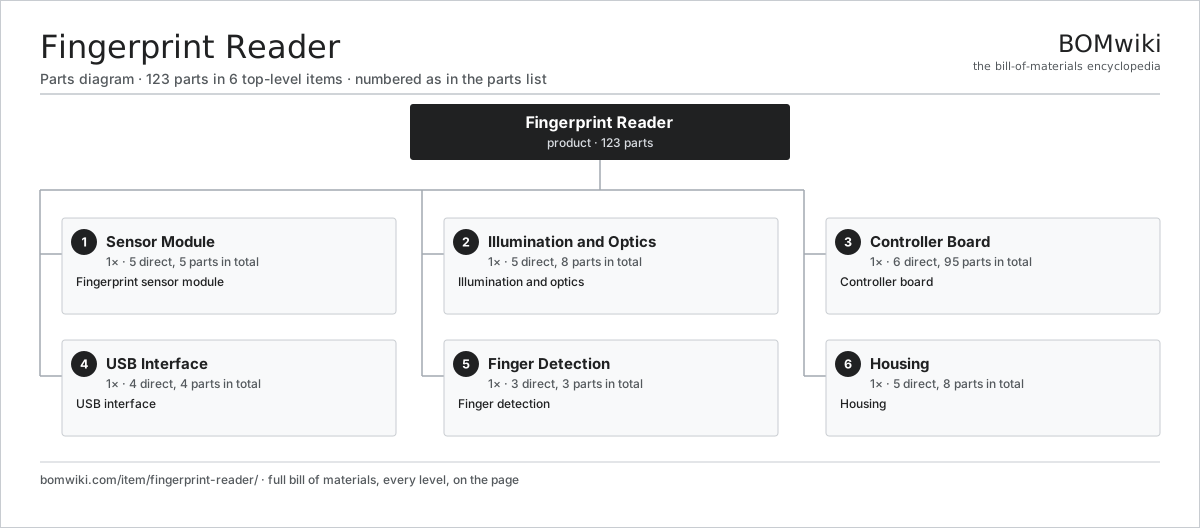
| # | Part | Qty | What it does |
|---|---|---|---|
| 1 | Sensor Module 5 parts | 1× | Fingerprint sensor module |
| 2 | Illumination and Optics 5 parts | 1× | Illumination and optics |
| 3 | Controller Board 6 parts | 1× | Controller board |
| 4 | USB Interface 4 parts | 1× | USB interface |
| 5 | Finger Detection 3 parts | 1× | Finger detection |
| 6 | Housing 5 parts | 1× | Housing |
3D model
No 3D model yet. Have a CAD file of this? Add a 3D model. STL renders right on this page; STEP, FreeCAD, and OpenSCAD sources are welcome too (openly licensed, like all 3D models on BOMwiki).
Build & assembly graph
expand / collapse · shared sub-assemblies converge · links to related products · est. labourTap an assembly to expand/collapse · tap a part to open it · use “Open page” for any node · drag to pan, scroll to zoom.
Bill of materials for Fingerprint Reader
6 top-level lines · 34 rows shown · 123 parts total · indented to 3 levels| # | Item / sub-assembly | Part no. | Qty/assy | Ext. qty | Parts | Type |
|---|---|---|---|---|---|---|
| 1 | Sensor Module 5 parts | fingerprint-reader-sensor-module | 1× | 1 | 5 | assembly |
| 1.1 | Capacitive Sensor Die | fingerprint-reader-sensor-die | 1× | 1 | · | part |
| 1.2 | CMOS Image Sensor | image-sensor | 1× | 1 | · | part |
| 1.3 | Touch Platen | fingerprint-reader-platen | 1× | 1 | · | part |
| 1.4 | ESD Ring | fingerprint-reader-esd-ring | 1× | 1 | · | part |
| 1.5 | Sensor Flex | fingerprint-reader-sensor-flex | 1× | 1 | · | part |
| 2 | Illumination and Optics 5 parts | fingerprint-reader-optics | 1× | 1 | 8 | assembly |
| 2.1 | Imaging Prism | fingerprint-reader-prism | 1× | 1 | · | part |
| 2.2 | Illumination LED | fingerprint-reader-led | 4× | 4 | · | part |
| 2.3 | Lens Assembly | camera-lens | 1× | 1 | · | part |
| 2.4 | Ambient Filter | fingerprint-reader-ir-filter | 1× | 1 | · | part |
| 2.5 | Optics Frame | fingerprint-reader-optics-frame | 1× | 1 | · | part |
| 3 | Controller Board 6 parts | fingerprint-reader-controller | 1× | 1 | 95 | assembly |
| 3.1 | Bare PCB | pcb-bare | 1× | 1 | · | part |
| 3.2 | Microcontroller | mcu | 1× | 1 | · | part |
| 3.3 | Secure Element | fingerprint-reader-secure-element | 1× | 1 | · | part |
| 3.4 | Template Flash | fingerprint-reader-template-flash | 1× | 1 | · | part |
| 3.5 | Voltage Regulator | fingerprint-reader-ldo | 1× | 1 | · | part |
| 3.6 | SMD Passive (R/C/L) | smd-passives | 90× | 90 | · | part |
| 4 | USB Interface 4 parts | fingerprint-reader-usb-interface | 1× | 1 | 4 | assembly |
| 4.1 | USB Cable | fingerprint-reader-usb-cable | 1× | 1 | · | part |
| 4.2 | ESD Array | fingerprint-reader-esd-array | 1× | 1 | · | part |
| 4.3 | EMI Ferrite | fingerprint-reader-ferrite | 1× | 1 | · | part |
| 4.4 | Connector | connector | 1× | 1 | · | part |
| 5 | Finger Detection 3 parts | fingerprint-reader-detect | 1× | 1 | 3 | assembly |
| 5.1 | Wake Electrode | fingerprint-reader-wake-electrode | 1× | 1 | · | part |
| 5.2 | Detect IC | fingerprint-reader-detect-ic | 1× | 1 | · | part |
| 5.3 | Status LED | fingerprint-reader-status-led | 1× | 1 | · | part |
| 6 | Housing 5 parts | fingerprint-reader-housing | 1× | 1 | 8 | assembly |
| 6.1 | Top Shell | fingerprint-reader-top-shell | 1× | 1 | · | part |
| 6.2 | Weighted Base | fingerprint-reader-base | 1× | 1 | · | part |
| 6.3 | Foot Pad | fingerprint-reader-foot-pad | 4× | 4 | · | part |
| 6.4 | Fastener Set | fastener-set | 1× | 1 | · | part |
| 6.5 | Light Pipe | fingerprint-reader-light-pipe | 1× | 1 | · | part |
Something wrong in this list? Report a problem with this BOM.
Related products
same domain, ranked by shared parts


Sourcing: possible vendors
Browse the supplier directory → Prices, MOQ, and lead times are algorithmic estimates, not quotes, and not claims about these companies. Company mappings are curated by keyword; est. price band $20–$3k. How estimates work| Vendor | HQ | Specialty | MOQ | Lead time |
|---|---|---|---|---|
| dell.com ↗ | Round Rock, US | Computers & infrastructure | 1,000 units | 8–14 wks |
|
🇺🇸HP
hp.com ↗
|
Palo Alto, US | Computers & printers | 1,000 units | 8–14 wks |
|
🇨🇳Lenovo
lenovo.com ↗
|
Beijing, CN | Computers | 1,000 units | 8–14 wks |
|
🇹🇼ASUS
asus.com ↗
|
Taipei, TW | Computers & components | 1,000 units | 8–14 wks |
|
🇨🇳Foxconn
foxconn.com ↗
|
Shenzhen, CN | Electronics contract mfg | 1,000 units | 8–14 wks |
691-word article