Fog Machine
ProductOverview
Fog machines create atmospheric effects in theater, concerts, and live events by heating glycol-based fog fluid until it vaporizes, then discharging the vapor into the venue air. Professional fog generators use a heated aluminum block, called a heat exchanger, to rapidly vaporize the fluid. Because the fluid boils at approximately 160–190°C, and the block is maintained at 200–250°C, the liquid turns to vapor almost instantaneously upon contact, producing a dense, cold fog that disperses naturally through the venue and settles near the stage floor.
The Fog Machine is a portable DMX-controlled fog generator designed for theaters, concert halls, and live broadcast studios. Two independent DMX512 channels allow the operator to vary fog intensity in real time during a show and to trigger brief fog bursts for dramatic effect. The system includes a 3-liter fluid reservoir, temperature-controlled heating block, and peristaltic pump capable of producing fog output from a light haze to a thick, opaque screen.
Heat Exchanger Design
The Heat Exchanger Block is the core thermal component. An aluminum Heat Block Core is precision-machined with internal passages sized to allow fluid to travel through the block in 3–5 seconds. A 2 kW electric Heating Element immersion heater maintains block temperature at 210–240°C using a proportional control loop tied to an embedded thermistor.
As fog fluid enters the block's inlet passage, the heat rapidly vaporizes it. At full pump output of 2 mL/second, the fluid residence time is approximately 4 seconds, during which essentially all of the fluid converts to vapor. The vaporized fluid exits the heat block as a pressure pulse (typically 2–5 psi absolute pressure downstream of the pump), then expands through the Discharge Nozzle and into the venue.
Fluid Circulation
The Pump and Valve Assembly uses a peristaltic pump, a rotor-driven mechanism that compresses and releases flexible silicone tubing in sequence. Unlike gear pumps (which can damage fluid and leave chemical residue), peristaltic pumps isolate the fluid from the motor via the tube, making them ideal for glycol and other specialty theatrical fluids. The pump is powered by a 12V DC motor driven from the Control Electronics Module control board.
The Discharge Solenoid Valve sits downstream of the heat block and modulates the discharge of vaporized fluid into the nozzle. During operation, the microcontroller adjusts valve opening linearly with the DMX command value, allowing smooth ramping of fog density from 0 to 100 percent.
DMX Control and Sequencing
The Control Electronics Module module receives two DMX channels:
- Channel A (Pump Intensity): Controls the peristaltic pump motor speed from 0 to 100 percent, determining how much fluid is driven through the heat block per second.
- Channel B (Heater On/Off and Warm-Up): Energizes the heater and monitors block temperature; if temperature drops below 190°C, the pump automatically stops to prevent cold fluid discharge.
Update rate is 44 Hz (standard DMX frame rate). The operator can program quick fog bursts (0.5–2 seconds) or sustained haze by varying Channel A. The heater typically requires 45–60 seconds to reach full operating temperature from a cold start.
Fluid Chemistry and Environmental Considerations
Professional fog machines use high-quality glycol-based fluids that are specifically formulated to:
- Vaporize cleanly at 160–190°C without residue.
- Condense to a visible aerosol at ambient temperature.
- Remain stable in the 3-liter Fluid Reservoir Assembly for months of storage.
Theater crews refill the Reservoir Tank from larger supply bottles, and the Level Float Switch alerts the operator when fluid reaches approximately 0.3 liters remaining. Glycol-based fog is non-toxic but can accumulate on stage and in venue ventilation systems over time; venues with strict air-quality requirements may implement additional HVAC exhausts or schedule fog-free performances.
Typical Stage Deployment
A theater uses one or two Fog Machine units mounted on rolling carts upstage or in wing positions. DMX512 cables connect to the main lighting console, and heavy-gauge power cables deliver 120V or 240V service. During a show, the operator triggers fog cues from the console, for example, at the start of Act 2, a 10-second fog burst fills the stage with a 3-foot-high layer of mist, creating an atmospheric frame for the subsequent scene.
Safety and Maintenance
The Thermal Insulation Wrap foam wraps the outer body to prevent touch-burns from the hot heat block (outer surface can reach 50°C at the nozzle). The Discharge Nozzle includes a perforated silencer that attenuates the hissing sound of vapor discharge. Before each performance, crew members verify that the reservoir is adequately filled, and after shutdown, they allow the heater to cool for 30 minutes before moving the unit.
Common Issues and Troubleshooting
If fog output becomes sparse or stops, the most common cause is fluid starvation due to a clogged suction line or depleted reservoir. The Level Float Switch will indicate low fluid. If the heater fails to reach setpoint, the thermistor or heating element may be faulty. If fog is very wet and appears as droplets rather than aerosol, the block temperature is too low; the firmware will prevent pump discharge in this condition.
Fog Machine parts and their functions
6 top-level parts · 25 parts in total · full bill of materials below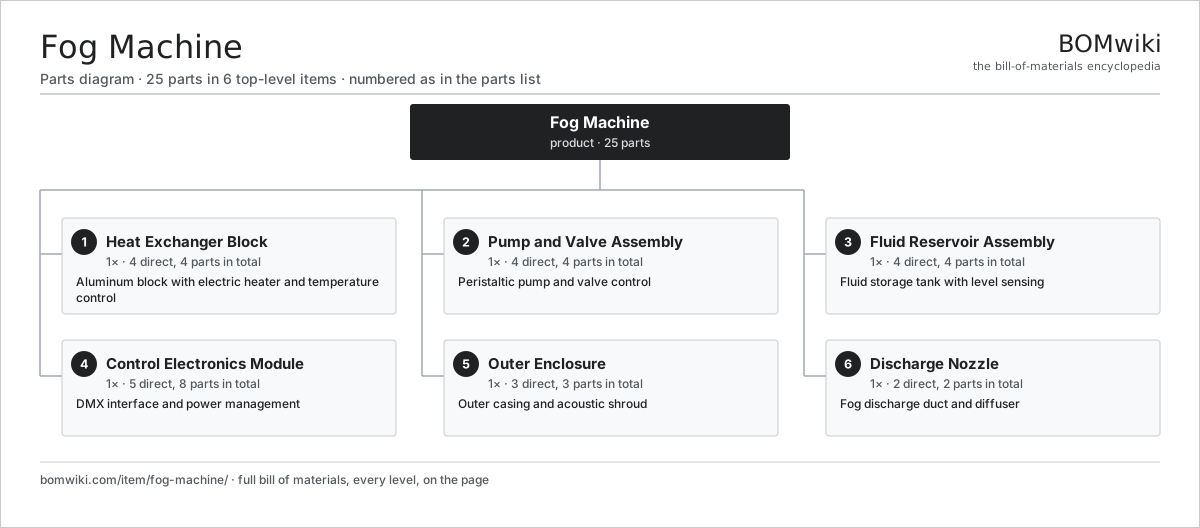
| # | Part | Qty | What it does |
|---|---|---|---|
| 1 | Heat Exchanger Block 4 parts | 1× | Aluminum block with electric heater and temperature control |
| 2 | Pump and Valve Assembly 4 parts | 1× | Peristaltic pump and valve control |
| 3 | Fluid Reservoir Assembly 4 parts | 1× | Fluid storage tank with level sensing |
| 4 | Control Electronics Module 5 parts | 1× | DMX interface and power management |
| 5 | Outer Enclosure 3 parts | 1× | Outer casing and acoustic shroud |
| 6 | Discharge Nozzle 2 parts | 1× | Fog discharge duct and diffuser |
3D model
No 3D model yet. Have a CAD file of this? Add a 3D model. STL renders right on this page; STEP, FreeCAD, and OpenSCAD sources are welcome too (openly licensed, like all 3D models on BOMwiki).
Build & assembly graph
expand / collapse · shared sub-assemblies converge · links to related products · est. labourTap an assembly to expand/collapse · tap a part to open it · use “Open page” for any node · drag to pan, scroll to zoom.
Bill of materials for Fog Machine
6 top-level lines · 28 rows shown · 25 parts total · indented to 3 levels| # | Item / sub-assembly | Part no. | Qty/assy | Ext. qty | Parts | Type |
|---|---|---|---|---|---|---|
| 1 | Heat Exchanger Block 4 parts | fog-machine-heating-assembly | 1× | 1 | 4 | assembly |
| 1.1 | Heat Block Core | fog-machine-heat-block | 1× | 1 | · | part |
| 1.2 | Heating Element | heating-element | 1× | 1 | · | part |
| 1.3 | Pressure Sensor | pressure-sensor | 1× | 1 | · | part |
| 1.4 | Fastener Set | fastener-set | 1× | 1 | · | part |
| 2 | Pump and Valve Assembly 4 parts | fog-machine-pump-system | 1× | 1 | 4 | assembly |
| 2.1 | Peristaltic Pump | fog-machine-peristaltic-pump | 1× | 1 | · | part |
| 2.2 | Discharge Solenoid Valve | fog-machine-solenoid-valve | 1× | 1 | · | part |
| 2.3 | Connector | connector | 1× | 1 | · | part |
| 2.4 | Fastener Set | fastener-set | 1× | 1 | · | part |
| 3 | Fluid Reservoir Assembly 4 parts | fog-machine-reservoir | 1× | 1 | 4 | assembly |
| 3.1 | Reservoir Tank | fog-machine-tank-body | 1× | 1 | · | part |
| 3.2 | Level Float Switch | fog-machine-level-switch | 1× | 1 | · | part |
| 3.3 | Connector | connector | 1× | 1 | · | part |
| 3.4 | Fastener Set | fastener-set | 1× | 1 | · | part |
| 4 | Control Electronics Module 5 parts | fog-machine-electronics | 1× | 1 | 8 | assembly |
| 4.1 | Bare PCB | pcb-bare | 1× | 1 | · | part |
| 4.2 | Microcontroller | mcu | 1× | 1 | · | part |
| 4.3 | Relay | relay | 3× | 3 | · | part |
| 4.4 | Power Supply | power-supply | 1× | 1 | · | part |
| 4.5 | Connector | connector | 2× | 2 | · | part |
| 5 | Outer Enclosure 3 parts | fog-machine-housing | 1× | 1 | 3 | assembly |
| 5.1 | Plastic Shell Assembly | fog-machine-body-shell | 1× | 1 | · | part |
| 5.2 | Thermal Insulation Wrap | fog-machine-insulation | 1× | 1 | · | part |
| 5.3 | Fastener Set | fastener-set | 1× | 1 | · | part |
| 6 | Discharge Nozzle 2 parts | fog-machine-output-nozzle | 1× | 1 | 2 | assembly |
| 6.1 | Nozzle Duct | fog-machine-nozzle-tube | 1× | 1 | · | part |
| 6.2 | Fastener Set | fastener-set | 1× | 1 | · | part |
Something wrong in this list? Report a problem with this BOM.
Related products
same domain, ranked by shared parts Stage Lighting Console
163 parts · shares 4 with this page
Stage Lighting Console
163 parts · shares 4 with this page
 Low Fog Machine
119 parts · shares 3 with this page
Snow Effect Machine
115 parts · shares 3 with this page
CO2 Jet
84 parts · shares 3 with this page
Low Fog Machine
119 parts · shares 3 with this page
Snow Effect Machine
115 parts · shares 3 with this page
CO2 Jet
84 parts · shares 3 with this page
 Confetti Cannon
28 parts · shares 2 with this page
Confetti Cannon
28 parts · shares 2 with this page
 DMX Dimmer Rack
71 parts · shares 2 with this page
DMX Dimmer Rack
71 parts · shares 2 with this page
Sourcing: possible vendors
Browse the supplier directory → Prices, MOQ, and lead times are algorithmic estimates, not quotes, and not claims about these companies. Company mappings are curated by keyword; est. price band $50–$3k. How estimates work| Vendor | HQ | Specialty | MOQ | Lead time |
|---|---|---|---|---|
|
🇯🇵Sony
sony.com ↗
|
Tokyo, JP | Consumer electronics | 1,000 units | 8–12 wks |
| samsung.com ↗ | Suwon, KR | Electronics & displays | 1,000 units | 8–12 wks |
|
🇺🇸Harman
harman.com ↗
|
Stamford, US | Audio (JBL, AKG) | 1,000 units | 8–12 wks |
|
🇺🇸Bose
bose.com ↗
|
Framingham, US | Audio | 1,000 units | 8–12 wks |
| yamaha.com ↗ | Hamamatsu, JP | Audio & instruments | 1,000 units | 8–12 wks |
877-word article