Forced-Air Patient Warmer
ProductOverview
Intraoperative hypothermia, core body temperature <36°C, is common during general anesthesia, occurring in 30–50% of surgical patients. Anesthetic agents impair thermoregulation, and cold OR environments, exposure of body cavities, and infusion of room-temperature fluids all contribute. Hypothermia increases bleeding risk, impairs wound healing, and doubles infectious complications, prompting modern ORs to make active patient warming standard of care.
The forced-air patient warmer is the most widely deployed intraoperative warming modality. A disposable blanket containing air chambers is placed over the patient's body; warm air from the warmer unit is delivered via insulated hose at rates of 1–3 m³/min. The patient's skin absorbs radiant and convective heat, raising core temperature at rates of 0.5–1.0°C per hour. Combined with warmed IV fluids and high-fresh-gas flows in the anesthesia machine, forced-air warming can prevent or correct mild perioperative hypothermia.
How it Works
Before the patient arrives in the OR, the anesthetist places the warmer unit on a cart or shelf in the room and powers it on. The blower motor (0.5–1 kW) spins up, drawing ambient air through the inlet filter. The air passes through the heating coil, where Nichrome wire heated by the power supply warms the air.
The proportional controller modulates heating element power via pulse-width modulation (PWM). A thermistor in the outlet measures real-time air temperature and feeds back to the controller, which adjusts power to maintain the operator-selected setpoint (typically 43–47°C). The heated air flows through the insulated delivery hose (2–3 m) to the blanket inlet via a quick-disconnect sterile coupling.
The disposable patient blanket contains multiple air chambers arranged to cover the patient's upper body (chest, arms), lower body (legs), or both. As warm air is delivered at 1–3 m³/min, the blanket inflates slightly (typically 1–2 cm puff), distributing warm air evenly across the body. The patient's skin absorbs this heat, raising core temperature.
A vent port on the blanket exhaust allows air and moisture to escape, preventing blanket over-pressure. At the end of surgery, the anesthetist simply disconnects the hose from the blanket, removes the disposable blanket (biohazard waste), and powers down the warmer.
Safety Protections
Multiple safety layers prevent thermal injury:
Thermistor feedback: The controller continuously adjusts heating to prevent overshoot. If air temperature approaches 49°C, the audible alarm activates.
Safety thermostat: A bimetallic thermostat hard-wired to cut heating at 48°C provides a second independent limit.
Thermal fuse: A non-resettable thermal fuse at 50°C ensures that even catastrophic control failure (heating element stuck on, sensor failure) will not deliver dangerously hot air.
Pressure relief: A pressure relief valve at 500 Pa prevents blanket over-inflation if the outlet becomes partially obstructed.
Blanket design: The blanket is designed with fleece or non-woven material facing the patient's skin, providing insulation and preventing direct contact with high-temperature plastic. The blanket itself is made of flame-retardant material per operating room safety standards.
Clinical Efficacy
Studies consistently show that forced-air warming reduces the incidence of inadvertent intraoperative hypothermia from 50% (passive insulation) to <5% (active warming). This translates to reduced postoperative shivering (uncomfortable and metabolically expensive), faster emergence from anesthesia, and lower rates of wound infection (hypothermia impairs immune response and tissue perfusion).
A typical intraoperative course: patient admitted to OR at 37.0°C core temperature. Within 15 minutes of anesthesia induction (before active warming), core temperature drops to 35.5–36.0°C. Forced-air warming is initiated; core temperature stabilizes and gradually rises at 0.5°C/hour. By end of surgery (90–120 minutes later), patient exits the OR at 36.5–37.0°C core temperature.
Blanket Types and Placement
Different surgical procedures require different blanket configurations:
- Upper body blanket: Covers chest, arms, and upper abdomen. Used for shoulder, head/neck, and cardiac surgery where lower body access is not needed.
- Lower body blanket: Covers abdomen, pelvis, legs, thighs. Used for hip, knee, and lower-abdominal surgery.
- Full-body blanket: Two-piece design covering upper and lower body simultaneously. Used for major surgery or when maximum rewarming is desired.
Blankets are single-use, sterile, and disposable. The air chambers are segmented to allow per-zone control in some advanced units (e.g., warmer upper body more, cooler lower body less), but most standard units deliver uniform air temperature to all chambers.
Limitations and Considerations
Forced-air warming is effective for mild hypothermia (>35°C) but cannot single-handedly correct severe hypothermia or rapidly rewarm patients in shock. In massive trauma with profound hypothermia, extracorporeal rewarming (ECMO) is required.
Additionally, forced-air blankets can reduce pulse oximetry probe signal if applied over the sensing site; proper blanket placement around (not directly over) monitoring sites is essential. Finally, the blanket adds bulk and may restrict surgical access in confined spaces (e.g., axilla during breast surgery); surgeons must plan blanket placement to minimize interference.
Cost is also a factor: disposable blankets range from 10–30 USD each. High-volume ORs (>10 cases/day) may spend 100–300 USD per day on blankets alone, incentivizing hospitals to use passive insulation (regular cotton blankets) for low-risk, short procedures while reserving active warming for high-risk or lengthy cases.
Forced-Air Patient Warmer parts and their functions
7 top-level parts · 25 parts in total · full bill of materials below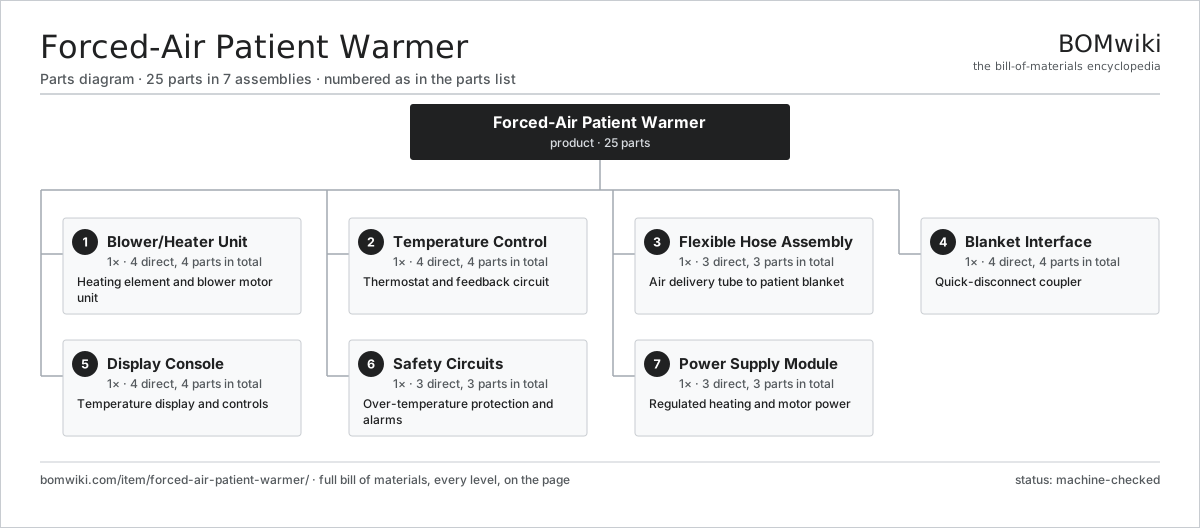
| # | Part | Qty | What it does |
|---|---|---|---|
| 1 | Blower/Heater Unit 4 parts | 1× | Heating element and blower motor unit |
| 2 | Temperature Control 4 parts | 1× | Thermostat and feedback circuit |
| 3 | Flexible Hose Assembly 3 parts | 1× | Air delivery tube to patient blanket |
| 4 | Blanket Interface 4 parts | 1× | Quick-disconnect coupler |
| 5 | Display Console 4 parts | 1× | Temperature display and controls |
| 6 | Safety Circuits 3 parts | 1× | Over-temperature protection and alarms |
| 7 | Power Supply Module 3 parts | 1× | Regulated heating and motor power |
3D model
No 3D model yet. Have a CAD file of this? Add a 3D model — STL renders right on this page; STEP, FreeCAD, and OpenSCAD sources are welcome too (openly licensed, like all 3D models on BOMwiki).
Build & assembly graph
expand / collapse · shared sub-assemblies converge · links to related products · est. labourTap an assembly to expand/collapse · tap a part to open it · use “Open page” for any node · drag to pan, scroll to zoom.
Bill of materials for Forced-Air Patient Warmer
7 top-level lines · 32 rows shown · 25 parts total · indented to 3 levels| # | Item / sub-assembly | Part no. | Qty/assy | Ext. qty | Parts | Type |
|---|---|---|---|---|---|---|
| 1 | Blower/Heater Unit 4 parts | forced-air-warmer-blower-heater | 1× | 1 | 4 | assembly |
| 1.1 | Blower Motor | forced-air-warmer-motor | 1× | 1 | · | part |
| 1.2 | Heating Coil | forced-air-warmer-heating-coil | 1× | 1 | · | part |
| 1.3 | Air Chamber | forced-air-warmer-air-chamber | 1× | 1 | · | part |
| 1.4 | Inlet Filter | forced-air-warmer-inlet-filter | 1× | 1 | · | part |
| 2 | Temperature Control 4 parts | forced-air-warmer-temperature-control | 1× | 1 | 4 | assembly |
| 2.1 | Thermistor Probe | forced-air-warmer-thermistor-probe | 1× | 1 | · | part |
| 2.2 | Proportional Controller | forced-air-warmer-proportional-controller | 1× | 1 | · | part |
| 2.3 | Safety Thermostat | forced-air-warmer-safety-thermostat | 1× | 1 | · | part |
| 2.4 | Bare PCB | pcb-bare | 1× | 1 | · | part |
| 3 | Flexible Hose Assembly 3 parts | forced-air-warmer-flexible-hose | 1× | 1 | 3 | assembly |
| 3.1 | Hose Tubing | forced-air-warmer-hose-tubing | 1× | 1 | · | part |
| 3.2 | Hose Insulation | forced-air-warmer-hose-insulation | 1× | 1 | · | part |
| 3.3 | Hose Connector | forced-air-warmer-hose-connector | 1× | 1 | · | part |
| 4 | Blanket Interface 4 parts | forced-air-warmer-blanket-interface | 1× | 1 | 4 | assembly |
| 4.1 | Blanket Inlet | forced-air-warmer-blanket-inlet | 1× | 1 | · | part |
| 4.2 | Blanket Outlet | forced-air-warmer-blanket-outlet | 1× | 1 | · | part |
| 4.3 | Blanket Frame | forced-air-warmer-blanket-frame | 1× | 1 | · | part |
| 4.4 | Blanket Seal | forced-air-warmer-blanket-seal | 1× | 1 | · | part |
| 5 | Display Console 4 parts | forced-air-warmer-display-console | 1× | 1 | 4 | assembly |
| 5.1 | LCD Display | forced-air-warmer-lcd-display | 1× | 1 | · | part |
| 5.2 | Power Knob | forced-air-warmer-power-knob | 1× | 1 | · | part |
| 5.3 | On/Off Switch | forced-air-warmer-on-off-switch | 1× | 1 | · | part |
| 5.4 | Status Lights | forced-air-warmer-status-lights | 1× | 1 | · | part |
| 6 | Safety Circuits 3 parts | forced-air-warmer-safety-circuits | 1× | 1 | 3 | assembly |
| 6.1 | Overheat Alarm | forced-air-warmer-overheat-alarm | 1× | 1 | · | part |
| 6.2 | Thermal Fuse | forced-air-warmer-thermal-fuse | 1× | 1 | · | part |
| 6.3 | Pressure Relief | forced-air-warmer-pressure-relief | 1× | 1 | · | part |
| 7 | Power Supply Module 3 parts | forced-air-warmer-power-supply | 1× | 1 | 3 | assembly |
| 7.1 | Power Supply | power-supply | 1× | 1 | · | part |
| 7.2 | Motor Relay | forced-air-warmer-motor-relay | 1× | 1 | · | part |
| 7.3 | Heater Relay | forced-air-warmer-heater-relay | 1× | 1 | · | part |
Related products
same domain, ranked by shared parts Anesthesia Machine
562 parts · shares 1 with this page
Anesthesia Machine
562 parts · shares 1 with this page
 Apheresis Machine
199 parts · shares 1 with this page
Apheresis Machine
199 parts · shares 1 with this page
 Autorefractor
513 parts · shares 1 with this page
Autorefractor
513 parts · shares 1 with this page
 Blood Bank Refrigerator
79 parts · shares 1 with this page
Blood Gas Analyzer
386 parts · shares 1 with this page
Blood Bank Refrigerator
79 parts · shares 1 with this page
Blood Gas Analyzer
386 parts · shares 1 with this page
 Blood/Fluid Warmer
28 parts · shares 1 with this page
Blood/Fluid Warmer
28 parts · shares 1 with this page
Sourcing: possible vendors
Prices, MOQ, and lead times are algorithmic estimates, not quotes, and not claims about these companies. Company mappings are curated by keyword; est. price band $500–$3M. How estimates work| Vendor | HQ | Specialty | MOQ | Lead time |
|---|---|---|---|---|
| gehealthcare.com ↗ | Chicago, US | Medical imaging & devices | 100 units | 12–20 wks |
| siemens-healthineers.com ↗ | Erlangen, DE | Medical systems | 100 units | 12–20 wks |
|
🇳🇱Philips
philips.com ↗
|
Amsterdam, NL | Health technology | 100 units | 12–20 wks |
| medtronic.com ↗ | Minneapolis, US | Medical devices | 100 units | 12–20 wks |
|
🇨🇳Mindray
mindray.com ↗
|
Shenzhen, CN | Medical devices | 100 units | 12–20 wks |
969-word article