FPGA Development Board
ProductOverview
An FPGA development board brings reconfigurable hardware prototyping within reach of engineers and researchers. At its core is an FPGA SoC, a semiconductor die containing millions of programmable logic gates, dedicated memory blocks, and often built-in processor cores. Users write HDL (hardware description language) code, synthesize it into a bitstream, and load that bitstream onto the board; the FPGA then executes custom digital logic at high speed and with microsecond-scale latency.
The Configuration Flash Memory holds the bitstream so the FPGA reconfigures itself on every power-up. The DDR SDRAM System provides fast working memory for data-intensive algorithms. The Power Delivery Network system supplies multiple voltage rails with tight regulation and low noise, essential for stable operation of clock and logic signals. The IO Bank Connectors expose the FPGA's user IO to external sensors, actuators, and instruments via headers and PMOD Connectors. The JTAG Programming Interface is the programmer's gateway, it allows uploading bitstreams and observing internal signals in real-time.
The Reference Clock Oscillator provides a stable reference clock that the FPGA SoC's internal PLL multiplies to higher frequencies needed by the logic.
How it works
At startup, the FPGA SoC's built-in boot ROM initiates a configuration sequence: it reads the bitstream from the Configuration Flash Memory via SPI, decrypts and decompresses it (if applicable), and writes it into the Logic Array. Within milliseconds, the FPGA SoC is ready to execute the user-defined hardware.
The Logic Array is a sea of programmable switches and routing. Each LUT (lookup table) is a small RAM that implements combinatorial logic; flip-flops add sequential storage. Interconnect routing is also programmable, so data paths between logic cells are user-defined. DSP Blocks and Embedded Memory Blocks are hardened structures optimized for arithmetic and storage, saving power and improving throughput compared to routing the same function through the Logic Array.
If the FPGA includes a processor core like an Processor Core, that core runs conventional software (C/C++) while the surrounding Logic Array executes custom accelerators. This hybrid model is common in modern SoC FPGAs: the processor handles control flow and OS tasks, while the logic fabric executes time-critical loops or specialized algorithms.
The DDR SDRAM System is accessed via a hard memory controller inside the FPGA, allowing the Processor Core and logic fabric to read/write the DRAM at full bandwidth (> 10 GB/s on modern parts).
All configuration and debug happens over the JTAG Programming Interface: a boundary-scan chain that can shift bits in and out, observing internal nodes and updating configuration memory without interrupting execution, a technique called JTAG in-circuit debugging.
FPGA Development Board parts and their functions
9 top-level parts · 31 parts in total · full bill of materials below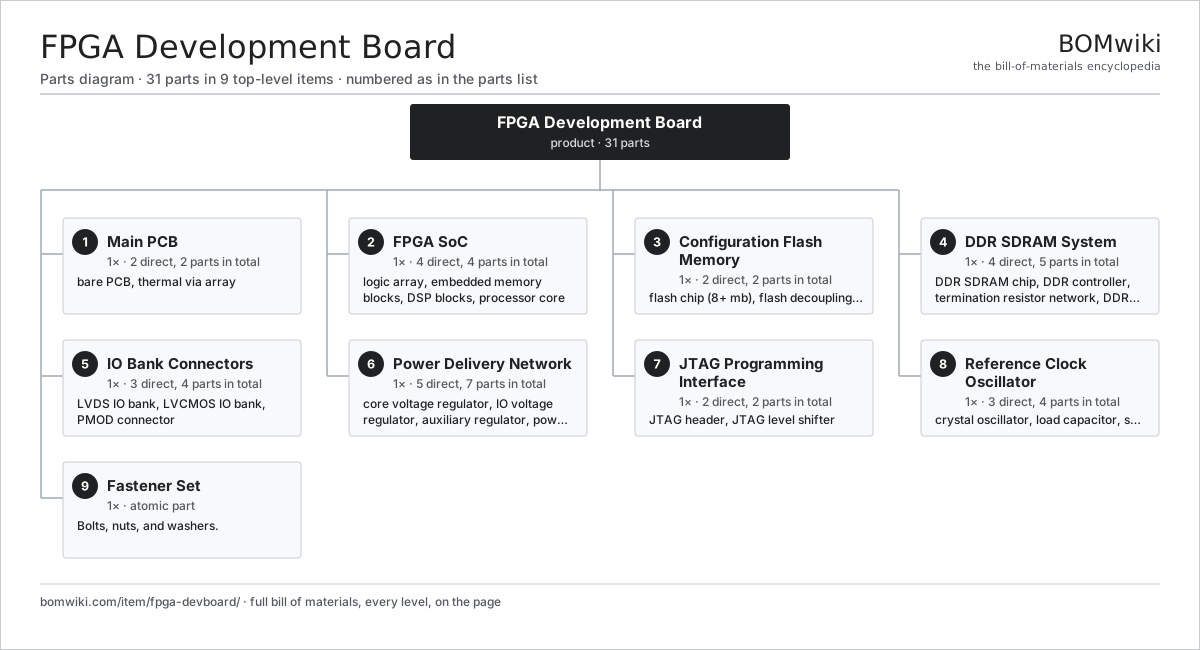
| # | Part | Qty | What it does |
|---|---|---|---|
| 1 | Main PCB 2 parts | 1× | Multi-layer PCB with high-speed routing and impedance control. |
| 2 | FPGA SoC 4 parts | 1× | Programmable logic fabric, processor cores, and hard IP blocks. |
| 3 | Configuration Flash Memory 2 parts | 1× | SPI or parallel flash that holds the bitstream. |
| 4 | DDR SDRAM System 4 parts | 1× | Dual-channel DDR3 or DDR4 with address and data routing. |
| 5 | IO Bank Connectors 3 parts | 1× | Headers and connectors routed to FPGA IOs. |
| 6 | Power Delivery Network 5 parts | 1× | Multi-rail DC-DC converters for core, IO, and auxiliary supplies. |
| 7 | JTAG Programming Interface 2 parts | 1× | Boundary-scan chain for configuration and in-circuit debugging. |
| 8 | Reference Clock Oscillator 3 parts | 1× | High-stability crystal or oscillator module. |
| 9 | Fastener Set | 1× | Bolts, nuts, and washers. |
3D model
No 3D model yet. Have a CAD file of this? Add a 3D model. STL renders right on this page; STEP, FreeCAD, and OpenSCAD sources are welcome too (openly licensed, like all 3D models on BOMwiki).
Build & assembly graph
expand / collapse · shared sub-assemblies converge · links to related products · est. labourTap an assembly to expand/collapse · tap a part to open it · use “Open page” for any node · drag to pan, scroll to zoom.
Bill of materials for FPGA Development Board
9 top-level lines · 34 rows shown · 31 parts total · indented to 3 levels| # | Item / sub-assembly | Part no. | Qty/assy | Ext. qty | Parts | Type |
|---|---|---|---|---|---|---|
| 1 | Main PCB 2 parts | fpga-devboard-pcb | 1× | 1 | 2 | assembly |
| 1.1 | Bare PCB | pcb-bare | 1× | 1 | · | part |
| 1.2 | Thermal Via Array | fpga-pcb-thermal-pad | 1× | 1 | · | part |
| 2 | FPGA SoC 4 parts | fpga-chip | 1× | 1 | 4 | assembly |
| 2.1 | Logic Array | fpga-logic-array | 1× | 1 | · | part |
| 2.2 | Embedded Memory Blocks | fpga-memory-blocks | 1× | 1 | · | part |
| 2.3 | DSP Blocks | fpga-dsp-blocks | 1× | 1 | · | part |
| 2.4 | Processor Core | fpga-processor-core | 1× | 1 | · | part |
| 3 | Configuration Flash Memory 2 parts | fpga-configuration-flash | 1× | 1 | 2 | assembly |
| 3.1 | Flash Chip (8+ Mb) | fpga-flash-chip | 1× | 1 | · | part |
| 3.2 | Flash Decoupling Capacitors | fpga-flash-decoupling | 1× | 1 | · | part |
| 4 | DDR SDRAM System 4 parts | fpga-ddr-memory | 1× | 1 | 5 | assembly |
| 4.1 | DDR SDRAM Chip | fpga-ddr-chip | 2× | 2 | · | part |
| 4.2 | DDR Controller | fpga-ddr-controller-ic | 1× | 1 | · | part |
| 4.3 | Termination Resistor Network | fpga-ddr-termination | 1× | 1 | · | part |
| 4.4 | DDR Bypass Capacitors | fpga-ddr-cap-bank | 1× | 1 | · | part |
| 5 | IO Bank Connectors 3 parts | fpga-io-connectors | 1× | 1 | 4 | assembly |
| 5.1 | LVDS IO Bank | fpga-lvds-bank | 1× | 1 | · | part |
| 5.2 | LVCMOS IO Bank | fpga-lvcmos-bank | 1× | 1 | · | part |
| 5.3 | PMOD Connector | fpga-pmod-connector | 2× | 2 | · | part |
| 6 | Power Delivery Network 5 parts | fpga-power-delivery | 1× | 1 | 7 | assembly |
| 6.1 | Core Voltage Regulator | fpga-core-vreg | 1× | 1 | · | part |
| 6.2 | IO Voltage Regulator | fpga-io-vreg | 1× | 1 | · | part |
| 6.3 | Auxiliary Regulator | fpga-aux-vreg | 1× | 1 | · | part |
| 6.4 | Power Decoupling Caps | fpga-pdn-capacitor-bank | 1× | 1 | · | part |
| 6.5 | Power Inductor | power-inductor | 3× | 3 | · | part |
| 7 | JTAG Programming Interface 2 parts | fpga-jtag-interface | 1× | 1 | 2 | assembly |
| 7.1 | JTAG Header | fpga-jtag-connector | 1× | 1 | · | part |
| 7.2 | JTAG Level Shifter | fpga-jtag-buffer-ic | 1× | 1 | · | part |
| 8 | Reference Clock Oscillator 3 parts | fpga-clock-oscillator | 1× | 1 | 4 | assembly |
| 8.1 | Crystal Oscillator | fpga-crystal | 1× | 1 | · | part |
| 8.2 | Load Capacitor | fpga-osc-load-cap | 2× | 2 | · | part |
| 8.3 | Series Resistor | fpga-osc-series-resistor | 1× | 1 | · | part |
| 9 | Fastener Set | fastener-set | 1× | 1 | · | part |
Something wrong in this list? Report a problem with this BOM.
Related products
same domain, ranked by shared parts


Sourcing: possible vendors
Browse the supplier directory → Prices, MOQ, and lead times are algorithmic estimates, not quotes, and not claims about these companies. Company mappings are curated by keyword; est. price band $20–$3k. How estimates work| Vendor | HQ | Specialty | MOQ | Lead time |
|---|---|---|---|---|
| dell.com ↗ | Round Rock, US | Computers & infrastructure | 1,000 units | 8–14 wks |
|
🇺🇸HP
hp.com ↗
|
Palo Alto, US | Computers & printers | 1,000 units | 8–14 wks |
|
🇨🇳Lenovo
lenovo.com ↗
|
Beijing, CN | Computers | 1,000 units | 8–14 wks |
|
🇹🇼ASUS
asus.com ↗
|
Taipei, TW | Computers & components | 1,000 units | 8–14 wks |
|
🇨🇳Foxconn
foxconn.com ↗
|
Shenzhen, CN | Electronics contract mfg | 1,000 units | 8–14 wks |
452-word article