Funicular Car
ProductOverview
A funicular car has no engine. It is one end of a balanced system: two cars permanently attached to opposite ends of a haul rope that passes over a winding wheel at the top station, so the descending car's weight lifts the ascending one and the drive motor supplies only the difference plus losses. The car itself is therefore a rolling structure built around three problems, keeping passengers level on a 30–60% slope, attaching safely to the rope, and stopping itself if the rope lets go.
The stepped body
The Stepped Car Body solves the slope problem geometrically. Its Body Frame is welded as a right triangle matching the line gradient, and the interior is a staircase of 3–5 compartments, each with a level Compartment Floor and its own bench Seat Assembly rows. Because the gradient is fixed for the whole line, the body is built for exactly that angle; the panoramic End Window at the downhill end is one of the type's signature features. Lines with varying gradients either accept tilted floors at the extremes or use newer self-levelling cabins, but the classic stepped body remains the standard solution.
Rope attachment
The Haul Rope Attachment is the car's lifeline and is engineered like one. The haul rope, full-locked coil steel of 30–45 mm, terminates in a Rope Socket whose poured zinc or resin cone develops the rope's full breaking strength. The socket pulls on a forged Drawbar with a static safety factor above five, through a Rope Shock Absorber that softens the jerk of starts and emergency stops at the winding house. A Slack-Rope Monitor watches the connection continuously: if tension vanishes, broken rope, derailed sheave, runaway, it trips the track brakes with no human in the loop. Long lines also run a tail rope between the cars' downhill ends, anchored at the Counter-Rope Anchor, so rope weight stays balanced over the full travel.
Track brakes
The Track Brake is what separates a funicular from a sled. Wheel brakes are useless on a 50% grade, adhesion is nowhere near sufficient, so the car brakes against the rail itself. Each Brake Caliper is a jaw pair that clamps both sides of the rail head through hardened Rail Grip Pad linings. Stacked disc springs in the Brake Spring Pack provide the clamping force; a hydraulic Release Cylinder holds them compressed during normal running. The logic is fail-safe by construction: braking requires no energy, only the loss of release pressure. That loss is commanded by the slack-rope monitor, by a wheel-driven Overspeed Governor tripping at about 1.3 times rated speed, by any Emergency Stop Button button, or simply by hydraulic failure.
Running gear and the Abt loop
Each Inclined-Track Bogie carries an asymmetric wheelset that looks wrong until the track layout is understood. One side runs Double-Flanged Wheel units, flanged on both faces, which do all the steering on their rail; the other side runs wide unflanged Flat Wheel rollers. Most funiculars are single-track with one passing loop at mid-line (the Abt system): because each car's flanged side always follows its own outer rail, the two cars sort themselves into opposite sides of the loop with no moving switch parts at all, and the flat wheels roll straight over the gaps in the loop trackwork where the haul ropes pass.
Doors, control, and power
Each compartment step gets its own Sliding Door aligned with the stepped station platform, driven by a Door Actuator and proved by a Door Lock Switch. Those proving contacts feed the Onboard Controller, which reports over the Line Telemetry Unit link to the winding house, the drive cannot start until every door on both cars proves closed and locked, and a Sensitive Edge reopens any leaf that meets an obstruction. Redundant Speed Sensor readings from the wheels are cross-checked against rope speed at the drive; disagreement means slip or a parted rope and triggers the brakes.
With no traction supply on the car, the Electrical System system runs everything from a 24 V Battery Box topped up through Charging Contact pads during station dwells, feeding the doors, telemetry, PA, and battery-backed Interior Light units. The design is covered by the European cableway safety framework (EN 12929/12930), which treats the funicular as a cable installation rather than a railway.
Funicular Car parts and their functions
7 top-level parts · 355 parts in total · full bill of materials below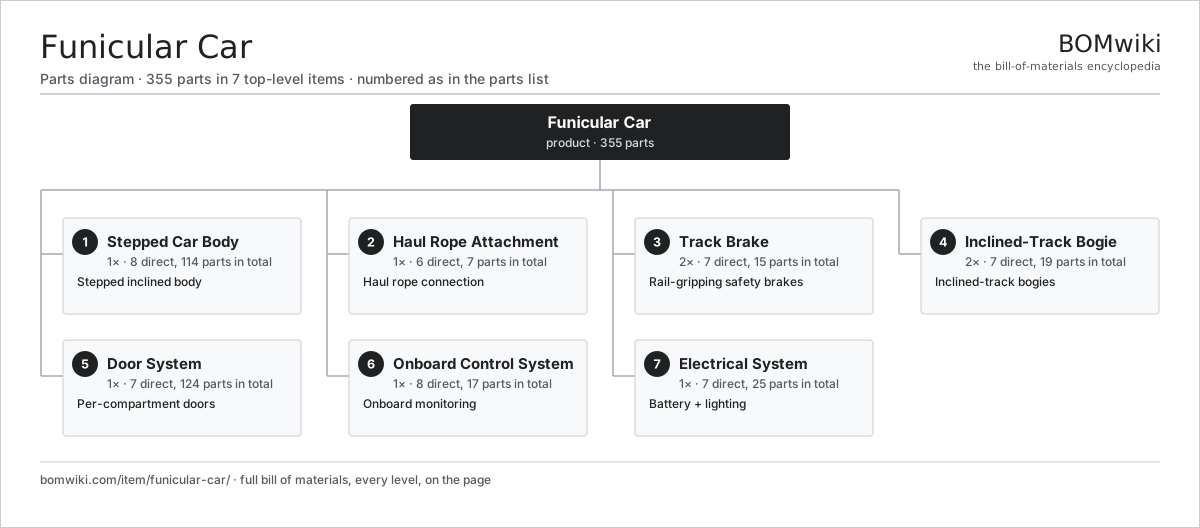
| # | Part | Qty | What it does |
|---|---|---|---|
| 1 | Stepped Car Body 8 parts | 1× | Stepped inclined body |
| 2 | Haul Rope Attachment 6 parts | 1× | Haul rope connection |
| 3 | Track Brake 7 parts | 2× | Rail-gripping safety brakes |
| 4 | Inclined-Track Bogie 7 parts | 2× | Inclined-track bogies |
| 5 | Door System 7 parts | 1× | Per-compartment doors |
| 6 | Onboard Control System 8 parts | 1× | Onboard monitoring |
| 7 | Electrical System 7 parts | 1× | Battery + lighting |
3D model
No 3D model yet. Have a CAD file of this? Add a 3D model. STL renders right on this page; STEP, FreeCAD, and OpenSCAD sources are welcome too (openly licensed, like all 3D models on BOMwiki).
Build & assembly graph
expand / collapse · shared sub-assemblies converge · links to related products · est. labourTap an assembly to expand/collapse · tap a part to open it · use “Open page” for any node · drag to pan, scroll to zoom.
Bill of materials for Funicular Car
7 top-level lines · 66 rows shown · 355 parts total · indented to 3 levels| # | Item / sub-assembly | Part no. | Qty/assy | Ext. qty | Parts | Type |
|---|---|---|---|---|---|---|
| 1 | Stepped Car Body 8 parts | funicular-car-body | 1× | 1 | 114 | assembly |
| 1.1 | Body Frame | funicular-car-body-frame | 1× | 1 | · | part |
| 1.2 | Compartment Floor | funicular-car-compartment-floor | 4× | 4 | · | part |
| 1.3 | End Window | funicular-car-end-window | 2× | 2 | · | part |
| 1.4 | Side Window | funicular-car-side-window | 8× | 8 | · | part |
| 1.5 | Roof Panel | funicular-car-roof-panel | 1× | 1 | · | part |
| 1.6 | Seat Assembly 5 parts | seat-assembly | 12× | 12 | 7 | assembly |
| 1.6.1 | Seat Frame | seat-frame | 1× | 12 | · | part |
| 1.6.2 | Seat Foam | seat-foam | 2× | 24 | · | part |
| 1.6.3 | Seat Cover | seat-cover | 1× | 12 | · | part |
| 1.6.4 | Seat Motor | seat-motor | 2× | 24 | · | part |
| 1.6.5 | Seat Heater Mat | seat-heater | 1× | 12 | · | part |
| 1.7 | Sheet Metal Panel | sheet-panel | 10× | 10 | · | part |
| 1.8 | Fastener Set | fastener-set | 4× | 4 | · | part |
| 2 | Haul Rope Attachment 6 parts | funicular-car-rope-attachment | 1× | 1 | 7 | assembly |
| 2.1 | Rope Socket | funicular-car-rope-socket | 1× | 1 | · | part |
| 2.2 | Drawbar | funicular-car-drawbar | 1× | 1 | · | part |
| 2.3 | Rope Shock Absorber | funicular-car-shock-absorber | 1× | 1 | · | part |
| 2.4 | Slack-Rope Monitor | funicular-car-rope-tension-monitor | 1× | 1 | · | part |
| 2.5 | Counter-Rope Anchor | funicular-car-counter-rope-anchor | 1× | 1 | · | part |
| 2.6 | Fastener Set | fastener-set | 2× | 2 | · | part |
| 3 | Track Brake 7 parts | funicular-car-track-brake | 2× | 2 | 15 | assembly |
| 3.1 | Brake Caliper | funicular-car-brake-caliper | 2× | 4 | · | part |
| 3.2 | Brake Spring Pack | funicular-car-brake-spring-pack | 2× | 4 | · | part |
| 3.3 | Release Cylinder | funicular-car-release-cylinder | 2× | 4 | · | part |
| 3.4 | Overspeed Governor | funicular-car-overspeed-governor | 1× | 2 | · | part |
| 3.5 | Rail Grip Pad | funicular-car-brake-pad | 4× | 8 | · | part |
| 3.6 | Pressure Sensor | pressure-sensor | 2× | 4 | · | part |
| 3.7 | O-Ring Set | oring-set | 2× | 4 | · | part |
| 4 | Inclined-Track Bogie 7 parts | funicular-car-bogie | 2× | 2 | 19 | assembly |
| 4.1 | Bogie Frame | funicular-car-bogie-frame | 1× | 2 | · | part |
| 4.2 | Double-Flanged Wheel | funicular-car-double-flange-wheel | 2× | 4 | · | part |
| 4.3 | Flat Wheel | funicular-car-flat-wheel | 2× | 4 | · | part |
| 4.4 | Wheel Axle | funicular-car-axle | 2× | 4 | · | part |
| 4.5 | Coil Spring | coil-spring | 4× | 8 | · | part |
| 4.6 | Ball Bearing | ball-bearing | 4× | 8 | · | part |
| 4.7 | Oil Seal | oil-seal | 4× | 8 | · | part |
| 5 | Door System 7 parts | funicular-car-door-system | 1× | 1 | 124 | assembly |
| 5.1 | Sliding Door | funicular-car-sliding-door | 4× | 4 | · | part |
| 5.2 | Door Actuator | funicular-car-door-actuator | 4× | 4 | · | part |
| 5.3 | Door Lock Switch | funicular-car-door-lock-switch | 4× | 4 | · | part |
| 5.4 | Sensitive Edge | funicular-car-sensitive-edge | 4× | 4 | · | part |
| 5.5 | Servo Motor 4 parts | servo-motor | 4× | 4 | 24 | assembly |
| 5.5.1 | Stator Assembly 3 parts + deeper › | stator-assembly | 1× | 4 | 3 | assembly |
| 5.5.2 | Rotor Assembly 4 parts + deeper › | rotor-assembly | 1× | 4 | 19 | assembly |
| 5.5.3 | Encoder | encoder | 1× | 4 | · | part |
| 5.5.4 | Motor Housing | motor-housing | 1× | 4 | · | part |
| 5.6 | Hall Sensor | hall-sensor | 4× | 4 | · | part |
| 5.7 | Connector | connector | 8× | 8 | · | part |
| 6 | Onboard Control System 8 parts | funicular-car-control-system | 1× | 1 | 17 | assembly |
| 6.1 | Onboard Controller | funicular-car-onboard-controller | 1× | 1 | · | part |
| 6.2 | Line Telemetry Unit | funicular-car-line-telemetry | 1× | 1 | · | part |
| 6.3 | Emergency Stop Button | funicular-car-emergency-stop | 3× | 3 | · | part |
| 6.4 | Speed Sensor | funicular-car-speed-sensor | 2× | 2 | · | part |
| 6.5 | Microcontroller | mcu | 2× | 2 | · | part |
| 6.6 | Bare PCB | pcb-bare | 2× | 2 | · | part |
| 6.7 | Relay | relay | 4× | 4 | · | part |
| 6.8 | Speaker | speaker | 2× | 2 | · | part |
| 7 | Electrical System 7 parts | funicular-car-electrical | 1× | 1 | 25 | assembly |
| 7.1 | Battery Box | funicular-car-battery-box | 1× | 1 | · | part |
| 7.2 | Charging Contact | funicular-car-charging-contact | 2× | 2 | · | part |
| 7.3 | Interior Light | funicular-car-interior-light | 8× | 8 | · | part |
| 7.4 | 12 V Battery | lv-battery | 2× | 2 | · | part |
| 7.5 | Power Supply | power-supply | 1× | 1 | · | part |
| 7.6 | Wire Bundle | wire-bundle | 3× | 3 | · | part |
| 7.7 | Connector | connector | 8× | 8 | · | part |
Something wrong in this list? Report a problem with this BOM.
Related products
same domain, ranked by shared parts Track Laying Machine
371 parts · shares 21 with this page
Track Laying Machine
371 parts · shares 21 with this page
 Double-Decker Bus
864 parts · shares 9 with this page
Double-Decker Bus
864 parts · shares 9 with this page
 Commuter EMU
14,010 parts · shares 22 with this page
Commuter EMU
14,010 parts · shares 22 with this page
 High-Speed Trainset
1,445,128 parts · shares 17 with this page
High-Speed Trainset
1,445,128 parts · shares 17 with this page
 Dining Car
1,219 parts · shares 21 with this page
Dining Car
1,219 parts · shares 21 with this page
 Double-Decker Train
1,994 parts · shares 21 with this page
Double-Decker Train
1,994 parts · shares 21 with this page
Sourcing: possible vendors
Browse the supplier directory → Prices, MOQ, and lead times are algorithmic estimates, not quotes, and not claims about these companies. Company mappings are curated by keyword; est. price band $500k–$60M. How estimates work| Vendor | HQ | Specialty | MOQ | Lead time |
|---|---|---|---|---|
|
🇨🇳CRRC
crrcgc.cc ↗
|
Beijing, CN | Rolling stock & rail systems | made to order | 40–72 wks |
|
🇫🇷Alstom
alstom.com ↗
|
Saint-Ouen, FR | Rail rolling stock | made to order | 40–72 wks |
| mobility.siemens.com ↗ | Munich, DE | Rail systems | made to order | 40–72 wks |
| stadlerrail.com ↗ | Bussnang, CH | Rail rolling stock | made to order | 40–72 wks |
|
🇺🇸Wabtec
wabteccorp.com ↗
|
Pittsburgh, US | Rail equipment | made to order | 40–72 wks |
786-word article