CNC Glass Cutting Table
ProductOverview
A CNC glass cutting table is a precision industrial machine that automatically cuts flat glass sheets into specified shapes with minimal scrap. The system uses a fine-grit diamond wheel to score the glass along a programmed path, then pneumatic breakout bars snap the glass cleanly along the score. This method is infinitely faster and more accurate than manual cutting, and critically, it produces minimal chipping or strength-compromising surface damage that hand-scored cuts often create.
Modern cutting tables are fully automated, with integrated nesting software that receives a list of required shapes and dimensions, then calculates the optimal layout on a given glass blank to minimize waste. The table can process dozens of cutting patterns per 8-hour shift, with part-level traceability for quality and batch management.
How It Works
A glass sheet is positioned manually on the Air Flotation Table, where the Air Pump, driven by the Pump Motor, supplies low-pressure air through an integrated Air Plenum beneath the porous ceramic surface. This air pressure lifts the glass just enough to overcome friction, typically 0.05–0.2 bar, allowing the sheet to float frictionlessly across the table. The Regulating Valve maintains stable pressure throughout the cutting cycle.
The operator selects a cutting pattern from the database, or the Optimizer Software automatically nests multiple customer orders onto the blank sheet. The CNC Controller PLC downloads the cutting path and initiates motion.
The Cutting Bridge gantry, driven by three servo axes, positions the Wheel Head Assembly over the starting point. The X-Axis Servo and Y-Axis Servo move the wheel head to the correct XY location, while the Z-Axis Servo lowers it until the diamond wheel contacts the glass surface.
The Spindle Motor accelerates the Diamond Wheel to 3000–6000 rpm. The Pressure Cylinder, controlled by the Pressure Regulator, applies a consistent down-force of 1–5 bar against the spinning wheel. The pressure sensor provides feedback, ensuring uniform scoring force across variations in glass thickness.
As the wheel spins and the gantry traverses its programmed path, it scores a thin line on the glass surface, approximately 0.5–1 mm deep, without removing a full kerf. This score is a stress concentrator: when stress is applied, the crack propagates only along the score. The servo axes execute straight lines, curves, and complex polygonal paths with ±0.2 mm accuracy, directly from the CAM program.
Once all scoring is complete, the sheet is repositioned with the first breakout line aligned to the pneumatic Breakout Bars. The Breakout Valve solenoid energizes, simultaneously extending the top Upper Breakout Cylinder and the bottom Lower Breakout Cylinder. The Impact Block surfaces deliver synchronized impulses to the glass, initiating rapid crack propagation along the scored line. The breakout force is typically 1000–2000 N per cylinder.
The broken piece falls into the Waste Conveyor, which transports it to a collection hopper. The gantry then indexes to the next breakout position and repeats. In a single cycle, multiple straight or curved cuts can be executed without repositioning the glass.
Cutting Quality and Edge Strength
Diamond wheel scoring produces clean, stress-free edges with no chipping, because the wheel removes minimal material. The score-and-break method, as opposed to kerf-cutting, which removes a wide channel of glass as waste, preserves edge strength: break-scored edges retain 85–95% of annealed glass strength, whereas kerf-cut edges are weakened by subsurface damage.
The resulting edges are ready for direct glazing into window frames or other assemblies without additional edge finishing. For applications requiring polished edges (e.g., mirrors, display glass), the parts still require post-processing, but the superior starting edge quality improves final edge strength.
Nesting and Scrap Optimization
The integrated Optimizer Software module accepts customer part data (dimensions, shape, quantity), existing blank sizes in inventory, and a scrap target (e.g., minimize cost, minimize waste percentage, or maximize throughput). The software explores thousands of layout combinations algorithmically and selects the nesting that achieves the objective. A well-optimized cut job typically achieves 75–90% material utilization, with the remainder collected as scrap. Some facilities use glass scrap as cullet (recycled glass feedstock for glass furnaces), offsetting disposal costs.
Industrial Variants and Integration
Large batch-processing facilities integrate the cutting table with automated blank storage and part sortation systems. High-speed tables process construction glass at 30–60 pieces per minute with scrap chutes feeding cullet systems. Smaller job-shop machines prioritize flexibility and ease of programming over raw throughput. Some tables include waterjet or laser scoring options for specialty materials, though diamond wheels remain the standard for volume production.
Quality control systems may include in-process inspection cameras that verify edge geometry, or statistical process control systems that track breakout force to detect wheel wear and trigger replacement.
CNC Glass Cutting Table parts and their functions
8 top-level parts · 73 parts in total · full bill of materials below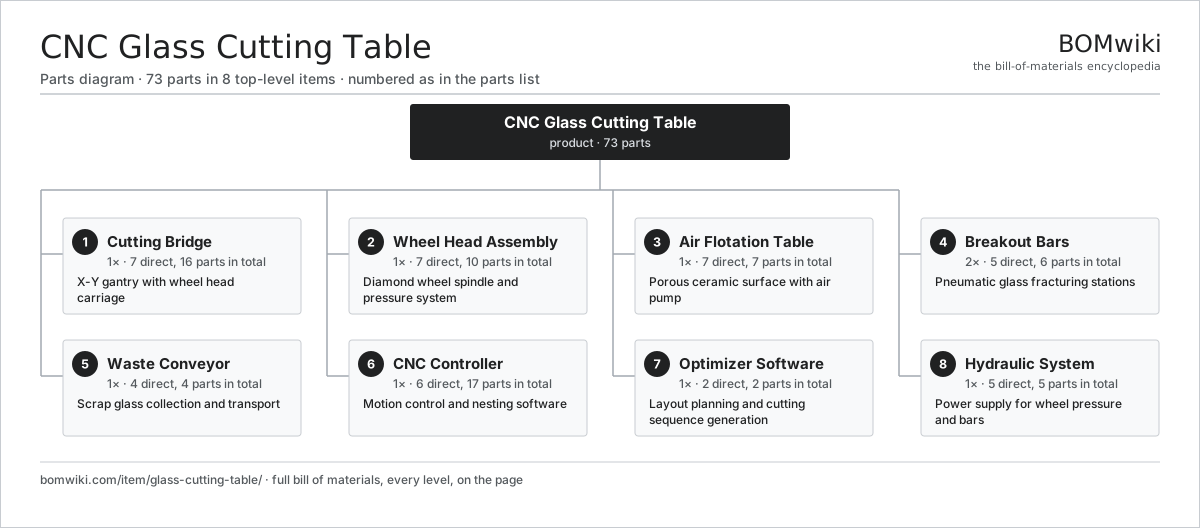
| # | Part | Qty | What it does |
|---|---|---|---|
| 1 | Cutting Bridge 7 parts | 1× | X-Y gantry with wheel head carriage |
| 2 | Wheel Head Assembly 7 parts | 1× | Diamond wheel spindle and pressure system |
| 3 | Air Flotation Table 7 parts | 1× | Porous ceramic surface with air pump |
| 4 | Breakout Bars 5 parts | 2× | Pneumatic glass fracturing stations |
| 5 | Waste Conveyor 4 parts | 1× | Scrap glass collection and transport |
| 6 | CNC Controller 6 parts | 1× | Motion control and nesting software |
| 7 | Optimizer Software 2 parts | 1× | Layout planning and cutting sequence generation |
| 8 | Hydraulic System 5 parts | 1× | Power supply for wheel pressure and bars |
3D model
No 3D model yet. Have a CAD file of this? Add a 3D model. STL renders right on this page; STEP, FreeCAD, and OpenSCAD sources are welcome too (openly licensed, like all 3D models on BOMwiki).
Build & assembly graph
expand / collapse · shared sub-assemblies converge · links to related products · est. labourTap an assembly to expand/collapse · tap a part to open it · use “Open page” for any node · drag to pan, scroll to zoom.
Bill of materials for CNC Glass Cutting Table
8 top-level lines · 51 rows shown · 73 parts total · indented to 3 levels| # | Item / sub-assembly | Part no. | Qty/assy | Ext. qty | Parts | Type |
|---|---|---|---|---|---|---|
| 1 | Cutting Bridge 7 parts | glass-cutting-table-cutting-bridge | 1× | 1 | 16 | assembly |
| 1.1 | X-Axis Servo | glass-cutting-table-x-servo-motor | 1× | 1 | · | part |
| 1.2 | Y-Axis Servo | glass-cutting-table-y-servo-motor | 1× | 1 | · | part |
| 1.3 | Z-Axis Servo | glass-cutting-table-z-servo-motor | 1× | 1 | · | part |
| 1.4 | Ball Screw | ball-screw | 3× | 3 | · | part |
| 1.5 | Linear Guide | glass-cutting-table-linear-guide | 6× | 6 | · | part |
| 1.6 | Encoder | encoder | 3× | 3 | · | part |
| 1.7 | Bridge Frame | glass-cutting-table-bridge-frame | 1× | 1 | · | part |
| 2 | Wheel Head Assembly 7 parts | glass-cutting-table-wheel-head-assembly | 1× | 1 | 10 | assembly |
| 2.1 | Spindle Motor | glass-cutting-table-spindle-motor | 1× | 1 | · | part |
| 2.2 | Diamond Wheel | glass-cutting-table-diamond-wheel | 1× | 1 | · | part |
| 2.3 | Wheel Bearing | glass-cutting-table-wheel-bearing-set | 4× | 4 | · | part |
| 2.4 | Pressure Cylinder | glass-cutting-table-pressure-cylinder | 1× | 1 | · | part |
| 2.5 | Pressure Regulator | glass-cutting-table-pressure-regulator | 1× | 1 | · | part |
| 2.6 | Pressure Sensor | pressure-sensor | 1× | 1 | · | part |
| 2.7 | Motor Mount Block | glass-cutting-table-motor-mount-block | 1× | 1 | · | part |
| 3 | Air Flotation Table 7 parts | glass-cutting-table-air-flotation-table | 1× | 1 | 7 | assembly |
| 3.1 | Ceramic Top | glass-cutting-table-ceramic-top | 1× | 1 | · | part |
| 3.2 | Air Pump | glass-cutting-table-air-pump | 1× | 1 | · | part |
| 3.3 | Pump Motor | glass-cutting-table-pump-motor | 1× | 1 | · | part |
| 3.4 | Air Plenum | glass-cutting-table-air-distribution-plenum | 1× | 1 | · | part |
| 3.5 | Regulating Valve | glass-cutting-table-regulating-valve | 1× | 1 | · | part |
| 3.6 | Pressure Sensor | pressure-sensor | 1× | 1 | · | part |
| 3.7 | Table Frame | glass-cutting-table-table-frame | 1× | 1 | · | part |
| 4 | Breakout Bars 5 parts | glass-cutting-table-breakout-bars | 2× | 2 | 6 | assembly |
| 4.1 | Upper Breakout Cylinder | glass-cutting-table-breakout-cylinder-upper | 1× | 2 | · | part |
| 4.2 | Lower Breakout Cylinder | glass-cutting-table-breakout-cylinder-lower | 1× | 2 | · | part |
| 4.3 | Breakout Valve | glass-cutting-table-bar-valve | 1× | 2 | · | part |
| 4.4 | Impact Block | glass-cutting-table-impact-block | 2× | 4 | · | part |
| 4.5 | Pressure Sensor | pressure-sensor | 1× | 2 | · | part |
| 5 | Waste Conveyor 4 parts | glass-cutting-table-waste-conveyor | 1× | 1 | 4 | assembly |
| 5.1 | Conveyor Motor | glass-cutting-table-conveyor-motor | 1× | 1 | · | part |
| 5.2 | Drive Belt | drive-belt | 1× | 1 | · | part |
| 5.3 | Conveyor Frame | glass-cutting-table-conveyor-frame | 1× | 1 | · | part |
| 5.4 | Collection Hopper | glass-cutting-table-collection-hopper | 1× | 1 | · | part |
| 6 | CNC Controller 6 parts | glass-cutting-table-cnc-controller | 1× | 1 | 17 | assembly |
| 6.1 | Microcontroller | mcu | 1× | 1 | · | part |
| 6.2 | LCD Panel | lcd-panel | 1× | 1 | · | part |
| 6.3 | Bare PCB | pcb-bare | 4× | 4 | · | part |
| 6.4 | Relay | relay | 4× | 4 | · | part |
| 6.5 | Power Supply | power-supply | 1× | 1 | · | part |
| 6.6 | Connector | connector | 6× | 6 | · | part |
| 7 | Optimizer Software 2 parts | glass-cutting-table-optimizer-software | 1× | 1 | 2 | assembly |
| 7.1 | Software License | glass-cutting-table-software-license | 1× | 1 | · | part |
| 7.2 | Database Module | glass-cutting-table-database-module | 1× | 1 | · | part |
| 8 | Hydraulic System 5 parts | glass-cutting-table-hydraulic-system | 1× | 1 | 5 | assembly |
| 8.1 | Hydraulic Pump | glass-cutting-table-hydraulic-pump | 1× | 1 | · | part |
| 8.2 | Hydraulic Motor | glass-cutting-table-hydraulic-motor | 1× | 1 | · | part |
| 8.3 | Hydraulic Reservoir | glass-cutting-table-hydraulic-reservoir | 1× | 1 | · | part |
| 8.4 | Relief Valve | glass-cutting-table-pressure-relief-valve | 1× | 1 | · | part |
| 8.5 | Hydraulic Hose | glass-cutting-table-hydraulic-hose | 1× | 1 | · | part |
Something wrong in this list? Report a problem with this BOM.
Related products
same domain, ranked by shared parts Industrial Ultrasonic Cleaner
787 parts · shares 8 with this page
Powder Coating Line
5,418 parts · shares 8 with this page
Industrial Ultrasonic Cleaner
787 parts · shares 8 with this page
Powder Coating Line
5,418 parts · shares 8 with this page
 Rubber Extrusion Line
524 parts · shares 8 with this page
Rubber Extrusion Line
524 parts · shares 8 with this page
 All-Electric Injection Molding Machine
851 parts · shares 7 with this page
All-Electric Injection Molding Machine
851 parts · shares 7 with this page
 Tensile Testing Machine
608 parts · shares 7 with this page
Tensile Testing Machine
608 parts · shares 7 with this page
Sourcing: possible vendors
Browse the supplier directory → Prices, MOQ, and lead times are algorithmic estimates, not quotes, and not claims about these companies. Company mappings are curated by keyword; est. price band $5k–$2M. How estimates work| Vendor | HQ | Specialty | MOQ | Lead time |
|---|---|---|---|---|
| atlascopco.com ↗ | Stockholm, SE | Compressors & industrial | 10 units | 12–20 wks |
|
🇦🇹Andritz
andritz.com ↗
|
Graz, AT | Process plants & machinery | 10 units | 12–20 wks |
| buhlergroup.com ↗ | Uzwil, CH | Food & materials processing | 10 units | 12–20 wks |
| gea.com ↗ | Düsseldorf, DE | Process technology | 10 units | 12–20 wks |
| mhi.com ↗ | Tokyo, JP | Heavy machinery | 10 units | 12–20 wks |
871-word article