Glass Edging Machine
ProductOverview
A glass edging machine is a precision automated tool that finishes the edges of flat glass sheets through a sequence of grinding and polishing operations. Raw glass edges are typically sharp, uneven, and prone to micro-chipping, which compromises both safety and aesthetics. Edging machines transform these raw edges into smooth, polished surfaces, often with rounded or beveled profiles, suitable for architectural glazing, mirrors, tabletops, display casings, and automotive applications.
The machine operates by clamping a glass sheet on a powered conveyor and advancing it through multiple workstations. Each station houses a spinning diamond-coated grinding wheel that removes the sharp edge and irregularities. Subsequent polishing stations apply soft abrasive pads to achieve optical clarity and a finished appearance. Water-cooled circulation supplies grinding emulsion to the wheel-glass interface, dissipating heat and carrying away glass particles.
Modern edging machines are computer numerical control (CNC) units capable of producing different edge profiles, straight bevels, ogees, polished bevels, through programmable spindle positioning and conveyor speed profiles. High-volume industrial machines process 100+ sheets per hour, while laboratory and custom-job machines operate at lower speeds with greater flexibility.
How It Works
A glass sheet is manually placed on the Conveyor Clamp, where four Clamp Cylinder actuators simultaneously grip opposite edges via rubber-lined Clamp Pad blocks. The Control Panel coordinates the motion sequence: the Conveyor Drive rotates its pulley, advancing the conveyor at a programmable speed of 1–5 meters per minute.
As the sheet moves forward, it passes beneath the first set of three Spindle Assembly stations. Each spindle rotates at 3000–5000 rpm, driven by its Spindle Motor. The diamond wheels, mounted via precise Collet Chuck tool holders, grind the glass edge at successive depth cuts. The Water Cooling System pumps grinding emulsion through Supply Manifold onto the wheel contact zone at 50–100 L/min, continuously cooling the wheel and washing away glass fines.
The machine's Motion Control system uses three servo axes, X (spindle horizontal position), Y (spindle height for different glass thicknesses), and Z (conveyor advance speed), to execute the selected edge profile. A CNC program might specify that the first spindle removes 0.5 mm of glass, the second refines the surface, and the third handles corner rounding. Feedback from Encoder devices on each axis ensures position accuracy to ±0.1 mm.
After grinding, the sheet exits the grinding station and enters the Polish Station. Here, two soft Felt Wheel buffers, rotating at 800–1200 rpm, apply a slurry of cerium oxide abrasive to polish the ground edge to optical clarity. The Slurry Applicator dispenses polish compound at a controlled rate. The polishing spindles are driven by lower-speed Polish Motor units optimized for smooth buffing without generating excessive heat.
Throughout the process, the Vacuum System continuously extracts fine glass dust and coolant aerosol from the work zone. The Dust Collector separates particles from air and deposits them into a collection bin, while filtered air is exhausted. The magnetic component of the Coolant Filter removes ferrous dust from the coolant, and the media filter prolongs the emulsion life to 4–6 weeks before requiring disposal and replacement.
Edge Profiles and Customization
Standard profiles include flat/straight edges (unpolished to polished), beveled edges (45-degree angle, various depths), ogee edges (concave with decorative shoulder), pencil-polish (small radius), and seamed edges (minimal bevel). Complex custom profiles are achievable through multi-point CNC programming of the spindle carriage and conveyor speed.
Quality control is integrated: some edging machines include inline edge detection sensors that measure profile geometry, comparing actual to specified dimensions and triggering alerts for out-of-spec parts.
Industrial Variants
Small-footprint machines for contract glazing shops handle typical architectural glass (up to 2.5 m × 1.5 m) with moderate throughput. Larger units in glass plants process large panes for storefronts and curtain walls. Specialized machines exist for beveled mirror production, where multiple spindles create dramatic decorative bevels, and for automotive windshield edge processing.
Older semi-automatic edging machines required operator intervention at each stage; modern fully automated units run with minimal supervision, producing consistent results across hundreds of sheets per batch.
Glass Edging Machine parts and their functions
8 top-level parts · 91 parts in total · full bill of materials below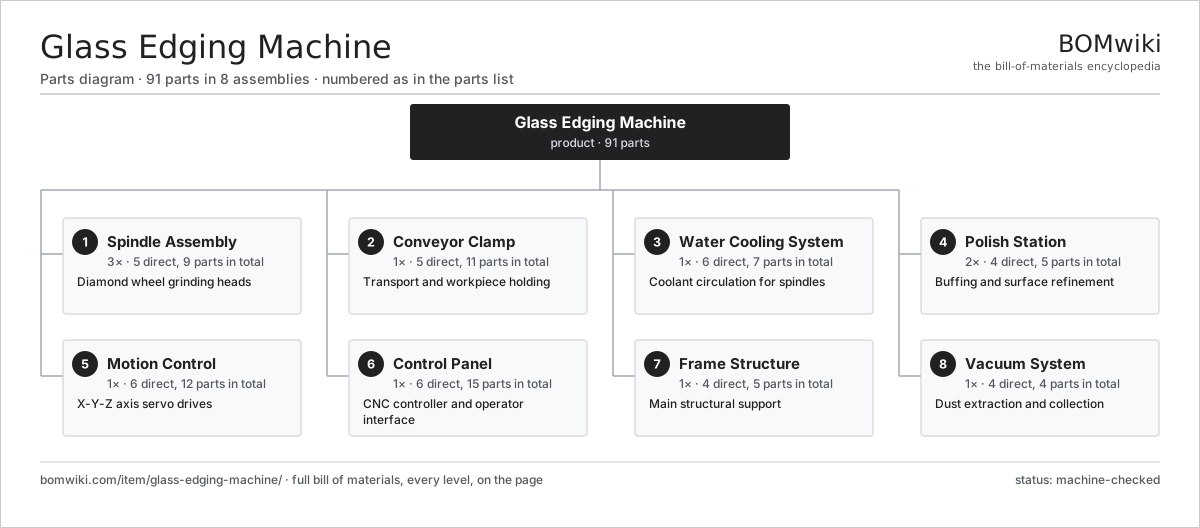
| # | Part | Qty | What it does |
|---|---|---|---|
| 1 | Spindle Assembly 5 parts | 3× | Diamond wheel grinding heads |
| 2 | Conveyor Clamp 5 parts | 1× | Transport and workpiece holding |
| 3 | Water Cooling System 6 parts | 1× | Coolant circulation for spindles |
| 4 | Polish Station 4 parts | 2× | Buffing and surface refinement |
| 5 | Motion Control 6 parts | 1× | X-Y-Z axis servo drives |
| 6 | Control Panel 6 parts | 1× | CNC controller and operator interface |
| 7 | Frame Structure 4 parts | 1× | Main structural support |
| 8 | Vacuum System 4 parts | 1× | Dust extraction and collection |
3D model
No 3D model yet. Have a CAD file of this? Add a 3D model — STL renders right on this page; STEP, FreeCAD, and OpenSCAD sources are welcome too (openly licensed, like all 3D models on BOMwiki).
Build & assembly graph
expand / collapse · shared sub-assemblies converge · links to related products · est. labourTap an assembly to expand/collapse · tap a part to open it · use “Open page” for any node · drag to pan, scroll to zoom.
Bill of materials for Glass Edging Machine
8 top-level lines · 48 rows shown · 91 parts total · indented to 3 levels| # | Item / sub-assembly | Part no. | Qty/assy | Ext. qty | Parts | Type |
|---|---|---|---|---|---|---|
| 1 | Spindle Assembly 5 parts | glass-edging-machine-spindle-assembly | 3× | 3 | 9 | assembly |
| 1.1 | Spindle Motor | glass-edging-machine-motor-spindle | 1× | 3 | · | part |
| 1.2 | Diamond Wheel | glass-edging-machine-diamond-wheel | 1× | 3 | · | part |
| 1.3 | Ball Bearing | ball-bearing | 4× | 12 | · | part |
| 1.4 | Collet Chuck | glass-edging-machine-collet-chuck | 1× | 3 | · | part |
| 1.5 | Oil Seal | oil-seal | 2× | 6 | · | part |
| 2 | Conveyor Clamp 5 parts | glass-edging-machine-conveyor-clamp | 1× | 1 | 11 | assembly |
| 2.1 | Conveyor Belt | glass-edging-machine-conveyor-belt | 1× | 1 | · | part |
| 2.2 | Conveyor Drive | glass-edging-machine-conveyor-drive | 1× | 1 | · | part |
| 2.3 | Clamp Cylinder | glass-edging-machine-pneumatic-clamp-cylinder | 4× | 4 | · | part |
| 2.4 | Clamp Pad | glass-edging-machine-clamp-pad | 4× | 4 | · | part |
| 2.5 | Fastener Set | fastener-set | 1× | 1 | · | part |
| 3 | Water Cooling System 6 parts | glass-edging-machine-water-cooling-system | 1× | 1 | 7 | assembly |
| 3.1 | Coolant Pump | coolant-pump | 1× | 1 | · | part |
| 3.2 | Coolant Reservoir | glass-edging-machine-coolant-reservoir | 1× | 1 | · | part |
| 3.3 | Coolant Filter | glass-edging-machine-coolant-filter | 1× | 1 | · | part |
| 3.4 | Supply Manifold | glass-edging-machine-supply-manifold | 1× | 1 | · | part |
| 3.5 | Flow Meter | glass-edging-machine-flow-meter | 1× | 1 | · | part |
| 3.6 | Pressure Sensor | pressure-sensor | 2× | 2 | · | part |
| 4 | Polish Station 4 parts | glass-edging-machine-polish-station | 2× | 2 | 5 | assembly |
| 4.1 | Polish Motor | glass-edging-machine-polish-motor | 1× | 2 | · | part |
| 4.2 | Felt Wheel | glass-edging-machine-felt-wheel | 1× | 2 | · | part |
| 4.3 | Slurry Applicator | glass-edging-machine-slurry-applicator | 1× | 2 | · | part |
| 4.4 | Ball Bearing | ball-bearing | 2× | 4 | · | part |
| 5 | Motion Control 6 parts | glass-edging-machine-motion-control | 1× | 1 | 12 | assembly |
| 5.1 | X-Axis Servo | glass-edging-machine-servo-drive-x | 1× | 1 | · | part |
| 5.2 | Y-Axis Servo | glass-edging-machine-servo-drive-y | 1× | 1 | · | part |
| 5.3 | Z-Axis Servo | glass-edging-machine-servo-drive-z | 1× | 1 | · | part |
| 5.4 | Encoder | encoder | 3× | 3 | · | part |
| 5.5 | Ball Screw | ball-screw | 3× | 3 | · | part |
| 5.6 | Linear Bearing | glass-edging-machine-linear-bearing | 3× | 3 | · | part |
| 6 | Control Panel 6 parts | glass-edging-machine-control-panel | 1× | 1 | 15 | assembly |
| 6.1 | Microcontroller | mcu | 1× | 1 | · | part |
| 6.2 | LCD Panel | lcd-panel | 1× | 1 | · | part |
| 6.3 | Bare PCB | pcb-bare | 2× | 2 | · | part |
| 6.4 | Relay | relay | 6× | 6 | · | part |
| 6.5 | Power Supply | power-supply | 1× | 1 | · | part |
| 6.6 | Connector | connector | 4× | 4 | · | part |
| 7 | Frame Structure 4 parts | glass-edging-machine-frame-structure | 1× | 1 | 5 | assembly |
| 7.1 | Main Beam | glass-edging-machine-main-beam | 1× | 1 | · | part |
| 7.2 | Spindle Carriage | glass-edging-machine-spindle-carriage | 1× | 1 | · | part |
| 7.3 | Side Panel | glass-edging-machine-side-panels | 2× | 2 | · | part |
| 7.4 | Fastener Set | fastener-set | 1× | 1 | · | part |
| 8 | Vacuum System 4 parts | glass-edging-machine-vacuum-system | 1× | 1 | 4 | assembly |
| 8.1 | Vacuum Motor | glass-edging-machine-vacuum-motor | 1× | 1 | · | part |
| 8.2 | Dust Collector | glass-edging-machine-dust-collector | 1× | 1 | · | part |
| 8.3 | Hose Assembly | glass-edging-machine-hose-assembly | 1× | 1 | · | part |
| 8.4 | Pressure Sensor | pressure-sensor | 1× | 1 | · | part |
Related products
same domain, ranked by shared parts Industrial FDM Printer
98 parts · shares 9 with this page
Electron Beam PBF
128 parts · shares 8 with this page
Industrial FDM Printer
98 parts · shares 9 with this page
Electron Beam PBF
128 parts · shares 8 with this page
 Industrial SLA Printer
94 parts · shares 8 with this page
Pressure Forming Machine
217 parts · shares 8 with this page
Industrial SLA Printer
94 parts · shares 8 with this page
Pressure Forming Machine
217 parts · shares 8 with this page
 Tire Tread Extruder
122 parts · shares 7 with this page
Tire Tread Extruder
122 parts · shares 7 with this page
Sourcing: possible vendors
Prices, MOQ, and lead times are algorithmic estimates, not quotes, and not claims about these companies. Company mappings are curated by keyword; est. price band $5k–$2M. How estimates work| Vendor | HQ | Specialty | MOQ | Lead time |
|---|---|---|---|---|
| atlascopco.com ↗ | Stockholm, SE | Compressors & industrial | 10 units | 12–20 wks |
|
🇦🇹Andritz
andritz.com ↗
|
Graz, AT | Process plants & machinery | 10 units | 12–20 wks |
| buhlergroup.com ↗ | Uzwil, CH | Food & materials processing | 10 units | 12–20 wks |
| gea.com ↗ | Düsseldorf, DE | Process technology | 10 units | 12–20 wks |
| mhi.com ↗ | Tokyo, JP | Heavy machinery | 10 units | 12–20 wks |
745-word article