Glass Tempering Furnace
ProductOverview
A glass tempering furnace is a specialized industrial kiln that subjects flat glass sheets to thermal stress, rapid heating followed by controlled rapid cooling, to create tempered glass with enhanced mechanical properties. Tempered glass achieves 5–6 times the bending strength of annealed glass and shatters into small, relatively harmless fragments rather than sharp shards. This process is essential in construction glazing, automotive safety glass, appliances, and architectural features where safety or durability is critical.
The furnace operates in three distinct stages: heating, dwell, and quenching. Raw annealed glass enters the unit at room temperature and passes through a long heating chamber maintained at 600–700 °C. The exact temperature depends on glass thickness and composition, thicker glass requires slightly lower temperatures to avoid distortion, while thin glass tolerates higher heat. Once the glass reaches the softening point, the material exhibits significant plastic deformation at stress, which is the critical state for tempering.
After heating, the glass moves to the quench section where hundreds of high-velocity air jets, positioned above and below the glass path, rapidly remove heat at rates of 80–150 °C per second. This rapid cooling freezes the outer surfaces before the interior has cooled significantly, creating permanent compressive residual stress in the surface layers and tensile stress in the core. This stress distribution is what gives tempered glass its strength and its characteristic safety shattering behavior.
How it Works
When annealed glass enters the furnace entrance, the Loading Table positions each sheet and the Conveyor System feeds it onto the Roller Assembly. The rollers, driven by the Drive Motor through a Gear Reducer, transport the glass at a speed synchronized to the thermal dwell time required for the specific glass thickness, typically 10–20 minutes for 5–10 mm glass.
Inside the Heating Chamber, arrays of electric Heating Element resistors surround the glass, uniformly heating it from both sides. The Thermocouple Bundle continuously monitors chamber temperature, and the Control System adjusts element power to maintain the target setpoint within ±5 °C. As the glass moves along the chamber, it gradually increases in temperature until it reaches the softening zone.
At the exit of the heating chamber, the glass enters the Quench Section. This critical stage features precisely aligned arrays of Quench Nozzle jets supplied by a pressurized Quench Manifold fed by the Blower Unit. The Blower Motor drives a Blower Wheel that compresses ambient air through an Intake Filter, delivering 0.5–2.0 bar pressure controlled by the Flow Control Valve.
The quench nozzles are positioned to direct jets at precise angles, ensuring uniform cooling across the entire glass surface. The sudden temperature drop freezes the outer edges while the interior remains warmer and therefore still plastic. As the core eventually cools, it tries to contract, but the already-hardened outer shell prevents this contraction, locking permanent compressive stress into the surface.
After quenching, the cooled tempered glass exits onto the Unloading Table, where it is stacked and allowed to cool to ambient temperature over the next 30–60 minutes. During this stabilization period, internal stresses settle into their final equilibrium state.
Process Parameters
The dwell time, how long glass stays in the heating chamber, is the primary variable controlling final temper strength. Longer dwell increases surface temperature uniformity, improving the stress distribution. Modern furnaces allow programmable dwell profiles, stepping the speed in zones to fine-tune heating. Quench pressure and jet positioning are equally critical: too low pressure results in insufficient cooling and weak temper; too high pressure may cause thermal shock damage or non-uniform cooling.
Furnace control systems continuously log temperature, speed, and quench pressure to a data recorder, providing full traceability of each tempered glass batch. This documentation is essential for safety-critical applications such as automotive windshields, where failure analysis may trace back to process deviation.
Industrial Variants
Furnaces vary widely in size and throughput. Laboratory units process single sheets (500×500 mm) for R&D purposes. Industrial furnaces handle standard architectural panes (up to 2.5 m × 6 m) at speeds of 2–4 sheets per minute. The largest flat glass furnaces occupy footprints of 15–20 meters and produce over 100 tons of tempered glass daily.
Horizontal furnaces (as described here) are the industry standard for flat glass. Vertical tube furnaces exist for smaller components and specialty applications, using gravity to advance glass through the heating and quench zones. Horizontal units offer better thermal uniformity and easier automation of handling and stacking.
Glass Tempering Furnace parts and their functions
8 top-level parts · 79 parts in total · full bill of materials below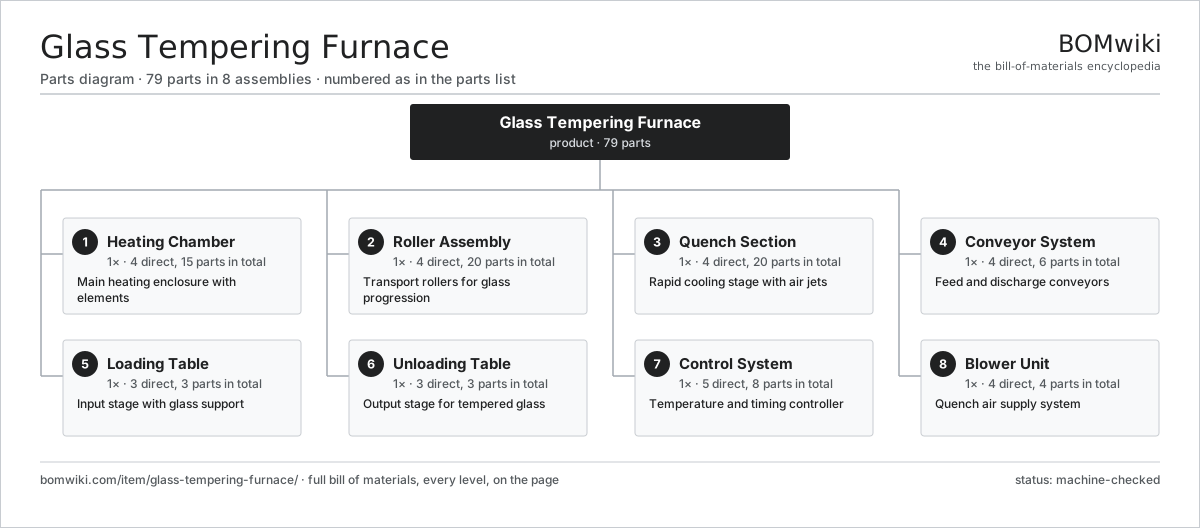
| # | Part | Qty | What it does |
|---|---|---|---|
| 1 | Heating Chamber 4 parts | 1× | Main heating enclosure with elements |
| 2 | Roller Assembly 4 parts | 1× | Transport rollers for glass progression |
| 3 | Quench Section 4 parts | 1× | Rapid cooling stage with air jets |
| 4 | Conveyor System 4 parts | 1× | Feed and discharge conveyors |
| 5 | Loading Table 3 parts | 1× | Input stage with glass support |
| 6 | Unloading Table 3 parts | 1× | Output stage for tempered glass |
| 7 | Control System 5 parts | 1× | Temperature and timing controller |
| 8 | Blower Unit 4 parts | 1× | Quench air supply system |
3D model
No 3D model yet. Have a CAD file of this? Add a 3D model — STL renders right on this page; STEP, FreeCAD, and OpenSCAD sources are welcome too (openly licensed, like all 3D models on BOMwiki).
Build & assembly graph
expand / collapse · shared sub-assemblies converge · links to related products · est. labourTap an assembly to expand/collapse · tap a part to open it · use “Open page” for any node · drag to pan, scroll to zoom.
Bill of materials for Glass Tempering Furnace
8 top-level lines · 39 rows shown · 79 parts total · indented to 3 levels| # | Item / sub-assembly | Part no. | Qty/assy | Ext. qty | Parts | Type |
|---|---|---|---|---|---|---|
| 1 | Heating Chamber 4 parts | glass-tempering-furnace-heating-chamber | 1× | 1 | 15 | assembly |
| 1.1 | Refractory Lining | glass-tempering-furnace-refractory-lining | 1× | 1 | · | part |
| 1.2 | Heating Element | heating-element | 12× | 12 | · | part |
| 1.3 | Chamber Frame | glass-tempering-furnace-chamber-frame | 1× | 1 | · | part |
| 1.4 | Thermocouple Bundle | thermocouple-bundle | 1× | 1 | · | part |
| 2 | Roller Assembly 4 parts | glass-tempering-furnace-roller-assembly | 1× | 1 | 20 | assembly |
| 2.1 | Drive Motor | glass-tempering-furnace-drive-motor | 1× | 1 | · | part |
| 2.2 | Gear Reducer | glass-tempering-furnace-gear-reducer | 1× | 1 | · | part |
| 2.3 | Roller Shaft | glass-tempering-furnace-roller-shaft | 6× | 6 | · | part |
| 2.4 | Ball Bearing | ball-bearing | 12× | 12 | · | part |
| 3 | Quench Section 4 parts | glass-tempering-furnace-quench-section | 1× | 1 | 20 | assembly |
| 3.1 | Quench Manifold | glass-tempering-furnace-quench-manifold | 1× | 1 | · | part |
| 3.2 | Quench Nozzle | glass-tempering-furnace-quench-nozzle | 16× | 16 | · | part |
| 3.3 | Flow Control Valve | glass-tempering-furnace-flow-control-valve | 1× | 1 | · | part |
| 3.4 | Pressure Sensor | pressure-sensor | 2× | 2 | · | part |
| 4 | Conveyor System 4 parts | glass-tempering-furnace-conveyor-system | 1× | 1 | 6 | assembly |
| 4.1 | Conveyor Motor | glass-tempering-furnace-conveyor-motor | 2× | 2 | · | part |
| 4.2 | Drive Belt | drive-belt | 2× | 2 | · | part |
| 4.3 | Support Frame | glass-tempering-furnace-support-frame | 1× | 1 | · | part |
| 4.4 | Fastener Set | fastener-set | 1× | 1 | · | part |
| 5 | Loading Table 3 parts | glass-tempering-furnace-loading-table | 1× | 1 | 3 | assembly |
| 5.1 | Table Top | glass-tempering-furnace-table-top | 1× | 1 | · | part |
| 5.2 | Height Actuator | glass-tempering-furnace-height-actuator | 1× | 1 | · | part |
| 5.3 | Positioning Stops | glass-tempering-furnace-positioning-stops | 1× | 1 | · | part |
| 6 | Unloading Table 3 parts | glass-tempering-furnace-unloading-table | 1× | 1 | 3 | assembly |
| 6.1 | Table Top | glass-tempering-furnace-table-top | 1× | 1 | · | part |
| 6.2 | Support Frame | glass-tempering-furnace-support-frame | 1× | 1 | · | part |
| 6.3 | Sheet Metal Panel | sheet-panel | 1× | 1 | · | part |
| 7 | Control System 5 parts | glass-tempering-furnace-control-system | 1× | 1 | 8 | assembly |
| 7.1 | Microcontroller | mcu | 1× | 1 | · | part |
| 7.2 | LCD Panel | lcd-panel | 1× | 1 | · | part |
| 7.3 | Relay | relay | 4× | 4 | · | part |
| 7.4 | Bare PCB | pcb-bare | 1× | 1 | · | part |
| 7.5 | Power Supply | power-supply | 1× | 1 | · | part |
| 8 | Blower Unit 4 parts | glass-tempering-furnace-blower-unit | 1× | 1 | 4 | assembly |
| 8.1 | Blower Motor | blower-motor | 1× | 1 | · | part |
| 8.2 | Blower Wheel | glass-tempering-furnace-blower-wheel | 1× | 1 | · | part |
| 8.3 | Intake Filter | glass-tempering-furnace-intake-filter | 1× | 1 | · | part |
| 8.4 | Isolation Damper | glass-tempering-furnace-isolation-damper | 1× | 1 | · | part |
Related products
same domain, ranked by shared parts Industrial FDM Printer
98 parts · shares 6 with this page
Industrial FDM Printer
98 parts · shares 6 with this page
 Cable Extrusion Line
46 parts · shares 5 with this page
Cable Extrusion Line
46 parts · shares 5 with this page
 Chalk Extrusion Machine
47 parts · shares 5 with this page
Match Making Machine
47 parts · shares 5 with this page
Hammer Mill
790 parts · shares 6 with this page
Chalk Extrusion Machine
47 parts · shares 5 with this page
Match Making Machine
47 parts · shares 5 with this page
Hammer Mill
790 parts · shares 6 with this page
 Industrial Parts Washer
78 parts · shares 5 with this page
Industrial Parts Washer
78 parts · shares 5 with this page
Sourcing: possible vendors
Prices, MOQ, and lead times are algorithmic estimates, not quotes, and not claims about these companies. Company mappings are curated by keyword; est. price band $5k–$2M. How estimates work| Vendor | HQ | Specialty | MOQ | Lead time |
|---|---|---|---|---|
| atlascopco.com ↗ | Stockholm, SE | Compressors & industrial | 10 units | 12–20 wks |
|
🇦🇹Andritz
andritz.com ↗
|
Graz, AT | Process plants & machinery | 10 units | 12–20 wks |
| buhlergroup.com ↗ | Uzwil, CH | Food & materials processing | 10 units | 12–20 wks |
| gea.com ↗ | Düsseldorf, DE | Process technology | 10 units | 12–20 wks |
| mhi.com ↗ | Tokyo, JP | Heavy machinery | 10 units | 12–20 wks |
791-word article