Headphone Amplifier
ProductOverview
A headphone amplifier exists because headphone loads vary enormously and most source devices drive them poorly. A sensitive in-ear monitor may need only a few milliwatts at 16 Ω; a 600 Ω studio headphone or a low-sensitivity planar magnetic can demand several volts of swing and hundreds of milliamps. A dedicated amplifier supplies both extremes from a low-impedance output while keeping noise below audibility on the most sensitive load.
The signal path is short: input selection, the Volume Section, a Gain Stage, and a Output Stage, guarded by a Protection Circuit circuit. Units with a built-in DAC Section add a USB input ahead of the analog chain.
How it works
Volume is set first. The Volume Potentiometer, typically a dual-gang Alps RK27, attenuates both channels together; placing it before the gain stage means the amplifier also attenuates its own input-referred noise at low listening levels. The Gain Switch changes the feedback ratio of the following stage: unity gain keeps the noise floor inaudible on IEMs, while +10 to +20 dB provides the swing high-impedance headphones need.
The Gain Stage is built around a low-noise Op-Amp per channel. Closed-loop gain is fixed by the Feedback Network; using 0.1 % thin-film resistors here holds channel balance within 0.1 dB across the band, far tighter than any potentiometer could manage on its own.
An op-amp alone cannot source the current a 32 Ω planar draws, so its output feeds the Output Stage: complementary Output Transistors running in Class-AB inside the op-amp's feedback loop. The Bias Network holds a few tens of milliamps of quiescent current through the pair so the handover between halves produces no crossover distortion; the resulting idle heat goes into the Output Heatsinks. A small Output Resistor isolates the loop from cable capacitance while keeping total output impedance under 1 Ω, which preserves the frequency response of multi-driver IEMs whose impedance swings with frequency.
DAC section
The USB Interface receives audio over USB in asynchronous mode: the amplifier's own Clock Oscillators pace the transfer rather than the computer's clock, which removes the host's timing jitter from the signal. Separate low-phase-noise crystals cover the 44.1 kHz and 48 kHz rate families. The DAC Chip, a 32-bit delta-sigma converter, produces a differential output current that the I/V and Filter Stage converts to voltage and low-pass filters, removing the converter's out-of-band noise before the analog volume control.
Power supply
Analog performance starts at the rails. The Linear Power Supply uses a Toroidal Transformer, a toroid chosen for low stray magnetic field, a Bridge Rectifier, and several thousand microfarads of Filter Capacitors. Linear Voltage Regulators then hold the ±12 to ±18 V rails fixed, rejecting the residual 100/120 Hz ripple by 60 dB or more. A Thermal Fuse buried in the transformer winding opens on overload. Linear supplies are heavier and less efficient than switchers, but they place no switching harmonics near the audio band, which is why they persist in this application.
Protection
Headphone drivers are fragile: a few volts of DC will burn out a voice coil. The Protection Circuit circuit interposes a Relay between amplifier and jack. At power-on the Delay Timer keeps the relay open for a few seconds while the rails settle and the op-amps come out of saturation, swallowing the turn-on thump. In operation the DC Detector watches the outputs and drops the relay within milliseconds if offset exceeds about ±0.5 V.
Construction
Everything mounts in the Chassis, with the transformer placed away from the gain stage to keep hum out of the signal path. The Front Panel carries the Headphone Jacks, commonly a 6.35 mm single-ended and a 4.4 mm balanced output, the volume knob, and the Input Selector. Rear Connectors take RCA line input and often provide a preamp output, letting the unit double as a desktop preamplifier.
Headphone Amplifier parts and their functions
8 top-level parts · 56 parts in total · full bill of materials below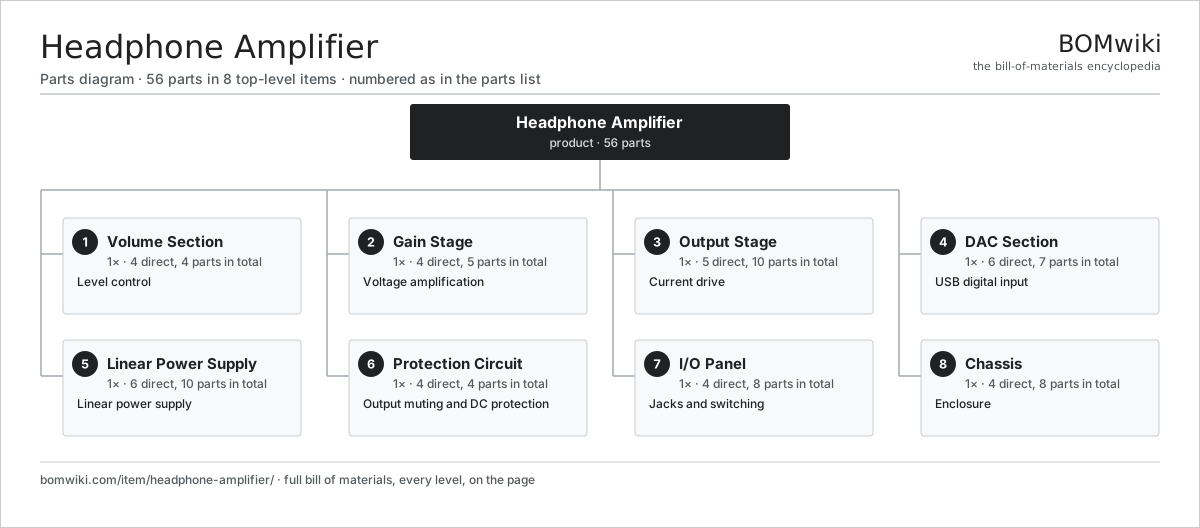
| # | Part | Qty | What it does |
|---|---|---|---|
| 1 | Volume Section 4 parts | 1× | Level control |
| 2 | Gain Stage 4 parts | 1× | Voltage amplification |
| 3 | Output Stage 5 parts | 1× | Current drive |
| 4 | DAC Section 6 parts | 1× | USB digital input |
| 5 | Linear Power Supply 6 parts | 1× | Linear power supply |
| 6 | Protection Circuit 4 parts | 1× | Output muting and DC protection |
| 7 | I/O Panel 4 parts | 1× | Jacks and switching |
| 8 | Chassis 4 parts | 1× | Enclosure |
3D model
No 3D model yet. Have a CAD file of this? Add a 3D model. STL renders right on this page; STEP, FreeCAD, and OpenSCAD sources are welcome too (openly licensed, like all 3D models on BOMwiki).
Build & assembly graph
expand / collapse · shared sub-assemblies converge · links to related products · est. labourTap an assembly to expand/collapse · tap a part to open it · use “Open page” for any node · drag to pan, scroll to zoom.
Bill of materials for Headphone Amplifier
8 top-level lines · 45 rows shown · 56 parts total · indented to 3 levels| # | Item / sub-assembly | Part no. | Qty/assy | Ext. qty | Parts | Type |
|---|---|---|---|---|---|---|
| 1 | Volume Section 4 parts | headphone-amplifier-volume-section | 1× | 1 | 4 | assembly |
| 1.1 | Volume Potentiometer | headphone-amplifier-volume-pot | 1× | 1 | · | part |
| 1.2 | Volume Knob | headphone-amplifier-volume-knob | 1× | 1 | · | part |
| 1.3 | Gain Switch | headphone-amplifier-gain-switch | 1× | 1 | · | part |
| 1.4 | Wire Bundle | wire-bundle | 1× | 1 | · | part |
| 2 | Gain Stage 4 parts | headphone-amplifier-gain-stage | 1× | 1 | 5 | assembly |
| 2.1 | Op-Amp | headphone-amplifier-opamp | 2× | 2 | · | part |
| 2.2 | Feedback Network | headphone-amplifier-feedback-network | 1× | 1 | · | part |
| 2.3 | Bare PCB | pcb-bare | 1× | 1 | · | part |
| 2.4 | SMD Passive (R/C/L) | smd-passives | 1× | 1 | · | part |
| 3 | Output Stage 5 parts | headphone-amplifier-output-stage | 1× | 1 | 10 | assembly |
| 3.1 | Output Transistors | headphone-amplifier-output-transistors | 4× | 4 | · | part |
| 3.2 | Bias Network | headphone-amplifier-bias-network | 1× | 1 | · | part |
| 3.3 | Output Heatsink | headphone-amplifier-heatsink | 2× | 2 | · | part |
| 3.4 | Output Resistor | headphone-amplifier-output-resistor | 2× | 2 | · | part |
| 3.5 | SMD Passive (R/C/L) | smd-passives | 1× | 1 | · | part |
| 4 | DAC Section 6 parts | headphone-amplifier-dac-section | 1× | 1 | 7 | assembly |
| 4.1 | DAC Chip | headphone-amplifier-dac-chip | 1× | 1 | · | part |
| 4.2 | USB Interface | headphone-amplifier-usb-interface | 1× | 1 | · | part |
| 4.3 | Clock Oscillator | headphone-amplifier-clock-oscillator | 2× | 2 | · | part |
| 4.4 | I/V and Filter Stage | headphone-amplifier-iv-stage | 1× | 1 | · | part |
| 4.5 | Bare PCB | pcb-bare | 1× | 1 | · | part |
| 4.6 | SMD Passive (R/C/L) | smd-passives | 1× | 1 | · | part |
| 5 | Linear Power Supply 6 parts | headphone-amplifier-psu | 1× | 1 | 10 | assembly |
| 5.1 | Toroidal Transformer | headphone-amplifier-transformer | 1× | 1 | · | part |
| 5.2 | Bridge Rectifier | headphone-amplifier-rectifier | 1× | 1 | · | part |
| 5.3 | Filter Capacitors | headphone-amplifier-filter-caps | 4× | 4 | · | part |
| 5.4 | Voltage Regulators | headphone-amplifier-regulators | 2× | 2 | · | part |
| 5.5 | Thermal Fuse | thermal-fuse | 1× | 1 | · | part |
| 5.6 | Bare PCB | pcb-bare | 1× | 1 | · | part |
| 6 | Protection Circuit 4 parts | headphone-amplifier-protection | 1× | 1 | 4 | assembly |
| 6.1 | Relay | relay | 1× | 1 | · | part |
| 6.2 | DC Detector | headphone-amplifier-dc-detector | 1× | 1 | · | part |
| 6.3 | Delay Timer | headphone-amplifier-delay-timer | 1× | 1 | · | part |
| 6.4 | SMD Passive (R/C/L) | smd-passives | 1× | 1 | · | part |
| 7 | I/O Panel 4 parts | headphone-amplifier-io-panel | 1× | 1 | 8 | assembly |
| 7.1 | Headphone Jack | headphone-amplifier-headphone-jack | 2× | 2 | · | part |
| 7.2 | Connector | connector | 4× | 4 | · | part |
| 7.3 | Input Selector | headphone-amplifier-input-selector | 1× | 1 | · | part |
| 7.4 | Wire Bundle | wire-bundle | 1× | 1 | · | part |
| 8 | Chassis 4 parts | headphone-amplifier-chassis | 1× | 1 | 8 | assembly |
| 8.1 | Sheet Metal Panel | sheet-panel | 2× | 2 | · | part |
| 8.2 | Front Panel | headphone-amplifier-front-panel | 1× | 1 | · | part |
| 8.3 | Chassis Feet | headphone-amplifier-feet | 4× | 4 | · | part |
| 8.4 | Fastener Set | fastener-set | 1× | 1 | · | part |
Something wrong in this list? Report a problem with this BOM.
Related products
same domain, ranked by shared parts Laser Show Projector
36 parts · shares 3 with this page
Laser Show Projector
36 parts · shares 3 with this page
 Professional Power Amplifier
52 parts · shares 3 with this page
Professional Power Amplifier
52 parts · shares 3 with this page
 CD Player
47 parts · shares 3 with this page
CD Player
47 parts · shares 3 with this page
 Channel Strip
55 parts · shares 3 with this page
Channel Strip
55 parts · shares 3 with this page
 DJ Mixer
86 parts · shares 3 with this page
Line Array Element
47 parts · shares 3 with this page
DJ Mixer
86 parts · shares 3 with this page
Line Array Element
47 parts · shares 3 with this page
Sourcing: possible vendors
Browse the supplier directory → Prices, MOQ, and lead times are algorithmic estimates, not quotes, and not claims about these companies. Company mappings are curated by keyword; est. price band $50–$3k. How estimates work| Vendor | HQ | Specialty | MOQ | Lead time |
|---|---|---|---|---|
|
🇯🇵Sony
sony.com ↗
|
Tokyo, JP | Consumer electronics | 1,000 units | 8–12 wks |
| samsung.com ↗ | Suwon, KR | Electronics & displays | 1,000 units | 8–12 wks |
|
🇺🇸Harman
harman.com ↗
|
Stamford, US | Audio (JBL, AKG) | 1,000 units | 8–12 wks |
|
🇺🇸Bose
bose.com ↗
|
Framingham, US | Audio | 1,000 units | 8–12 wks |
| yamaha.com ↗ | Hamamatsu, JP | Audio & instruments | 1,000 units | 8–12 wks |
721-word article