Hearing Loop System
ProductOverview
A hearing loop (or induction loop, T-coil system) is a room-based audio distribution system that broadcasts speech and presentations directly to hearing aid users via electromagnetic induction. A copper wire running around the room's perimeter carries an audio-modulated electrical current, generating a time-varying magnetic field. Modern hearing aids include a small coil (the T-coil or telecoil) that receives this magnetic signal and converts it to audio, bypassing the hearing aid's microphone and environmental noise.
Hearing loops are widely deployed in lecture halls, courtrooms, theaters, churches, and public buildings to provide hearing-impaired patrons with clear, direct access to audio without requiring compatible personal FM or Bluetooth receivers. They comply with accessibility standards including the Americans with Disabilities Act (ADA) and EN 60118-4 international standards. For hearing aid wearers, a loop system is often preferred over FM or digital wireless systems because no additional receiver device is required, the T-coil is built into most hearing aids.
How it works
The loop amplifier accepts audio from a microphone (speaker, presenter, lecturer) via the XLR input and/or auxiliary audio from a computer, sound system, or multimedia player via the 3.5 mm auxiliary input. The amplifier combines these sources, applies feedback suppression to prevent howling, and outputs an amplified signal to the perimeter loop wire.
The loop wire carries an alternating electrical current proportional to the audio signal (1–3 amperes typical). This current creates a time-varying magnetic field that circulates through the room. A hearing aid user with T-coil activated has their hearing aid's internal induction coil receive this magnetic signal; the aid's circuits demodulate the signal, converting it back to audio and playing it through the aid's amplifier and speaker.
From the user's perspective, they hear the speaker's voice or presentation audio directly in their hearing aid at a volume and clarity independent of room noise, reverberation, or distance from the sound source. The loop provides approximately equal signal strength throughout the room (to the extent that the loop wire routing and current amplitude allow), creating uniform coverage.
Advantages over wireless systems
No receiver required: Unlike FM or digital wireless systems, hearing aid users need only activate their built-in T-coil, no additional battery-powered receiver to carry, charge, or lose.
Simplified operation: Deaf and hard-of-hearing people manage their own hearing aid settings; room staff or event organizers do not need to hand out, retrieve, or maintain numerous individual receivers.
Cost-effective: A room installation cost (wire, amplifier, installation labor) is amortized across many users over years, rather than purchasing multiple wireless receivers at $500–2000 each.
Reliable: No RF interference, dropouts, or battery-dependent receivers. The system works as long as the amplifier is powered.
Privacy: Unlike wireless systems that broadcast to all receivers, a loop signal is confined to the loop perimeter and does not radiate beyond the room, reducing eavesdropping risk in sensitive settings (courtrooms, medical offices).
Limitations and hearing aid compatibility
Not all hearing aids include a T-coil; older or basic models may lack this feature. Users with newer digital hearing aids typically have T-coil capability, though it must be explicitly activated (often a switch or program setting). Some users find T-coil audio quality slightly lower than standard microphone input, particularly if the loop system has inadequate feedback suppression.
Loop performance degrades in large halls or irregularly shaped rooms where the wire routing cannot maintain uniform field strength. Metallic structural elements (steel I-beams, reinforced concrete) can induce eddy currents that weaken the magnetic field in localized areas.
Installation and field strength
The induction loop is typically routed around the room's perimeter, mounted 50–100 mm from walls using cable clips. Alternatively, in portable setups, the wire can be laid on the floor around the seating area, fastened with tape or clips.
Field strength is measured in dB SPL equivalent (hearing aid manufacturers define a reference sensitivity for their T-coils). Standard guidance requires ≥80 dB SPL equivalent field strength throughout the coverage area; 100–120 dB is ideal for robust, noise-free reception. This is achieved by tuning the amplifier output and loop current (1–3 A typical, higher current → stronger field).
Feedback control and microphone management
If a microphone's speaker (e.g., a lecturer) uses a hearing aid with activated T-coil, feedback can occur: the loop signal reaches the speaker's hearing aid, is amplified by the aid's speaker, is picked up by the presentation microphone, and re-enters the amplifier, creating a howling oscillation.
The feedback suppression circuitry mitigates this via:
- Notch filtering: Attenuating specific frequencies where feedback is most likely.
- Phase control: Adjusting the phase relationship between the loop signal and microphone input to cancel feedback-coupled components.
- Peak limiting: Preventing amplifier saturation that triggers feedback.
Modern hearing aids also include feedback suppression on their end, reducing system-level feedback risk.
Signage and user awareness
A major limitation of hearing loops is user awareness. Many hearing aid wearers don't know their devices have T-coils or how to activate them. Standardized loop signage, the T-coil symbol (a stylized ear with a T), is displayed at room entrances to inform users that a loop is available. User guides provide instructions for activating T-coil mode.
Public health agencies and accessibility advocates recommend that organizations installing loops conduct outreach campaigns and include loop information in building orientation materials, websites, and event announcements.
Standards and compliance
Hearing loop systems are defined by:
- EN 60118-4 (international): Technical specifications for loop systems and hearing aid T-coil compatibility.
- ADA (United States): Requirement for loop or comparable audio distribution in public venues.
- BS 6083 (UK): British standard for loop installation and performance.
These standards specify minimum field strength, frequency response, and installation practices to ensure consistent, high-quality service.
Hearing Loop System parts and their functions
6 top-level parts · 244 parts in total · full bill of materials below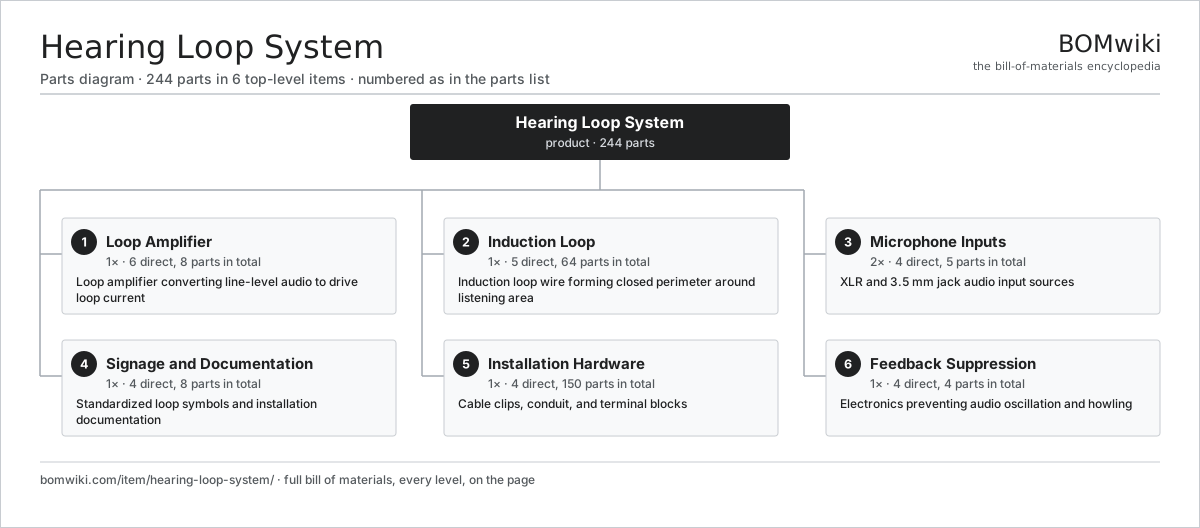
| # | Part | Qty | What it does |
|---|---|---|---|
| 1 | Loop Amplifier 6 parts | 1× | Loop amplifier converting line-level audio to drive loop current |
| 2 | Induction Loop 5 parts | 1× | Induction loop wire forming closed perimeter around listening area |
| 3 | Microphone Inputs 4 parts | 2× | XLR and 3.5 mm jack audio input sources |
| 4 | Signage and Documentation 4 parts | 1× | Standardized loop symbols and installation documentation |
| 5 | Installation Hardware 4 parts | 1× | Cable clips, conduit, and terminal blocks |
| 6 | Feedback Suppression 4 parts | 1× | Electronics preventing audio oscillation and howling |
3D model
No 3D model yet. Have a CAD file of this? Add a 3D model. STL renders right on this page; STEP, FreeCAD, and OpenSCAD sources are welcome too (openly licensed, like all 3D models on BOMwiki).
Build & assembly graph
expand / collapse · shared sub-assemblies converge · links to related products · est. labourTap an assembly to expand/collapse · tap a part to open it · use “Open page” for any node · drag to pan, scroll to zoom.
Bill of materials for Hearing Loop System
6 top-level lines · 33 rows shown · 244 parts total · indented to 3 levels| # | Item / sub-assembly | Part no. | Qty/assy | Ext. qty | Parts | Type |
|---|---|---|---|---|---|---|
| 1 | Loop Amplifier 6 parts | hearing-loop-system-amplifier | 1× | 1 | 8 | assembly |
| 1.1 | Amplifier Chassis | hearing-loop-system-amplifier-chassis | 1× | 1 | · | part |
| 1.2 | Amplifier Electronics | hearing-loop-system-amplifier-electronics | 1× | 1 | · | part |
| 1.3 | Input Stage | hearing-loop-system-input-stage | 1× | 1 | · | part |
| 1.4 | Output Stage | hearing-loop-system-output-stage | 1× | 1 | · | part |
| 1.5 | Power Supply | power-supply | 1× | 1 | · | part |
| 1.6 | Connector | connector | 3× | 3 | · | part |
| 2 | Induction Loop 5 parts | hearing-loop-system-loop-cable | 1× | 1 | 64 | assembly |
| 2.1 | Loop Wire | hearing-loop-system-loop-wire | 1× | 1 | · | part |
| 2.2 | Cable Conduit | hearing-loop-system-cable-conduit | 1× | 1 | · | part |
| 2.3 | Loop Termination | hearing-loop-system-loop-termination | 2× | 2 | · | part |
| 2.4 | Cable Clips | hearing-loop-system-cable-clips | 20× | 20 | · | part |
| 2.5 | Fastener Set | fastener-set | 40× | 40 | · | part |
| 3 | Microphone Inputs 4 parts | hearing-loop-system-microphone-inputs | 2× | 2 | 5 | assembly |
| 3.1 | XLR Input | hearing-loop-system-xlr-input | 1× | 2 | · | part |
| 3.2 | Auxiliary Input | hearing-loop-system-aux-input | 1× | 2 | · | part |
| 3.3 | Input Cables | hearing-loop-system-input-cables | 2× | 4 | · | part |
| 3.4 | Mixing Control | hearing-loop-system-mixing-control | 1× | 2 | · | part |
| 4 | Signage and Documentation 4 parts | hearing-loop-system-signage | 1× | 1 | 8 | assembly |
| 4.1 | Loop Symbol Plaques | hearing-loop-system-loop-symbol | 4× | 4 | · | part |
| 4.2 | Installation Manual | hearing-loop-system-installation-manual | 1× | 1 | · | part |
| 4.3 | User Guide | hearing-loop-system-user-guide | 1× | 1 | · | part |
| 4.4 | Event Signage | hearing-loop-system-event-signage | 2× | 2 | · | part |
| 5 | Installation Hardware 4 parts | hearing-loop-system-installation-hardware | 1× | 1 | 150 | assembly |
| 5.1 | Wall Anchors | hearing-loop-system-wall-anchors | 40× | 40 | · | part |
| 5.2 | Conduit Brackets | hearing-loop-system-conduit-brackets | 20× | 20 | · | part |
| 5.3 | Cable Tie-Downs | hearing-loop-system-cable-tie-downs | 30× | 30 | · | part |
| 5.4 | Fastener Set | fastener-set | 60× | 60 | · | part |
| 6 | Feedback Suppression 4 parts | hearing-loop-system-feedback-suppression | 1× | 1 | 4 | assembly |
| 6.1 | Feedback Filter | hearing-loop-system-feedback-filter | 1× | 1 | · | part |
| 6.2 | Limiter Circuit | hearing-loop-system-limiter-circuit | 1× | 1 | · | part |
| 6.3 | Phase Control | hearing-loop-system-phase-control | 1× | 1 | · | part |
| 6.4 | Bare PCB | pcb-bare | 1× | 1 | · | part |
Something wrong in this list? Report a problem with this BOM.
Related products
same domain, ranked by shared parts Anesthesia Machine
562 parts · shares 1 with this page
Anesthesia Machine
562 parts · shares 1 with this page
 Apheresis Machine
199 parts · shares 1 with this page
Apheresis Machine
199 parts · shares 1 with this page
 Autorefractor
513 parts · shares 1 with this page
Autorefractor
513 parts · shares 1 with this page
 Blood Bank Refrigerator
79 parts · shares 1 with this page
Blood Gas Analyzer
386 parts · shares 1 with this page
Blood Bank Refrigerator
79 parts · shares 1 with this page
Blood Gas Analyzer
386 parts · shares 1 with this page
 Blood/Fluid Warmer
28 parts · shares 1 with this page
Blood/Fluid Warmer
28 parts · shares 1 with this page
Sourcing: possible vendors
Browse the supplier directory → Prices, MOQ, and lead times are algorithmic estimates, not quotes, and not claims about these companies. Company mappings are curated by keyword; est. price band $500–$3M. How estimates work| Vendor | HQ | Specialty | MOQ | Lead time |
|---|---|---|---|---|
| gehealthcare.com ↗ | Chicago, US | Medical imaging & devices | 100 units | 12–20 wks |
| siemens-healthineers.com ↗ | Erlangen, DE | Medical systems | 100 units | 12–20 wks |
|
🇳🇱Philips
philips.com ↗
|
Amsterdam, NL | Health technology | 100 units | 12–20 wks |
| medtronic.com ↗ | Minneapolis, US | Medical devices | 100 units | 12–20 wks |
|
🇨🇳Mindray
mindray.com ↗
|
Shenzhen, CN | Medical devices | 100 units | 12–20 wks |
1,044-word article