Heart-Lung Machine
ProductOverview
A heart-lung machine performs cardiopulmonary bypass: it drains venous blood from the patient, adds oxygen, removes carbon dioxide, controls blood temperature, and pumps the blood back into the arterial system. With the circulation externalised, surgeons can stop the heart with cardioplegia solution and operate on a still, bloodless field. The machine was first used successfully by John Gibbon in 1953; a modern console supports bypass runs of several hours during valve replacement, coronary grafting, and aortic surgery.
The machine itself is the permanent console, pumps, monitors, gas supply, and water circuit, while the blood-contacting path is a sterile single-use Tubing System (Disposable Circuit) mounted on it before each case. A perfusionist operates the console throughout the procedure.
Blood path
Venous blood drains by gravity or vacuum assist from the right atrium through the Cannula Set into the Venous Reservoir, a hard-shell tank of 3–4 litres that buffers volume changes, defoams, and filters cardiotomy suction returns. From the reservoir the main arterial pump pushes blood through the membrane oxygenator, the Arterial Line Filter (a 38 µm screen that traps any remaining emboli), and back through the aortic cannula. Total prime volume of the circuit is 1.2–1.8 litres, usually filled with crystalloid so the patient is hemodiluted when bypass begins.
Pumps
The console carries two pump types. The Roller Pump Module modules are positive-displacement peristaltic pumps: a Pump Rotor Arm sweeps two Occluding Rollers around a length of tubing held in the Pump Raceway, pushing a fixed volume per revolution. The Occlusion Adjuster is set so the rollers almost, but not quite, fully flatten the tubing, under-occlusion loses output, over-occlusion destroys red cells. Roller pumps serve the cardiotomy suckers, the ventricular vent, and cardioplegia delivery, where their precise, pressure-independent output is wanted.
Systemic flow normally comes from the Centrifugal Pump Drive. Its disposable Disposable Pump Head contains a vaned or smooth-cone impeller spun to 4,000 rpm through a Magnetic Coupler, so no shaft penetrates the blood chamber. Output depends on both speed and downstream resistance, which makes the pump inherently pressure-limited: it cannot burst a clamped line the way a roller pump can. Actual delivered flow is therefore measured directly with the ultrasonic Ultrasonic Flow Probe. Every pump position retains a Emergency Hand Crank so perfusion can continue by hand if all power is lost.
Gas exchange and temperature
The disposable oxygenator hangs on the Oxygenator Holder and receives sweep gas from the Gas Blender, which proportions oxygen and air to a set FiO2; flow through each Gas Flowmeter determines CO2 removal, much as minute ventilation does in the lung. A Vaporizer Mount lets volatile anesthetic be added to the sweep gas, and the Oxygen Analyzer confirms delivered oxygen fraction.
Blood temperature is managed through the Heat Exchanger Circuit: water held in the Water Reservoir is heated or chilled between 2 °C and 41 °C and circulated through the oxygenator's integral heat exchanger via Insulated Water Hoses. Cooling the patient to 28–32 °C reduces metabolic oxygen demand and adds a safety margin; the Water Temperature Controller then rewarms at a limited gradient to avoid gaseous emboli forming as solubility falls.
Safety systems
The Safety Sensor Suite suite interlocks the pumps. An ultrasonic Ultrasonic Bubble Detector on the arterial line stops the pump and fires the Electric Tube Clamp within milliseconds if air above roughly 0.3 mL is detected, since arterial air embolism is the most feared bypass accident. The capacitive Reservoir Level Sensor on the venous reservoir slows or stops the arterial pump before the reservoir can empty and entrain air. Four Pressure Sensor channels watch arterial line and cardioplegia pressures, and Temperature Probes track arterial, venous, and water temperatures.
Console and controls
The Console Base is a wheeled steel Console Chassis with rails accepting interchangeable pump modules and two Accessory Masts for holders and monitors. The Control and Monitoring System gives each pump its own Microcontroller-based controller and LCD Panel, with a central System Display aggregating flows, pressures, temperatures, and bypass timers. All electronics run from an isolated medical-grade Power Supply, and the Backup Power System battery bank carries the full pump load for at least an hour, long enough to finish a case or come safely off bypass during a mains failure.
Heart-Lung Machine parts and their functions
9 top-level parts · 298 parts in total · full bill of materials below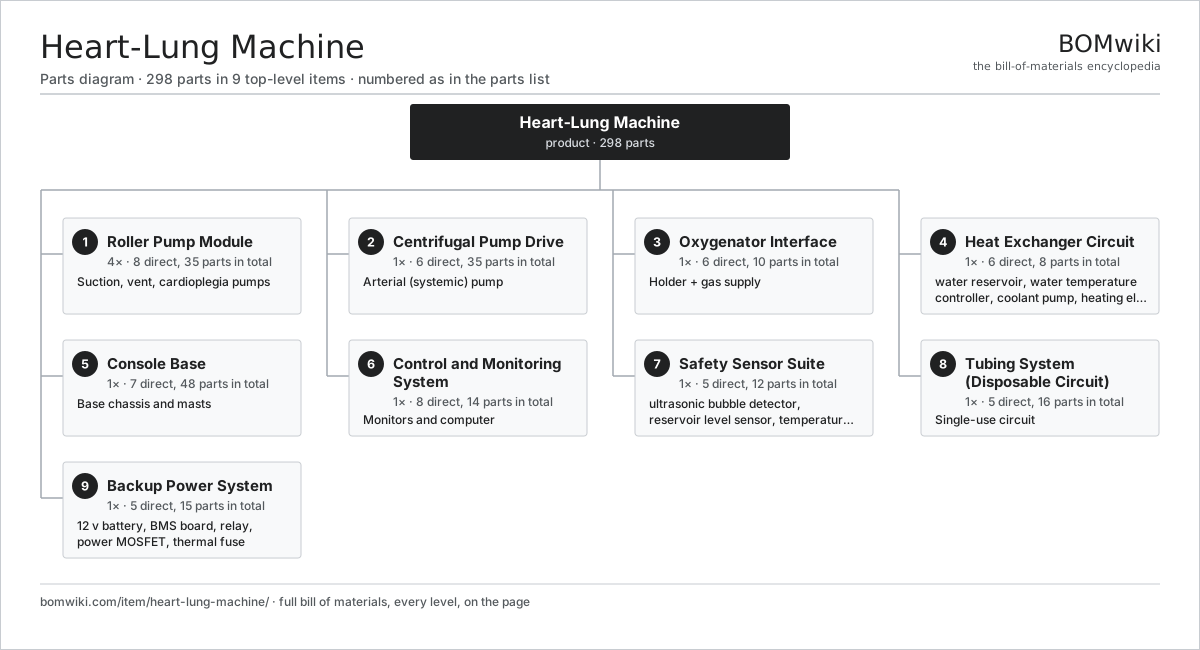
| # | Part | Qty | What it does |
|---|---|---|---|
| 1 | Roller Pump Module 8 parts | 4× | Suction, vent, cardioplegia pumps |
| 2 | Centrifugal Pump Drive 6 parts | 1× | Arterial (systemic) pump |
| 3 | Oxygenator Interface 6 parts | 1× | Holder + gas supply |
| 4 | Heat Exchanger Circuit 6 parts | 1× | Water circuit that warms or cools the blood through the oxygenator heat exchanger for controlled hypothermia. |
| 5 | Console Base 7 parts | 1× | Base chassis and masts |
| 6 | Control and Monitoring System 8 parts | 1× | Monitors and computer |
| 7 | Safety Sensor Suite 5 parts | 1× | Bubble, level, pressure, and temperature sensors that interlock the pumps against air embolism and over-pressure. |
| 8 | Tubing System (Disposable Circuit) 5 parts | 1× | Single-use circuit |
| 9 | Backup Power System 5 parts | 1× | On-board battery bank that keeps all pumps running for at least 60 minutes on mains failure. |
3D model
No 3D model yet. Have a CAD file of this? Add a 3D model. STL renders right on this page; STEP, FreeCAD, and OpenSCAD sources are welcome too (openly licensed, like all 3D models on BOMwiki).
Build & assembly graph
expand / collapse · shared sub-assemblies converge · links to related products · est. labourTap an assembly to expand/collapse · tap a part to open it · use “Open page” for any node · drag to pan, scroll to zoom.
Bill of materials for Heart-Lung Machine
9 top-level lines · 78 rows shown · 298 parts total · indented to 3 levels| # | Item / sub-assembly | Part no. | Qty/assy | Ext. qty | Parts | Type |
|---|---|---|---|---|---|---|
| 1 | Roller Pump Module 8 parts | heart-lung-machine-roller-pump | 4× | 4 | 35 | assembly |
| 1.1 | Pump Rotor Arm | heart-lung-machine-pump-rotor | 1× | 4 | · | part |
| 1.2 | Occluding Roller | heart-lung-machine-roller | 2× | 8 | · | part |
| 1.3 | Pump Raceway | heart-lung-machine-raceway | 1× | 4 | · | part |
| 1.4 | Occlusion Adjuster | heart-lung-machine-occlusion-adjuster | 1× | 4 | · | part |
| 1.5 | Emergency Hand Crank | heart-lung-machine-hand-crank | 1× | 4 | · | part |
| 1.6 | Servo Motor 4 parts | servo-motor | 1× | 4 | 24 | assembly |
| 1.6.1 | Stator Assembly 3 parts + deeper › | stator-assembly | 1× | 4 | 3 | assembly |
| 1.6.2 | Rotor Assembly 4 parts + deeper › | rotor-assembly | 1× | 4 | 19 | assembly |
| 1.6.3 | Encoder | encoder | 1× | 4 | · | part |
| 1.6.4 | Motor Housing | motor-housing | 1× | 4 | · | part |
| 1.7 | Encoder | encoder | 1× | 4 | · | part |
| 1.8 | Ball Bearing | ball-bearing | 4× | 16 | · | part |
| 2 | Centrifugal Pump Drive 6 parts | heart-lung-machine-centrifugal-pump | 1× | 1 | 35 | assembly |
| 2.1 | Disposable Pump Head | heart-lung-machine-pump-head | 1× | 1 | · | part |
| 2.2 | Magnetic Coupler | heart-lung-machine-magnetic-coupler | 1× | 1 | · | part |
| 2.3 | Ultrasonic Flow Probe | heart-lung-machine-flow-probe | 1× | 1 | · | part |
| 2.4 | Servo Motor 4 parts | servo-motor | 1× | 1 | 24 | assembly |
| 2.4.1 | Stator Assembly 3 parts + deeper › | stator-assembly | 1× | 1 | 3 | assembly |
| 2.4.2 | Rotor Assembly 4 parts + deeper › | rotor-assembly | 1× | 1 | 19 | assembly |
| 2.4.3 | Encoder | encoder | 1× | 1 | · | part |
| 2.4.4 | Motor Housing | motor-housing | 1× | 1 | · | part |
| 2.5 | Neodymium Magnet | neodymium-magnet | 6× | 6 | · | part |
| 2.6 | Hall Sensor | hall-sensor | 2× | 2 | · | part |
| 3 | Oxygenator Interface 6 parts | heart-lung-machine-oxygenator-interface | 1× | 1 | 10 | assembly |
| 3.1 | Oxygenator Holder | heart-lung-machine-oxygenator-holder | 1× | 1 | · | part |
| 3.2 | Gas Blender | heart-lung-machine-gas-blender | 1× | 1 | · | part |
| 3.3 | Gas Flowmeter | heart-lung-machine-gas-flowmeter | 2× | 2 | · | part |
| 3.4 | Vaporizer Mount | heart-lung-machine-vaporizer-mount | 1× | 1 | · | part |
| 3.5 | Oxygen Analyzer | heart-lung-machine-o2-analyzer | 1× | 1 | · | part |
| 3.6 | Connector | connector | 4× | 4 | · | part |
| 4 | Heat Exchanger Circuit 6 parts | heart-lung-machine-heat-exchanger-circuit | 1× | 1 | 8 | assembly |
| 4.1 | Water Reservoir | heart-lung-machine-water-reservoir | 1× | 1 | · | part |
| 4.2 | Water Temperature Controller | heart-lung-machine-temp-controller | 1× | 1 | · | part |
| 4.3 | Coolant Pump | coolant-pump | 1× | 1 | · | part |
| 4.4 | Heating Element | heating-element | 2× | 2 | · | part |
| 4.5 | Insulated Water Hose | heart-lung-machine-water-hose | 2× | 2 | · | part |
| 4.6 | Pressure Sensor | pressure-sensor | 1× | 1 | · | part |
| 5 | Console Base 7 parts | heart-lung-machine-console | 1× | 1 | 48 | assembly |
| 5.1 | Console Chassis | heart-lung-machine-chassis | 1× | 1 | · | part |
| 5.2 | Accessory Mast | heart-lung-machine-mast | 2× | 2 | · | part |
| 5.3 | Wheel Assembly 5 parts | wheel-assembly | 4× | 4 | 9 | assembly |
| 5.3.1 | Alloy Wheel | alloy-wheel | 1× | 4 | · | part |
| 5.3.2 | Tire | tire | 1× | 4 | · | part |
| 5.3.3 | TPMS Sensor | tpms-sensor | 1× | 4 | · | part |
| 5.3.4 | Lug Nut | lug-nut | 5× | 20 | · | part |
| 5.3.5 | Valve Stem | valve-stem | 1× | 4 | · | part |
| 5.4 | Sheet Metal Panel | sheet-panel | 6× | 6 | · | part |
| 5.5 | Power Supply | power-supply | 1× | 1 | · | part |
| 5.6 | Fastener Set | fastener-set | 1× | 1 | · | part |
| 5.7 | Wire Bundle | wire-bundle | 1× | 1 | · | part |
| 6 | Control and Monitoring System 8 parts | heart-lung-machine-control-system | 1× | 1 | 14 | assembly |
| 6.1 | System Display | heart-lung-machine-system-display | 1× | 1 | · | part |
| 6.2 | LCD Panel | lcd-panel | 2× | 2 | · | part |
| 6.3 | Touch Digitizer | touch-digitizer | 1× | 1 | · | part |
| 6.4 | Compute SoC Module | soc-module | 1× | 1 | · | part |
| 6.5 | Microcontroller | mcu | 4× | 4 | · | part |
| 6.6 | Bare PCB | pcb-bare | 3× | 3 | · | part |
| 6.7 | SMD Passive (R/C/L) | smd-passives | 1× | 1 | · | part |
| 6.8 | Speaker | speaker | 1× | 1 | · | part |
| 7 | Safety Sensor Suite 5 parts | heart-lung-machine-safety-sensors | 1× | 1 | 12 | assembly |
| 7.1 | Ultrasonic Bubble Detector | heart-lung-machine-bubble-detector | 2× | 2 | · | part |
| 7.2 | Reservoir Level Sensor | heart-lung-machine-level-sensor | 1× | 1 | · | part |
| 7.3 | Temperature Probe | heart-lung-machine-temp-probe | 4× | 4 | · | part |
| 7.4 | Pressure Sensor | pressure-sensor | 4× | 4 | · | part |
| 7.5 | Electric Tube Clamp | heart-lung-machine-tube-clamp | 1× | 1 | · | part |
| 8 | Tubing System (Disposable Circuit) 5 parts | heart-lung-machine-tubing-system | 1× | 1 | 16 | assembly |
| 8.1 | Venous Reservoir | heart-lung-machine-venous-reservoir | 1× | 1 | · | part |
| 8.2 | PVC Circuit Tubing | heart-lung-machine-pvc-tubing | 1× | 1 | · | part |
| 8.3 | Arterial Line Filter | heart-lung-machine-arterial-filter | 1× | 1 | · | part |
| 8.4 | Cannula Set | heart-lung-machine-cannula-set | 1× | 1 | · | part |
| 8.5 | Connector | connector | 12× | 12 | · | part |
| 9 | Backup Power System 5 parts | heart-lung-machine-backup-power | 1× | 1 | 15 | assembly |
| 9.1 | 12 V Battery | lv-battery | 2× | 2 | · | part |
| 9.2 | BMS Board | bms-board | 1× | 1 | · | part |
| 9.3 | Relay | relay | 2× | 2 | · | part |
| 9.4 | Power MOSFET | mosfet | 8× | 8 | · | part |
| 9.5 | Thermal Fuse | thermal-fuse | 2× | 2 | · | part |
Something wrong in this list? Report a problem with this BOM.
Related products
same domain, ranked by shared parts ECMO Machine
142 parts · shares 32 with this page
Rehabilitation Robot Arm
467 parts · shares 27 with this page
Bladder Scanner
483 parts · shares 26 with this page
Infant Radiant Warmer
142 parts · shares 23 with this page
Surgical Navigation System
127 parts · shares 13 with this page
ECMO Machine
142 parts · shares 32 with this page
Rehabilitation Robot Arm
467 parts · shares 27 with this page
Bladder Scanner
483 parts · shares 26 with this page
Infant Radiant Warmer
142 parts · shares 23 with this page
Surgical Navigation System
127 parts · shares 13 with this page
 Apheresis Machine
199 parts · shares 22 with this page
Apheresis Machine
199 parts · shares 22 with this page
Sourcing: possible vendors
Browse the supplier directory → Prices, MOQ, and lead times are algorithmic estimates, not quotes, and not claims about these companies. Company mappings are curated by keyword; est. price band $500–$3M. How estimates work| Vendor | HQ | Specialty | MOQ | Lead time |
|---|---|---|---|---|
| gehealthcare.com ↗ | Chicago, US | Medical imaging & devices | 100 units | 12–20 wks |
| siemens-healthineers.com ↗ | Erlangen, DE | Medical systems | 100 units | 12–20 wks |
|
🇳🇱Philips
philips.com ↗
|
Amsterdam, NL | Health technology | 100 units | 12–20 wks |
| medtronic.com ↗ | Minneapolis, US | Medical devices | 100 units | 12–20 wks |
|
🇨🇳Mindray
mindray.com ↗
|
Shenzhen, CN | Medical devices | 100 units | 12–20 wks |
806-word article