Holter ECG Monitor
ProductOverview
A Holter monitor is a portable electrocardiogram recorder designed to capture the electrical activity of the heart continuously over 24, 48, or even 72 hours while the patient goes about their daily life at home or work. Named after inventor Norman Holter, the device reveals intermittent arrhythmias (irregular heartbeats) and ischemic episodes that would be missed on a standard 12-lead ECG recorded in the clinic, a single 10-second snapshot may show nothing abnormal even though the patient experiences palpitations or syncope several times per day. By storing hours of ECG waveforms, the Holter monitor lets cardiologists correlate recorded rhythms with patient symptoms logged in a diary and confirm or rule out serious conditions like atrial fibrillation, ventricular ectopy, or transient myocardial ischemia.
The entire Portable Recorder Device is a compact pocket-sized device the patient wears clipped to a belt or carried in a pouch. Multiple Electrode Lead Set with adhesive Pre-Gelled Electrode Pad pads are taped to the chest in a standard pattern. The leads run from these adhesive contacts to the recorder, where the ECG Processor Board continuously samples voltage at each electrode and digitizes the waveform. Data is compressed and stored on the Data Storage Module. After the monitoring period, the patient brings the recorder to the clinic, where it is placed in a Reader/Charger Dock that downloads the stored data to a computer running Analysis & Report Software analysis software.
How it works
Each Pre-Gelled Electrode Pad is a small pre-gelled adhesive pad applied directly to the patient's skin at standard anatomical locations (typically the precordium and lateral chest for 3-channel recording, or more electrodes for 12-channel systems). The electrode material is silver-silver chloride or silver-nylon, chosen for low electrical noise and good skin impedance characteristics. Lead wires from these electrodes carry the tiny potential differences (millivolts) to the ECG Processor Board.
The Analog ECG Frontend on the processor board amplifies these microvolt signals by a factor of 1000–10,000 and filters out noise. A 60 Hz notch filter removes power-line hum, and an anti-aliasing low-pass filter (typically set at 100 Hz or higher) prevents digital aliasing. The resulting analog signal feeds into an analog-to-digital converter (part of the Microcontroller) that samples at 250–1000 Hz depending on the recorder model, yielding 12–16 bits of digital resolution per sample.
The ECG Processor Board compresses the continuous stream of samples and stores it on the Data Storage Module, typically a Flash Memory IC containing gigabits of NAND flash. Early Holter recorders used analog cassette tape; modern devices use flash memory, allowing storage of millions of heartbeats in a device smaller than a pager. The Microcontroller on the processor board also monitors the Li-ion Cell, 18650 Rechargeable Battery voltage and manages charging via the Micro-USB Charging Port, which accepts standard micro-USB power.
Many modern recorders include patient event marking: if the patient feels a palpitation or faints, they press a button on the recorder and it inserts a timestamp into the data stream. Later, when the clinician reviews the stored ECG, they can jump directly to the time the patient reported a symptom and see what the heart rhythm was at that moment, often revealing a clear causative arrhythmia.
After 24–48 hours of wear, the patient removes the electrode patches and docks the Portable Recorder Device into the Reader/Charger Dock. The dock supplies charging current and establishes a USB connection to a clinical computer. The Analysis & Report Software application reads the entire stored waveform and performs automated arrhythmia detection: it identifies heartbeats, measures PR intervals, QRS duration, and ST segments, and flags any beats that deviate from the patient's established baseline or that match criteria for dangerous rhythms (sustained ventricular tachycardia, second- or third-degree atrioventricular block, etc.). The software generates a summary report listing all detected episodes and their timestamps, which the cardiologist then reviews manually, often over-reading the computer's conclusions to avoid false positives.
Modern Holter systems often include a wireless transmission option: some recorders automatically upload data to a cloud server over cellular or Wi-Fi, allowing remote analysis and faster turnaround for urgent findings.
Holter ECG Monitor parts and their functions
7 top-level parts · 55 parts in total · full bill of materials below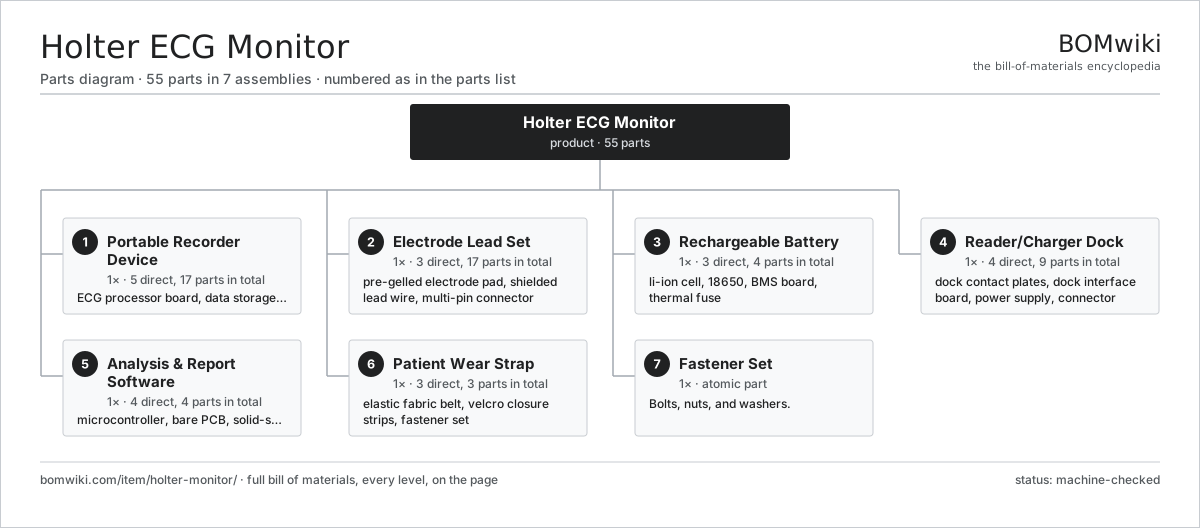
| # | Part | Qty | What it does |
|---|---|---|---|
| 1 | Portable Recorder Device 5 parts | 1× | Compact body-worn unit that continuously digitizes and stores 2–12 channel ECG data on internal memory. |
| 2 | Electrode Lead Set 3 parts | 1× | Multi-channel electrode leads (typically 3–12 channels) with adhesive patches for skin contact. |
| 3 | Rechargeable Battery 3 parts | 1× | Internal lithium-ion cell with protection circuit and low-power management. |
| 4 | Reader/Charger Dock 4 parts | 1× | Docking station that charges the recorder and reads ECG data via USB to PC. |
| 5 | Analysis & Report Software 4 parts | 1× | Computer application that reads recorded ECG, detects arrhythmias, and generates clinical report. |
| 6 | Patient Wear Strap 3 parts | 1× | Adjustable belt or pouch strap so patient can wear recorder on torso or hip. |
| 7 | Fastener Set | 1× | Bolts, nuts, and washers. |
3D model
No 3D model yet. Have a CAD file of this? Add a 3D model — STL renders right on this page; STEP, FreeCAD, and OpenSCAD sources are welcome too (openly licensed, like all 3D models on BOMwiki).
Build & assembly graph
expand / collapse · shared sub-assemblies converge · links to related products · est. labourTap an assembly to expand/collapse · tap a part to open it · use “Open page” for any node · drag to pan, scroll to zoom.
Bill of materials for Holter ECG Monitor
7 top-level lines · 43 rows shown · 55 parts total · indented to 3 levels| # | Item / sub-assembly | Part no. | Qty/assy | Ext. qty | Parts | Type |
|---|---|---|---|---|---|---|
| 1 | Portable Recorder Device 5 parts | holter-recorder-unit | 1× | 1 | 17 | assembly |
| 1.1 | ECG Processor Board 5 parts | holter-processor-board | 1× | 1 | 10 | assembly |
| 1.1.1 | Microcontroller | mcu | 1× | 1 | · | part |
| 1.1.2 | Analog ECG Frontend 3 parts + deeper › | holter-analog-frontend | 1× | 1 | 3 | assembly |
| 1.1.3 | Bare PCB | pcb-bare | 1× | 1 | · | part |
| 1.1.4 | SMD Passive (R/C/L) | smd-passives | 1× | 1 | · | part |
| 1.1.5 | Connector | connector | 4× | 4 | · | part |
| 1.2 | Data Storage Module 3 parts | holter-memory-module | 1× | 1 | 3 | assembly |
| 1.2.1 | Flash Memory IC | holter-flash-chip | 1× | 1 | · | part |
| 1.2.2 | Bare PCB | pcb-bare | 1× | 1 | · | part |
| 1.2.3 | Connector | connector | 1× | 1 | · | part |
| 1.3 | Micro-USB Charging Port | holter-charging-connector | 1× | 1 | · | part |
| 1.4 | Protective Case 2 parts | holter-case-housing | 1× | 1 | 2 | assembly |
| 1.4.1 | Case Body | holter-case-shell | 1× | 1 | · | part |
| 1.4.2 | Belt Clip or Pouch Attachment | holter-case-clip | 1× | 1 | · | part |
| 1.5 | Thermal Fuse | thermal-fuse | 1× | 1 | · | part |
| 2 | Electrode Lead Set 3 parts | holter-electrode-leads | 1× | 1 | 17 | assembly |
| 2.1 | Pre-Gelled Electrode Pad | holter-electrode-patch | 8× | 8 | · | part |
| 2.2 | Shielded Lead Wire | holter-lead-wire | 8× | 8 | · | part |
| 2.3 | Multi-Pin Connector | holter-connector-plug | 1× | 1 | · | part |
| 3 | Rechargeable Battery 3 parts | holter-battery-pack | 1× | 1 | 4 | assembly |
| 3.1 | Li-ion Cell, 18650 | li-cell-18650 | 2× | 2 | · | part |
| 3.2 | BMS Board | bms-board | 1× | 1 | · | part |
| 3.3 | Thermal Fuse | thermal-fuse | 1× | 1 | · | part |
| 4 | Reader/Charger Dock 4 parts | holter-analysis-dock | 1× | 1 | 9 | assembly |
| 4.1 | Dock Contact Plates | holter-dock-connector | 1× | 1 | · | part |
| 4.2 | Dock Interface Board 4 parts | holter-dock-electronics | 1× | 1 | 5 | assembly |
| 4.2.1 | Microcontroller | mcu | 1× | 1 | · | part |
| 4.2.2 | Bare PCB | pcb-bare | 1× | 1 | · | part |
| 4.2.3 | Relay | relay | 1× | 1 | · | part |
| 4.2.4 | Connector | connector | 2× | 2 | · | part |
| 4.3 | Power Supply | power-supply | 1× | 1 | · | part |
| 4.4 | Connector | connector | 2× | 2 | · | part |
| 5 | Analysis & Report Software 4 parts | holter-software-processor | 1× | 1 | 4 | assembly |
| 5.1 | Microcontroller | mcu | 1× | 1 | · | part |
| 5.2 | Bare PCB | pcb-bare | 1× | 1 | · | part |
| 5.3 | Solid-State Storage Drive | ssd-storage | 1× | 1 | · | part |
| 5.4 | Connector | connector | 1× | 1 | · | part |
| 6 | Patient Wear Strap 3 parts | holter-case-strap | 1× | 1 | 3 | assembly |
| 6.1 | Elastic Fabric Belt | holter-fabric-strap | 1× | 1 | · | part |
| 6.2 | Velcro Closure Strips | holter-velcro-fastener | 1× | 1 | · | part |
| 6.3 | Fastener Set | fastener-set | 1× | 1 | · | part |
| 7 | Fastener Set | fastener-set | 1× | 1 | · | part |
Related products
same domain, ranked by shared parts Diagnostic Spirometer
46 parts · shares 1 with this page
Orthopedic Cast Saw
73 parts · shares 4 with this page
Surgical Navigation System
127 parts · shares 4 with this page
Bladder Scanner
483 parts · shares 3 with this page
Diagnostic Spirometer
46 parts · shares 1 with this page
Orthopedic Cast Saw
73 parts · shares 4 with this page
Surgical Navigation System
127 parts · shares 4 with this page
Bladder Scanner
483 parts · shares 3 with this page
 Fetal Doppler
41 parts · shares 3 with this page
Fetal Doppler
41 parts · shares 3 with this page
 Apheresis Machine
199 parts · shares 4 with this page
Apheresis Machine
199 parts · shares 4 with this page
Sourcing: possible vendors
Prices, MOQ, and lead times are algorithmic estimates, not quotes, and not claims about these companies. Company mappings are curated by keyword; est. price band $500–$3M. How estimates work| Vendor | HQ | Specialty | MOQ | Lead time |
|---|---|---|---|---|
| gehealthcare.com ↗ | Chicago, US | Medical imaging & devices | 100 units | 12–20 wks |
| siemens-healthineers.com ↗ | Erlangen, DE | Medical systems | 100 units | 12–20 wks |
|
🇳🇱Philips
philips.com ↗
|
Amsterdam, NL | Health technology | 100 units | 12–20 wks |
| medtronic.com ↗ | Minneapolis, US | Medical devices | 100 units | 12–20 wks |
|
🇨🇳Mindray
mindray.com ↗
|
Shenzhen, CN | Medical devices | 100 units | 12–20 wks |
703-word article