All-In-One Home Brewing System
ProductOverview
A home-brewing system automates the beer brewing process by integrating a large heated kettle, grain basket, recirculation pump, and microcontroller that coordinates mashing, lautering, boiling, and cooling. Unlike simple stovetop brewing (extract-based shortcuts), all-grain electric brewing systems produce craft-quality beer by steeping crushed malted barley in hot water at precise temperatures, recirculating wort through the grain bed to extract sugars, and executing timed boils with hop additions.
These systems target homebrewers seeking consistency, repeatability, and hands-free operation. A single brewer can now monitor and adjust up to four separate temperature steps without manual stirring. The Main Digital Controller executes programmed "profiles" (e.g., 62°C for 20 min, ramp to 72°C for 30 min, then mash-out at 78°C), logging temperature and timer data for recipe refinement.
How It Works
Grain Steeping (Mashing)
Crushed malted grain (≈10–15 kg per 15-gallon batch) is added to the Grain Manifold & False Bottom, which is False Bottom Mesh Screen sitting ≈5 cm above the Kettle Body bottom. Hot water (typically 65°C) is then poured into the kettle, submerging the grain.
The Recirculation Pump Assembly recirculates wort (grain-filtered water) upward through the Wort Uptake Dip Tube, continuously extracting dissolved sugars from the steeping grain. The Main Digital Controller measures temperature via the Pressure Sensor and adjusts the Heating Element to hold the mash at target temperature ±1°C for 60–90 minutes. The recirculation rate (controlled via pump PWM) is typically 2–5 L/min to avoid grain bed compaction.
Grain Lautering (Wort Runoff)
After the mash rests, the Recirculation Pump Assembly is slowed to 1–2 L/min, and wort is drained from the Kettle Dip-Tube Outlet outlet into a separate collection vessel, while sparge water (hot, 78°C) is slowly introduced into the Grain Manifold & False Bottom from above. This two-step process ("fly sparge") rinsing remaining sugars from the grain bed and recovering ≈90% of fermentable sugars. The grain bed acts as a natural filter: the False Bottom Mesh Screen prevents grain husks from exiting, while smaller particles settle and compact.
Boiling and Cooling
Once lautering finishes, the collected wort (now ≈45–55 L) is brought to a rolling boil by the Heating Element (4.5–6 kW). The Microcontroller on the Main Digital Controller signals the Relay to energize the element, and the Pressure Sensor monitors temperature approaching 100°C.
The boil lasts 45–90 minutes. During boil, dried hops are added in stages: bittering hops early (60 min), aroma hops near the end (5–10 min). The LCD Control Panel LCD and Piezo Buzzer remind the brewer of each addition.
Post-boil, hot wort (≈98°C) is cooled to yeast pitching temperature (18–22°C) using the Immersion Chiller, an immersion chiller submerged in the kettle. Cold garden-hose water runs through the copper or stainless tube coil, extracting heat from the wort. This process takes 90–120 minutes and is critical: rapid cooling prevents haze and off-flavor development.
Automation & Control Logic
The Main Digital Controller MCU executes a profile stored in memory: a sequence of temperature setpoints and ramp rates. For each step, the PID algorithm adjusts heating-element duty cycle to reach target and hold it. The Temperature Probe Pocket isolates the PT100 sensor from grain contact, reducing thermal lag.
When a target is reached, the LCD displays "Mash Rest: 45 min remaining" and counts down. At the transition (e.g., ramp from 62°C to 72°C), the MCU increases heating power, and the sensor feeds back in real time. A simple profile might look:
- Step 1: 62°C, 20 min (protein rest)
- Step 2: 72°C, 30 min (main sugar extraction)
- Step 3: Ramp to 78°C (mash-out)
- Step 4: Boil 60 min
Custom profiles can be entered via the Pushbutton Set or loaded from SD card (on advanced variants).
Electrical Safety & Power Distribution
The home-brewing-system-heating-element, drawing 20–30A at 240V, is the system's highest power consumer. A dedicated Main Circuit Breaker (40A) protects the circuit. The Heating Element Contactor, a 240V electromechanical relay, is controlled by the low-voltage Microcontroller via a Relay module; this isolation prevents logic-ground faults from affecting mains. The Electrical Distribution & Relays assembly routes mains through the breaker, then contactor, to the heating element. Control wiring (24V signals) is kept separate.
The Mains Power Cable carries mains from the breaker to the contactor. All metal chassis parts (kettle, pump frame) are grounded via the Terminal Block Assembly.
The Recirculation Pump Assembly motor is typically 120V single-phase and can run on a standard kitchen outlet, isolated from the 240V mains circuit via its own plug.
Recirculation Pump and Grain Bed Management
The Recirculation Pump Assembly is a peristaltic type: a rubber tube is squeezed by rotating rollers, advancing fluid in a slow, gentle pulse. This design avoids shear stress that could crush grain kernels or denature proteins.
Flow rate is 5–20 L/min (controlled via PWM speed). A high rate (>5 L/min) risks compacting the grain bed (starving the lower grains of oxygen and water), reducing extraction; a low rate (<1 L/min) causes layering (hot water escaping without contacting all grain). Experienced brewers run 2–5 L/min during the mash phase and 1–2 L/min during lautering.
The Tubing & Valve Assembly assembly is food-grade silicone tubing and stainless fittings, rated to 120°C, to withstand hot wort and steam.
Water Chemistry and Recipe Scaling
All-grain brewing assumes water composition: chloride and sulfate ratios affect flavor. The Brew Kettle & Heating holds 50 L of water; a typical all-grain recipe calls for ≈45 L strike water (initial grain steeping) plus 10–15 L sparge water, totaling 55–60 L, slightly overflowing the kettle. Brewers account for this by either splitting the batch into two smaller brews or using an external hotwater tank.
Brew size scales linearly: a 15-gallon batch (56 L) requires ≈40 kg grain and proportional hops and water.
Design Variants and Upgrades
Precision brewers upgrade with wireless temperature probes in grain bed at different depths, revealing thermal stratification. Some systems add a secondary kettle for sparge-water heating, keeping strike and sparge temps independent.
Advanced controllers log temperature and time data to cloud storage, enabling recipe analytics and yeast-performance tracking. Open-source firmware projects (e.g., Fermentarium, Grainfather) allow customization of ramping algorithms.
Hybrid systems integrate HERMS (heat exchanger recirculating mash system), where recirculated wort passes through a 240V-heated secondary kettle before returning to the grain bed, eliminating the large heating element and reducing bulk.
All-In-One Home Brewing System parts and their functions
8 top-level parts · 43 parts in total · full bill of materials below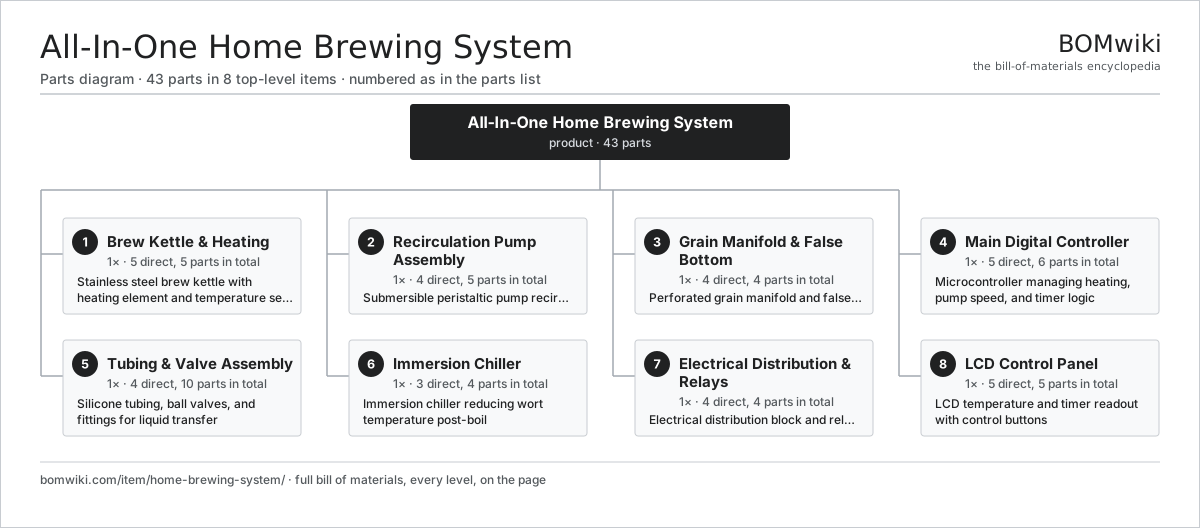
| # | Part | Qty | What it does |
|---|---|---|---|
| 1 | Brew Kettle & Heating 5 parts | 1× | Stainless steel brew kettle with heating element and temperature sensor |
| 2 | Recirculation Pump Assembly 4 parts | 1× | Submersible peristaltic pump recirculating wort during mashing |
| 3 | Grain Manifold & False Bottom 4 parts | 1× | Perforated grain manifold and false bottom for water-grain separation |
| 4 | Main Digital Controller 5 parts | 1× | Microcontroller managing heating, pump speed, and timer logic |
| 5 | Tubing & Valve Assembly 4 parts | 1× | Silicone tubing, ball valves, and fittings for liquid transfer |
| 6 | Immersion Chiller 3 parts | 1× | Immersion chiller reducing wort temperature post-boil |
| 7 | Electrical Distribution & Relays 4 parts | 1× | Electrical distribution block and relay module for heating element |
| 8 | LCD Control Panel 5 parts | 1× | LCD temperature and timer readout with control buttons |
3D model
No 3D model yet. Have a CAD file of this? Add a 3D model. STL renders right on this page; STEP, FreeCAD, and OpenSCAD sources are welcome too (openly licensed, like all 3D models on BOMwiki).
Build & assembly graph
expand / collapse · shared sub-assemblies converge · links to related products · est. labourTap an assembly to expand/collapse · tap a part to open it · use “Open page” for any node · drag to pan, scroll to zoom.
Bill of materials for All-In-One Home Brewing System
8 top-level lines · 42 rows shown · 43 parts total · indented to 3 levels| # | Item / sub-assembly | Part no. | Qty/assy | Ext. qty | Parts | Type |
|---|---|---|---|---|---|---|
| 1 | Brew Kettle & Heating 5 parts | home-brewing-system-kettle-assembly | 1× | 1 | 5 | assembly |
| 1.1 | Kettle Body | home-brewing-system-kettle-body | 1× | 1 | · | part |
| 1.2 | Heating Element | heating-element | 1× | 1 | · | part |
| 1.3 | Pressure Sensor | pressure-sensor | 1× | 1 | · | part |
| 1.4 | Kettle Dip-Tube Outlet | home-brewing-system-kettle-spigot | 1× | 1 | · | part |
| 1.5 | Temperature Probe Pocket | home-brewing-system-thermowell | 1× | 1 | · | part |
| 2 | Recirculation Pump Assembly 4 parts | home-brewing-system-pump | 1× | 1 | 5 | assembly |
| 2.1 | Pump Drive Motor | home-brewing-system-pump-motor | 1× | 1 | · | part |
| 2.2 | Peristaltic Pump Head | home-brewing-system-pump-head | 1× | 1 | · | part |
| 2.3 | Motor-Pump Coupling | home-brewing-system-pump-coupling | 1× | 1 | · | part |
| 2.4 | Connector | connector | 2× | 2 | · | part |
| 3 | Grain Manifold & False Bottom 4 parts | home-brewing-system-grain-basket | 1× | 1 | 4 | assembly |
| 3.1 | Grain Manifold Ring | home-brewing-system-manifold-ring | 1× | 1 | · | part |
| 3.2 | False Bottom Mesh Screen | home-brewing-system-false-bottom | 1× | 1 | · | part |
| 3.3 | Wort Uptake Dip Tube | home-brewing-system-dip-tube | 1× | 1 | · | part |
| 3.4 | Fastener Set | fastener-set | 1× | 1 | · | part |
| 4 | Main Digital Controller 5 parts | home-brewing-system-controller | 1× | 1 | 6 | assembly |
| 4.1 | Microcontroller | mcu | 1× | 1 | · | part |
| 4.2 | Relay | relay | 2× | 2 | · | part |
| 4.3 | Power Monitoring Circuit | home-brewing-system-power-sensing | 1× | 1 | · | part |
| 4.4 | Bare PCB | pcb-bare | 1× | 1 | · | part |
| 4.5 | SMD Passive (R/C/L) | smd-passives | 1× | 1 | · | part |
| 5 | Tubing & Valve Assembly 4 parts | home-brewing-system-plumbing | 1× | 1 | 10 | assembly |
| 5.1 | Silicone Tubing | home-brewing-system-silicone-tubing | 3× | 3 | · | part |
| 5.2 | Stainless Ball Valve | home-brewing-system-ball-valves | 2× | 2 | · | part |
| 5.3 | Connector | connector | 4× | 4 | · | part |
| 5.4 | O-Ring Set | oring-set | 1× | 1 | · | part |
| 6 | Immersion Chiller 3 parts | home-brewing-system-cooling-coil | 1× | 1 | 4 | assembly |
| 6.1 | Chiller Coil Tubing | home-brewing-system-coil-tubing | 1× | 1 | · | part |
| 6.2 | Chiller Water Inlet Valve | home-brewing-system-inlet-valve | 1× | 1 | · | part |
| 6.3 | Connector | connector | 2× | 2 | · | part |
| 7 | Electrical Distribution & Relays 4 parts | home-brewing-system-power-distribution | 1× | 1 | 4 | assembly |
| 7.1 | Main Circuit Breaker | home-brewing-system-main-breaker | 1× | 1 | · | part |
| 7.2 | Heating Element Contactor | home-brewing-system-contactor | 1× | 1 | · | part |
| 7.3 | Terminal Block Assembly | home-brewing-system-terminals | 1× | 1 | · | part |
| 7.4 | Mains Power Cable | home-brewing-system-shielded-cable | 1× | 1 | · | part |
| 8 | LCD Control Panel 5 parts | home-brewing-system-display | 1× | 1 | 5 | assembly |
| 8.1 | LCD Panel | lcd-panel | 1× | 1 | · | part |
| 8.2 | Pushbutton Set | home-brewing-system-control-buttons | 1× | 1 | · | part |
| 8.3 | Piezo Buzzer | home-brewing-system-beeper | 1× | 1 | · | part |
| 8.4 | Bare PCB | pcb-bare | 1× | 1 | · | part |
| 8.5 | SMD Passive (R/C/L) | smd-passives | 1× | 1 | · | part |
Something wrong in this list? Report a problem with this BOM.
Related products
same domain, ranked by shared parts Electric Multicooker
151 parts · shares 4 with this page
Electric Multicooker
151 parts · shares 4 with this page
 Sous Vide Immersion Circulator
294 parts · shares 4 with this page
Super-Automatic Espresso Machine
293 parts · shares 4 with this page
Herbal Infusion Machine
34 parts · shares 3 with this page
Tofu Maker
40 parts · shares 3 with this page
Gooseneck Electric Kettle
28 parts · shares 3 with this page
Sous Vide Immersion Circulator
294 parts · shares 4 with this page
Super-Automatic Espresso Machine
293 parts · shares 4 with this page
Herbal Infusion Machine
34 parts · shares 3 with this page
Tofu Maker
40 parts · shares 3 with this page
Gooseneck Electric Kettle
28 parts · shares 3 with this page
Sourcing: possible vendors
Browse the supplier directory → Prices, MOQ, and lead times are algorithmic estimates, not quotes, and not claims about these companies. Company mappings are curated by keyword; est. price band $20–$600. How estimates work| Vendor | HQ | Specialty | MOQ | Lead time |
|---|---|---|---|---|
|
🇦🇺Breville
breville.com ↗
|
Sydney, AU | Kitchen appliances | 2,000 units | 6–10 wks |
| groupeseb.com ↗ | Écully, FR | Cookware & small appliances | 2,000 units | 6–10 wks |
| hamiltonbeach.com ↗ | Glen Allen, US | Small appliances | 2,000 units | 6–10 wks |
| panasonic.com ↗ | Osaka, JP | Electronics & appliances | 2,000 units | 6–10 wks |
|
🇨🇳Midea
midea.com ↗
|
Foshan, CN | Home appliances | 2,000 units | 6–10 wks |
1,144-word article