Fermentation Chamber
ProductOverview
A home fermentation chamber is a temperature and humidity-controlled cabinet enabling reproducible microbial fermentation independent of ambient conditions. Fermentation, the metabolic process of microorganisms breaking down sugars in anaerobic or semi-anaerobic conditions, is fundamental to beer, wine, kombucha, yogurt, kimchi, and tempeh production. Each microbe (yeast strain, lactic-acid bacterium, acetic-acid bacterium) has an optimal temperature window (typically 15–25°C for ales, 5–12°C for lagers); deviations cause off-flavors, sluggish fermentation, or contamination.
A home fermentation chamber eliminates seasonal and climate variability: the Temperature & Humidity Controller MCU maintains temperature ±0.5°C year-round, humidity at 40–80% RH, and executes multi-stage profiles (e.g., 72-hour lag phase at 18°C, then 10-day active fermentation at 20°C). This reproducibility is impossible in a basement or garage subject to outdoor temperature swings.
How It Works
Insulation and Thermal Mass
The Insulated Enclosure is a double-wall structure with ≥5 cm polyurethane foam insulation (R-value ≥25) between outer and inner shells. This high insulation reduces heat leak; a 20°C internal setpoint requires minimal cooling even if ambient is 25°C.
The inner chamber typically holds large glass carboys (≈20–50 L each) of fermenting liquid. Glass has high thermal mass, further buffering temperature swings.
Refrigeration and Heating Coordination
The Refrigeration Loop (evaporator) sits inside the chamber, cooled by the home-fermentation-chamber-refrigeration-unit compressor circuit. A Expansion Valve, controlled by the Temperature & Humidity Controller MCU, modulates refrigerant flow. If chamber temperature exceeds setpoint, the MCU increases valve opening, boosting cooling. If temperature drops below setpoint, the Auxiliary Heating System energizes (for setpoints ≥15°C), providing supplemental warmth.
This dual-loop design is crucial: if only cooling were available, a cold ambient night could chill the chamber below target; a heating-only system would overshoot on hot days.
The Air Circulation Fan fan, running at low speed (20–50 CFM), circulates air around the evaporator coil and throughout the chamber, preventing thermal stratification. The fan is whisper-quiet (≤40 dB) to avoid agitation artifacts in fermenting liquid.
Humidity Management
Fermentation generates CO₂ gas, which carries trace compounds. Managing humidity prevents:
- Excessive dryness (low RH): Risk of airlock drying out, allowing oxygen ingress and oxidative spoilage.
- Excessive moisture (high RH): Condensation on chamber walls and mold growth on external surfaces.
The Ultrasonic Humidifier operates an ultrasonic transducer creating a fine mist. The Humidity Sensor measures chamber RH; if below setpoint (e.g., 60%), the MCU activates the humidifier. If above setpoint, the Dehumidifier (silica-gel wheel or fan-assisted) removes moisture. A steady 50–70% RH is typical.
Fermentation Profiles and Automation
The LCD Display & Keypad shows 5–10 preset programs stored in MCU memory:
- Ale (English): 20°C for 14 days
- Lager (Czech Pilsen): 10°C for 21 days (with optional diacetyl rest)
- Kombucha: 25°C for 7–10 days, humidity 65–75%
- Yogurt: 43°C for 6–8 hours
- Kimchi: 15°C for 3–7 days
- Wine: 18°C for 40–90 days
When the operator selects "Ale" and presses Start, the Temperature & Humidity Controller ramps the chamber from ambient to 20°C over 2–4 hours (slow ramp prevents thermal shock to yeast), holds at 20°C for exactly 14 days, then alerts the operator. Custom profiles can be programmed via buttons: e.g., "18°C for 2 days, then ramp to 22°C over 6 hours, hold 5 days, then drop to 15°C for 2 days (diacetyl rest)."
An RTC (real-time clock) in the MCU tracks absolute time; the LCD Display & Keypad LCD displays "Day 8 of 14, 20.1°C, 62% RH."
Door and Sealing
The Door Seal Gasket, a silicone or EPDM magnetic strip, creates a tight seal when the door closes. The Sight Glass, tempered glass or polycarbonate, allows observation without opening the door (which would disrupt temperature and introduce external air/contamination).
The door hinge is soft-close, preventing accidental slamming that could agitate fermenting liquid.
Monitoring and Alerts
If chamber temperature drifts >1.5°C from setpoint for >30 minutes (sensor failure or compressor fault), the MCU sounds the Alert Buzzer and displays a fault code on the LCD. If the operator manually opens the door, an internal switch triggers a gentle reminder beep after 2 minutes of open-door time, encouraging quick closure.
Microbe Behavior and Temperature Sensitivity
Different microbes have narrow optimal ranges:
- Saccharomyces cerevisiae (ale yeast): 18–25°C; above 25°C produces fruity esters; below 18°C lags.
- Saccharomyces pastorianus (lager yeast): 8–15°C; slower, cleaner flavors; below 8°C becomes dormant; above 15°C spoils the style.
- Lactobacillus (kimchi, sauerkraut): 15–25°C; below 10°C very slow; above 30°C risks spoilage organisms.
A 1°C deviation over days shifts flavor profile significantly. A fermentation chamber's ±0.5°C stability is thus central to quality.
Practical Workflow
- Brew day: Operator prepares fermentable liquid (wort, juice, milk, vegetable brine), cools to room temperature, and transfers to a glass carboy.
- Inoculation: Yeast or culture is pitched into the cooled liquid.
- Loading: Carboy is placed on the Shelf Frame inside the chamber.
- Program selection: Operator selects "Ale" or custom profile on Control Buttons.
- Temperature ramp: Chamber cools/heats to target over 2–4 hours. MCU logs ramp rate to prevent thermal shock.
- Fermentation: Microbes consume sugars, generating CO₂ and alcohol. The chamber maintains setpoint ±0.5°C for 7–90 days depending on ferment type.
- Completion alert: MCU sounds Alert Buzzer, operator removes carboy, performs secondary fermentation or packaging.
Design Variants
Commercial-grade chambers: 500–1000 L capacity, dual-compressor systems for independent temperature zones, data-logging via WiFi.
Hybrid chambers: Smaller (50 L), passively insulated, with a small Peltier cooling element (electronics-grade thermoelectric cooler) instead of a full compressor, consuming <100W but limited to ±5°C control.
Wine-specific models: Vibration isolation for ≤20 dB noise (critical for wine's sensitivity to disturbance), dual humidity zones, and glycerin-buffered shelves.
Ambient-compensating designs: Some models include external thermistors, adjusting refrigeration and heating setpoints based on ambient conditions, reducing compressor cycling on warm days.
Fermentation Chamber parts and their functions
8 top-level parts · 38 parts in total · full bill of materials below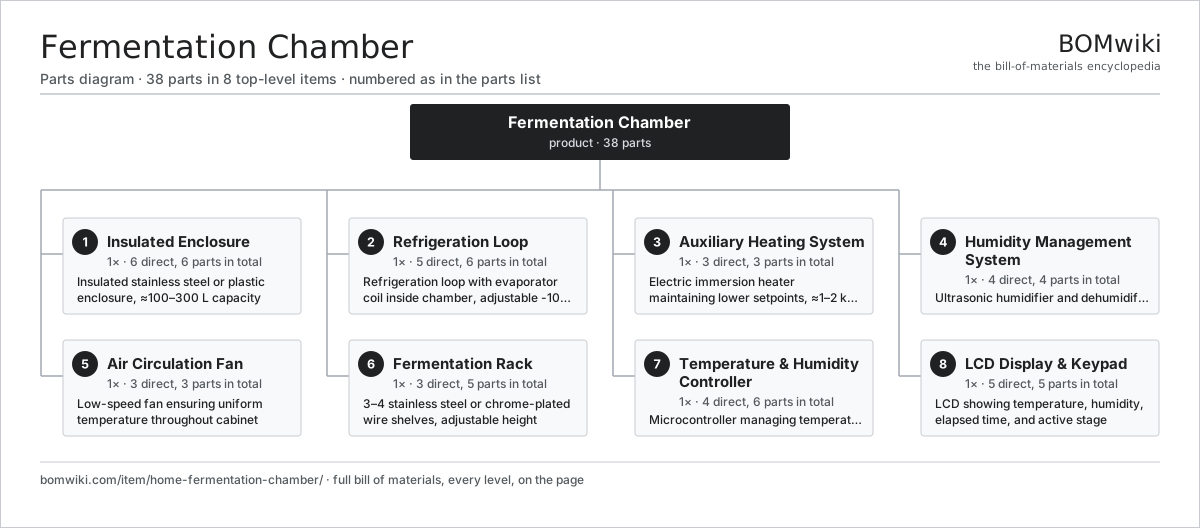
| # | Part | Qty | What it does |
|---|---|---|---|
| 1 | Insulated Enclosure 6 parts | 1× | Insulated stainless steel or plastic enclosure, ≈100–300 L capacity |
| 2 | Refrigeration Loop 5 parts | 1× | Refrigeration loop with evaporator coil inside chamber, adjustable -10°C to 30°C |
| 3 | Auxiliary Heating System 3 parts | 1× | Electric immersion heater maintaining lower setpoints, ≈1–2 kW |
| 4 | Humidity Management System 4 parts | 1× | Ultrasonic humidifier and dehumidifier pair, 40–80% RH target |
| 5 | Air Circulation Fan 3 parts | 1× | Low-speed fan ensuring uniform temperature throughout cabinet |
| 6 | Fermentation Rack 3 parts | 1× | 3–4 stainless steel or chrome-plated wire shelves, adjustable height |
| 7 | Temperature & Humidity Controller 4 parts | 1× | Microcontroller managing temperature, humidity, and door-opening alerts |
| 8 | LCD Display & Keypad 5 parts | 1× | LCD showing temperature, humidity, elapsed time, and active stage |
3D model
No 3D model yet. Have a CAD file of this? Add a 3D model. STL renders right on this page; STEP, FreeCAD, and OpenSCAD sources are welcome too (openly licensed, like all 3D models on BOMwiki).
Build & assembly graph
expand / collapse · shared sub-assemblies converge · links to related products · est. labourTap an assembly to expand/collapse · tap a part to open it · use “Open page” for any node · drag to pan, scroll to zoom.
Bill of materials for Fermentation Chamber
8 top-level lines · 41 rows shown · 38 parts total · indented to 3 levels| # | Item / sub-assembly | Part no. | Qty/assy | Ext. qty | Parts | Type |
|---|---|---|---|---|---|---|
| 1 | Insulated Enclosure 6 parts | home-fermentation-chamber-cabinet | 1× | 1 | 6 | assembly |
| 1.1 | Outer Enclosure | home-fermentation-chamber-outer-shell | 1× | 1 | · | part |
| 1.2 | Inner Chamber | home-fermentation-chamber-inner-shell | 1× | 1 | · | part |
| 1.3 | Foam Insulation | home-fermentation-chamber-insulation | 1× | 1 | · | part |
| 1.4 | Door Seal Gasket | home-fermentation-chamber-door-gasket | 1× | 1 | · | part |
| 1.5 | Sight Glass | home-fermentation-chamber-viewing-window | 1× | 1 | · | part |
| 1.6 | Door Handle | home-fermentation-chamber-door-handle | 1× | 1 | · | part |
| 2 | Refrigeration Loop 5 parts | home-fermentation-chamber-cooling-coil | 1× | 1 | 6 | assembly |
| 2.1 | Cooling Compressor | home-fermentation-chamber-compressor | 1× | 1 | · | part |
| 2.2 | Evaporator Coil | home-fermentation-chamber-evaporator | 1× | 1 | · | part |
| 2.3 | Condenser Coil | home-fermentation-chamber-condenser | 1× | 1 | · | part |
| 2.4 | Expansion Valve | home-fermentation-chamber-expansion-valve | 1× | 1 | · | part |
| 2.5 | Refrigerant Tubing | home-fermentation-chamber-refrigerant-lines | 2× | 2 | · | part |
| 3 | Auxiliary Heating System 3 parts | home-fermentation-chamber-heating-element | 1× | 1 | 3 | assembly |
| 3.1 | Heating Element | heating-element | 1× | 1 | · | part |
| 3.2 | Thermostat Switch | tofu-maker-thermostat-switch | 1× | 1 | · | part |
| 3.3 | Heating Relay | home-fermentation-chamber-heating-relay | 1× | 1 | · | part |
| 4 | Humidity Management System 4 parts | home-fermentation-chamber-humidity-control | 1× | 1 | 4 | assembly |
| 4.1 | Ultrasonic Humidifier | home-fermentation-chamber-humidifier | 1× | 1 | · | part |
| 4.2 | Water Reservoir | home-fermentation-chamber-humidifier-tank | 1× | 1 | · | part |
| 4.3 | Dehumidifier | home-fermentation-chamber-dehumidifier | 1× | 1 | · | part |
| 4.4 | Humidity Sensor | home-fermentation-chamber-humidity-sensor | 1× | 1 | · | part |
| 5 | Air Circulation Fan 3 parts | home-fermentation-chamber-air-circulation | 1× | 1 | 3 | assembly |
| 5.1 | Circulation Fan Motor | home-fermentation-chamber-fan-motor | 1× | 1 | · | part |
| 5.2 | Fan Blade | home-fermentation-chamber-fan-blade | 1× | 1 | · | part |
| 5.3 | Fan Speed Controller | home-fermentation-chamber-fan-speed-controller | 1× | 1 | · | part |
| 6 | Fermentation Rack 3 parts | home-fermentation-chamber-shelving | 1× | 1 | 5 | assembly |
| 6.1 | Shelf Frame | home-fermentation-chamber-shelf-frame | 1× | 1 | · | part |
| 6.2 | Vertical Posts | home-fermentation-chamber-shelf-posts | 1× | 1 | · | part |
| 6.3 | Shelf Decking | home-fermentation-chamber-shelf-decks | 3× | 3 | · | part |
| 7 | Temperature & Humidity Controller 4 parts | home-fermentation-chamber-controller | 1× | 1 | 6 | assembly |
| 7.1 | Microcontroller | mcu | 1× | 1 | · | part |
| 7.2 | Relay | relay | 3× | 3 | · | part |
| 7.3 | Bare PCB | pcb-bare | 1× | 1 | · | part |
| 7.4 | SMD Passive (R/C/L) | smd-passives | 1× | 1 | · | part |
| 8 | LCD Display & Keypad 5 parts | home-fermentation-chamber-display-panel | 1× | 1 | 5 | assembly |
| 8.1 | LCD Panel | lcd-panel | 1× | 1 | · | part |
| 8.2 | Control Buttons | home-fermentation-chamber-keypad | 1× | 1 | · | part |
| 8.3 | Alert Buzzer | home-fermentation-chamber-buzzer | 1× | 1 | · | part |
| 8.4 | Bare PCB | pcb-bare | 1× | 1 | · | part |
| 8.5 | SMD Passive (R/C/L) | smd-passives | 1× | 1 | · | part |
Something wrong in this list? Report a problem with this BOM.
Related products
same domain, ranked by shared parts Bread Machine
162 parts · shares 2 with this page
Bread Machine
162 parts · shares 2 with this page
 Chocolate Melanger
32 parts · shares 2 with this page
Chocolate Melanger
32 parts · shares 2 with this page
 Compressor Ice Cream Maker
248 parts · shares 2 with this page
Electric Grain Mill
39 parts · shares 2 with this page
Compressor Ice Cream Maker
248 parts · shares 2 with this page
Electric Grain Mill
39 parts · shares 2 with this page
Sourcing: possible vendors
Browse the supplier directory → Prices, MOQ, and lead times are algorithmic estimates, not quotes, and not claims about these companies. Company mappings are curated by keyword; est. price band $20–$600. How estimates work| Vendor | HQ | Specialty | MOQ | Lead time |
|---|---|---|---|---|
|
🇦🇺Breville
breville.com ↗
|
Sydney, AU | Kitchen appliances | 2,000 units | 6–10 wks |
| groupeseb.com ↗ | Écully, FR | Cookware & small appliances | 2,000 units | 6–10 wks |
| hamiltonbeach.com ↗ | Glen Allen, US | Small appliances | 2,000 units | 6–10 wks |
| panasonic.com ↗ | Osaka, JP | Electronics & appliances | 2,000 units | 6–10 wks |
|
🇨🇳Midea
midea.com ↗
|
Foshan, CN | Home appliances | 2,000 units | 6–10 wks |
1,071-word article