Industrial Hot Glue Gun
ProductOverview
An industrial hot-glue gun is a portable adhesive dispensing tool that melts solid thermoplastic hot-melt glue cartridges and extrudes the melted adhesive onto surfaces for rapid bonding. Hot-melt adhesives are 100% solids materials with no solvents, allowing instant bond formation as the adhesive cools below its glass transition temperature (typically within seconds).
Hot-melt technology dominates assembly work in manufacturing: bookbinding, electronics encapsulation, furniture edge-banding, shoe construction, and packaging. This tool represents an industrial-grade variant with temperature control, proportional trigger actuation, and rapid thermal cycling.
How it Works
The AC to Internal DC Power Supply converts mains AC voltage to internal control voltages. When powered on, the Heating Element (a PTC positive-temperature-coefficient ceramic element) begins warming the Aluminum Heat Exchanger Block, an aluminum thermal conductor.
Inside the barrel, a standard thermoplastic glue cartridge (10 mm diameter, 45–50 mm long) rests in the Cartridge Barrel Tube. The cartridge is a solid stick of hot-melt adhesive held in place by the Cartridge Retention Collet. As the heater block reaches operating temperature (typically 160–200°C for commercial hotmelts), heat conducts into the cartridge, melting the adhesive from the front surface where it contacts the heater bore.
When the operator pulls the trigger, the Proportional Trigger Switch energizes the Solenoid Plunger Drive, an electromagnetic solenoid. The solenoid plunger advances, pushing the internal Cartridge Push Rod against the rear face of the cartridge. This mechanical pressure extrudes the molten adhesive forward through the Nozzle Mounting Seat and out the Nozzle Orifice Tip, delivering a bead of hot glue to the substrate.
The Anti-Drip Check Valve is a spring-loaded check valve in the nozzle seat that closes when the trigger is released, preventing dribble and material waste.
Temperature Control
The Thermistor Temperature Sensor, a thermistor embedded in the heater block, continuously monitors adhesive temperature. The Thermostat Control Board board compares actual temperature to the operator-set target and modulates power to the Heating Element using a Power MOSFET switching transistor. This proportional control maintains steady temperature within ±5°C, critical for consistent adhesive viscosity and bond strength.
Some industrial models allow temperature adjustment via a dial or digital display, enabling selection of low-temperature adhesives (120–140°C) for temperature-sensitive substrates or high-temperature formulations (200–220°C) for demanding applications.
Thermal Safety
A Thermal Fuse in the PTC Heating Element Chamber assembly provides a safety cutoff if heater temperature exceeds safe limits, preventing adhesive degradation or housing damage. The Thermal Insulation Wrap ceramic wool wrap around the heater block minimizes external surface temperature, keeping the Handle and Barrel Assembly cool enough to handle continuously.
The Idle Rest Stand with heat-resistant Stand Contact Pad is essential for safe idle positioning. Resting the hot nozzle directly on a plastic surface or wood would cause burns or substrate damage.
Adhesive Chemistry
Hot-melt adhesives are typically ethylene-vinyl acetate (EVA) copolymer or polyamide compounds. These materials have near-zero viscosity when molten (at operating temperature) but solidify rapidly as they cool, developing full bond strength within 30 seconds to 2 minutes depending on formulation and substrate porosity.
Common bond strengths are 1–5 MPa shear strength, comparable to mechanical fasteners for light-duty assembly but insufficient for structural applications. The adhesive bonds well to paper, card stock, wood, fabric, metal, and many plastics. Porous substrates (cardboard, fabric) allow the adhesive to wick into surface porosity, increasing bond area and strength.
Nozzle and Tip Selection
The Nozzle Orifice Tip is replaceable and available in various orifice sizes (0.5 mm to 2.0 mm diameter) for different bead geometry. A 0.5 mm orifice produces fine precision beads for electronics work. A 2.0 mm orifice creates thicker beads for rigid bonding and gap-filling. The nozzle angle also varies: flat tips for edge-banding, pointed tips for spot adhesive, and angled tips for hard-to-reach joints.
Ergonomics and Trigger Control
The Proportional Trigger Switch is proportional: partial trigger pull delivers lower extrusion rate, full pull maximum flow. Experienced operators pulse the trigger to dispense precise adhesive quantities, reducing waste and excess squeeze-out.
The Polymer Grip Sleeve handle is insulated thermoplastic, remaining cool to the touch despite the hot heater block a few inches away. The Trigger Safety Guard prevents accidental activation and protects the operator.
Maintenance and Cartridge Replacement
When a cartridge empties, the operator removes the Rear End Cap and slides the spent stick out. A fresh cartridge inserts from the rear, engages the Cartridge Retention Collet, and is ready to dispense within 1–2 minutes as the heater brings the new adhesive to melting point.
The Nozzle Orifice Tip accumulates dried adhesive over weeks of use. Periodic removal and soak in hot water (or a specialized solvent for stubborn deposits) restores flow. Replacement tips are inexpensive and often included with cartridge multi-packs.
Applications in Industry
Bookbinding: rapid spine adhesive for paperback book assembly, replacing sewing.
Packaging: edge-sealing and flap closure on cartons and mailers.
Footwear: sole-to-upper bonding before final stitching; particularly valuable for foam or synthetic materials where mechanical fastening is difficult.
Electronics: potting (encapsulation) of PCB assemblies and connectors for moisture and vibration protection.
Furniture: edge-banding veneer to particleboard edges, replacing mechanical fastening.
Cordless Variants
Some manufacturers offer cordless hot-glue guns with built-in lithium-ion batteries and rapid heating (reaching temperature in 30–60 seconds). These sacrifice runtime (20–30 minutes per charge) for mobility on job sites where power access is limited. The core thermal mechanism remains identical to corded models.
Environmental and Cost Considerations
Hot-melt adhesives are non-toxic and produce zero volatile organic compounds (VOCs), making them preferable to solvent-based alternatives in enclosed assembly areas. Cartridge costs are modest (typically $2–$5 per 40 mL stick), and industrial users often buy in bulk for significant per-unit savings.
Industrial Hot Glue Gun parts and their functions
8 top-level parts · 28 parts in total · full bill of materials below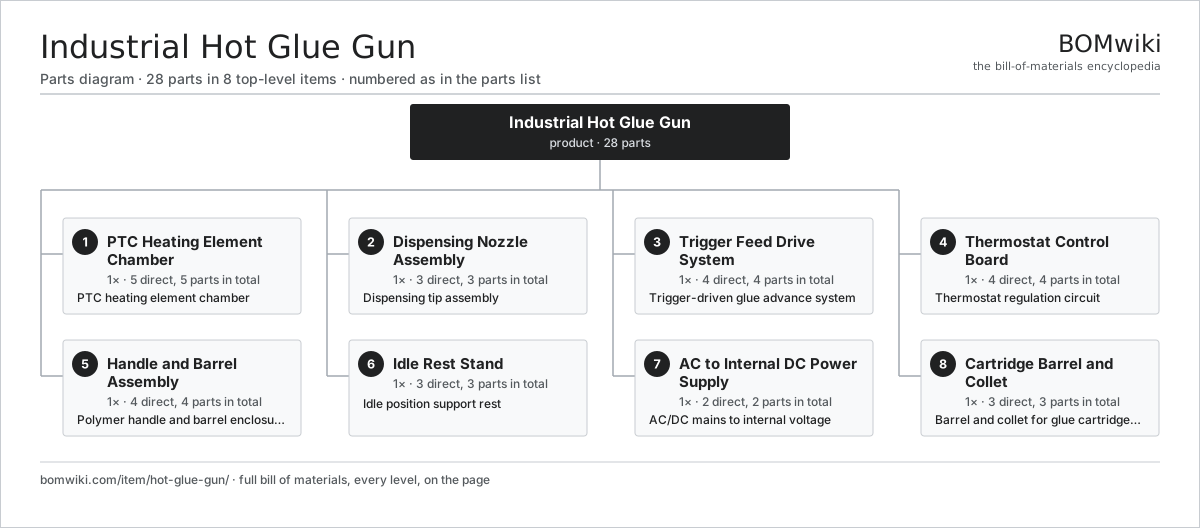
| # | Part | Qty | What it does |
|---|---|---|---|
| 1 | PTC Heating Element Chamber 5 parts | 1× | PTC heating element chamber |
| 2 | Dispensing Nozzle Assembly 3 parts | 1× | Dispensing tip assembly |
| 3 | Trigger Feed Drive System 4 parts | 1× | Trigger-driven glue advance system |
| 4 | Thermostat Control Board 4 parts | 1× | Thermostat regulation circuit |
| 5 | Handle and Barrel Assembly 4 parts | 1× | Polymer handle and barrel enclosure |
| 6 | Idle Rest Stand 3 parts | 1× | Idle position support rest |
| 7 | AC to Internal DC Power Supply 2 parts | 1× | AC/DC mains to internal voltage |
| 8 | Cartridge Barrel and Collet 3 parts | 1× | Barrel and collet for glue cartridge insertion |
3D model
No 3D model yet. Have a CAD file of this? Add a 3D model. STL renders right on this page; STEP, FreeCAD, and OpenSCAD sources are welcome too (openly licensed, like all 3D models on BOMwiki).
Build & assembly graph
expand / collapse · shared sub-assemblies converge · links to related products · est. labourTap an assembly to expand/collapse · tap a part to open it · use “Open page” for any node · drag to pan, scroll to zoom.
Bill of materials for Industrial Hot Glue Gun
8 top-level lines · 36 rows shown · 28 parts total · indented to 3 levels| # | Item / sub-assembly | Part no. | Qty/assy | Ext. qty | Parts | Type |
|---|---|---|---|---|---|---|
| 1 | PTC Heating Element Chamber 5 parts | hot-glue-gun-heater | 1× | 1 | 5 | assembly |
| 1.1 | Heating Element | heating-element | 1× | 1 | · | part |
| 1.2 | Aluminum Heat Exchanger Block | hot-glue-gun-heater-block | 1× | 1 | · | part |
| 1.3 | Thermistor Temperature Sensor | hot-glue-gun-temperature-sensor | 1× | 1 | · | part |
| 1.4 | Thermal Fuse | thermal-fuse | 1× | 1 | · | part |
| 1.5 | Thermal Insulation Wrap | hot-glue-gun-insulation | 1× | 1 | · | part |
| 2 | Dispensing Nozzle Assembly 3 parts | hot-glue-gun-nozzle | 1× | 1 | 3 | assembly |
| 2.1 | Nozzle Orifice Tip | hot-glue-gun-nozzle-tip | 1× | 1 | · | part |
| 2.2 | Nozzle Mounting Seat | hot-glue-gun-nozzle-seat | 1× | 1 | · | part |
| 2.3 | Anti-Drip Check Valve | hot-glue-gun-anti-drip-plug | 1× | 1 | · | part |
| 3 | Trigger Feed Drive System 4 parts | hot-glue-gun-feed-mechanism | 1× | 1 | 4 | assembly |
| 3.1 | Proportional Trigger Switch | hot-glue-gun-trigger-switch | 1× | 1 | · | part |
| 3.2 | Solenoid Plunger Drive | hot-glue-gun-solenoid-ram | 1× | 1 | · | part |
| 3.3 | Cartridge Push Rod | hot-glue-gun-push-rod | 1× | 1 | · | part |
| 3.4 | Trigger Return Spring | hot-glue-gun-rod-spring | 1× | 1 | · | part |
| 4 | Thermostat Control Board 4 parts | hot-glue-gun-temperature-control | 1× | 1 | 4 | assembly |
| 4.1 | Bare PCB | pcb-bare | 1× | 1 | · | part |
| 4.2 | Power MOSFET | mosfet | 1× | 1 | · | part |
| 4.3 | SMD Passive (R/C/L) | smd-passives | 1× | 1 | · | part |
| 4.4 | Microcontroller | mcu | 1× | 1 | · | part |
| 5 | Handle and Barrel Assembly 4 parts | hot-glue-gun-housing | 1× | 1 | 4 | assembly |
| 5.1 | Polymer Grip Sleeve | hot-glue-gun-grip-plastic | 1× | 1 | · | part |
| 5.2 | Trigger Safety Guard | hot-glue-gun-trigger-guard | 1× | 1 | · | part |
| 5.3 | Cartridge Barrel Tube | hot-glue-gun-barrel-tube | 1× | 1 | · | part |
| 5.4 | Fastener Set | fastener-set | 1× | 1 | · | part |
| 6 | Idle Rest Stand 3 parts | hot-glue-gun-stand | 1× | 1 | 3 | assembly |
| 6.1 | Stand Base Platform | hot-glue-gun-stand-base | 1× | 1 | · | part |
| 6.2 | Stand Support Arm | hot-glue-gun-stand-bracket | 1× | 1 | · | part |
| 6.3 | Stand Contact Pad | hot-glue-gun-stand-pad | 1× | 1 | · | part |
| 7 | AC to Internal DC Power Supply 2 parts | hot-glue-gun-power-supply | 1× | 1 | 2 | assembly |
| 7.1 | Power Supply | power-supply | 1× | 1 | · | part |
| 7.2 | Thermal Fuse | thermal-fuse | 1× | 1 | · | part |
| 8 | Cartridge Barrel and Collet 3 parts | hot-glue-gun-cartridge-driver | 1× | 1 | 3 | assembly |
| 8.1 | Cartridge Barrel Tube | hot-glue-gun-barrel-tube | 1× | 1 | · | part |
| 8.2 | Cartridge Retention Collet | hot-glue-gun-collet-ring | 1× | 1 | · | part |
| 8.3 | Rear End Cap | hot-glue-gun-rear-cap | 1× | 1 | · | part |
Something wrong in this list? Report a problem with this BOM.
Related products
same domain, ranked by shared parts Heat Gun
183 parts · shares 3 with this page
Heat Gun
183 parts · shares 3 with this page
 HEPA Dust Extractor
51 parts · shares 2 with this page
HEPA Dust Extractor
51 parts · shares 2 with this page
 Desktop 3D Printer
56 parts · shares 1 with this page
Desktop 3D Printer
56 parts · shares 1 with this page
 Desktop CNC Mill
52 parts · shares 1 with this page
Desktop Laser Engraver
43 parts · shares 1 with this page
Desktop Vacuum Former
37 parts · shares 1 with this page
Desktop CNC Mill
52 parts · shares 1 with this page
Desktop Laser Engraver
43 parts · shares 1 with this page
Desktop Vacuum Former
37 parts · shares 1 with this page
Sourcing: possible vendors
Browse the supplier directory → Prices, MOQ, and lead times are algorithmic estimates, not quotes, and not claims about these companies. Company mappings are curated by keyword; est. price band $30–$800. How estimates work| Vendor | HQ | Specialty | MOQ | Lead time |
|---|---|---|---|---|
| stanleyblackanddecker.com ↗ | New Britain, US | Tools (DeWalt, Craftsman) | 500 units | 6–12 wks |
| bosch-professional.com ↗ | Leinfelden, DE | Power tools | 500 units | 6–12 wks |
| ttigroup.com ↗ | Hong Kong, CN | Tools (Milwaukee, Ryobi) | 500 units | 6–12 wks |
|
🇯🇵Makita
makita.com ↗
|
Anjo, JP | Power tools | 500 units | 6–12 wks |
|
🇨🇭Hilti
hilti.com ↗
|
Schaan, CH | Construction tools | 500 units | 6–12 wks |
1,019-word article