Hoverboard
ProductOverview
A hoverboard is a self-balancing scooter: two motorized wheels under a split deck that the rider steers by leaning. There are no handlebars and no throttle. The board stands itself upright and moves only because a controller is constantly measuring how the rider is tilting it and driving the wheels to keep its own deck level.
The board is built on the Chassis & Shell, a two-piece shell joined at a center pivot so the left and right foot pads can rotate independently of each other. Each side carries one Hub Motor Wheel, a gearless in-wheel brushless motor with the tire molded straight onto the rim. All of the intelligence sits on the Mainboard, which reads the rider through the frame's own motion sensor plus a Foot Sensor Board under each pad, then drives both wheels. Energy comes from the Battery Pack, and a Lighting & Audio Module module adds headlights and a Bluetooth speaker.
How it works
Balancing is a continuous control loop. An inertial measurement unit on the Mainboard measures the pitch angle and rotation rate of the chassis hundreds of times a second. When the rider leans forward, the deck tips forward; the controller sees that tilt and commands the wheels to roll forward to drive the deck back under the rider. Lean harder and the wheels spin faster to chase the larger error, which is what the rider feels as accelerating. Lean back and the loop reverses to brake or reverse. The board is never balanced once and left alone, it is falling and catching itself many times a second.
Steering comes from the split deck. Each Foot Sensor Board watches its own foot pad through a gyro and a pair of optical presence switches. Because the two pads pivot independently around the chassis center axle, tilting one pad forward while keeping the other flat makes the controller spin one wheel faster than the other, turning the board. The presence switches also act as a safety interlock: both pads must report a foot before the motors will arm.
Each Hub Motor Wheel is driven by its own three-phase MOSFET bridge on the mainboard. The controller energizes the stator coils in sequence while three Hall sensors report rotor position, so the field always pulls the magnet ring the right way, gearless electronic commutation, the same scheme used in the Hub Motor Wheel of an electric scooter. Phase current is sensed through shunt resistors so the controller can limit torque and protect the transistors.
The Battery Pack is a 36 V lithium-ion pack with its own battery management board guarding against over-discharge, overcurrent, and cell imbalance, and a protected charge inlet at the Charge Port feeds it from a wall adapter.
Hoverboard parts and their functions
8 top-level parts · 399 parts in total · full bill of materials below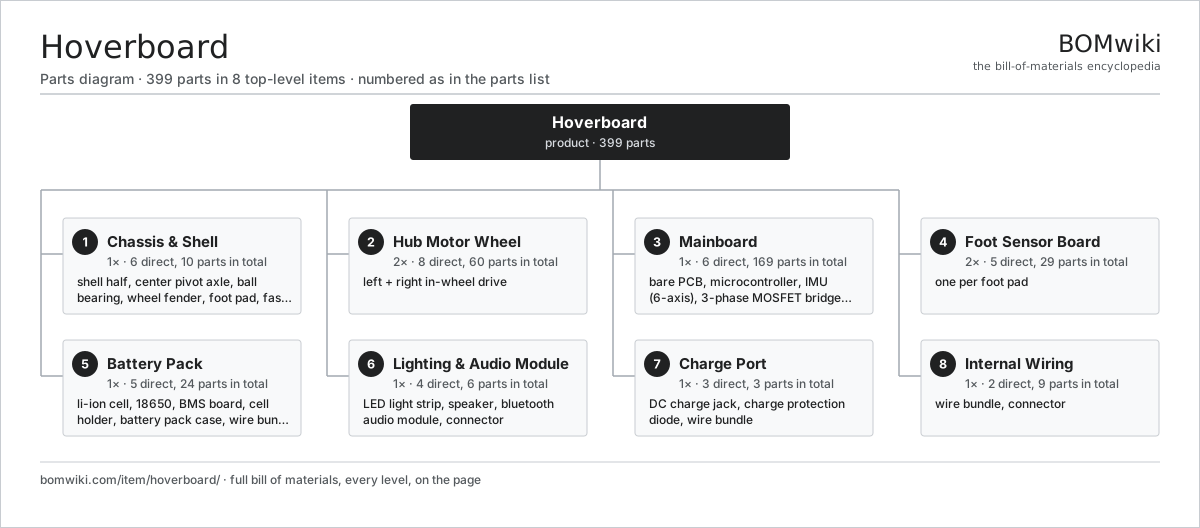
| # | Part | Qty | What it does |
|---|---|---|---|
| 1 | Chassis & Shell 6 parts | 1× | Two-piece shell joined by a center pivot so each foot pad tilts independently. |
| 2 | Hub Motor Wheel 8 parts | 2× | left + right in-wheel drive |
| 3 | Mainboard 6 parts | 1× | Central balance controller driving both hub motors from IMU feedback. |
| 4 | Foot Sensor Board 5 parts | 2× | one per foot pad |
| 5 | Battery Pack 5 parts | 1× | 10S2P lithium-ion pack powering both motors. |
| 6 | Lighting & Audio Module 4 parts | 1× | Front LED headlights, status lighting, and a Bluetooth speaker. |
| 7 | Charge Port 3 parts | 1× | DC barrel inlet with charge-protection diode. |
| 8 | Internal Wiring 2 parts | 1× | Phase and signal harness tying the boards, motors, and battery together. |
3D model
No 3D model yet. Have a CAD file of this? Add a 3D model. STL renders right on this page; STEP, FreeCAD, and OpenSCAD sources are welcome too (openly licensed, like all 3D models on BOMwiki).
Build & assembly graph
expand / collapse · shared sub-assemblies converge · links to related products · est. labourTap an assembly to expand/collapse · tap a part to open it · use “Open page” for any node · drag to pan, scroll to zoom.
Bill of materials for Hoverboard
8 top-level lines · 57 rows shown · 399 parts total · indented to 3 levels| # | Item / sub-assembly | Part no. | Qty/assy | Ext. qty | Parts | Type |
|---|---|---|---|---|---|---|
| 1 | Chassis & Shell 6 parts | hoverboard-chassis | 1× | 1 | 10 | assembly |
| 1.1 | Shell Half | hoverboard-shell-half | 2× | 2 | · | part |
| 1.2 | Center Pivot Axle | hoverboard-pivot-axle | 1× | 1 | · | part |
| 1.3 | Ball Bearing | ball-bearing | 2× | 2 | · | part |
| 1.4 | Wheel Fender | hoverboard-fender | 2× | 2 | · | part |
| 1.5 | Foot Pad | hoverboard-foot-pad | 2× | 2 | · | part |
| 1.6 | Fastener Set | fastener-set | 1× | 1 | · | part |
| 2 | Hub Motor Wheel 8 parts | hoverboard-hub-motor | 2× | 2 | 60 | assembly |
| 2.1 | Stator Assembly 3 parts | stator-assembly | 1× | 2 | 3 | assembly |
| 2.1.1 | Stator Core (laminations) | stator-core | 1× | 2 | · | part |
| 2.1.2 | Copper Winding | copper-winding | 1× | 2 | · | part |
| 2.1.3 | Slot Insulation | stator-insulation | 1× | 2 | · | part |
| 2.2 | Copper Winding | copper-winding | 1× | 2 | · | part |
| 2.3 | Rotor Assembly 4 parts | rotor-assembly | 1× | 2 | 19 | assembly |
| 2.3.1 | Rotor Shaft | rotor-shaft | 1× | 2 | · | part |
| 2.3.2 | Rotor Core | rotor-core | 1× | 2 | · | part |
| 2.3.3 | Neodymium Magnet | neodymium-magnet | 16× | 32 | · | part |
| 2.3.4 | Ball Bearing | ball-bearing | 1× | 2 | · | part |
| 2.4 | Neodymium Magnet | neodymium-magnet | 30× | 60 | · | part |
| 2.5 | Hall Sensor | hall-sensor | 3× | 6 | · | part |
| 2.6 | Ball Bearing | ball-bearing | 2× | 4 | · | part |
| 2.7 | Solid Tire | hoverboard-tire | 1× | 2 | · | part |
| 2.8 | Hub Motor Axle | hoverboard-motor-axle | 1× | 2 | · | part |
| 3 | Mainboard 6 parts | hoverboard-mainboard | 1× | 1 | 169 | assembly |
| 3.1 | Bare PCB | pcb-bare | 1× | 1 | · | part |
| 3.2 | Microcontroller | mcu | 1× | 1 | · | part |
| 3.3 | IMU (6-axis) | imu | 1× | 1 | · | part |
| 3.4 | 3-Phase MOSFET Bridge 3 parts | hoverboard-mosfet-bridge | 2× | 2 | 10 | assembly |
| 3.4.1 | Power MOSFET | mosfet | 6× | 12 | · | part |
| 3.4.2 | Gate Driver IC | hoverboard-gate-driver | 1× | 2 | · | part |
| 3.4.3 | Current Shunt Resistor | hoverboard-shunt-resistor | 3× | 6 | · | part |
| 3.5 | SMD Passive (R/C/L) | smd-passives | 140× | 140 | · | part |
| 3.6 | Connector | connector | 6× | 6 | · | part |
| 4 | Foot Sensor Board 5 parts | hoverboard-sensor-board | 2× | 2 | 29 | assembly |
| 4.1 | Bare PCB | pcb-bare | 1× | 2 | · | part |
| 4.2 | Gyro/Tilt Sensor | hoverboard-gyro-sensor | 1× | 2 | · | part |
| 4.3 | Optical Presence Switch | hoverboard-optical-switch | 2× | 4 | · | part |
| 4.4 | SMD Passive (R/C/L) | smd-passives | 24× | 48 | · | part |
| 4.5 | Connector | connector | 1× | 2 | · | part |
| 5 | Battery Pack 5 parts | hoverboard-battery-pack | 1× | 1 | 24 | assembly |
| 5.1 | Li-ion Cell, 18650 | li-cell-18650 | 20× | 20 | · | part |
| 5.2 | BMS Board | bms-board | 1× | 1 | · | part |
| 5.3 | Cell Holder | hoverboard-cell-holder | 1× | 1 | · | part |
| 5.4 | Battery Pack Case | hoverboard-pack-case | 1× | 1 | · | part |
| 5.5 | Wire Bundle | wire-bundle | 1× | 1 | · | part |
| 6 | Lighting & Audio Module 4 parts | hoverboard-lighting-audio | 1× | 1 | 6 | assembly |
| 6.1 | LED Light Strip | hoverboard-led-strip | 2× | 2 | · | part |
| 6.2 | Speaker | speaker | 1× | 1 | · | part |
| 6.3 | Bluetooth Audio Module | hoverboard-bluetooth-module | 1× | 1 | · | part |
| 6.4 | Connector | connector | 2× | 2 | · | part |
| 7 | Charge Port 3 parts | hoverboard-charge-port | 1× | 1 | 3 | assembly |
| 7.1 | DC Charge Jack | hoverboard-dc-jack | 1× | 1 | · | part |
| 7.2 | Charge Protection Diode | hoverboard-charge-diode | 1× | 1 | · | part |
| 7.3 | Wire Bundle | wire-bundle | 1× | 1 | · | part |
| 8 | Internal Wiring 2 parts | hoverboard-wiring | 1× | 1 | 9 | assembly |
| 8.1 | Wire Bundle | wire-bundle | 1× | 1 | · | part |
| 8.2 | Connector | connector | 8× | 8 | · | part |
Something wrong in this list? Report a problem with this BOM.
Related products
same domain, ranked by shared parts Self-Balancing Personal Transporter
402 parts · shares 14 with this page
Self-Balancing Personal Transporter
402 parts · shares 14 with this page
 Self-Balancing Unicycle
602 parts · shares 13 with this page
Self-Balancing Unicycle
602 parts · shares 13 with this page
 Electric Skateboard
215 parts · shares 13 with this page
Electric Trike
214 parts · shares 13 with this page
Electric Skateboard
215 parts · shares 13 with this page
Electric Trike
214 parts · shares 13 with this page
 Electric Motorcycle
1,278 parts · shares 12 with this page
Electric Motorcycle
1,278 parts · shares 12 with this page
Sourcing: possible vendors
Browse the supplier directory → Prices, MOQ, and lead times are algorithmic estimates, not quotes, and not claims about these companies. Company mappings are curated by keyword; est. price band $300–$15k. How estimates work| Vendor | HQ | Specialty | MOQ | Lead time |
|---|---|---|---|---|
| segway.com ↗ | Beijing, CN | micromobility | made to order | 10–16 wks |
|
🇺🇸Razor
razor.com ↗
|
Cerritos, US | scooters & rideables | made to order | 10–16 wks |
|
🇺🇸Gotrax
gotrax.com ↗
|
Carrollton, US | e-scooters & rideables | made to order | 10–16 wks |
464-word article