HVOF Spray System
ProductOverview
HVOF (high-velocity oxy-fuel) spray is the highest-hardness and lowest-porosity thermal coating technology, producing coatings so dense that some deposits are indistinguishable from wrought material. Unlike simpler flame spray guns where fuel and oxygen mix and burn once, HVOF operates at sustained combustion pressure (40 bar) inside a long expansion barrel, generating gas velocities of Mach 3–4 and powder particle velocities exceeding 600 m/s. The combination of extreme velocity and high temperature (3500 K) melts tungsten carbide and other refractory powders to complete homogeneity before impact, resulting in coatings with porosity <3%, hardness >1500 HV, and outstanding wear and corrosion resistance. HVOF is the standard for jet engine components, pump seals, landing gear, and any critical surface where failure cannot be tolerated.
The Combustion Chamber operates under sustained pressure, distinguishing HVOF from lower-pressure flame spray. A Chamber Body forged steel vessel is rated 50 bar continuous. The Fuel Atomizer atomizes fuel (kerosene, liquid propane, or hydrogen) into a fine mist at 40 bar. The Oxygen Inlet supplies pressurized oxygen at matching 40 bar. A Spark Plug Igniter continuous-discharge igniter creates a spark at 25 kV to initiate combustion. Once burning at pressure, the combustion is self-sustaining as long as fuel and oxygen are supplied; the chamber walls are lined with Chamber Refractory yttria-stabilized zirconia ceramic to insulate and contain the 3500 K flame.
The Fuel Supply System system delivers pressurized fuel to the combustion chamber. A Fuel Tank pressurized vessel (20 L, 20 bar rated) stores kerosene or liquid propane. A Fuel Pump positive-displacement gear pump driven by a 24 V motor pressurizes the fuel to 40 bar. A Fuel Regulator proportional valve allows electronic control of fuel pressure (0–50 bar output) via a 0–10 V signal from the Control Cabinet. A Fuel Filter 10 micron cartridge keeps the fuel clean, preventing nozzle plugging. A Fuel Shutoff Solenoid emergency solenoid can cut fuel supply within 50 ms for safety.
Similarly, the Oxygen Supply System system delivers compressed oxygen at 40 bar. An Oxygen Regulator reduces incoming tank pressure to 40 bar. An Oxygen Flowmeter rotameter displays real-time flow (500–2000 L/min depending on parameters). An Oxygen Solenoid 2-way solenoid valve provides on-off control of oxygen during ignition and shutdown. An Oxygen Check Valve cracking valve prevents backflow into the oxygen tank if downstream pressure spikes.
The Expansion Barrel is where combustion products undergo extreme acceleration. Combustion gases exiting the Combustion Chamber at subsonic velocity enter a long, tapered expansion duct. The Barrel Bore, lined with tungsten carbide, is 12 mm diameter at the inlet and tapers to 7 mm at the exit. This taper causes isentropic (constant-entropy) expansion: the gas accelerates from subsonic to supersonic velocity (Mach 3–4) without losing temperature significantly. The Barrel Insulation ceramic fiber wrap (external) insulates the barrel, allowing the interior to operate at 3500 K while keeping the outside safe. The Barrel Water Jacket internal water jacket dissipates 25–30 kW continuous, carrying cooling water from the Cooling System.
The High-Pressure Powder Feeder injects tungsten carbide or other hard powder into the hot, pressurized barrel. A Pressure Hopper sealed pressure vessel (5 L) holds the powder and maintains 30 bar internal pressure via a Carrier Gas Booster pneumatic intensifier. A Powder Metering Valve proportional spool valve (24 V solenoid command) controls powder flow rate from 10–100 g/min. The powder, pressurized, flows into a tungsten-carbide Powder Injection Nozzle that injects it into the supersonic gas stream inside the barrel at high velocity. The powder melts and accelerates in the expanding gas, exiting the barrel as liquid droplets traveling at 600–800 m/s depending on particle size and material.
The Cooling System is by far the most intensive of any thermal spray technology. The barrel dissipates 25–30 kW, and operating periods produce extreme heat load. A Cooling Water Pump centrifugal pump delivers 40–50 L/min demineralized water at 5 bar through the Barrel Water Jacket internal passages. A large Radiator aluminum bar-plate heat exchanger with fan rejects 30 kW at 10°C temperature rise. A Water Manifold distribution block with proportional thermostat controls water routing; a Thermostatic Valve proportional valve maintains 30°C outlet water ±2°C. A Water Filter 20 micron cartridge prevents sediment from clogging the narrow barrel jacket passages.
The Control Cabinet orchestrates the entire system. An Microcontroller PLC-class microcontroller executes the startup sequence: verify cooling water flow, energize the Spark Plug Igniter, open the Oxygen Solenoid, then gradually ramp the Fuel Pump pressure via the Fuel Regulator. Once combustion is stable (monitored via Flow & Pressure Sensors pressure transducers), the MCU enables the powder feed by opening the Powder Metering Valve. Proportional solenoid drivers (Fuel Proportioner Driver and Oxygen Proportioner Driver) amplify the MCU's 0–10 V command signals to coil power. Safety interlocks prevent powder injection unless combustion is verified stable; if cooling water flow drops below threshold or gas pressures diverge from the controlled band, the MCU shuts down the system immediately.
The Expansion Barrel, with its Barrel Bore tungsten-carbide lining, is the highest-wear component in the system. Solid particles impacting at 600+ m/s and hot gases at 3500 K gradually erode the bore over 20–50 operating hours. Replacement is the standard maintenance; the bore diameter grows with wear, reducing pressure and velocity, necessitating routine bore inspection and replacement.
In aerospace, HVOF coatings protect turbine blades, compressor rotors, and combustor liners. Coatings are typically WC-Co (tungsten carbide in cobalt binder), 0.3–0.5 mm thick, hardness >1500 HV, with porosity <3%. These coatings outlast uncoated parts by 10–50x in high-temperature, high-stress environments. Pump and compressor seals (for oil, chemical, water pumps) use CrC-NiCr (chromium carbide in nickel-chromium binder) HVOF coatings for superior wear and corrosion resistance. Landing gear components survive hundreds of flight cycles with HVOF-coated pivot surfaces. Industrial repair shops restore worn shafts, bearing raceways, and seal grooves with HVOF, restoring components to original geometry and hardness without full replacement.
How it works
- Shop compressed oxygen is supplied at high pressure (80+ bar). The Oxygen Regulator reduces it to 40 bar downstream. The Oxygen Flowmeter displays flow rate (e.g., 1000 L/min).
- Liquid fuel (kerosene or propane) is stored in the Fuel Tank pressurized vessel. The Fuel Pump (24 V motor-driven positive displacement) pressurizes fuel to 40 bar, and the Fuel Regulator proportional valve fine-tunes pressure via 0–10 V command from the Control Cabinet MCU.
- The operator activates the Control Cabinet. The MCU verifies cooling water flow via a flow sensor (mandatory interlock).
- The MCU energizes the Spark Plug Igniter continuous-discharge igniter and opens the Oxygen Solenoid, allowing 40 bar oxygen into the Combustion Chamber.
- The MCU gradually opens the Fuel Shutoff Solenoid and increases the Fuel Pump pressure. Atomized fuel (from Fuel Atomizer) and oxygen mix inside the Chamber Body at 40 bar. The Spark Plug Igniter ignites the mixture.
- Combustion begins and becomes self-sustaining at pressure. The Chamber Refractory ceramic insulation contains the 3500 K flame. Hot combustion products (CO₂, H₂O, N₂, excess O₂) at 40 bar and 3500 K fill the chamber.
- Combustion gases exit the Combustion Chamber and enter the Expansion Barrel expansion duct. The Barrel Bore tungsten-carbide-lined barrel tapers from 12 mm to 7 mm diameter.
- Isentropic expansion accelerates the gas from subsonic (at chamber exit) to Mach 3–4 velocity (3000+ m/s) at the barrel exit. Temperature remains high (3000+ K) due to isentropic expansion with minimal entropy increase.
- Meanwhile, the Control Cabinet MCU opens the Powder Metering Valve proportional powder metering valve. Tungsten-carbide or other hard powder from the Pressure Hopper pressure hopper is forced into the Carrier Gas Booster pressurized carrier gas stream at 30 bar.
- Pressurized powder flows into the Powder Injection Nozzle tungsten-carbide injection nozzle and is shot into the barrel at high velocity, mixing with the Mach 3–4 supersonic gas.
- Powder particles melt rapidly in the 3500 K gas stream. The suspended molten droplets are accelerated by the expanding gas, exiting the barrel at 600–800 m/s (depending on particle size and material density).
- The operator holds the spray gun and aims it at the workpiece, maintaining 200–300 mm standoff distance. Molten droplets impact the grit-blasted surface and solidify instantly, forming an extremely dense coating.
- Throughout operation, the Cooling System pump circulates 40–50 L/min water through the Barrel Water Jacket internal jacket. The Radiator rejects 25–30 kW, and the Thermostatic Valve maintains water outlet at 30°C.
- The Flow & Pressure Sensors pressure transducers on the fuel and oxygen lines continuously monitor combustion pressure. If pressure drops (indicating combustion loss), the MCU immediately shuts down the system via solenoid de-energization.
- When the operator stops, the MCU de-energizes the Oxygen Solenoid and Fuel Shutoff Solenoid, cutting off gas supply. The flame extinguishes within 50 ms, and residual hot gas exits the barrel.
HVOF Spray System parts and their functions
7 top-level parts · 35 parts in total · full bill of materials below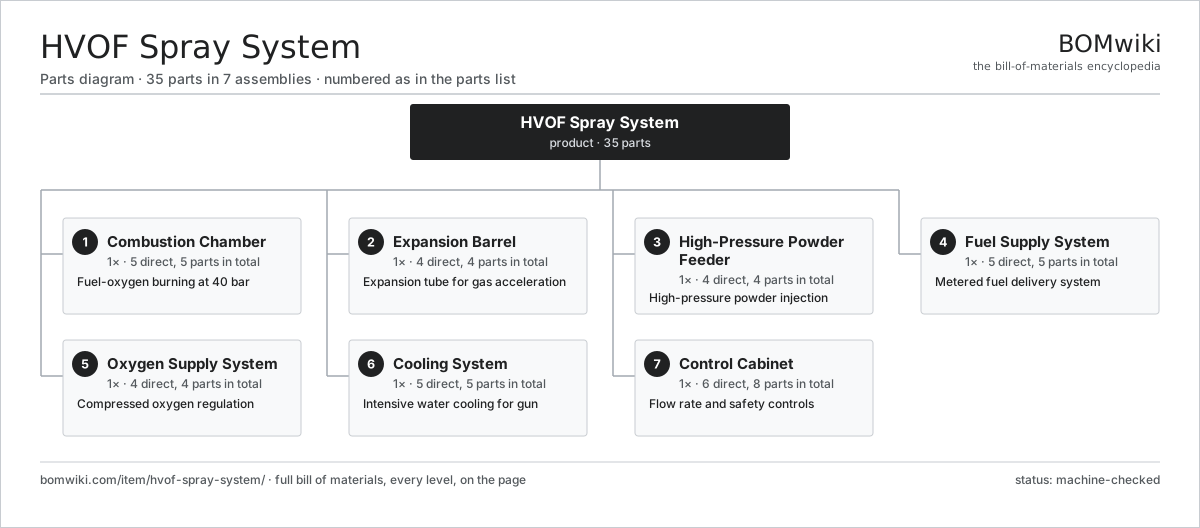
| # | Part | Qty | What it does |
|---|---|---|---|
| 1 | Combustion Chamber 5 parts | 1× | Fuel-oxygen burning at 40 bar |
| 2 | Expansion Barrel 4 parts | 1× | Expansion tube for gas acceleration |
| 3 | High-Pressure Powder Feeder 4 parts | 1× | High-pressure powder injection |
| 4 | Fuel Supply System 5 parts | 1× | Metered fuel delivery system |
| 5 | Oxygen Supply System 4 parts | 1× | Compressed oxygen regulation |
| 6 | Cooling System 5 parts | 1× | Intensive water cooling for gun |
| 7 | Control Cabinet 6 parts | 1× | Flow rate and safety controls |
3D model
No 3D model yet. Have a CAD file of this? Add a 3D model — STL renders right on this page; STEP, FreeCAD, and OpenSCAD sources are welcome too (openly licensed, like all 3D models on BOMwiki).
Build & assembly graph
expand / collapse · shared sub-assemblies converge · links to related products · est. labourTap an assembly to expand/collapse · tap a part to open it · use “Open page” for any node · drag to pan, scroll to zoom.
Bill of materials for HVOF Spray System
7 top-level lines · 40 rows shown · 35 parts total · indented to 3 levels| # | Item / sub-assembly | Part no. | Qty/assy | Ext. qty | Parts | Type |
|---|---|---|---|---|---|---|
| 1 | Combustion Chamber 5 parts | hvof-spray-system-combustion-chamber | 1× | 1 | 5 | assembly |
| 1.1 | Chamber Body | hvof-spray-system-chamber-body | 1× | 1 | · | part |
| 1.2 | Spark Plug Igniter | hvof-spray-system-spark-plug | 1× | 1 | · | part |
| 1.3 | Fuel Atomizer | hvof-spray-system-fuel-injector-hvof | 1× | 1 | · | part |
| 1.4 | Oxygen Inlet | hvof-spray-system-oxygen-inlet-hvof | 1× | 1 | · | part |
| 1.5 | Chamber Refractory | hvof-spray-system-chamber-lining | 1× | 1 | · | part |
| 2 | Expansion Barrel 4 parts | hvof-spray-system-barrel | 1× | 1 | 4 | assembly |
| 2.1 | Barrel Bore | hvof-spray-system-barrel-bore | 1× | 1 | · | part |
| 2.2 | Barrel Insulation | hvof-spray-system-barrel-insulation | 1× | 1 | · | part |
| 2.3 | Barrel Water Jacket | hvof-spray-system-barrel-cooling | 1× | 1 | · | part |
| 2.4 | Fastener Set | fastener-set | 1× | 1 | · | part |
| 3 | High-Pressure Powder Feeder 4 parts | hvof-spray-system-powder-feeder | 1× | 1 | 4 | assembly |
| 3.1 | Pressure Hopper | hvof-spray-system-powder-hopper-hp | 1× | 1 | · | part |
| 3.2 | Powder Metering Valve | hvof-spray-system-metering-valve | 1× | 1 | · | part |
| 3.3 | Carrier Gas Booster | hvof-spray-system-carrier-gas-booster | 1× | 1 | · | part |
| 3.4 | Powder Injection Nozzle | hvof-spray-system-inject-nozzle | 1× | 1 | · | part |
| 4 | Fuel Supply System 5 parts | hvof-spray-system-fuel-supply | 1× | 1 | 5 | assembly |
| 4.1 | Fuel Tank | hvof-spray-system-fuel-tank | 1× | 1 | · | part |
| 4.2 | Fuel Pump | hvof-spray-system-fuel-pump | 1× | 1 | · | part |
| 4.3 | Fuel Regulator | hvof-spray-system-fuel-regulator | 1× | 1 | · | part |
| 4.4 | Fuel Filter | hvof-spray-system-fuel-filter | 1× | 1 | · | part |
| 4.5 | Fuel Shutoff Solenoid | hvof-spray-system-fuel-shutoff | 1× | 1 | · | part |
| 5 | Oxygen Supply System 4 parts | hvof-spray-system-oxygen-supply | 1× | 1 | 4 | assembly |
| 5.1 | Oxygen Regulator | hvof-spray-system-oxygen-regulator | 1× | 1 | · | part |
| 5.2 | Oxygen Flowmeter | hvof-spray-system-oxygen-flowmeter | 1× | 1 | · | part |
| 5.3 | Oxygen Solenoid | hvof-spray-system-oxygen-solenoid | 1× | 1 | · | part |
| 5.4 | Oxygen Check Valve | hvof-spray-system-oxygen-check-valve | 1× | 1 | · | part |
| 6 | Cooling System 5 parts | hvof-spray-system-cooling-system | 1× | 1 | 5 | assembly |
| 6.1 | Cooling Water Pump | hvof-spray-system-water-pump | 1× | 1 | · | part |
| 6.2 | Radiator | hvof-spray-system-radiator-large | 1× | 1 | · | part |
| 6.3 | Water Manifold | hvof-spray-system-water-manifold | 1× | 1 | · | part |
| 6.4 | Thermostatic Valve | hvof-spray-system-thermostatic-control | 1× | 1 | · | part |
| 6.5 | Water Filter | hvof-spray-system-water-filter | 1× | 1 | · | part |
| 7 | Control Cabinet 6 parts | hvof-spray-system-control-cabinet | 1× | 1 | 8 | assembly |
| 7.1 | Bare PCB | pcb-bare | 1× | 1 | · | part |
| 7.2 | Microcontroller | mcu | 1× | 1 | · | part |
| 7.3 | Fuel Proportioner Driver | hvof-spray-system-fuel-proportioner | 1× | 1 | · | part |
| 7.4 | Oxygen Proportioner Driver | hvof-spray-system-oxygen-proportioner | 1× | 1 | · | part |
| 7.5 | Relay | relay | 3× | 3 | · | part |
| 7.6 | Flow & Pressure Sensors | hvof-spray-system-flow-feedback | 1× | 1 | · | part |
Related products
same domain, ranked by shared parts All-Electric Injection Molding Machine
851 parts · shares 1 with this page
Automated Paint Spray Line
2,003 parts · shares 1 with this page
Ballpoint Pen Assembly Machine
51 parts · shares 1 with this page
Banbury Internal Mixer
64 parts · shares 1 with this page
Binder Jetting Printer
112 parts · shares 1 with this page
All-Electric Injection Molding Machine
851 parts · shares 1 with this page
Automated Paint Spray Line
2,003 parts · shares 1 with this page
Ballpoint Pen Assembly Machine
51 parts · shares 1 with this page
Banbury Internal Mixer
64 parts · shares 1 with this page
Binder Jetting Printer
112 parts · shares 1 with this page
Sourcing: possible vendors
Prices, MOQ, and lead times are algorithmic estimates, not quotes, and not claims about these companies. Company mappings are curated by keyword; est. price band $5k–$2M. How estimates work| Vendor | HQ | Specialty | MOQ | Lead time |
|---|---|---|---|---|
| atlascopco.com ↗ | Stockholm, SE | Compressors & industrial | 10 units | 12–20 wks |
|
🇦🇹Andritz
andritz.com ↗
|
Graz, AT | Process plants & machinery | 10 units | 12–20 wks |
| buhlergroup.com ↗ | Uzwil, CH | Food & materials processing | 10 units | 12–20 wks |
| gea.com ↗ | Düsseldorf, DE | Process technology | 10 units | 12–20 wks |
| mhi.com ↗ | Tokyo, JP | Heavy machinery | 10 units | 12–20 wks |
1,741-word article