Industrial Battery Charger
ProductOverview
An industrial battery charger, in utility language, a float-cum-boost charger or station charger, maintains the DC system that a substation, power plant, or switchgear room cannot operate without. The 110 V (or 220 V) station battery supplies breaker trip and close coils, protection relays, SCADA, and emergency lighting; if it fails, protection goes blind exactly when a fault needs clearing. The charger's job is to keep that battery permanently full while simultaneously carrying the station's continuous DC load, so the battery is only ever drawn on when AC supply is lost.
This is deliberately conservative engineering. The unit described here is a thyristor (SCR) phase-controlled design: heavier and less efficient than a switch-mode charger, but built from a Power Transformer and six SCR Modules that tolerate 4 kV impulse environments, run on natural convection with no fans to fail, and routinely serve 25–30 years.
How it works
Incoming 415 V three-phase passes the Input Breaker, backup Line Fuses, Surge Suppressor, and EMI Filter into the double-wound power transformer. The transformer matters beyond voltage matching: its separate primary and secondary Copper Windings on the Transformer Core give full galvanic isolation, which is what allows the DC system to float unearthed, a requirement explained below.
The secondary feeds the SCR Rectifier Stage, a six-pulse full bridge on a convection Heatsink Extrusion. Output control is by firing angle: the Firing Circuit delays each SCR's gate pulse relative to its phase zero-crossing, so conduction starts later in the half-cycle and average DC voltage falls. The Microcontroller in the Charge Controller adjusts this angle continuously, reading the bus through the Voltage Sense Divider and output current through the Current Shunt. A Snubber Board tames commutation transients and the Freewheel Diode carries choke current through the off intervals.
Six-pulse rectification leaves 300 Hz ripple, which the Output Filter, the Filter Choke and Filter Capacitor bank, smooths below 2% RMS. That figure qualifies the unit as a "battery eliminator": it can hold the DC load alone with the battery disconnected for testing, without relay-chattering ripple. A Blocking Diode stops the battery discharging back into a failed bridge, and Output Fuses protect each pole.
Charging regimes
Lead-acid station batteries follow IEEE 450 practice with two regimes. In float, the charger holds 2.25 V per cell, 124 V across a 55-cell string, which exactly balances self-discharge; regulation must stay within ±1% because a few tens of millivolts per cell separates undercharge (sulfation) from overcharge (grid corrosion and water loss). A battery-mounted probe lets the controller apply −3 mV/°C/cell temperature compensation. After a deep discharge, boost mode raises the output toward 2.7 V/cell under the adjustable current limit, recharging the string in hours rather than days; the controller tapers current as voltage rises and drops back to float automatically. The Hall Sensor on the battery leg tells the controller which way current is flowing, distinguishing a recharging battery from one quietly carrying station load through a failed bridge.
Protection and the floating bus
Station DC systems are deliberately unearthed: a single earth fault anywhere in the trip wiring then causes no current flow and no spurious breaker operation. The cost is that the first fault is silent, and a second fault on the opposite pole could trip every breaker in the station. The Ground Fault Board makes the first fault visible, a balanced resistor bridge between the poles and earth that alarms the moment either pole leaks, identifying which side is down. Four Relay contacts in the Metering & Alarm Panel report mains fail, charger fail, DC over/undervoltage, and earth fault to SCADA, while the operator reads the center-zero DC Ammeter and DC Voltmeter, analog instruments kept alongside the LCD Panel precisely because they work with everything else dead. A DC Output Breaker isolates the charger for service; in critical stations two complete chargers run on one battery so either can be taken down.
Everything mounts in a powder-coated Cabinet Frame cubicle behind Sheet Metal Panels, breathing through filtered Louver Vents, with field cables entering via the Cable Entry Plate. The only scheduled maintenance is an annual check of filter capacitors, alarm calibration, and torque on the power connections.
Industrial Battery Charger parts and their functions
8 top-level parts · 71 parts in total · full bill of materials below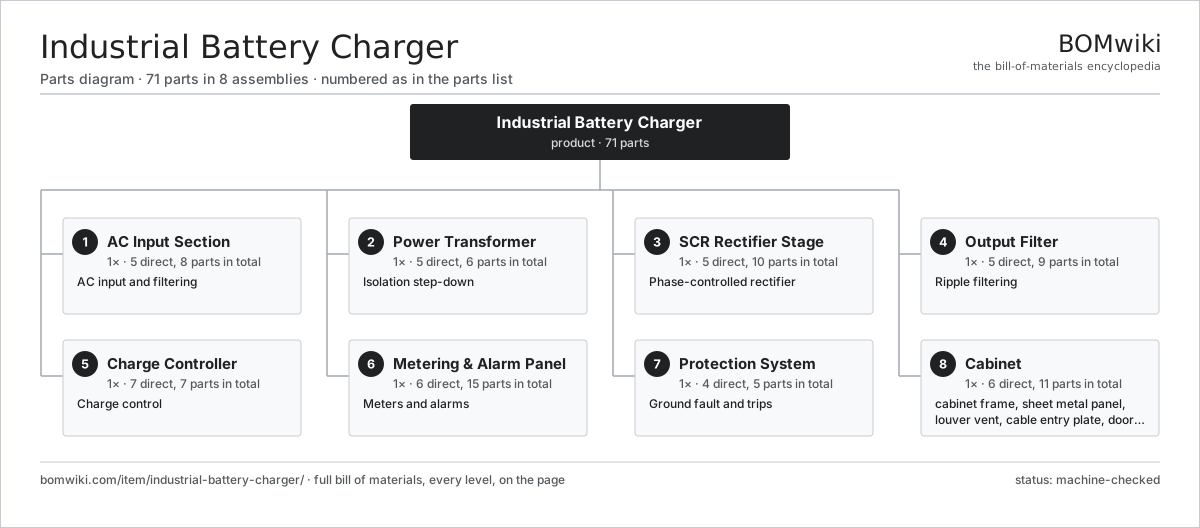
| # | Part | Qty | What it does |
|---|---|---|---|
| 1 | AC Input Section 5 parts | 1× | AC input and filtering |
| 2 | Power Transformer 5 parts | 1× | Isolation step-down |
| 3 | SCR Rectifier Stage 5 parts | 1× | Phase-controlled rectifier |
| 4 | Output Filter 5 parts | 1× | Ripple filtering |
| 5 | Charge Controller 7 parts | 1× | Charge control |
| 6 | Metering & Alarm Panel 6 parts | 1× | Meters and alarms |
| 7 | Protection System 4 parts | 1× | Ground fault and trips |
| 8 | Cabinet 6 parts | 1× | Free-standing IP42 sheet-steel cubicle with convection ventilation. |
3D model
No 3D model yet. Have a CAD file of this? Add a 3D model — STL renders right on this page; STEP, FreeCAD, and OpenSCAD sources are welcome too (openly licensed, like all 3D models on BOMwiki).
Build & assembly graph
expand / collapse · shared sub-assemblies converge · links to related products · est. labourTap an assembly to expand/collapse · tap a part to open it · use “Open page” for any node · drag to pan, scroll to zoom.
Bill of materials for Industrial Battery Charger
8 top-level lines · 51 rows shown · 71 parts total · indented to 3 levels| # | Item / sub-assembly | Part no. | Qty/assy | Ext. qty | Parts | Type |
|---|---|---|---|---|---|---|
| 1 | AC Input Section 5 parts | industrial-battery-charger-input-section | 1× | 1 | 8 | assembly |
| 1.1 | Input Breaker | industrial-battery-charger-input-breaker | 1× | 1 | · | part |
| 1.2 | Line Fuse | industrial-battery-charger-line-fuse | 3× | 3 | · | part |
| 1.3 | EMI Filter | industrial-battery-charger-emi-filter | 1× | 1 | · | part |
| 1.4 | Surge Suppressor | industrial-battery-charger-surge-suppressor | 1× | 1 | · | part |
| 1.5 | Connector | connector | 2× | 2 | · | part |
| 2 | Power Transformer 5 parts | industrial-battery-charger-transformer | 1× | 1 | 6 | assembly |
| 2.1 | Transformer Core | industrial-battery-charger-transformer-core | 1× | 1 | · | part |
| 2.2 | Copper Winding | copper-winding | 2× | 2 | · | part |
| 2.3 | Terminal Board | industrial-battery-charger-terminal-board | 1× | 1 | · | part |
| 2.4 | Thermal Fuse | thermal-fuse | 1× | 1 | · | part |
| 2.5 | Fastener Set | fastener-set | 1× | 1 | · | part |
| 3 | SCR Rectifier Stage 5 parts | industrial-battery-charger-scr-stage | 1× | 1 | 10 | assembly |
| 3.1 | SCR Module | industrial-battery-charger-scr-module | 6× | 6 | · | part |
| 3.2 | Heatsink Extrusion | industrial-battery-charger-heatsink-extrusion | 1× | 1 | · | part |
| 3.3 | Snubber Board | industrial-battery-charger-snubber-board | 1× | 1 | · | part |
| 3.4 | Freewheel Diode | industrial-battery-charger-freewheel-diode | 1× | 1 | · | part |
| 3.5 | Fastener Set | fastener-set | 1× | 1 | · | part |
| 4 | Output Filter 5 parts | industrial-battery-charger-output-filter | 1× | 1 | 9 | assembly |
| 4.1 | Filter Choke | industrial-battery-charger-filter-choke | 1× | 1 | · | part |
| 4.2 | Filter Capacitor | industrial-battery-charger-filter-capacitor | 4× | 4 | · | part |
| 4.3 | Bleeder Resistor | industrial-battery-charger-bleeder-resistor | 1× | 1 | · | part |
| 4.4 | Blocking Diode | industrial-battery-charger-blocking-diode | 1× | 1 | · | part |
| 4.5 | Output Fuse | industrial-battery-charger-output-fuse | 2× | 2 | · | part |
| 5 | Charge Controller 7 parts | industrial-battery-charger-controller | 1× | 1 | 7 | assembly |
| 5.1 | Bare PCB | pcb-bare | 1× | 1 | · | part |
| 5.2 | Microcontroller | mcu | 1× | 1 | · | part |
| 5.3 | SMD Passive (R/C/L) | smd-passives | 1× | 1 | · | part |
| 5.4 | Firing Circuit | industrial-battery-charger-firing-circuit | 1× | 1 | · | part |
| 5.5 | Voltage Sense Divider | industrial-battery-charger-voltage-sense-divider | 1× | 1 | · | part |
| 5.6 | Current Shunt | industrial-battery-charger-current-shunt | 1× | 1 | · | part |
| 5.7 | Hall Sensor | hall-sensor | 1× | 1 | · | part |
| 6 | Metering & Alarm Panel 6 parts | industrial-battery-charger-metering-panel | 1× | 1 | 15 | assembly |
| 6.1 | LCD Panel | lcd-panel | 1× | 1 | · | part |
| 6.2 | DC Voltmeter | industrial-battery-charger-dc-voltmeter | 1× | 1 | · | part |
| 6.3 | DC Ammeter | industrial-battery-charger-dc-ammeter | 2× | 2 | · | part |
| 6.4 | Control Switch | industrial-battery-charger-control-switch | 3× | 3 | · | part |
| 6.5 | Relay | relay | 4× | 4 | · | part |
| 6.6 | Connector | connector | 4× | 4 | · | part |
| 7 | Protection System 4 parts | industrial-battery-charger-protection | 1× | 1 | 5 | assembly |
| 7.1 | Ground Fault Board | industrial-battery-charger-ground-fault-board | 1× | 1 | · | part |
| 7.2 | DC Output Breaker | industrial-battery-charger-dc-output-breaker | 1× | 1 | · | part |
| 7.3 | Relay | relay | 2× | 2 | · | part |
| 7.4 | Wire Bundle | wire-bundle | 1× | 1 | · | part |
| 8 | Cabinet 6 parts | industrial-battery-charger-cabinet | 1× | 1 | 11 | assembly |
| 8.1 | Cabinet Frame | industrial-battery-charger-frame | 1× | 1 | · | part |
| 8.2 | Sheet Metal Panel | sheet-panel | 5× | 5 | · | part |
| 8.3 | Louver Vent | industrial-battery-charger-louver-vent | 2× | 2 | · | part |
| 8.4 | Cable Entry Plate | industrial-battery-charger-cable-entry-plate | 1× | 1 | · | part |
| 8.5 | Door Lock | industrial-battery-charger-door-lock | 1× | 1 | · | part |
| 8.6 | Fastener Set | fastener-set | 1× | 1 | · | part |
Related products
same domain, ranked by shared parts Automatic Voltage Regulator
83 parts · shares 5 with this page
Automatic Voltage Regulator
83 parts · shares 5 with this page
 Demand Response Controller
73 parts · shares 4 with this page
Demand Response Controller
73 parts · shares 4 with this page
 Smart Electrical Panel
133 parts · shares 4 with this page
Automatic Transfer Switch
212 parts · shares 4 with this page
Smart Electrical Panel
133 parts · shares 4 with this page
Automatic Transfer Switch
212 parts · shares 4 with this page
Sourcing: possible vendors
Prices, MOQ, and lead times are algorithmic estimates, not quotes, and not claims about these companies. Company mappings are curated by keyword; est. price band $5k–$50M. How estimates work| Vendor | HQ | Specialty | MOQ | Lead time |
|---|---|---|---|---|
| gevernova.com ↗ | Cambridge, US | Power generation | made to order | 20–40 wks |
| siemens-energy.com ↗ | Munich, DE | Power & grid | made to order | 20–40 wks |
| hitachienergy.com ↗ | Zurich, CH | Grid & transformers | made to order | 20–40 wks |
|
🇨🇭ABB
abb.com ↗
|
Zurich, CH | Electrification & automation | made to order | 20–40 wks |
| se.com ↗ | Rueil-Malmaison, FR | Electrical & automation | made to order | 20–40 wks |
800-word article