Industrial PLC
ProductOverview
Programmable logic controllers (PLCs) are the backbone of factory automation, packaging lines, and process control. Industrial PLCs differ from general-purpose computers in their determinism (guaranteed response time on every scan), their environmental hardiness (operation across wide temperature ranges with industrial power supplies), and their ready-made IO abstraction, a PLC directly reads switch closures, outputs relay commands, and measures analog signals without writing hardware drivers. The typical industrial PLC is modular: a backplane accepts hot-swappable IO cards (digital input, digital output, analog), a CPU module runs the control logic, and optional fieldbus modules link to supervisory systems.
Modern PLCs trace their ancestry to relay logic: a PLC's programming language, ladder diagram, directly mimics the rung-contact notation of hardwired relay cabinets, so electricians could retrain without learning C or Python. That said, advanced PLCs also support structured text (ST), function blocks (FB), and state machines, allowing the same hardware to run anything from simple sequence control to complex closed-loop regulation.
Architecture
The Backplane / Rack is the machine's nervous system. It is a multi-row PCB with 10–12 slots accepting modules via 64-pin DIN 41612 connectors. The bus carries 24 V power, analog and digital signal pairs (often mirrored for redundancy), and fieldbus clock signals. Hot-swappability is a core feature: a technician can pull a failed DO module mid-production, insert a replacement, and the PLC will re-enumerate the IO automatically without a reboot.
The CPU Module module is where user logic lives. Its CPU PCB hosts a 32-bit microcontroller running a real-time kernel; the Program Memory Module holds the compiled ladder or function-block program; and the Watchdog Timer enforces that every scan completes within a deadline. A fault (watchdog timeout, temperature overrun, or detected memory corruption) forces the controller into a safe shutdown state, halting all outputs.
Digital IO is split into two module types. The Digital Input Module module reads switch closures and proximity sensor outputs. Each Optoisolator Channel channel isolates the 24 V field circuit from the CPU at 3.3 kV minimum, protecting against transients on long cables or lightning strikes. Debouncing is done in hardware (10–20 ms filtering) so the CPU sees clean digital states. The Digital Output Module module (relays or transistors) executes commands. Its Relay Output Channel stages switch solenoid coils, motor starters, and indicator lamps; each channel holds its safe state during firmware upload to prevent spurious actuation.
Analog input comes from the Analog Input Module module. Most industrial sensors output 4–20 mA (transmitters on long cables) or 0–10 V (local sensors). The module's Signal Conditioning Stage stage, an instrumentation amplifier and anti-aliasing low-pass filter, accepts these signals, and the ADC Converter converts them to 14-bit digital values at 1 kHz. The 4–20 mA loop standard dominates field instruments (transmitters, pressure gauges, level probes) because the 4 mA baseline allows detection of open-wire faults (zero current = cable break).
The Analog Output Module module generates command signals for proportional valves, variable-frequency drives, and servo positioners. Its DAC Converter produces a 12-bit analog value, and the Output Amplifier conditions it to either 0–10 V (proportional servo) or 4–20 mA (transmitter emulation, most common). Jumpers or firmware settings select the range at commission time.
Real-Time Guarantees
The CPU executes its control program in a cyclic scan:
- Read all input modules in parallel.
- Execute the ladder/function-block program.
- Write all output modules in parallel.
- Service communications and housekeeping.
The Real-Time Clock Module time-stamps events. The Watchdog Timer resets on every cycle; if a scan stalls (e.g., waiting on an unfired transition or an infinite loop in user code), the watchdog fires after a configured interval (often 100 ms), halting execution and energizing a safe-state relay. This architecture gives the PLC hard real-time properties: response to an input edge is bounded by the scan period, typically 1–10 ms depending on CPU and program size.
Industrial Fieldbus Integration
The Communications Module module connects the PLC to supervisory systems (SCADA, MES, cloud gateways). Profibus, CANopen, and Ethernet/IP are the dominant protocols in discrete manufacturing; chemical and food plants often use Modbus. The Comms PCB runs the slave stack, exchanging data blocks with a master or broadcast node on every PLC scan. A typical exchange is a 32-byte input block (DI/AI readings) and a 32-byte output block (DO/AO commands), happening 10–50 times per second depending on the protocol.
Enclosure and Environmental Hardiness
The DIN-Rail Enclosure is a compact DIN-rail cabinet housing the backplane and all modules. Its Cabinet Body is powder-coated steel with thermal vents; the Hinged Door provides access to terminals and a faceplate for status LEDs. Cable entry is via Cable Gland M20/M25 glands sealing against dust and water. For hot installations the Cooling Fan runs on thermostat, keeping the enclosure below 50 °C.
Operating temperature for a standard PLC is 0–60 °C; extended-range units tolerate −25 to +70 °C. The Internal Power Supply supply is a regulated 24 V DC feed from the plant's industrial distribution; the PLC itself is inert to 18–30 V brownout.
Commissioning and Programming
Ladder diagram is the lingua franca. An electrician draws contact-coil rungs using standard symbols; the PLC vendor's IDE (Allen-Bradley, Siemens, Mitsubishi) compiles these to bytecode that runs on the CPU. More sophisticated programs use structured text (ST) or function blocks, allowing subroutine libraries and state machines. Once the program is uploaded, the PLC begins scanning, reading inputs, executing logic, driving outputs, at its cycle rate, indefinitely, until power loss or a deliberate stop command from SCADA.
Field technicians monitor the PLC via an Hinged Door light tower (red/amber/green LEDs) or a ruggedised HMI touchscreen linked via fieldbus. Troubleshooting is done by halting the PLC, forcing outputs to safe states, and inspecting the scan diagnostics: which module is responding, which output is commanded, which input is seen. The modular design means a failed IO card can be swapped without halting production in adjacent zones.
Variants and Sizing
Compact fixed-logic PLCs (5–16 IO, no modules) are common for small machines. Scalable modular systems (seen here) are used in large production lines, where IO can grow from 32 to 256 points by simply adding modules. Some PLCs add specialized modules: high-speed pulse counters for encoder feedback, thermocouple input cards for temperature control, or stepper/servo drivers for positioning axes. Redundant systems (dual CPU, voting logic) exist for critical processes, adding cost but guaranteeing uptime.
Industrial PLC parts and their functions
9 top-level parts · 484 parts in total · full bill of materials below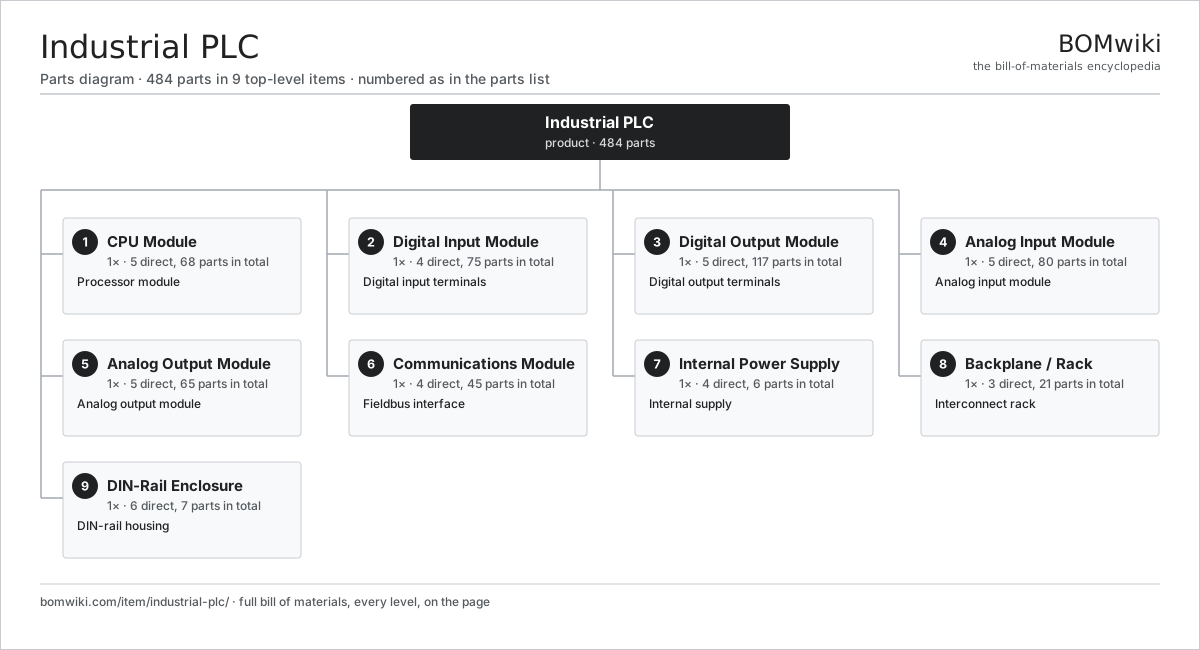
| # | Part | Qty | What it does |
|---|---|---|---|
| 1 | CPU Module 5 parts | 1× | Processor module |
| 2 | Digital Input Module 4 parts | 1× | Digital input terminals |
| 3 | Digital Output Module 5 parts | 1× | Digital output terminals |
| 4 | Analog Input Module 5 parts | 1× | Analog input module |
| 5 | Analog Output Module 5 parts | 1× | Analog output module |
| 6 | Communications Module 4 parts | 1× | Fieldbus interface |
| 7 | Internal Power Supply 4 parts | 1× | Internal supply |
| 8 | Backplane / Rack 3 parts | 1× | Interconnect rack |
| 9 | DIN-Rail Enclosure 6 parts | 1× | DIN-rail housing |
3D model
No 3D model yet. Have a CAD file of this? Add a 3D model. STL renders right on this page; STEP, FreeCAD, and OpenSCAD sources are welcome too (openly licensed, like all 3D models on BOMwiki).
Build & assembly graph
expand / collapse · shared sub-assemblies converge · links to related products · est. labourTap an assembly to expand/collapse · tap a part to open it · use “Open page” for any node · drag to pan, scroll to zoom.
Bill of materials for Industrial PLC
9 top-level lines · 70 rows shown · 484 parts total · indented to 3 levels| # | Item / sub-assembly | Part no. | Qty/assy | Ext. qty | Parts | Type |
|---|---|---|---|---|---|---|
| 1 | CPU Module 5 parts | industrial-plc-cpu | 1× | 1 | 68 | assembly |
| 1.1 | CPU PCB 4 parts | industrial-plc-cpu-board | 1× | 1 | 63 | assembly |
| 1.1.1 | Bare PCB | pcb-bare | 1× | 1 | · | part |
| 1.1.2 | Microcontroller | mcu | 1× | 1 | · | part |
| 1.1.3 | SMD Passive (R/C/L) | smd-passives | 60× | 60 | · | part |
| 1.1.4 | Crystal Oscillator | industrial-plc-oscillator | 1× | 1 | · | part |
| 1.2 | Program Memory Module | industrial-plc-memory | 1× | 1 | · | part |
| 1.3 | Real-Time Clock Module | industrial-plc-rtc-module | 1× | 1 | · | part |
| 1.4 | Watchdog Timer | industrial-plc-watchdog | 1× | 1 | · | part |
| 1.5 | Connector | connector | 2× | 2 | · | part |
| 2 | Digital Input Module 4 parts | industrial-plc-io-di | 1× | 1 | 75 | assembly |
| 2.1 | DI Input PCB 3 parts | industrial-plc-di-board | 1× | 1 | 42 | assembly |
| 2.1.1 | Bare PCB | pcb-bare | 1× | 1 | · | part |
| 2.1.2 | Microcontroller | mcu | 1× | 1 | · | part |
| 2.1.3 | SMD Passive (R/C/L) | smd-passives | 40× | 40 | · | part |
| 2.2 | Input Terminal Block | industrial-plc-di-terminals | 16× | 16 | · | part |
| 2.3 | Optoisolator Channel | industrial-plc-di-optocoupler | 16× | 16 | · | part |
| 2.4 | Connector | connector | 1× | 1 | · | part |
| 3 | Digital Output Module 5 parts | industrial-plc-io-do | 1× | 1 | 117 | assembly |
| 3.1 | DO Output PCB 4 parts | industrial-plc-do-board | 1× | 1 | 68 | assembly |
| 3.1.1 | Bare PCB | pcb-bare | 1× | 1 | · | part |
| 3.1.2 | Microcontroller | mcu | 1× | 1 | · | part |
| 3.1.3 | Power MOSFET | mosfet | 16× | 16 | · | part |
| 3.1.4 | SMD Passive (R/C/L) | smd-passives | 50× | 50 | · | part |
| 3.2 | Output Terminal Block | industrial-plc-do-terminals | 16× | 16 | · | part |
| 3.3 | Relay Output Channel | industrial-plc-do-relay | 16× | 16 | · | part |
| 3.4 | Status LED | industrial-plc-do-status-led | 16× | 16 | · | part |
| 3.5 | Connector | connector | 1× | 1 | · | part |
| 4 | Analog Input Module 5 parts | industrial-plc-io-ai | 1× | 1 | 80 | assembly |
| 4.1 | AI PCB 3 parts | industrial-plc-ai-board | 1× | 1 | 69 | assembly |
| 4.1.1 | Bare PCB | pcb-bare | 1× | 1 | · | part |
| 4.1.2 | Conditioning Op-Amp | industrial-plc-ai-opamp | 8× | 8 | · | part |
| 4.1.3 | SMD Passive (R/C/L) | smd-passives | 60× | 60 | · | part |
| 4.2 | Analog Input Terminals | industrial-plc-ai-terminals | 8× | 8 | · | part |
| 4.3 | ADC Converter | industrial-plc-ai-adc | 1× | 1 | · | part |
| 4.4 | Signal Conditioning Stage | industrial-plc-ai-conditioning | 1× | 1 | · | part |
| 4.5 | Connector | connector | 1× | 1 | · | part |
| 5 | Analog Output Module 5 parts | industrial-plc-io-ao | 1× | 1 | 65 | assembly |
| 5.1 | AO PCB 3 parts | industrial-plc-ao-board | 1× | 1 | 55 | assembly |
| 5.1.1 | Bare PCB | pcb-bare | 1× | 1 | · | part |
| 5.1.2 | SMD Passive (R/C/L) | smd-passives | 50× | 50 | · | part |
| 5.1.3 | Range Selection Jumper | industrial-plc-ao-jumper | 4× | 4 | · | part |
| 5.2 | DAC Converter | industrial-plc-ao-dac | 1× | 1 | · | part |
| 5.3 | Analog Output Terminals | industrial-plc-ao-terminals | 4× | 4 | · | part |
| 5.4 | Output Amplifier | industrial-plc-ao-opamp | 4× | 4 | · | part |
| 5.5 | Connector | connector | 1× | 1 | · | part |
| 6 | Communications Module 4 parts | industrial-plc-comms | 1× | 1 | 45 | assembly |
| 6.1 | Comms PCB 3 parts | industrial-plc-comms-board | 1× | 1 | 42 | assembly |
| 6.1.1 | Bare PCB | pcb-bare | 1× | 1 | · | part |
| 6.1.2 | Microcontroller | mcu | 1× | 1 | · | part |
| 6.1.3 | SMD Passive (R/C/L) | smd-passives | 40× | 40 | · | part |
| 6.2 | Network Connector | industrial-plc-comms-connector | 1× | 1 | · | part |
| 6.3 | Fieldbus PHY Transceiver | industrial-plc-comms-transceiver | 1× | 1 | · | part |
| 6.4 | Connector | connector | 1× | 1 | · | part |
| 7 | Internal Power Supply 4 parts | industrial-plc-power | 1× | 1 | 6 | assembly |
| 7.1 | Power Supply | power-supply | 1× | 1 | · | part |
| 7.2 | Fused Feed | industrial-plc-power-fuse | 2× | 2 | · | part |
| 7.3 | Power LED | industrial-plc-power-indicator | 1× | 1 | · | part |
| 7.4 | Connector | connector | 2× | 2 | · | part |
| 8 | Backplane / Rack 3 parts | industrial-plc-backplane | 1× | 1 | 21 | assembly |
| 8.1 | Backplane PCB | industrial-plc-backplane-pcb | 1× | 1 | · | part |
| 8.2 | Module Slot | industrial-plc-slot-connector | 10× | 10 | · | part |
| 8.3 | Slot Guide Rail | industrial-plc-slot-guide | 10× | 10 | · | part |
| 9 | DIN-Rail Enclosure 6 parts | industrial-plc-enclosure | 1× | 1 | 7 | assembly |
| 9.1 | Cabinet Body | industrial-plc-enclosure-body | 1× | 1 | · | part |
| 9.2 | Hinged Door | industrial-plc-enclosure-door | 1× | 1 | · | part |
| 9.3 | DIN Rail | industrial-plc-enclosure-din-rail | 1× | 1 | · | part |
| 9.4 | Cable Gland | industrial-plc-enclosure-gland | 2× | 2 | · | part |
| 9.5 | Cooling Fan | industrial-plc-enclosure-fan | 1× | 1 | · | part |
| 9.6 | Fastener Set | fastener-set | 1× | 1 | · | part |
Something wrong in this list? Report a problem with this BOM.
Related products
same domain, ranked by shared parts Arc Welding Robot
1,532 parts · shares 2 with this page
Drone Docking Station
210 parts · shares 2 with this page
Gantry Loading Robot
800 parts · shares 2 with this page
Laser Welding Robot
1,294 parts · shares 2 with this page
Machine Tending Robot
1,174 parts · shares 2 with this page
Parallel Kinematic Robot
831 parts · shares 2 with this page
Arc Welding Robot
1,532 parts · shares 2 with this page
Drone Docking Station
210 parts · shares 2 with this page
Gantry Loading Robot
800 parts · shares 2 with this page
Laser Welding Robot
1,294 parts · shares 2 with this page
Machine Tending Robot
1,174 parts · shares 2 with this page
Parallel Kinematic Robot
831 parts · shares 2 with this page
Sourcing: possible vendors
Browse the supplier directory → Prices, MOQ, and lead times are algorithmic estimates, not quotes, and not claims about these companies. Company mappings are curated by keyword; est. price band $3k–$500k. How estimates work| Vendor | HQ | Specialty | MOQ | Lead time |
|---|---|---|---|---|
|
🇯🇵Fanuc
fanuc.com ↗
|
Oshino, JP | Industrial robots & CNC | 20 units | 10–18 wks |
| abb.com ↗ | Zurich, CH | Industrial robots | 20 units | 10–18 wks |
|
🇯🇵Yaskawa
yaskawa.com ↗
|
Kitakyushu, JP | Robots & motion | 20 units | 10–18 wks |
|
🇩🇪KUKA
kuka.com ↗
|
Augsburg, DE | Industrial robots | 20 units | 10–18 wks |
| universal-robots.com ↗ | Odense, DK | Collaborative robots | 20 units | 10–18 wks |
1,144-word article