Blood/Fluid Warmer
ProductOverview
Infusion warmers are used in critical care, trauma, and massive transfusion scenarios to prevent accidental hypothermia. During massive transfusion, defined as >4 units packed RBCs transfused in <2 hours, cold blood and room-temperature crystalloid fluids can drop patient core temperature rapidly. Hypothermia impairs coagulation, increases bleeding risk, and worsens outcomes. A fluid warmer sitting inline between the blood bank and the patient's IV catheter is the simplest means of preventing this complication.
The device heats fluids from ambient (20–22°C) or blood-bank storage (1–6°C for packed RBCs) to physiologic temperature (37–40°C) in seconds. Passive versions rely on thermal conductivity and dwell time; active versions use electrical heating elements. The active in-line warmer is standard for rapid massive transfusion, where gravity infusion speeds can exceed 100 mL/min through large-bore IV catheters.
How it Works
Cold blood or fluid enters the warmer through the inlet Luer-lock and enters the heating cartridge, a small aluminum block with an internal chamber. An embedded heating element (Nichrome coil) energized by the power supply brings the aluminum block to 40–42°C.
As fluid passes through the 2–4 mL internal chamber at rates up to 300 mL/min, it absorbs heat from the aluminum walls. A PT100 temperature probe positioned within the cartridge measures outlet temperature and feeds back to the thermostat controller. The controller modulates the TRIAC power switch, applying proportional power to the heating element to maintain the setpoint (typically 37–40°C).
The warmed fluid exits through the outlet Luer-lock and flows down the connecting tubing (typically 1.5–2 m of PVC or polyurethane, about 250 mL priming volume) to the patient's peripheral IV catheter. A drip chamber allows the nurse to visually assess flow and detect air bubbles before they reach the patient.
The pump module is optional. In passive warming, gravity from the blood bag provides flow. In active systems, a peristaltic pump driven by a stepper motor can enforce precise flow rates even against resistance from the patient's small-bore catheter.
Safety Systems
The device implements multiple layers of safety. A mechanical thermal fuse rated to 45°C provides a non-resettable backup, cutting power to the heating element if the thermostat malfunctions and allows outlet temperature to exceed 45°C. A secondary thermocouple with hardwired logic creates a 42°C safety limit independent of the main thermostat.
An optical air-bubble detector positioned in the outlet tubing detects large air bubbles (>0.5 mL), triggers the alarm buzzer, and shuts off the pump, preventing air embolism. The display unit shows real-time outlet temperature and flow rate; any fault (over-temperature, air detected, low power) illuminates red status LEDs and sounds the alarm.
The inlet Luer-lock incorporates a 100 µm particulate filter, removing clots or emboli that could lodge in the heating cartridge.
Clinical Use
Massive transfusion protocols call for warmer use as mandatory. A typical scenario: trauma resuscitation at a level-1 trauma center. After initial crystalloid bolus, the trauma team switches to uncrossed type O packed RBCs (4–6 units) given wide open through a 16–18 gauge peripheral line. The blood passes through the warmer, exiting at 37–40°C rather than 2°C, preventing the 1–2°C core temperature drop per unit that would otherwise occur.
Flow rates in massive transfusion are high: 20-gauge catheters push 150–200 mL/min; 18-gauge delivers 250+ mL/min. The warmer must not introduce significant back-pressure; the internal cartridge design is optimized to minimize resistance. Warmup time is also critical: the first unit should reach target temperature within 30–60 seconds of starting the infusion.
Standard practice: prime the warmer and connecting tubing with a 50 mL syringe of saline before attaching the blood. This ensures no air enters the patient's circulation. After use, the heating cartridge is discarded or autoclaved (depending on reusable vs. single-use design); the tubing and Luer connectors are disposed as biohazard waste.
Limitations
Warmers are effective only for IV infusions. Massive intracavitary fluid (e.g., warmed saline irrigation during open thoracotomy) requires a separate OR-level warmer station. Additionally, a warmer cannot correct core hypothermia already present; it only prevents further heat loss during infusion. Patients requiring resuscitation from profound hypothermia (cardiac arrest at <30°C) may benefit from extracorporeal rewarming (ECMO), which the warmer cannot provide.
Blood/Fluid Warmer parts and their functions
7 top-level parts · 28 parts in total · full bill of materials below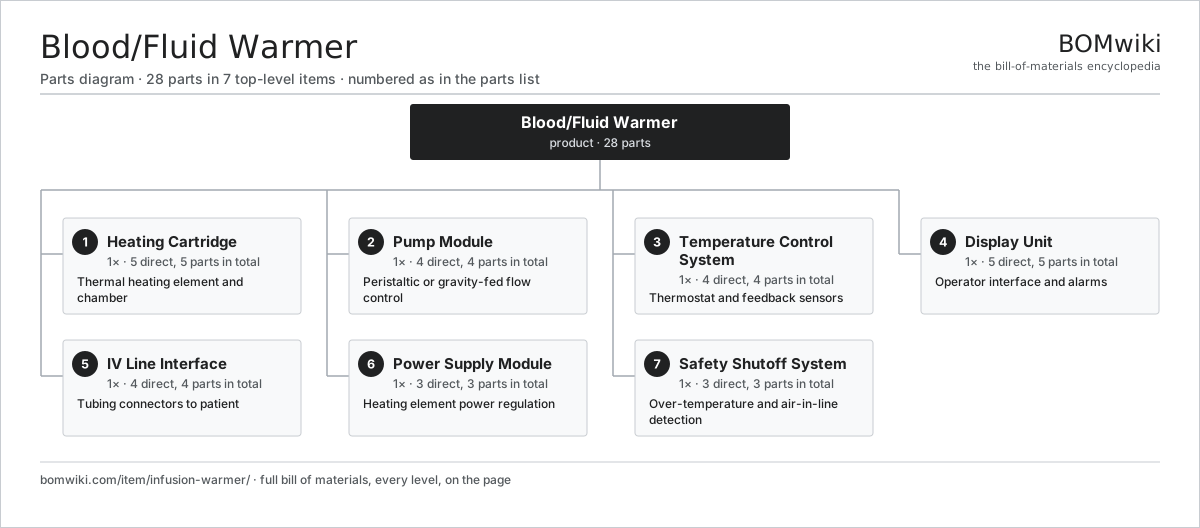
| # | Part | Qty | What it does |
|---|---|---|---|
| 1 | Heating Cartridge 5 parts | 1× | Thermal heating element and chamber |
| 2 | Pump Module 4 parts | 1× | Peristaltic or gravity-fed flow control |
| 3 | Temperature Control System 4 parts | 1× | Thermostat and feedback sensors |
| 4 | Display Unit 5 parts | 1× | Operator interface and alarms |
| 5 | IV Line Interface 4 parts | 1× | Tubing connectors to patient |
| 6 | Power Supply Module 3 parts | 1× | Heating element power regulation |
| 7 | Safety Shutoff System 3 parts | 1× | Over-temperature and air-in-line detection |
3D model
No 3D model yet. Have a CAD file of this? Add a 3D model. STL renders right on this page; STEP, FreeCAD, and OpenSCAD sources are welcome too (openly licensed, like all 3D models on BOMwiki).
Build & assembly graph
expand / collapse · shared sub-assemblies converge · links to related products · est. labourTap an assembly to expand/collapse · tap a part to open it · use “Open page” for any node · drag to pan, scroll to zoom.
Bill of materials for Blood/Fluid Warmer
7 top-level lines · 35 rows shown · 28 parts total · indented to 3 levels| # | Item / sub-assembly | Part no. | Qty/assy | Ext. qty | Parts | Type |
|---|---|---|---|---|---|---|
| 1 | Heating Cartridge 5 parts | infusion-warmer-heating-cartridge | 1× | 1 | 5 | assembly |
| 1.1 | Aluminum Block | infusion-warmer-aluminum-block | 1× | 1 | · | part |
| 1.2 | Heating Element | heating-element | 1× | 1 | · | part |
| 1.3 | Inlet Port | infusion-warmer-inlet-port | 1× | 1 | · | part |
| 1.4 | Outlet Port | infusion-warmer-outlet-port | 1× | 1 | · | part |
| 1.5 | Probe Site | infusion-warmer-temperature-probe-site | 1× | 1 | · | part |
| 2 | Pump Module 4 parts | infusion-warmer-pump-module | 1× | 1 | 4 | assembly |
| 2.1 | Peristaltic Pump Head | infusion-warmer-peristaltic-pump | 1× | 1 | · | part |
| 2.2 | Pump Tubing | infusion-warmer-pump-tubing | 1× | 1 | · | part |
| 2.3 | Flow Control Valve | infusion-warmer-flow-control-valve | 1× | 1 | · | part |
| 2.4 | Stepper Motor | stepper-motor | 1× | 1 | · | part |
| 3 | Temperature Control System 4 parts | infusion-warmer-temperature-control | 1× | 1 | 4 | assembly |
| 3.1 | RTD Temperature Probe | infusion-warmer-rtd-probe | 1× | 1 | · | part |
| 3.2 | Thermostat Circuit | infusion-warmer-comparator-circuit | 1× | 1 | · | part |
| 3.3 | Heating TRIAC | infusion-warmer-heating-triac | 1× | 1 | · | part |
| 3.4 | Bare PCB | pcb-bare | 1× | 1 | · | part |
| 4 | Display Unit 5 parts | infusion-warmer-display-unit | 1× | 1 | 5 | assembly |
| 4.1 | LCD Display | infusion-warmer-lcd-display | 1× | 1 | · | part |
| 4.2 | Control Buttons | infusion-warmer-control-buttons | 1× | 1 | · | part |
| 4.3 | Alarm Buzzer | infusion-warmer-alarm-buzzer | 1× | 1 | · | part |
| 4.4 | Status LEDs | infusion-warmer-status-leds | 1× | 1 | · | part |
| 4.5 | Microcontroller | mcu | 1× | 1 | · | part |
| 5 | IV Line Interface 4 parts | infusion-warmer-iv-line-interface | 1× | 1 | 4 | assembly |
| 5.1 | Inlet Luer | infusion-warmer-inlet-luer | 1× | 1 | · | part |
| 5.2 | Outlet Luer | infusion-warmer-outlet-luer | 1× | 1 | · | part |
| 5.3 | Connecting Tubing | infusion-warmer-connecting-tubing | 1× | 1 | · | part |
| 5.4 | Drip Chamber | infusion-warmer-drip-chamber | 1× | 1 | · | part |
| 6 | Power Supply Module 3 parts | infusion-warmer-power-supply | 1× | 1 | 3 | assembly |
| 6.1 | Power Supply | power-supply | 1× | 1 | · | part |
| 6.2 | AC Input Filter | infusion-warmer-ac-input-filter | 1× | 1 | · | part |
| 6.3 | Fuse/Breaker | infusion-warmer-fuse-breaker | 1× | 1 | · | part |
| 7 | Safety Shutoff System 3 parts | infusion-warmer-safety-shutoff | 1× | 1 | 3 | assembly |
| 7.1 | Thermal Fuse Backup | infusion-warmer-thermal-fuse-backup | 1× | 1 | · | part |
| 7.2 | Air Detector | infusion-warmer-air-detector | 1× | 1 | · | part |
| 7.3 | High-Temp Sensor | infusion-warmer-high-temp-sensor | 1× | 1 | · | part |
Something wrong in this list? Report a problem with this BOM.
Related products
same domain, ranked by shared parts Anesthesia Machine
562 parts · shares 2 with this page
Anesthesia Machine
562 parts · shares 2 with this page
 Blood Bank Refrigerator
79 parts · shares 2 with this page
Blood Gas Analyzer
386 parts · shares 2 with this page
Blood Bank Refrigerator
79 parts · shares 2 with this page
Blood Gas Analyzer
386 parts · shares 2 with this page
 CPAP Machine
259 parts · shares 2 with this page
CPAP Machine
259 parts · shares 2 with this page
 ECMO Machine
142 parts · shares 2 with this page
ECMO Machine
142 parts · shares 2 with this page
 Fetal Monitor
312 parts · shares 2 with this page
Fetal Monitor
312 parts · shares 2 with this page
Sourcing: possible vendors
Browse the supplier directory → Prices, MOQ, and lead times are algorithmic estimates, not quotes, and not claims about these companies. Company mappings are curated by keyword; est. price band $500–$3M. How estimates work| Vendor | HQ | Specialty | MOQ | Lead time |
|---|---|---|---|---|
| gehealthcare.com ↗ | Chicago, US | Medical imaging & devices | 100 units | 12–20 wks |
| siemens-healthineers.com ↗ | Erlangen, DE | Medical systems | 100 units | 12–20 wks |
|
🇳🇱Philips
philips.com ↗
|
Amsterdam, NL | Health technology | 100 units | 12–20 wks |
| medtronic.com ↗ | Minneapolis, US | Medical devices | 100 units | 12–20 wks |
|
🇨🇳Mindray
mindray.com ↗
|
Shenzhen, CN | Medical devices | 100 units | 12–20 wks |
813-word article