Vacuum Casting Machine
ProductOverview
A vacuum induction casting machine is a precision desktop system designed for jewelers and artisans producing high-quality metal castings from wax or rubber patterns. The system combines induction heating, which raises metal to molten state without open flame, with vacuum processing to eliminate gas porosity and surface defects common in traditional casting methods. Vacuum casting is critical for fine jewelry where small voids become visible or compromise structural integrity; it is also used for dental prosthetics, hearing aid components, and intricate sculptural metalwork.
The machine operates on a simple principle: induction coils generate eddy currents in the crucible metal, and after melting, the sealed vacuum chamber reduces ambient air pressure below the vapor pressure of volatile elements. This forces dissolved gases from the mold cavity and casting, resulting in denser, more ductile final pieces. Typical gold, silver, and platinum jewelry grades benefit immediately from vacuum processing, with castings showing 30–50% fewer gas pores than conventional torch-melted castings.
How it works
The operator loads a ceramic investment flask, containing the wax pattern and refractory mold, onto the flask handler platform. Meanwhile, precious metal scrap or ingot is placed in a ceramic crucible and inserted into the induction heating unit. The control panel accepts a programmed temperature profile: heating rate, dwell time at melting point, and cooling setpoint.
When the cycle starts, the induction coil energizes at 3–10 kHz RF frequency, inducing eddy currents that resistively heat the metal to 1200–1400°C in 10–20 minutes without touching it, avoiding crucible contamination. A thermocouple embedded in the mold provides real-time feedback to the controller, which regulates power to hold the target temperature within ±10°C.
Once metal reaches melting point, the operator manually or via automated sequence lowers the flask into the vacuum chamber, seals the lid, and activates the vacuum pump. The pressure drops from atmospheric (760 torr) to 0.5–5 torr in 30–60 seconds, depending on system pump capacity. At this pressure, the partial pressure of hydrogen and oxygen becomes extremely low, and dissolved gases in the molten metal preferentially escape into the vacuum rather than remaining trapped as bubbles.
The crucible is then heated further (or held at temperature) while under vacuum, then the solenoid vent valve automatically opens, allowing the mold to cool in air or nitrogen backfill. This prevents atmospheric reabsorption of gases. After cooling (typically 30–60 minutes), the flask is removed and the casting is extracted from the ceramic investment using vibration or a light chilling bath.
Components and Engineering
The induction coil is a precision-wound copper tube, typically 0.125–0.25 inch OD, arranged in a flat spiral or short helix around the crucible. The coil is fed with high-frequency AC from a dedicated power supply, which bridges AC mains to a resonant LC circuit tuned to the coil impedance. The capacitor bank stores reactive energy, allowing the system to transfer 85–95% of input power directly to the crucible at resonance, rather than dissipating it as heat in the electronics.
The chamber is a sealed cylinder of 304 stainless steel, with wall thickness 0.125–0.25 inch, capable of withstanding full vacuum (14.7 psi inward force) for 10,000+ cycles. The lid is removable and sealed with a silicone or EPDM O-ring; a hand screw or clamp lever forces it down against the gasket. The pump port connects to a rotary vane (oil-sealed) or diaphragm pump rated 5–20 CFM at the target vacuum. For home shop use, a small 1–2 hp pump suffices; production shops use larger 3–5 hp units for faster cycle times.
The cooling system circulates water or synthetic coolant through jackets surrounding the induction coil at 5–20 gpm, removing 20–40 kW of waste heat during heating. A centrifugal pump draws coolant from a reservoir and pushes it through the coil jacket, then through a radiator (aluminum fin-tube core) where it rejects heat to ambient air or secondary water loop. The check valve prevents backflow when the pump stops. Hose assemblies are high-temperature silicone (200°C rating) with crimped or NPT brass fittings.
The crucible is high-alumina ceramic (99.7% Al₂O₃) or graphite, chosen based on metal chemistry: graphite for ferrous castings, alumina for precious metals and non-ferrous alloys. The crucible is seated in a setter block, a refractory ceramic block with a conical or cylindrical recess holding the crucible concentric to the induction coil. The heat shield is a high-density refractory board (often alumina or zirconia foam) surrounding the crucible, reducing thermal radiation losses and protecting the coil jacket from radiant heat.
The control panel houses a microcontroller (typically ARM-based) running a preloaded profile or accepting manual setpoints via a small LCD display and keypad. The controller reads the thermocouple voltage via a cold-junction compensator and 12-bit ADC, then modulates the induction power supply using a solid-state relay or phase-angle controller. A separate analog pressure transducer feeds the vacuum reading directly to the display. The panel includes a large emergency stop button, separate start and stop buttons, and LED status lights for power, heating, and vacuum active states.
Maintenance and Operation
Crucibles require replacement after 20–50 castings depending on metal type and temperature; scratches or cracks accelerate oxidation and contamination. The chamber lid O-ring should be inspected visually for hardening and replaced annually or if vacuum no longer achieves target pressure. The induction coil should be flushed with coolant monthly to prevent mineral buildup in hard-water regions.
Safety considerations include electrical lockout (240V mains), hot surfaces (crucible and chamber reach >1100°C), and risk of metal splashing if water inadvertently contacts molten metal (explosive boiling). Most commercial systems include thermal overload protection on the power supply, vacuum sensor cutoff (preventing heating if pump fails), and insulated handles on the flask handler. Proper ventilation is essential, as volatile components (sulfur, phosphorus) may be released during melting. The exhaust system with activated carbon filter captures most fumes.
Production rates vary: a single casting cycle takes 45–90 minutes soup-to-nuts, so 6–10 castings per 8-hour shift is typical for a single-operator shop. Batch capacity depends on crucible volume; larger shops invest in multiple small machines to run castings in parallel.
Vacuum Casting Machine parts and their functions
7 top-level parts · 39 parts in total · full bill of materials below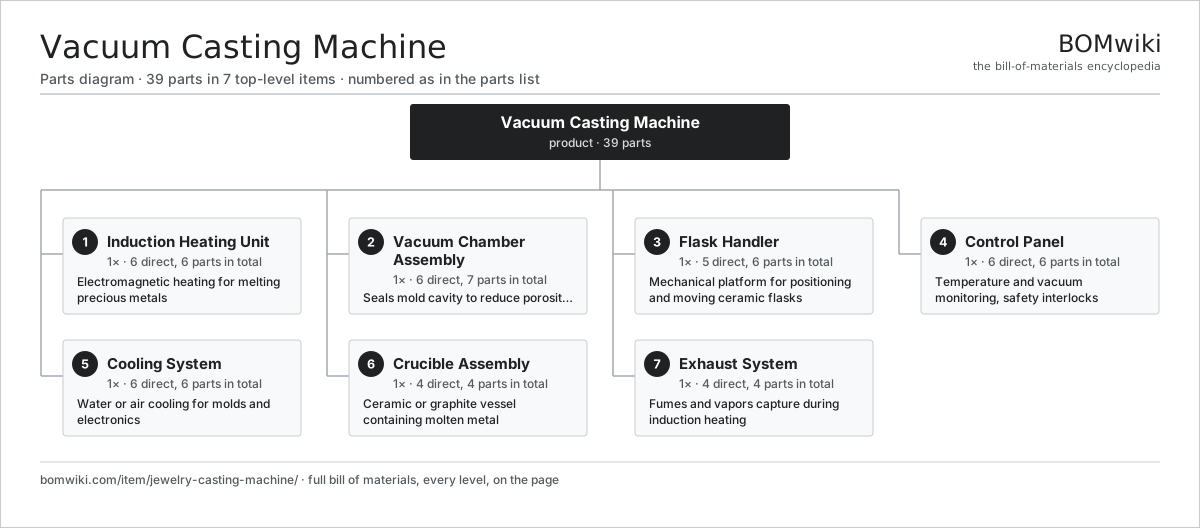
| # | Part | Qty | What it does |
|---|---|---|---|
| 1 | Induction Heating Unit 6 parts | 1× | Electromagnetic heating for melting precious metals |
| 2 | Vacuum Chamber Assembly 6 parts | 1× | Seals mold cavity to reduce porosity during casting |
| 3 | Flask Handler 5 parts | 1× | Mechanical platform for positioning and moving ceramic flasks |
| 4 | Control Panel 6 parts | 1× | Temperature and vacuum monitoring, safety interlocks |
| 5 | Cooling System 6 parts | 1× | Water or air cooling for molds and electronics |
| 6 | Crucible Assembly 4 parts | 1× | Ceramic or graphite vessel containing molten metal |
| 7 | Exhaust System 4 parts | 1× | Fumes and vapors capture during induction heating |
3D model
No 3D model yet. Have a CAD file of this? Add a 3D model. STL renders right on this page; STEP, FreeCAD, and OpenSCAD sources are welcome too (openly licensed, like all 3D models on BOMwiki).
Build & assembly graph
expand / collapse · shared sub-assemblies converge · links to related products · est. labourTap an assembly to expand/collapse · tap a part to open it · use “Open page” for any node · drag to pan, scroll to zoom.
Bill of materials for Vacuum Casting Machine
7 top-level lines · 44 rows shown · 39 parts total · indented to 3 levels| # | Item / sub-assembly | Part no. | Qty/assy | Ext. qty | Parts | Type |
|---|---|---|---|---|---|---|
| 1 | Induction Heating Unit 6 parts | jewelry-casting-machine-induction-unit | 1× | 1 | 6 | assembly |
| 1.1 | Power Supply | power-supply | 1× | 1 | · | part |
| 1.2 | RF Induction Coil | jewelry-casting-machine-rf-coil | 1× | 1 | · | part |
| 1.3 | Tuning Capacitor Bank | jewelry-casting-machine-capacitor-bank | 1× | 1 | · | part |
| 1.4 | Temperature Sensor | temperature-sensor | 1× | 1 | · | part |
| 1.5 | Relay | relay | 1× | 1 | · | part |
| 1.6 | Cooling Jacket | jewelry-casting-machine-cooling-jacket | 1× | 1 | · | part |
| 2 | Vacuum Chamber Assembly 6 parts | jewelry-casting-machine-vacuum-chamber | 1× | 1 | 7 | assembly |
| 2.1 | Chamber Body | jewelry-casting-machine-chamber-body | 1× | 1 | · | part |
| 2.2 | Chamber Lid | jewelry-casting-machine-chamber-lid | 1× | 1 | · | part |
| 2.3 | Vacuum Pump Port | jewelry-casting-machine-vacuum-pump-port | 1× | 1 | · | part |
| 2.4 | O-Ring Set | oring-set | 2× | 2 | · | part |
| 2.5 | Pressure Sensor | pressure-sensor | 1× | 1 | · | part |
| 2.6 | Solenoid Vent Valve | jewelry-casting-machine-solenoid-valve | 1× | 1 | · | part |
| 3 | Flask Handler 5 parts | jewelry-casting-machine-flask-handler | 1× | 1 | 6 | assembly |
| 3.1 | Handler Base Frame | jewelry-casting-machine-handler-base | 1× | 1 | · | part |
| 3.2 | Flask Cradle Block | jewelry-casting-machine-cradle-block | 2× | 2 | · | part |
| 3.3 | Lift Mechanism | jewelry-casting-machine-lift-mechanism | 1× | 1 | · | part |
| 3.4 | Fastener Set | fastener-set | 1× | 1 | · | part |
| 3.5 | Temperature Probe Mount | jewelry-casting-machine-temperature-probe-mount | 1× | 1 | · | part |
| 4 | Control Panel 6 parts | jewelry-casting-machine-control-panel | 1× | 1 | 6 | assembly |
| 4.1 | Microcontroller | mcu | 1× | 1 | · | part |
| 4.2 | Bare PCB | pcb-bare | 1× | 1 | · | part |
| 4.3 | SMD Passive (R/C/L) | smd-passives | 1× | 1 | · | part |
| 4.4 | LCD Panel | lcd-panel | 1× | 1 | · | part |
| 4.5 | Control Button Assembly | jewelry-casting-machine-control-buttons | 1× | 1 | · | part |
| 4.6 | Status Indicator Lights | jewelry-casting-machine-indicator-lights | 1× | 1 | · | part |
| 5 | Cooling System 6 parts | jewelry-casting-machine-cooling-system | 1× | 1 | 6 | assembly |
| 5.1 | Coolant Reservoir | jewelry-casting-machine-coolant-reservoir | 1× | 1 | · | part |
| 5.2 | Coolant Pump | coolant-pump | 1× | 1 | · | part |
| 5.3 | Cooling Radiator | jewelry-casting-machine-radiator | 1× | 1 | · | part |
| 5.4 | Drive Belt | drive-belt | 1× | 1 | · | part |
| 5.5 | Coolant Check Valve | jewelry-casting-machine-check-valve | 1× | 1 | · | part |
| 5.6 | High-Temperature Hose Assembly | jewelry-casting-machine-hose-assembly | 1× | 1 | · | part |
| 6 | Crucible Assembly 4 parts | jewelry-casting-machine-crucible-assembly | 1× | 1 | 4 | assembly |
| 6.1 | Crucible Body | jewelry-casting-machine-crucible-body | 1× | 1 | · | part |
| 6.2 | Crucible Lid | jewelry-casting-machine-crucible-lid | 1× | 1 | · | part |
| 6.3 | Refractory Heat Shield | jewelry-casting-machine-heat-shield | 1× | 1 | · | part |
| 6.4 | Crucible Setter Block | jewelry-casting-machine-setter-block | 1× | 1 | · | part |
| 7 | Exhaust System 4 parts | jewelry-casting-machine-exhaust-system | 1× | 1 | 4 | assembly |
| 7.1 | Exhaust Capture Hood | jewelry-casting-machine-exhaust-hood | 1× | 1 | · | part |
| 7.2 | Flexible Exhaust Duct | jewelry-casting-machine-flex-duct | 1× | 1 | · | part |
| 7.3 | Activated Carbon Filter | jewelry-casting-machine-carbon-filter | 1× | 1 | · | part |
| 7.4 | Blower Motor | blower-motor | 1× | 1 | · | part |
Something wrong in this list? Report a problem with this BOM.
Related products
same domain, ranked by shared parts Cable Extrusion Line
46 parts · shares 7 with this page
Cable Extrusion Line
46 parts · shares 7 with this page
 Chalk Extrusion Machine
47 parts · shares 7 with this page
Binder Jetting Printer
112 parts · shares 7 with this page
Chalk Extrusion Machine
47 parts · shares 7 with this page
Binder Jetting Printer
112 parts · shares 7 with this page
 Industrial FDM Printer
98 parts · shares 7 with this page
Match Making Machine
47 parts · shares 6 with this page
Crayon Molding Machine
56 parts · shares 6 with this page
Industrial FDM Printer
98 parts · shares 7 with this page
Match Making Machine
47 parts · shares 6 with this page
Crayon Molding Machine
56 parts · shares 6 with this page
Sourcing: possible vendors
Browse the supplier directory → Prices, MOQ, and lead times are algorithmic estimates, not quotes, and not claims about these companies. Company mappings are curated by keyword; est. price band $5k–$2M. How estimates work| Vendor | HQ | Specialty | MOQ | Lead time |
|---|---|---|---|---|
| atlascopco.com ↗ | Stockholm, SE | Compressors & industrial | 10 units | 12–20 wks |
|
🇦🇹Andritz
andritz.com ↗
|
Graz, AT | Process plants & machinery | 10 units | 12–20 wks |
| buhlergroup.com ↗ | Uzwil, CH | Food & materials processing | 10 units | 12–20 wks |
| gea.com ↗ | Düsseldorf, DE | Process technology | 10 units | 12–20 wks |
| mhi.com ↗ | Tokyo, JP | Heavy machinery | 10 units | 12–20 wks |
1,213-word article