Digital Jukebox
ProductOverview
A digital jukebox is an entertainment system found in bars, restaurants, bowling alleys, and social venues: a touchscreen-driven music player that lets patrons queue songs by tapping a display, paying with coins or a card. Unlike a smartphone connected to a Bluetooth speaker (which is free and convenience-driven), a jukebox monetizes the service, paying per song or per time block, and creates a shared social listening experience, where multiple people contribute to a playlist and the venue owner earns revenue from music plays.
The Digital Jukebox is essentially an embedded computer (a headless PC or SoC) loaded with a music library (50–100k songs), a touchscreen interface (Touchscreen Display), a stereo power amplifier (Stereo Power Amplifier), and integral speakers (Speaker System). The payment module locks down playback until payment is received, and the LED lighting adds visual excitement, pulsating with the music. All of this is housed in a attractive cabinet designed to be the centerpiece of a bar or game room.
How it works
A patron approaches the jukebox and taps the Touchscreen Display. The interface displays the music library, allowing them to browse by artist, album, genre, or text search. Once they select a song, the master controller checks the available credit: if they have paid via coin or card, or if they have a prepaid account, the credit is deducted and the song is queued. If credit is insufficient, the display prompts them to add payment.
The Media Server pulls the selected song from the music database (stored as MP3 or FLAC), decodes it, and sends the audio to the Stereo Power Amplifier. The preamplifier boosts the signal to the power amplifier, which drives the speakers at the requested volume (controlled via the EQ knob on the unit or touchscreen). The LED controller reads the audio stream, extracts bass frequencies via a simple EQ, and pulses the RGB LEDs to the beat, red during bass hits, color shifts with the song.
Touchscreen interface and UX
The display controller runs a custom UI, often web-based (HTML5 running on a WebKit browser), with large touch targets optimized for intoxicated patrons or gloved hands. The interface typically shows:
- A song search / browse view
- Current queue with time remaining
- Equalizer or lighting controls
- Account balance and payment options
Modern jukeboxes push updates over the network (Ethernet or WiFi). The venue owner or operator can refresh the music library remotely, add new songs weekly, or push promotions ("Play any three songs, get a free drink coupon"). Some jukeboxes integrate with real-time charts (Spotify, Apple Music API) to auto-rotate trending songs.
Payment models
Jukeboxes monetize through:
- Per-song credit: User buys a "credit" (say, $1 = 2 songs) via coin or card, and queues songs.
- Subscription billing: Monthly account prepaid, unlimited plays (used in upscale venues).
- Time-based: $X for 30 minutes of control (less common but popular in private parties).
The payment controller maintains a ledger of credits, checks sufficiency before queueing, and reports revenue to the operator. Many newer jukeboxes push earnings to the cloud, so venue owners can monitor across multiple machines.
Audio quality and EQ
The Stereo Power Amplifier is typically 50–200 W RMS stereo, enough to fill a bar or restaurant without distortion at conversation volume. Most include an EQ knob for bass boost (popular in bars for dance music) and treble trim (to reduce harshness in bright environments). Some allow the operator to save EQ presets per music genre or venue characteristic (e.g., "Rock," "Dance," "Ambient").
Lighting and visual feedback
The LED Controller with Beat Sync performs beat detection on the audio: it monitors the low-frequency content and triggers LED pulses when bass peaks occur. Color transitions can be set by song metadata (genre → color), or by user preference. Some venues use the jukebox lighting as a focal point, dimming the main lights when a popular song plays and letting the jukebox light show take over.
Hosting and library management
Modern jukeboxes sync their library with a cloud service owned by the jukebox vendor (e.g., Nugs, TouchTunes, Rockbot). When a new hit single is released, it appears on all connected machines within hours. The Network Interface checks for updates periodically, and if bandwidth is available, new songs are downloaded and added to the Music Hard Drive / SSD. This keeps the library fresh without requiring an operator to manually manage files.
Some venues hire "jukebox programmers", staff who curate the library for their specific clientele, removing songs that never get played and stocking up on customer favorites. The jukebox analytics (tracking which songs are most often requested) inform these decisions.
Social and community aspect
Unlike a Spotify speaker or bar background music, a jukebox is participatory: the display itself invites interaction, and seeing your song queued and played in front of your peers is a small victory. Bars often run jukebox competitions or promotions ("Most plays this month gets a prize"), turning the machine into a social anchor. This is why despite the rise of streaming, jukeboxes remain profitable in venues with regular social gatherings.
Digital Jukebox parts and their functions
13 top-level parts · 563 parts in total · full bill of materials below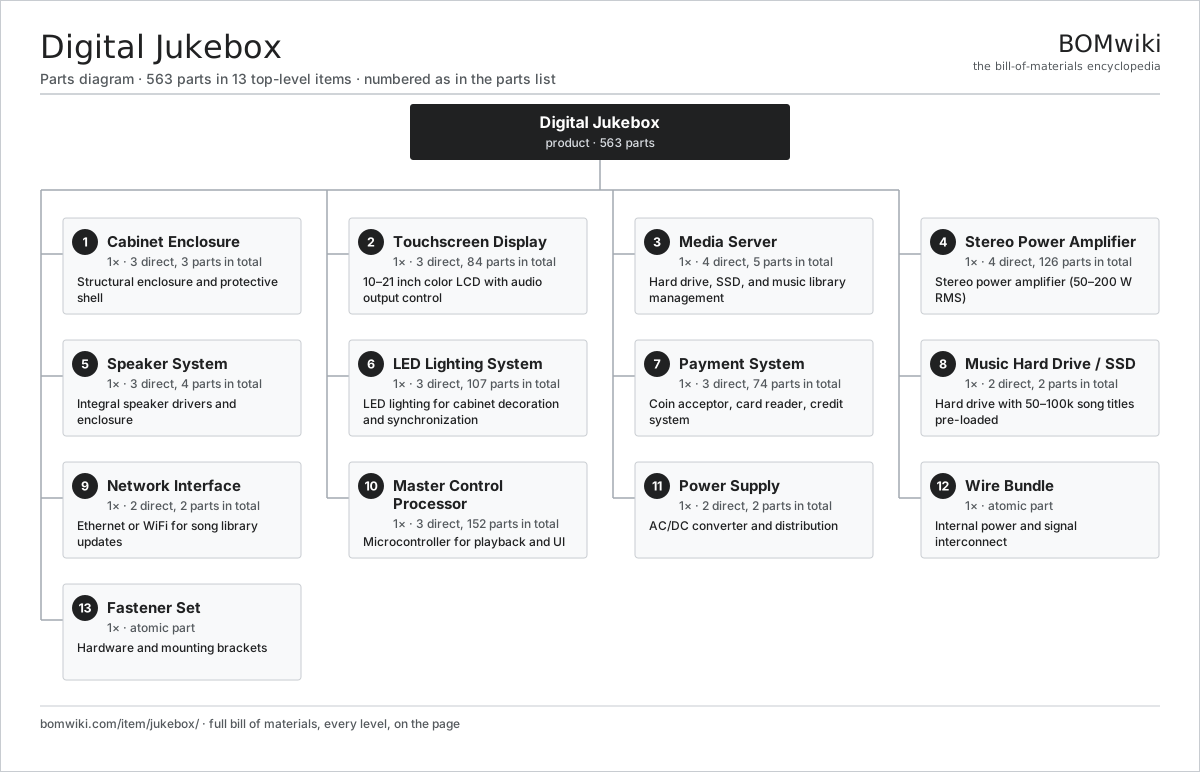
| # | Part | Qty | What it does |
|---|---|---|---|
| 1 | Cabinet Enclosure 3 parts | 1× | Structural enclosure and protective shell |
| 2 | Touchscreen Display 3 parts | 1× | 10–21 inch color LCD with audio output control |
| 3 | Media Server 4 parts | 1× | Hard drive, SSD, and music library management |
| 4 | Stereo Power Amplifier 4 parts | 1× | Stereo power amplifier (50–200 W RMS) |
| 5 | Speaker System 3 parts | 1× | Integral speaker drivers and enclosure |
| 6 | LED Lighting System 3 parts | 1× | LED lighting for cabinet decoration and synchronization |
| 7 | Payment System 3 parts | 1× | Coin acceptor, card reader, credit system |
| 8 | Music Hard Drive / SSD 2 parts | 1× | Hard drive with 50–100k song titles pre-loaded |
| 9 | Network Interface 2 parts | 1× | Ethernet or WiFi for song library updates |
| 10 | Master Control Processor 3 parts | 1× | Microcontroller for playback and UI |
| 11 | Power Supply 2 parts | 1× | AC/DC converter and distribution |
| 12 | Wire Bundle | 1× | Internal power and signal interconnect |
| 13 | Fastener Set | 1× | Hardware and mounting brackets |
3D model
No 3D model yet. Have a CAD file of this? Add a 3D model. STL renders right on this page; STEP, FreeCAD, and OpenSCAD sources are welcome too (openly licensed, like all 3D models on BOMwiki).
Build & assembly graph
expand / collapse · shared sub-assemblies converge · links to related products · est. labourTap an assembly to expand/collapse · tap a part to open it · use “Open page” for any node · drag to pan, scroll to zoom.
Bill of materials for Digital Jukebox
13 top-level lines · 59 rows shown · 563 parts total · indented to 3 levels| # | Item / sub-assembly | Part no. | Qty/assy | Ext. qty | Parts | Type |
|---|---|---|---|---|---|---|
| 1 | Cabinet Enclosure 3 parts | jukebox-cabinet | 1× | 1 | 3 | assembly |
| 1.1 | Cabinet Body (wood or metal) | jukebox-cabinet-body | 1× | 1 | · | part |
| 1.2 | Protective Front Glass Panel | jukebox-cabinet-front-glass | 1× | 1 | · | part |
| 1.3 | Ventilation Louvers | jukebox-cabinet-vents | 1× | 1 | · | part |
| 2 | Touchscreen Display 3 parts | jukebox-touchscreen | 1× | 1 | 84 | assembly |
| 2.1 | LCD Panel | lcd-panel | 1× | 1 | · | part |
| 2.2 | Display Bezel | jukebox-display-bezel | 1× | 1 | · | part |
| 2.3 | Display Controller Card 3 parts | jukebox-display-driver | 1× | 1 | 82 | assembly |
| 2.3.1 | Bare PCB | pcb-bare | 1× | 1 | · | part |
| 2.3.2 | Display Microcontroller | jukebox-display-mcu | 1× | 1 | · | part |
| 2.3.3 | SMD Passive (R/C/L) | smd-passives | 80× | 80 | · | part |
| 3 | Media Server 4 parts | jukebox-media-server | 1× | 1 | 5 | assembly |
| 3.1 | Server SoC (x86 or ARM) | jukebox-server-soc | 1× | 1 | · | part |
| 3.2 | Music Hard Drive / SSD 2 parts | jukebox-music-db | 1× | 1 | 2 | assembly |
| 3.2.1 | SSD Storage Module | jukebox-drive-ssd | 1× | 1 | · | part |
| 3.2.2 | Drive Enclosure with Vibration Damping | jukebox-drive-enclosure | 1× | 1 | · | part |
| 3.3 | System RAM (4–8 GB) | jukebox-server-memory | 1× | 1 | · | part |
| 3.4 | Server Motherboard | jukebox-server-motherboard | 1× | 1 | · | part |
| 4 | Stereo Power Amplifier 4 parts | jukebox-audio-amplifier | 1× | 1 | 126 | assembly |
| 4.1 | Amplifier PCB 3 parts | jukebox-amp-board | 1× | 1 | 122 | assembly |
| 4.1.1 | Bare PCB | pcb-bare | 1× | 1 | · | part |
| 4.1.2 | Preamplifier IC | jukebox-preamp-ic | 1× | 1 | · | part |
| 4.1.3 | SMD Passive (R/C/L) | smd-passives | 120× | 120 | · | part |
| 4.2 | Power Amplifier IC (per channel) | jukebox-power-amp-ic | 2× | 2 | · | part |
| 4.3 | Aluminum Heatsink | jukebox-heatsink | 1× | 1 | · | part |
| 4.4 | EQ / Bass Control Potentiometer | jukebox-eq-control | 1× | 1 | · | part |
| 5 | Speaker System 3 parts | jukebox-speaker-system | 1× | 1 | 4 | assembly |
| 5.1 | Speaker | speaker | 2× | 2 | · | part |
| 5.2 | Speaker Enclosure | jukebox-speaker-enclosure | 1× | 1 | · | part |
| 5.3 | Passive Crossover (if 2-way) | jukebox-passive-crossover | 1× | 1 | · | part |
| 6 | LED Lighting System 3 parts | jukebox-lighting-system | 1× | 1 | 107 | assembly |
| 6.1 | RGB LED Strip (per side) | jukebox-led-strip | 4× | 4 | · | part |
| 6.2 | LED Controller with Beat Sync 3 parts | jukebox-led-controller | 1× | 1 | 102 | assembly |
| 6.2.1 | Bare PCB | pcb-bare | 1× | 1 | · | part |
| 6.2.2 | LED Control Microcontroller | jukebox-led-mcu | 1× | 1 | · | part |
| 6.2.3 | SMD Passive (R/C/L) | smd-passives | 100× | 100 | · | part |
| 6.3 | Ambient Light Sensor | jukebox-light-sensor | 1× | 1 | · | part |
| 7 | Payment System 3 parts | jukebox-payment-system | 1× | 1 | 74 | assembly |
| 7.1 | Coin Acceptor / Validator | jukebox-coin-acceptor | 1× | 1 | · | part |
| 7.2 | NFC / RFID Card Reader | jukebox-card-reader | 1× | 1 | · | part |
| 7.3 | Payment Processing Microcontroller 3 parts | jukebox-payment-mcu | 1× | 1 | 72 | assembly |
| 7.3.1 | Bare PCB | pcb-bare | 1× | 1 | · | part |
| 7.3.2 | Microcontroller | mcu | 1× | 1 | · | part |
| 7.3.3 | SMD Passive (R/C/L) | smd-passives | 70× | 70 | · | part |
| 8 | Music Hard Drive / SSD 2 parts | jukebox-music-db | 1× | 1 | 2 | assembly |
| 8.1 | SSD Storage Module | jukebox-drive-ssd | 1× | 1 | · | part |
| 8.2 | Drive Enclosure with Vibration Damping | jukebox-drive-enclosure | 1× | 1 | · | part |
| 9 | Network Interface 2 parts | jukebox-network-interface | 1× | 1 | 2 | assembly |
| 9.1 | Connector | connector | 1× | 1 | · | part |
| 9.2 | Network Module (Ethernet or WiFi) | jukebox-network-module | 1× | 1 | · | part |
| 10 | Master Control Processor 3 parts | jukebox-control-processor | 1× | 1 | 152 | assembly |
| 10.1 | Bare PCB | pcb-bare | 1× | 1 | · | part |
| 10.2 | Master Control MCU | jukebox-control-mcu | 1× | 1 | · | part |
| 10.3 | SMD Passive (R/C/L) | smd-passives | 150× | 150 | · | part |
| 11 | Power Supply 2 parts | jukebox-power-supply | 1× | 1 | 2 | assembly |
| 11.1 | Power Supply | power-supply | 1× | 1 | · | part |
| 11.2 | Power Distribution Board | jukebox-distribution-board | 1× | 1 | · | part |
| 12 | Wire Bundle | wire-bundle | 1× | 1 | · | part |
| 13 | Fastener Set | fastener-set | 1× | 1 | · | part |
Something wrong in this list? Report a problem with this BOM.
Related products
same domain, ranked by shared parts Dolby Atmos Soundbar
387 parts · shares 4 with this page
Dolby Atmos Soundbar
387 parts · shares 4 with this page
 Karaoke Machine
59 parts · shares 4 with this page
Karaoke Machine
59 parts · shares 4 with this page
 Portable Boombox
47 parts · shares 3 with this page
Portable Boombox
47 parts · shares 3 with this page
 Portable PA System
86 parts · shares 3 with this page
Line Array Element
47 parts · shares 2 with this page
Portable PA System
86 parts · shares 3 with this page
Line Array Element
47 parts · shares 2 with this page
 Studio Headphones
265 parts · shares 2 with this page
Studio Headphones
265 parts · shares 2 with this page
Sourcing: possible vendors
Browse the supplier directory → Prices, MOQ, and lead times are algorithmic estimates, not quotes, and not claims about these companies. Company mappings are curated by keyword; est. price band $50–$3k. How estimates work| Vendor | HQ | Specialty | MOQ | Lead time |
|---|---|---|---|---|
|
🇯🇵Sony
sony.com ↗
|
Tokyo, JP | Consumer electronics | 1,000 units | 8–12 wks |
| samsung.com ↗ | Suwon, KR | Electronics & displays | 1,000 units | 8–12 wks |
|
🇺🇸Harman
harman.com ↗
|
Stamford, US | Audio (JBL, AKG) | 1,000 units | 8–12 wks |
|
🇺🇸Bose
bose.com ↗
|
Framingham, US | Audio | 1,000 units | 8–12 wks |
| yamaha.com ↗ | Hamamatsu, JP | Audio & instruments | 1,000 units | 8–12 wks |
902-word article