Laser Hair Growth Cap
ProductOverview
Laser hair growth caps employ low-level light therapy (LLLT), also termed photobiomodulation (PBM), to stimulate hair follicles. The mechanism relies on red light (650 nm) penetrating the scalp to a depth of 2–5 mm, where it is absorbed by cytochrome c oxidase in mitochondrial complex IV. This photon absorption boosts ATP production in follicle stem cells and dermal papilla cells, enhancing metabolic activity and extending the anagen (growth) phase of the hair cycle. Clinical studies document 20–35% increase in hair density after 24 weeks of thrice-weekly treatments.
Unlike laser hair removal (which uses high-power 808 nm or longer wavelengths to destroy follicles), hair growth caps deliver low-power 650 nm light (5 mW per diode, 1–2 W total). The cap is wearable, fitting over the head like a helmet, with 200–400 laser diodes distributed across the scalp surface. Sessions last 20–30 minutes, with users treating 3–5 times per week.
How it works
The Cap Shell is a lightweight thermoplastic helmet (polycarbonate or ABS, 300–400 g) covering the entire scalp. Inside, the Laser Diode Array consists of a Diode Module (200–400 miniature laser diodes, each 650 nm, 5 mW output) mounted on a Flex PCB flexible polyimide substrate. The diodes are arranged in a uniform grid to ensure even light distribution across the scalp surface.
When the user puts on the cap and activates the device via the control panel (typically a single power button on the side), the Controller Board microcontroller initializes the Power MOSFET high-side driver, which applies a PWM signal to enable the laser diodes. The Current Limiter precision resistor array limits current to each diode cluster (100–150 mA total per cluster) to prevent thermal runaway.
The 650 nm red light from the diode array passes through the Helmet Body (translucent plastic shell) and the Foam Insert (comfort padding, 10–15 mm EVA foam that diffuses light slightly), reaching the scalp. The internal surface of the shell is often light-focusing (white or reflective), bouncing scattered photons back toward the scalp for higher photon density.
A Safety Interlock proximity sensor monitors head contact: if the cap is removed or lifted during operation, the sensor triggers a Relay that cuts laser power within <1 second. A manual E-Stop Button provides emergency shutdown.
The Battery Pack (four Li-ion Cell, 18650 cells wired in series and parallel, totaling 60–100 Wh) provides power for 2–3 hours of continuous operation. A BMS Board battery management system protects against overcharge, overdischarge, and thermal events. The battery connects via USB-C or XT60 connector to the cap's Controller Board board mounted inside the shell.
Heat dissipation is passive via Cooling Vane aluminum radiator fins embedded in the helmet shell; optional active cooling uses a small brushless Blower Motor (12V, 0.1 A) if extended sessions cause the Thermal Fuse temperature sensor to register >60°C.
Photobiomodulation mechanism
Red light (650 nm) penetrates scalp to ~3 mm depth, reaching dermal papilla cells and follicle stem cells. Photons are absorbed by chromophores, primarily cytochrome c oxidase (CcO) in mitochondrial complex IV. CcO-bound photons (600–1000 nm range) increase electron transfer efficiency, boosting oxidative phosphorylation and ATP synthesis. Elevated ATP levels:
- Stimulate follicle stem cell proliferation via increased cell cycle progression.
- Extend the anagen (growth) phase by upregulating growth-promoting cytokines (FGF, IGF-1, VEGF).
- Reduce apoptosis in follicle cells, lowering the telogen (shedding) ratio.
Additionally, red light activates transient receptor potential (TRP) cation channels (TRPA1, TRPV1) on dermal fibroblasts, triggering calcium signaling that enhances collagen synthesis and reduces inflammation, secondary benefits for scalp health.
Clinical data
Published randomized controlled trials (RCTs) document:
- Hair density: 20–35% increase after 24 weeks of thrice-weekly 20-minute treatments (vs. <5% in sham controls).
- Hair thickness: 15–25% increase in mean follicle diameter.
- Anagen ratio: Increases from ~80% baseline to >90% after 12 weeks.
- User satisfaction: 70–80% of users report perceived improvement in fullness and reduced shedding.
Efficacy is highest for androgenetic alopecia (male/female pattern baldness) in early-to-intermediate stages (Norwood-Hamilton II–IV). Advanced baldness (V–VII) shows minimal response because miniaturized follicles may not respond to PBM alone. Combination with topical minoxidil or oral finasteride shows synergistic effect.
Design and ergonomics
The Helmet Body is engineered for comfort: the Foam Insert (EVA foam, 10–15 mm) distributes pressure over the scalp, reducing headache complaints. The Adjustable Strap Velcro headband allows fit customization (50–65 cm circumference), accommodating most adult head sizes. The Visor Shield detachable visor blocks light leakage around eyes and forehead.
LED indicators (power, treatment mode, temperature) on the visor provide real-time feedback. An integrated timer (typically 20–30 minute auto-shutoff) prevents accidental prolonged exposure. Advanced models offer programmable session protocols (e.g., 3× per week for 10 weeks) stored in the MCU.
Safety and regulatory
Class 3B lasers (1–5 mW per diode at 650 nm) are considered safe for direct eye exposure in short bursts (<0.25 seconds) due to aversion response (blinking). However, sustained direct eye exposure risks retinal injury. The Visor Shield blocks direct line-of-sight from eyes to diodes. The Safety Interlock proximity sensor and E-Stop Button provide mechanical safety: if the cap is lifted or removed, lasers shut off instantly. FDA classifies hair growth caps as Class II medical devices (510k required); most models are cleared for OTC use.
Maintenance and consumables
The Diode Module laser diodes are rated for 10,000+ operating hours (approximately 3–5 years with thrice-weekly use). Gradual wavelength drift (<1%) and power loss (<10%) occur over time; replacement of the entire diode array is necessary when output power drops below 50% baseline.
The Li-ion Cell, 18650 battery cells have a rated cycle life of 300–500 full discharge/charge cycles; in practice, battery capacity drops to ~80% nominal after 2–3 years of regular use. Battery replacement is straightforward (four cells, soldered to BMS Board).
The Foam Insert padding degrades over 5+ years and can be replaced. The Helmet Body shell is durable; cracking or light leakage (if visor cracks) requires shell replacement.
Cost of devices ranges $500–$3,000 retail; subscription-based rental services ($20–$50/month) have emerged for price-sensitive consumers.
Comparison with other modalities
- Topical minoxidil: Effective but requires daily application; combination with red light shows 20–30% better results than minoxidil alone.
- Oral finasteride: Blocks DHT; best for slowing hair loss, not regrowing. Red light often used as complementary therapy.
- Hair transplantation: Surgical, expensive (~$5,000–$15,000); red light cannot regrow transplanted hairs faster but supports post-transplant healing.
- Microneedling + topicals: Enhances serum absorption; combined with red light, shows synergistic effect in early alopecia.
Red light therapy is non-invasive, painless, and low-risk, making it suitable for early intervention or maintenance after medical treatments.
Laser Hair Growth Cap parts and their functions
6 top-level parts · 37 parts in total · full bill of materials below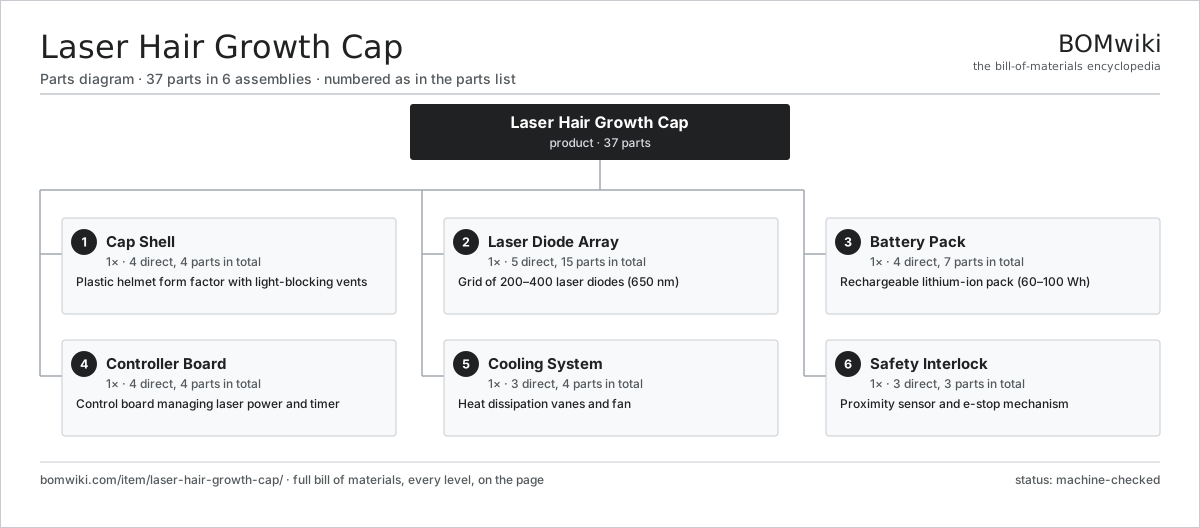
| # | Part | Qty | What it does |
|---|---|---|---|
| 1 | Cap Shell 4 parts | 1× | Plastic helmet form factor with light-blocking vents |
| 2 | Laser Diode Array 5 parts | 1× | Grid of 200–400 laser diodes (650 nm) |
| 3 | Battery Pack 4 parts | 1× | Rechargeable lithium-ion pack (60–100 Wh) |
| 4 | Controller Board 4 parts | 1× | Control board managing laser power and timer |
| 5 | Cooling System 3 parts | 1× | Heat dissipation vanes and fan |
| 6 | Safety Interlock 3 parts | 1× | Proximity sensor and e-stop mechanism |
3D model
No 3D model yet. Have a CAD file of this? Add a 3D model — STL renders right on this page; STEP, FreeCAD, and OpenSCAD sources are welcome too (openly licensed, like all 3D models on BOMwiki).
Build & assembly graph
expand / collapse · shared sub-assemblies converge · links to related products · est. labourTap an assembly to expand/collapse · tap a part to open it · use “Open page” for any node · drag to pan, scroll to zoom.
Bill of materials for Laser Hair Growth Cap
6 top-level lines · 29 rows shown · 37 parts total · indented to 3 levels| # | Item / sub-assembly | Part no. | Qty/assy | Ext. qty | Parts | Type |
|---|---|---|---|---|---|---|
| 1 | Cap Shell 4 parts | laser-hair-growth-cap-shell | 1× | 1 | 4 | assembly |
| 1.1 | Helmet Body | laser-hair-growth-cap-helmet-body | 1× | 1 | · | part |
| 1.2 | Foam Insert | laser-hair-growth-cap-foam-insert | 1× | 1 | · | part |
| 1.3 | Adjustable Strap | laser-hair-growth-cap-adjustable-strap | 1× | 1 | · | part |
| 1.4 | Visor Shield | laser-hair-growth-cap-visor-shield | 1× | 1 | · | part |
| 2 | Laser Diode Array 5 parts | laser-hair-growth-cap-laser-array | 1× | 1 | 15 | assembly |
| 2.1 | Diode Module | laser-hair-growth-cap-diode-module | 1× | 1 | · | part |
| 2.2 | Flex PCB | laser-hair-growth-cap-flex-pcb | 1× | 1 | · | part |
| 2.3 | Heat Sink | laser-hair-growth-cap-heat-sink | 1× | 1 | · | part |
| 2.4 | LED Indicator | laser-hair-growth-cap-led-indicator | 4× | 4 | · | part |
| 2.5 | Fastener Set | fastener-set | 8× | 8 | · | part |
| 3 | Battery Pack 4 parts | laser-hair-growth-cap-battery-pack | 1× | 1 | 7 | assembly |
| 3.1 | Li-ion Cell, 18650 | li-cell-18650 | 4× | 4 | · | part |
| 3.2 | BMS Board | bms-board | 1× | 1 | · | part |
| 3.3 | Battery Housing | laser-hair-growth-cap-battery-housing | 1× | 1 | · | part |
| 3.4 | Connector | connector | 1× | 1 | · | part |
| 4 | Controller Board 4 parts | laser-hair-growth-cap-controller | 1× | 1 | 4 | assembly |
| 4.1 | Microcontroller | mcu | 1× | 1 | · | part |
| 4.2 | Power MOSFET | laser-hair-growth-cap-power-mosfet | 1× | 1 | · | part |
| 4.3 | Current Limiter | laser-hair-growth-cap-current-limiting-resistor | 1× | 1 | · | part |
| 4.4 | Bare PCB | pcb-bare | 1× | 1 | · | part |
| 5 | Cooling System 3 parts | laser-hair-growth-cap-cooling-system | 1× | 1 | 4 | assembly |
| 5.1 | Cooling Vane | laser-hair-growth-cap-cooling-vane | 2× | 2 | · | part |
| 5.2 | Blower Motor | blower-motor | 1× | 1 | · | part |
| 5.3 | Thermal Fuse | thermal-fuse | 1× | 1 | · | part |
| 6 | Safety Interlock 3 parts | laser-hair-growth-cap-safety-interlock | 1× | 1 | 3 | assembly |
| 6.1 | Proximity Sensor | laser-hair-growth-cap-proximity-sensor | 1× | 1 | · | part |
| 6.2 | E-Stop Button | laser-hair-growth-cap-eStop-button | 1× | 1 | · | part |
| 6.3 | Relay | relay | 1× | 1 | · | part |
Related products
same domain, ranked by shared parts Beard Trimmer
52 parts · shares 2 with this page
Electric Callus Remover
52 parts · shares 2 with this page
Electric Nail Drill
133 parts · shares 2 with this page
Beard Trimmer
52 parts · shares 2 with this page
Electric Callus Remover
52 parts · shares 2 with this page
Electric Nail Drill
133 parts · shares 2 with this page
 Hair Clipper
103 parts · shares 2 with this page
Hair Clipper
103 parts · shares 2 with this page
 Water Flosser
100 parts · shares 2 with this page
Cryolipolysis Machine
58 parts · shares 3 with this page
Water Flosser
100 parts · shares 2 with this page
Cryolipolysis Machine
58 parts · shares 3 with this page
Sourcing: possible vendors
Prices, MOQ, and lead times are algorithmic estimates, not quotes, and not claims about these companies. Company mappings are curated by keyword; est. price band $15–$500. How estimates work| Vendor | HQ | Specialty | MOQ | Lead time |
|---|---|---|---|---|
| philips.com ↗ | Amsterdam, NL | Grooming & care | 2,000 units | 6–10 wks |
|
🇩🇪Braun
braun.com ↗
|
Kronberg, DE | Grooming (P&G) | 2,000 units | 6–10 wks |
|
🇺🇸Conair
conair.com ↗
|
Stamford, US | Personal care appliances | 2,000 units | 6–10 wks |
|
🇬🇧Dyson
dyson.com ↗
|
Malmesbury, GB | Vacuums & hair care | 2,000 units | 6–10 wks |
| panasonic.com ↗ | Osaka, JP | Electronics & appliances | 2,000 units | 6–10 wks |
1,237-word article