LED Video Wall
ProductOverview
An LED video wall is a large, seamless display made up of multiple rectangular cabinet modules tiled together, each containing a 2D grid of full-color LED pixels. Unlike a projection system, an LED wall is active emissive: each pixel contains red, green, and blue LEDs, and the scanning circuitry continuously refreshes them thousands of times per second to produce a bright, detailed image. LED walls are used for broadcast backdrops (behind anchors or speakers), outdoor advertising, sports arenas, concerts, and anywhere a large format, bright, durable display is needed. Modern LED cabinets achieve pixel pitches as small as 2–3 mm, making them competitive with projection for image sharpness, and because they are emissive (not reflective like projection), they work in fully lit environments without washout.
How it works
Each LED Cabinet Module (×4) houses a grid of LED pixels, typically arranged in a raster of 64×64 or 128×128 pixels per cabinet, depending on the pixel pitch. Within each pixel are three red, green, and blue LED dies (or in some designs, a single package with R, G, B). The driver IC for each pixel accepts current commands and sets the brightness of each color channel independently, allowing the pixel to display any color in the RGB gamut.
The challenge is scanning: with thousands of pixels per cabinet and limited communication bandwidth, the Cabinet Driver Board cannot address every pixel individually at video frame rate. Instead, the LED Scanning FPGA uses "line scanning" or "1:k multiplexing." In a 1:16 multiplexing scheme, the FPGA selects one horizontal row of pixels at a time and drives them for a few microseconds, then moves to the next row. By rapidly scanning through all rows many times per second (the refresh rate, typically 1920–3840 Hz), human eyes integrate the flashing into a steady image, the same principle as CRT monitors and LCD backlights.
The receiving card for each cabinet takes the incoming video signal (SDI, HDMI, or Ethernet DVI) and scales it to the cabinet's native resolution. The Video Scaler / Interpolator performs interpolation or decimation to fit the incoming video to the cabinet size, and the color lookup table applies gamma correction and color space conversion. The resulting pixel data is then streamed in real time to the LED Scanning FPGA at the cabinet's refresh rate.
Brightness and outdoor performance
Outdoor LED walls require high brightness (800–2000 nits) to remain visible in daylight. This demands massive current: a 300×300 pixel cabinet at full brightness might draw 3–5 kW. The Thermal Management is therefore critical: the cooling fans pull air through the cabinet to carry away heat, and the Thermal Sensor monitors temperature, throttling brightness if the cabinet overheats. Indoor walls can be dimmer (300–800 nits) and thus cooler.
Brightness control is typically done via pulse-width modulation (PWM): instead of changing the DC current to the LEDs (which would shift color), the LED Scanning FPGA varies the duty cycle of a constant-current pulse, maintaining consistent color temperature while adjusting perceived brightness.
Seamless tiling and calibration
The magic of a video wall is that multiple cabinets tile seamlessly into one image. This requires:
- Geometric alignment: Each cabinet must be mounted perfectly flat and aligned with its neighbors. Slight gaps or steps are acceptable (sub-millimeter), but if a cabinet is tilted, the edge will be visible as a bright or dark seam.
- Brightness and color uniformity: Even if all cabinets are the same model, LEDs age at slightly different rates. The Control System monitors brightness and color across all cabinets and applies per-cabinet gain and color offsets to match them. This is called "white balance" or "field calibration."
- Timing and synchronization: All receiving cards must latch the incoming video data at exactly the same moment. Jitter of even a few microseconds causes visible artifacts. The Video Receiver PCB on each cabinet synchronizes to the video timing (SAV/EAV markers in SDI), and a dedicated sync line distributes a genlock reference to all cards.
Modular expansion and content creation
A standard broadcast set might use a 2×3 array of cabinets (two wide, three tall), creating a 1280×960 pixel wall. A stadium might use a 10×5 array. The Frame & Support Structure is modular aluminum extrusion that can be configured for any rectangular size. The Media Processor accepts a single SDI input from a graphics server or video switcher and distributes scaled versions to all receiving cards. Professional LED walls often have tiling control that allows different regions of the wall to display different content (e.g., left side program, right side crowd shots, center crawl), all fed from a single control system.
Maintenance and repair
LED pixels degrade over time. While LEDs last 50,000–100,000 hours at rated current, brightness typically falls 20–30% over the lifetime. Many broadcast installations plan for cabinet replacement every 5–10 years. Individual pixel replacement is rare, entire cabinets are swapped when the brightness falls below acceptable levels. Some manufacturers offer partial cabinet replacement (e.g., swapping the top half) to extend the display life.
LED Video Wall parts and their functions
10 top-level parts · 2,795 parts in total · full bill of materials below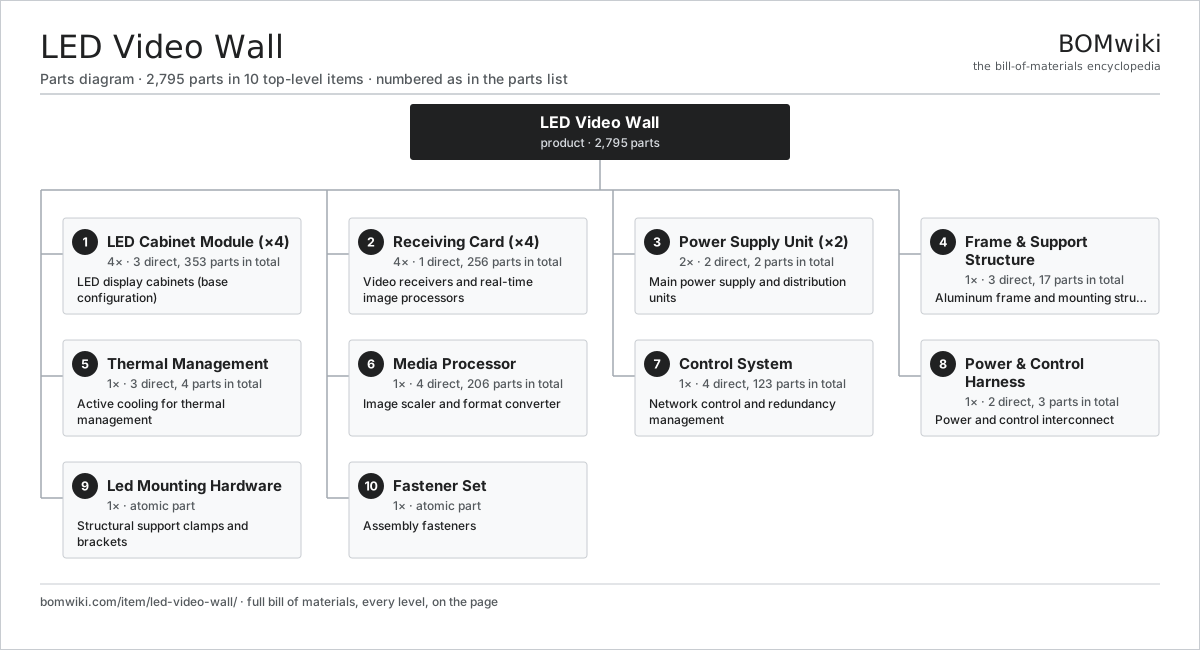
| # | Part | Qty | What it does |
|---|---|---|---|
| 1 | LED Cabinet Module (×4) 3 parts | 4× | LED display cabinets (base configuration) |
| 2 | Receiving Card (×4) 1 parts | 4× | Video receivers and real-time image processors |
| 3 | Power Supply Unit (×2) 2 parts | 2× | Main power supply and distribution units |
| 4 | Frame & Support Structure 3 parts | 1× | Aluminum frame and mounting structure |
| 5 | Thermal Management 3 parts | 1× | Active cooling for thermal management |
| 6 | Media Processor 4 parts | 1× | Image scaler and format converter |
| 7 | Control System 4 parts | 1× | Network control and redundancy management |
| 8 | Power & Control Harness 2 parts | 1× | Power and control interconnect |
| 9 | Led Mounting Hardware | 1× | Structural support clamps and brackets |
| 10 | Fastener Set | 1× | Assembly fasteners |
Diagrams & photos

.jpg)
3D model
No 3D model yet. Have a CAD file of this? Add a 3D model. STL renders right on this page; STEP, FreeCAD, and OpenSCAD sources are welcome too (openly licensed, like all 3D models on BOMwiki).
Build & assembly graph
expand / collapse · shared sub-assemblies converge · links to related products · est. labourTap an assembly to expand/collapse · tap a part to open it · use “Open page” for any node · drag to pan, scroll to zoom.
Bill of materials for LED Video Wall
10 top-level lines · 44 rows shown · 2,795 parts total · indented to 3 levels| # | Item / sub-assembly | Part no. | Qty/assy | Ext. qty | Parts | Type |
|---|---|---|---|---|---|---|
| 1 | LED Cabinet Module (×4) 3 parts | led-video-cabinet | 4× | 4 | 353 | assembly |
| 1.1 | LED Panel Array 2 parts | led-display-panel | 1× | 4 | 49 | assembly |
| 1.1.1 | LED Pixel Module 4 parts + deeper › | led-pixel-module | 12× | 48 | 4 | assembly |
| 1.1.2 | Panel PCB Assembly | led-panel-pcb | 1× | 4 | · | part |
| 1.2 | Cabinet Driver Board 4 parts | led-driver-board | 1× | 4 | 303 | assembly |
| 1.2.1 | Bare PCB | pcb-bare | 1× | 4 | · | part |
| 1.2.2 | LED Scanning FPGA | led-driver-fpga | 1× | 4 | · | part |
| 1.2.3 | Power Distribution Board | led-power-distribution | 1× | 4 | · | part |
| 1.2.4 | SMD Passive (R/C/L) | smd-passives | 300× | 1,200 | · | part |
| 1.3 | Cabinet Housing | led-cabinet-structure | 1× | 4 | · | part |
| 2 | Receiving Card (×4) 1 parts | led-receiving-card | 4× | 4 | 256 | assembly |
| 2.1 | Video Receiver PCB 6 parts | led-rx-processor-card | 1× | 4 | 256 | assembly |
| 2.1.1 | Bare PCB | pcb-bare | 1× | 4 | · | part |
| 2.1.2 | Video Scaler / Interpolator | led-video-scaler-chip | 1× | 4 | · | part |
| 2.1.3 | Color Lookup Table (LUT) Memory | led-color-lut-memory | 1× | 4 | · | part |
| 2.1.4 | Output Serializer IC | led-output-serializer | 1× | 4 | · | part |
| 2.1.5 | Connector | connector | 2× | 8 | · | part |
| 2.1.6 | SMD Passive (R/C/L) | smd-passives | 250× | 1,000 | · | part |
| 3 | Power Supply Unit (×2) 2 parts | led-power-supply | 2× | 2 | 2 | assembly |
| 3.1 | Power Supply | power-supply | 1× | 2 | · | part |
| 3.2 | PSU Connector Block | led-psu-connector-block | 1× | 2 | · | part |
| 4 | Frame & Support Structure 3 parts | led-frame-structure | 1× | 1 | 17 | assembly |
| 4.1 | Aluminum Extrusion Profile | led-aluminum-profile | 8× | 8 | · | part |
| 4.2 | Corner Bracket | led-corner-bracket | 8× | 8 | · | part |
| 4.3 | Diagonal Bracing Kit | led-bracing-kit | 1× | 1 | · | part |
| 5 | Thermal Management 3 parts | led-cooling-system | 1× | 1 | 4 | assembly |
| 5.1 | Blower Motor | blower-motor | 2× | 2 | · | part |
| 5.2 | Cooling Air Duct | led-cooling-duct | 1× | 1 | · | part |
| 5.3 | Thermal Sensor | led-thermal-sensor | 1× | 1 | · | part |
| 6 | Media Processor 4 parts | led-processor-unit | 1× | 1 | 206 | assembly |
| 6.1 | Bare PCB | pcb-bare | 1× | 1 | · | part |
| 6.2 | Video Processing FPGA | led-processor-fpga | 1× | 1 | · | part |
| 6.3 | Connector | connector | 4× | 4 | · | part |
| 6.4 | SMD Passive (R/C/L) | smd-passives | 200× | 200 | · | part |
| 7 | Control System 4 parts | led-control-system | 1× | 1 | 123 | assembly |
| 7.1 | Bare PCB | pcb-bare | 1× | 1 | · | part |
| 7.2 | Control Microcontroller | led-control-mcu | 1× | 1 | · | part |
| 7.3 | Ethernet Network Module | led-network-interface | 1× | 1 | · | part |
| 7.4 | SMD Passive (R/C/L) | smd-passives | 120× | 120 | · | part |
| 8 | Power & Control Harness 2 parts | led-cabling-harness | 1× | 1 | 3 | assembly |
| 8.1 | Wire Bundle | wire-bundle | 2× | 2 | · | part |
| 8.2 | Connector Set (power + control) | led-connector-set | 1× | 1 | · | part |
| 9 | Led Mounting Hardware | led-video-wall-led-mounting-hardware | 1× | 1 | · | part |
| 10 | Fastener Set | fastener-set | 1× | 1 | · | part |
Something wrong in this list? Report a problem with this BOM.
Related products
same domain, ranked by shared parts AV Receiver
1,097 parts · shares 3 with this page
Cinema Sound Processor
839 parts · shares 3 with this page
AV Receiver
1,097 parts · shares 3 with this page
Cinema Sound Processor
839 parts · shares 3 with this page
 Video Production Switcher
3,640 parts · shares 3 with this page
Video Production Switcher
3,640 parts · shares 3 with this page
 Camera Control Unit
156 parts · shares 2 with this page
Camera Control Unit
156 parts · shares 2 with this page
 Loudspeaker Management Processor
42 parts · shares 2 with this page
Loudspeaker Management Processor
42 parts · shares 2 with this page
 Projector
482 parts · shares 2 with this page
Projector
482 parts · shares 2 with this page
Sourcing: possible vendors
Browse the supplier directory → Prices, MOQ, and lead times are algorithmic estimates, not quotes, and not claims about these companies. Company mappings are curated by keyword; est. price band $50–$3k. How estimates work| Vendor | HQ | Specialty | MOQ | Lead time |
|---|---|---|---|---|
|
🇯🇵Sony
sony.com ↗
|
Tokyo, JP | Consumer electronics | 1,000 units | 8–12 wks |
| samsung.com ↗ | Suwon, KR | Electronics & displays | 1,000 units | 8–12 wks |
|
🇺🇸Harman
harman.com ↗
|
Stamford, US | Audio (JBL, AKG) | 1,000 units | 8–12 wks |
|
🇺🇸Bose
bose.com ↗
|
Framingham, US | Audio | 1,000 units | 8–12 wks |
| yamaha.com ↗ | Hamamatsu, JP | Audio & instruments | 1,000 units | 8–12 wks |
896-word article