Line Array Element
ProductOverview
A line array element is the fundamental building block of modern concert and touring loudspeaker systems. Rather than relying on a single large speaker cabinet to cover an entire venue, audio engineers stack dozens of identical modular elements into vertical or curved arrays. This approach provides focused acoustic energy coverage, dramatically reducing feedback risk and floor reflections while delivering consistent high-SPL performance. The Dual Woofer Assembly and High-Frequency Compression Driver form a coaxially-arranged 2-way speaker within a trapezoidal Cabinet Assembly that includes an aluminum Aluminum Rigging Frame permitting vertical stacking and angular orientation.
How it Works
Line Source Acoustics
A point source (single speaker) radiates sound spherically; sound pressure level (SPL) drops by 6 dB for each doubling of distance from the source. In a large venue (150-foot distance), a single point source would be inaudible in the back rows.
A line source, such as a vertical array of speakers, radiates sound cylindrically. SPL drops by only 3 dB for each doubling of distance. This substantial advantage (half the loss rate) is why touring sound companies use arrays: they deliver consistent level across 200 feet of venue depth from a single amplifier feed.
The acoustic summing happens because of wavelength-dependent phase relationships. A vertical array of elements spaced at λ/2 (half the wavelength) at any given frequency causes all elements to radiate in-phase at that frequency, constructively interfering and summing their outputs. At frequencies with shorter wavelengths (higher frequencies), elements space more tightly in terms of wavelength, and the array becomes more directional.
Dual Woofer Configuration
The Dual Woofer Assembly consists of two 6.5-inch direct-radiator cones mounted in parallel electrical connection (both feed from the same amplifier). Dual drivers serve two purposes:
Extended excursion handling: Each cone can move only about 6 mm before the surround limits further motion (Xmax). Two cones in series-parallel arrangement allow 12 mm total acoustic excursion, delivering deeper bass at loud levels without distortion.
Power distribution: Two drivers share the electrical power, halving the heat dissipation in each driver's voice coil and improving thermal reliability at sustained high output.
Compression Driver and Waveguide
Above 600 Hz, the High-Frequency Compression Driver compression driver takes over. Rather than using a cone directly radiating into air, the compression driver uses a small diaphragm vibrating against a fixed chamber (the "compression zone"). This chamber allows the driver to load the diaphragm with high acoustic impedance, increasing efficiency and controllability. The output from the driver chamber couples into an Exponential Horn exponential horn that provides both directional focusing and impedance matching between the driver and the room.
The exponential horn's geometry (60° horizontal × 40° vertical coverage) shapes the radiation pattern to match the array's intended coverage: narrower vertical coverage (40°) is desirable because the array itself handles vertical directivity through stacking; broader horizontal coverage (60°) aids left-to-right coverage uniformity.
Passive Crossover
The Passive Crossover Network is an entirely passive network, no active electronics, no phantom power required. The crossover's Crossover Inductor and Crossover Capacitor form a second-order (24 dB/octave) Butterworth filter splitting the amplifier signal. Below 600 Hz, the inductor blocks the high frequencies destined for the compression driver, sending only bass to the woofer. Above 600 Hz, the capacitor blocks low frequencies, routing only treble to the compression driver.
The Crossover Resistor Pad pads tune the relative level between woofers and HF driver, and a Thermal Fuse protects the compression driver from over-power conditions.
Rigging and Stacking
The Aluminum Rigging Frame aluminum extrusion cage provides structural rigidity and flying points. Multiple shackles attach to the Rigging Fly Point brackets, suspending the element from truss or ceiling hardware. The Splay Adjustment Pin adjusts the vertical angle between stacked elements. A typical system might stack 12 elements at 3° splay each, totaling 36° coverage. This tuning ensures that sound from the top element reaches the far back of the venue at similar SPL to the front rows.
System Integration
Elements are daisy-chained via Connector and Signal Path Speakon connectors running from the power amplifier. The first element receives amplified audio; an XLR loop-through on each element allows a mixing console to control the entire array with a single amplifier channel (mono). A professional touring system might comprise:
- Top array: 12 elements providing main coverage
- Front fill: 4 elements covering the first 30 feet
- Side hang: 6 elements per side for venues wider than array coverage
Each sub-array is driven by independent channels of a multi-channel power amplifier, allowing the mixing engineer to balance coverage zones.
Frequency-Dependent Directivity
At low frequencies (250 Hz), where wavelength is approximately 4.5 feet, the array elements are spaced at only 1/10 wavelength vertically (0.38 meter element height is much less than 4.5 feet). At such wide spacing relative to wavelength, low-frequency directivity is weak; sound radiates more omnidirectionally. At high frequencies (4 kHz, wavelength 3.4 inches), the element height exceeds one full wavelength, creating strong lobing, multiple main lobes and nulls. Professional array design uses DSP (in the mixing console) to apply frequency-dependent delay and level adjustments that maintain smooth coverage across the entire bandwidth.
Thermal Considerations
Dual woofers distribute power handling, but sustained high-SPL operation still generates heat. The passive Passive Crossover Network inductor and compression driver voice coil dissipate power. The Internal Diagonal Brace internal cross-bracing provides air pathways for convective cooling. In permanent installations, small fans are sometimes added; in touring applications where setup/teardown occurs daily, convective cooling alone is sufficient.
Maintenance and Replacement
Line array elements are designed for field interchangeability. If a woofer cone tears or a compression driver diaphragm crinkles, technicians unbolt the affected component (via the Aluminum Rigging Frame) and swap in a spare element. No realignment is needed; replacement elements are manufactured within specifications ensuring passive summing behavior is restored.
Line Array Element parts and their functions
7 top-level parts · 47 parts in total · full bill of materials below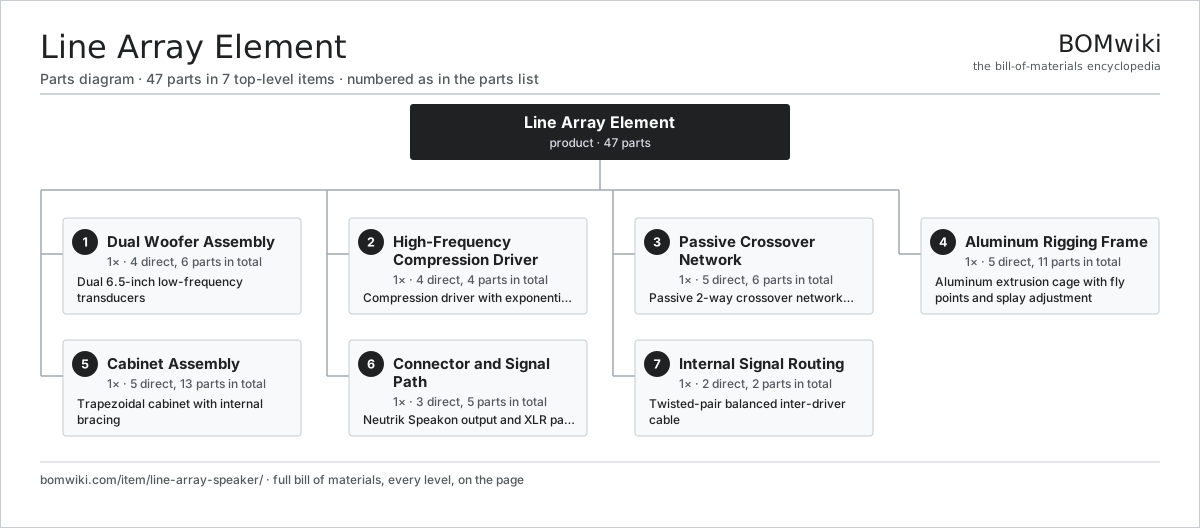
| # | Part | Qty | What it does |
|---|---|---|---|
| 1 | Dual Woofer Assembly 4 parts | 1× | Dual 6.5-inch low-frequency transducers |
| 2 | High-Frequency Compression Driver 4 parts | 1× | Compression driver with exponential horn waveguide |
| 3 | Passive Crossover Network 5 parts | 1× | Passive 2-way crossover network splitting 600 Hz |
| 4 | Aluminum Rigging Frame 5 parts | 1× | Aluminum extrusion cage with fly points and splay adjustment |
| 5 | Cabinet Assembly 5 parts | 1× | Trapezoidal cabinet with internal bracing |
| 6 | Connector and Signal Path 3 parts | 1× | Neutrik Speakon output and XLR pass-through |
| 7 | Internal Signal Routing 2 parts | 1× | Twisted-pair balanced inter-driver cable |
3D model
No 3D model yet. Have a CAD file of this? Add a 3D model. STL renders right on this page; STEP, FreeCAD, and OpenSCAD sources are welcome too (openly licensed, like all 3D models on BOMwiki).
Build & assembly graph
expand / collapse · shared sub-assemblies converge · links to related products · est. labourTap an assembly to expand/collapse · tap a part to open it · use “Open page” for any node · drag to pan, scroll to zoom.
Bill of materials for Line Array Element
7 top-level lines · 37 rows shown · 47 parts total · indented to 3 levels| # | Item / sub-assembly | Part no. | Qty/assy | Ext. qty | Parts | Type |
|---|---|---|---|---|---|---|
| 1 | Dual Woofer Assembly 4 parts | line-array-speaker-woofer-pair | 1× | 1 | 6 | assembly |
| 1.1 | Speaker | speaker | 2× | 2 | · | part |
| 1.2 | Woofer Baffle Ring | line-array-speaker-woofer-mounting | 1× | 1 | · | part |
| 1.3 | Fastener Set | fastener-set | 2× | 2 | · | part |
| 1.4 | Woofer Crossover Terminal | line-array-speaker-woofer-crossover-tap | 1× | 1 | · | part |
| 2 | High-Frequency Compression Driver 4 parts | line-array-speaker-hf-driver | 1× | 1 | 4 | assembly |
| 2.1 | Compression Driver Motor | line-array-speaker-compression-motor | 1× | 1 | · | part |
| 2.2 | Exponential Horn | line-array-speaker-horn-waveguide | 1× | 1 | · | part |
| 2.3 | Driver Isolation Mount | line-array-speaker-compression-suspension | 1× | 1 | · | part |
| 2.4 | Fastener Set | fastener-set | 1× | 1 | · | part |
| 3 | Passive Crossover Network 5 parts | line-array-speaker-crossover | 1× | 1 | 6 | assembly |
| 3.1 | Crossover Inductor | line-array-speaker-crossover-inductor | 1× | 1 | · | part |
| 3.2 | Crossover Capacitor | line-array-speaker-crossover-capacitor | 1× | 1 | · | part |
| 3.3 | Crossover Resistor Pad | line-array-speaker-crossover-resistor | 2× | 2 | · | part |
| 3.4 | Thermal Fuse | thermal-fuse | 1× | 1 | · | part |
| 3.5 | Bare PCB | pcb-bare | 1× | 1 | · | part |
| 4 | Aluminum Rigging Frame 5 parts | line-array-speaker-rigging-frame | 1× | 1 | 11 | assembly |
| 4.1 | Aluminum Frame Extrusion | line-array-speaker-frame-extrusion | 4× | 4 | · | part |
| 4.2 | Rigging Fly Point | line-array-speaker-fly-point | 2× | 2 | · | part |
| 4.3 | Splay Adjustment Pin | line-array-speaker-splay-pin | 1× | 1 | · | part |
| 4.4 | Fastener Set | fastener-set | 3× | 3 | · | part |
| 4.5 | Sheet Metal Panel | sheet-panel | 1× | 1 | · | part |
| 5 | Cabinet Assembly 5 parts | line-array-speaker-enclosure | 1× | 1 | 13 | assembly |
| 5.1 | Cabinet Side Panel | line-array-speaker-cabinet-panel | 5× | 5 | · | part |
| 5.2 | Internal Diagonal Brace | line-array-speaker-internal-brace | 4× | 4 | · | part |
| 5.3 | Acoustic Damping Foam | line-array-speaker-damping-material | 1× | 1 | · | part |
| 5.4 | Fastener Set | fastener-set | 2× | 2 | · | part |
| 5.5 | Acoustic Sealant | line-array-speaker-cabinet-seal | 1× | 1 | · | part |
| 6 | Connector and Signal Path 3 parts | line-array-speaker-amplifier-connector | 1× | 1 | 5 | assembly |
| 6.1 | Connector | connector | 2× | 2 | · | part |
| 6.2 | Internal Signal Routing 2 parts | line-array-speaker-internal-wiring | 1× | 1 | 2 | assembly |
| 6.2.1 | Wire Bundle | wire-bundle | 1× | 1 | · | part |
| 6.2.2 | Fastener Set | fastener-set | 1× | 1 | · | part |
| 6.3 | Fastener Set | fastener-set | 1× | 1 | · | part |
| 7 | Internal Signal Routing 2 parts | line-array-speaker-internal-wiring | 1× | 1 | 2 | assembly |
| 7.1 | Wire Bundle | wire-bundle | 1× | 1 | · | part |
| 7.2 | Fastener Set | fastener-set | 1× | 1 | · | part |
Something wrong in this list? Report a problem with this BOM.
Related products
same domain, ranked by shared parts Karaoke Machine
59 parts · shares 3 with this page
Karaoke Machine
59 parts · shares 3 with this page
 Digital Jukebox
563 parts · shares 2 with this page
Digital Jukebox
563 parts · shares 2 with this page
 Dolby Atmos Soundbar
387 parts · shares 2 with this page
Dolby Atmos Soundbar
387 parts · shares 2 with this page
 Studio Headphones
265 parts · shares 2 with this page
Studio Headphones
265 parts · shares 2 with this page
 CD Player
47 parts · shares 3 with this page
CD Player
47 parts · shares 3 with this page
 Channel Strip
55 parts · shares 3 with this page
Channel Strip
55 parts · shares 3 with this page
Sourcing: possible vendors
Browse the supplier directory → Prices, MOQ, and lead times are algorithmic estimates, not quotes, and not claims about these companies. Company mappings are curated by keyword; est. price band $50–$3k. How estimates work| Vendor | HQ | Specialty | MOQ | Lead time |
|---|---|---|---|---|
|
🇯🇵Sony
sony.com ↗
|
Tokyo, JP | Consumer electronics | 1,000 units | 8–12 wks |
| samsung.com ↗ | Suwon, KR | Electronics & displays | 1,000 units | 8–12 wks |
|
🇺🇸Harman
harman.com ↗
|
Stamford, US | Audio (JBL, AKG) | 1,000 units | 8–12 wks |
|
🇺🇸Bose
bose.com ↗
|
Framingham, US | Audio | 1,000 units | 8–12 wks |
| yamaha.com ↗ | Hamamatsu, JP | Audio & instruments | 1,000 units | 8–12 wks |
1,025-word article