Livestock Ultrasound
ProductOverview
Livestock ultrasound scanners provide real-time cross-sectional tissue images for equine reproduction assessment, bovine pregnancy diagnosis, and soft-tissue examination in field settings. Unlike stationary hospital units, portable units are designed for mobility into barns and pastures, powered by rechargeable batteries and small enough to operate from a mobile cart or backpack.
The Livestock Ultrasound operates on pulse-echo principles: a piezoelectric transducer sends brief ultrasound pulses (3–10 MHz frequency) into tissue, and echoes returning from interfaces (tissue-fluid boundaries) are detected, amplified, and processed into a grayscale image. The Ultrasound Processing Unit beamformer performs phased-array calculations to focus the transmitted beam and dynamically focus received echoes at multiple depths, producing real-time B-mode (brightness-mode) images.
Two specialized probes are included: a Rectal Transducer Probe for internal reproductive organs (ovaries, uterus, prostate) and a External Linear Transducer linear probe for superficial examination (muscle, tendon, joint, heart).
Transducer Technology and Probes
Piezoelectric crystals are the core of all ultrasound imaging. When voltage is applied, they expand; when voltage is removed, they contract. By applying rapidly alternating voltage (3–10 million times per second), crystals vibrate at ultrasound frequency, converting electrical energy to mechanical acoustic waves. Conversely, returning echoes deform the crystal, generating return voltage proportional to the echo amplitude. The Piezo Array consists of 64–128 small crystals arranged in a linear or sector geometry and electrically connected to independent receiver circuits.
The Rectal Transducer Probe probe (3.5–5 MHz) has a small footprint (20 mm diameter rod, 80 mm insertion length) designed for insertion into the bovine or equine rectum. At this frequency, penetration depth is 15–20 cm (sufficient for ovarian and uterine imaging in livestock), and resolution is moderate (1–2 mm), adequate for detecting follicles (5–30 mm diameter) and embryonic structures (>5 mm). The probe performs sector scanning: the transmitted beam sweeps 60–90° laterally, creating a pie-slice-shaped image.
The External Linear Transducer linear array probe (7.5–10 MHz) is held against skin surface, with Ultrasonic Gel acoustic gel providing acoustic coupling (air is nearly acoustically transparent; gel bridges the impedance mismatch). The linear array produces a rectangular image (width = probe footprint ~50 mm, depth = 0–25 cm), ideal for imaging muscle, ligament, and tendon in limbs or chest wall.
Both probes terminate in multi-pin Probe Connector connectors carrying the 64–128 individual element signals to the Ultrasound Processing Unit processing unit. The probes are connected via shielded Shielded Cable (4 m length, EMI-filtered to reduce electromagnetic noise that degrades image quality).
Ultrasound Signal Processing
The Beamformer DSP is the computational heart of the scanner. It receives raw RF (radio-frequency) signals from all 64–128 transducer elements and performs phased-array beamforming: by introducing calculated delays to the element signals before summing them, the beamformer focuses transmitted acoustic energy at a desired depth and steers the receive focal point dynamically across depths. This creates a clear, focused image. Without beamforming, signals from all elements would sum incoherently, producing a blurry image.
The Image Processor converts the beamformed RF signal into B-mode grayscale images via envelope detection and logarithmic compression. Each pixel brightness represents echo strength (white = strong echo, black = weak echo). The processor generates 20–30 complete images per second (frame rate), creating the illusion of real-time video motion.
The Transducer Control Module module adjusts gain (amplification of returning echoes, 0–60 dB range). If the scanner display shows a dark image, the technician increases gain; if the image is washed out (too bright), gain is decreased.
Display and Image Storage
The LCD Display is a color LCD screen (800 × 600 resolution, 10–15 inches diagonal), powered by 12 VDC from the main battery. The display shows the real-time B-mode image in the center, with parameter controls and menus at the edges. The Control Panel interface (touch panel or soft buttons) allows the operator to:
- Select probe (rectal or external)
- Adjust depth scale (0–25 cm)
- Freeze frame and capture still images
- Record cine loops (real-time video sequences for later review)
- Annotate images with measurements (distance, area)
- Export images to USB or SD card
The Memory Module SD card slot stores cine loops and freeze frames. A 64 GB card can record approximately 1000 two-minute cine loops (at 20 fps, 800 × 600 resolution), allowing technicians to build a database of examinations for longitudinal tracking.
Power System
The Power System comprises LiPo Cell LiPo cells (3.7 V nominal, 10 Ah capacity each) configured in a 14.8 V nominal, 20 Ah pack providing sufficient energy for 4–6 hours of continuous imaging (typical power draw is 40–60W). A BMS Board battery management system protects against over-charge (>16.5 V), over-discharge (<11 V), and over-current conditions that would damage the pack.
The Power Supply AC mains charger accepts 110–240 VAC input and charges the battery via XT90 or Anderson Battery Cable connector at 20 A charging current, requiring 2–3 hours for full recharge. During charging, a charging indicator light on the scanner main unit illuminates; when charging is complete, the light goes off. Most field operators carry a spare fully charged battery (low cost, ~$200) to avoid scanner downtime.
The battery pack is mounted in a Battery Pack integrated housing (typically on the scanner cart or in a backpack pouch), with the connector cable routed to the main processing unit. Weight is approximately 3 kg, adding minimal bulk to the portable scanner system.
Probe Support and Ergonomics
The Probe Support Arm is an articulated Support Arm (aluminum or stainless steel, counter-balanced) supporting the external probe during extended scanning without operator hand fatigue. The arm features friction ball-joint Arm Joint connectors at shoulder and elbow, allowing the operator to position the probe at any angle and have it remain in place (gentle friction prevents drift without locking). The arm reach is typically 0.8–1.2 m, sufficient for scanner positioned on a cart to reach patient limbs or torso.
The external probe is held in a quick-release Probe Clamp (lever-actuated clamp), allowing one-handed probe removal without fumbling. For rectal scanning, the probe is held by hand; operators wear long nitrile gloves and apply lubricant (not ultrasonic gel) for safe insertion. After use, both probes are cleaned with Cleaning Kit isopropyl alcohol and a soft brush, removing gel and organic material that could promote bacterial growth or crystal corrosion.
Clinical Applications
Equine Reproduction: Mares are scanned via rectal probe during estrous cycle monitoring. Ovarian follicles appear as 5–30 mm fluid-filled (black) spheres on gray ovarian stroma. The uterine horn (a fluid-filled tubular structure) shows wall thickness and echogenicity. Serial scans every 1–2 days during estrus allow prediction of ovulation (follicle >35 mm diameter suggests imminent ovulation), timing of breeding or artificial insemination.
Bovine Pregnancy Diagnosis: Rectal probe scanning at 28–35 days post-breeding can detect an embryonic vesicle (fluid-filled sac, 2–3 cm diameter) in the uterine horn, confirming pregnancy earlier than manual palpation (which requires 40+ days). At 50–60 days, an embryo with heartbeat is visible, confirming viability. Serial scans throughout gestation monitor fetal development, detect twin pregnancies (which complicate delivery), and assess placental attachment.
Soft-Tissue Imaging: External linear probe scanning of limbs reveals muscle strains (altered echogenicity, fluid accumulation), tendon tears (hypoechoic or anechoic defects), and joint effusion (fluid around ligament insertions). A 1 cm × 1 cm muscle strain in an athletic horse may be detectable by ultrasound before clinical lameness develops, allowing early intervention and preventing catastrophic rupture.
Cardiac Screening: A small external probe positioned in the 4th–5th intercostal space can visualize cardiac chambers, valve motion, and wall thickness, useful for pre-purchase evaluations or monitoring horses with arrhythmias.
Image Interpretation and Quality Control
Image quality depends on transducer frequency, gain, depth setting, and coupling. Beginners commonly make errors: applying insufficient gel (acoustic shadowing below air), scanning at excessive depth (image noise increases with attenuation), or using wrong probe frequency (3.5 MHz for deep structures, 7.5 MHz for superficial detail). Good technique requires training: most practitioners require 20–50 examinations to achieve diagnostic competence.
Artifacts are common: reverberation (echoes bouncing between probe and skin surface, creating false images), acoustic shadowing (loss of signal behind bone), and mirror image (erroneous duplication of structures across bright interfaces). Experienced operators recognize these artifacts and reposition the probe to minimize them.
Frame averaging (summing multiple consecutive frames before display) reduces noise and is essential for diagnostic imaging, though it reduces temporal resolution (slower apparent motion). Most scanners default to 2–4 frame averaging, balancing image noise and temporal fidelity.
Maintenance and Calibration
Weekly: visual inspection of probes for cracks or connector corrosion; cleaning with isopropyl alcohol and soft brush after each use; battery charge-discharge cycling (if not used for >3 months, batteries should be cycled monthly to preserve health).
Monthly: replacement of SD card with fresh card if full; backup of all recordings to external hard drive to prevent data loss from card failure.
Quarterly: acoustic calibration check using a tissue phantom (synthetic block mimicking tissue acoustics); if distance measurements are off by >5%, the scanner may require factory recalibration.
Annually: high-voltage supply module inspection (if user repairs are needed); replacement of damaged cables or connectors; software firmware update to latest stable release.
The portable livestock ultrasound scanner has transformed equine and bovine veterinary medicine: non-invasive imaging provides diagnostic certainty faster and cheaper than laboratory tests or exploratory surgery. Breeding soundness exams, pregnancy monitoring, and musculoskeletal injury assessment are now routine in large animal practice.
Livestock Ultrasound parts and their functions
8 top-level parts · 30 parts in total · full bill of materials below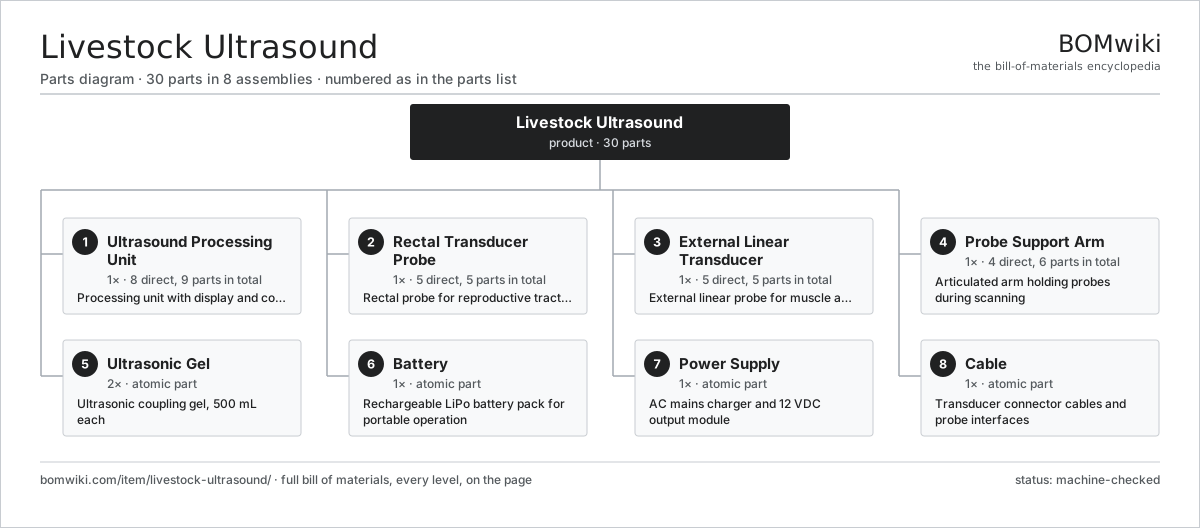
| # | Part | Qty | What it does |
|---|---|---|---|
| 1 | Ultrasound Processing Unit 8 parts | 1× | Processing unit with display and controls |
| 2 | Rectal Transducer Probe 5 parts | 1× | Rectal probe for reproductive tract imaging |
| 3 | External Linear Transducer 5 parts | 1× | External linear probe for muscle and organ scanning |
| 4 | Probe Support Arm 4 parts | 1× | Articulated arm holding probes during scanning |
| 5 | Ultrasonic Gel | 2× | Ultrasonic coupling gel, 500 mL each |
| 6 | Battery | 1× | Rechargeable LiPo battery pack for portable operation |
| 7 | Power Supply | 1× | AC mains charger and 12 VDC output module |
| 8 | Cable | 1× | Transducer connector cables and probe interfaces |
3D model
No 3D model yet. Have a CAD file of this? Add a 3D model — STL renders right on this page; STEP, FreeCAD, and OpenSCAD sources are welcome too (openly licensed, like all 3D models on BOMwiki).
Build & assembly graph
expand / collapse · shared sub-assemblies converge · links to related products · est. labourTap an assembly to expand/collapse · tap a part to open it · use “Open page” for any node · drag to pan, scroll to zoom.
Bill of materials for Livestock Ultrasound
8 top-level lines · 30 rows shown · 30 parts total · indented to 3 levels| # | Item / sub-assembly | Part no. | Qty/assy | Ext. qty | Parts | Type |
|---|---|---|---|---|---|---|
| 1 | Ultrasound Processing Unit 8 parts | livestock-ultrasound-scanner | 1× | 1 | 9 | assembly |
| 1.1 | Transducer Control Module | livestock-ultrasound-transducer-control | 1× | 1 | · | part |
| 1.2 | LCD Display | livestock-ultrasound-display | 1× | 1 | · | part |
| 1.3 | Beamformer DSP | livestock-ultrasound-beamformer | 1× | 1 | · | part |
| 1.4 | Image Processor | livestock-ultrasound-image-processor | 1× | 1 | · | part |
| 1.5 | Memory Module | livestock-ultrasound-memory-storage | 1× | 1 | · | part |
| 1.6 | Control Panel | livestock-ultrasound-keyboard | 1× | 1 | · | part |
| 1.7 | Bare PCB | pcb-bare | 2× | 2 | · | part |
| 1.8 | Power Supply | power-supply | 1× | 1 | · | part |
| 2 | Rectal Transducer Probe 5 parts | livestock-ultrasound-transducer-rectal | 1× | 1 | 5 | assembly |
| 2.1 | Piezo Array | livestock-ultrasound-transducer-element | 1× | 1 | · | part |
| 2.2 | Probe Body | livestock-ultrasound-probe-housing | 1× | 1 | · | part |
| 2.3 | Acoustic Lens | livestock-ultrasound-acoustic-lens | 1× | 1 | · | part |
| 2.4 | Probe Connector | livestock-ultrasound-probe-connector | 1× | 1 | · | part |
| 2.5 | Shielded Cable | livestock-ultrasound-cable-shielded | 1× | 1 | · | part |
| 3 | External Linear Transducer 5 parts | livestock-ultrasound-transducer-external | 1× | 1 | 5 | assembly |
| 3.1 | Piezo Array | livestock-ultrasound-transducer-element | 1× | 1 | · | part |
| 3.2 | Probe Body | livestock-ultrasound-probe-housing | 1× | 1 | · | part |
| 3.3 | Acoustic Lens | livestock-ultrasound-acoustic-lens | 1× | 1 | · | part |
| 3.4 | Probe Connector | livestock-ultrasound-probe-connector | 1× | 1 | · | part |
| 3.5 | Shielded Cable | livestock-ultrasound-cable-shielded | 1× | 1 | · | part |
| 4 | Probe Support Arm 4 parts | livestock-ultrasound-probe-stand | 1× | 1 | 6 | assembly |
| 4.1 | Support Arm | livestock-ultrasound-arm | 1× | 1 | · | part |
| 4.2 | Arm Joint | livestock-ultrasound-arm-joint | 2× | 2 | · | part |
| 4.3 | Probe Clamp | livestock-ultrasound-probe-clamp | 2× | 2 | · | part |
| 4.4 | Fastener Set | fastener-set | 1× | 1 | · | part |
| 5 | Ultrasonic Gel | livestock-ultrasound-gel-bottle | 2× | 2 | · | part |
| 6 | Battery | livestock-ultrasound-battery | 1× | 1 | · | part |
| 7 | Power Supply | livestock-ultrasound-power-supply | 1× | 1 | · | part |
| 8 | Cable | livestock-ultrasound-cable | 1× | 1 | · | part |
Related products
same domain, ranked by shared parts Dental CAD/CAM Mill
50 parts · shares 1 with this page
Dental CAD/CAM Mill
50 parts · shares 1 with this page
 Dental Curing Light
26 parts · shares 1 with this page
Dental Curing Light
26 parts · shares 1 with this page
 Dental Diode Laser
441 parts · shares 1 with this page
Dental Diode Laser
441 parts · shares 1 with this page
 Dental Operating Light
155 parts · shares 1 with this page
Dental Operating Light
155 parts · shares 1 with this page
 Dental X-Ray Unit
113 parts · shares 1 with this page
Equine Surgery Table
98 parts · shares 1 with this page
Dental X-Ray Unit
113 parts · shares 1 with this page
Equine Surgery Table
98 parts · shares 1 with this page
Sourcing: possible vendors
Prices, MOQ, and lead times are algorithmic estimates, not quotes, and not claims about these companies. Company mappings are curated by keyword; est. price band $200–$200k. How estimates work| Vendor | HQ | Specialty | MOQ | Lead time |
|---|---|---|---|---|
| dentsplysirona.com ↗ | Charlotte, US | Dental equipment | 100 units | 10–16 wks |
|
🇺🇸Envista
envistaco.com ↗
|
Brea, US | Dental (KaVo, Nobel) | 100 units | 10–16 wks |
|
🇫🇮Planmeca
planmeca.com ↗
|
Helsinki, FI | Dental units & imaging | 100 units | 10–16 wks |
|
🇺🇸A-dec
a-dec.com ↗
|
Newberg, US | Dental chairs & delivery | 100 units | 10–16 wks |
|
🇺🇸Midmark
midmark.com ↗
|
Versailles, US | Medical & veterinary equipment | 100 units | 10–16 wks |
1,645-word article