Loudspeaker Management Processor
ProductOverview
A loudspeaker management processor is a single-channel real-time digital signal processor dedicated to the correction and optimization of speaker system frequency response, phase coherence, and temporal alignment. Unlike a mixing console (which handles dozens of channels), a loudspeaker processor focuses on a single amplified output, applying up to 10 parametric equalizer filters, phase correction, time delay, and peak limiting to ensure that a given speaker cluster meets frequency response specifications and integrates coherently with adjacent clusters.
The device sits between a mixing console main output and a power amplifier, transparently processing the audio signal in real-time. Its primary value is room correction: acoustic engineers measure a speaker's response in a particular venue using calibrated microphones and impedance analyzer software, identify problematic resonances or cancellations, and program the processor to apply inverse EQ curves that flatten the perceived response.
How it Works
DSP Core and Processing
The DSP Engine and Program Memory floating-point DSP processor executes digital filter algorithms at a 48 kHz sample rate (23 microseconds per sample). Unlike a fixed-point DSP (which uses integer arithmetic and has limited numerical range), floating-point arithmetic allows arbitrary coefficient values and unlimited headroom without risk of overflow, critical for precision filter design.
The processor implements each parametric equalizer filter as a second-order Infinite Impulse Response (IIR) biquad section. A single parametric EQ filter is specified by three parameters:
- Center frequency (e.g., 125 Hz)
- Q factor (bandwidth; higher Q = narrower filter)
- Gain (boost or cut in decibels)
The processor chain includes 10 such biquads per output, enabling nearly arbitrary frequency response shaping. A typical room correction might include:
- High-pass filter at 40 Hz (eliminating sub-bass garbage)
- Notch at 60 Hz (removing AC mains hum and harmonics)
- Peaking boosts at 250 Hz and 2 kHz (countering venue absorption)
- Peaking cuts at 1 kHz (removing boxiness)
Phase Alignment and Time Delay
Beyond frequency response, speakers can radiate sound at different arrival times due to physical placement. The DSP Engine and Program Memory includes a variable delay line allowing insertion of 0–1000 ms of delay before the final output. A typical application: main speakers are 50 feet from a microphone, and fill speakers are 20 feet closer. Sound from the fills arrives 100 milliseconds earlier (at 1130 ft/s). By inserting 100 ms delay on the fills, both speaker clusters reach audience ears in phase, constructively interfering.
Anti-Aliasing and Sample Rate
The Analog Input Stage ADC operates at 48 kHz, the universal sampling rate for professional audio. This rate captures frequencies up to 24 kHz (Nyquist frequency). An anti-alias filter on the ADC input physically attenuates any signal above 24 kHz before digitization, preventing aliasing (where out-of-band frequencies fold back into the audio band as distortion).
Peak Limiting
Although not explicitly called out as a separate subsystem, the DSP firmware includes a brick-wall limiter preventing the output from clipping. The Analog Output Stage DAC has a maximum output range (e.g., ±10 V); if the processed signal exceeds that range, clipping distorts the audio. The soft-knee limiter monitors the DSP output and gently reduces gain as the signal approaches maximum, preventing distortion.
Real-Time Processing
All computation happens within the 48 kHz sample-rate loop. At 48 kHz, there are 48,000 samples per second, or one sample every 20.8 microseconds. The DSP must complete all filter computations (10 biquads, delay line interpolation, limiting) within that window, typically 100+ cycles on a modern DSP. Modern processors easily handle this workload, with CPU utilization below 50% even with advanced filtering.
Display and Control
The User Interface Assembly touchscreen allows field engineers to:
- View current filter settings (center frequency, Q, gain) and delay time.
- Adjust parameters using the encoder knob or touchscreen keyboard.
- Load and save presets (e.g., "concert mode," "speech intelligibility").
- View real-time frequency response graphs.
All adjustments are applied in real-time without interruption to audio flow, no clicks, pops, or momentary dropouts.
Network Remote Control
The Ethernet Connectivity ethernet interface connects to a laptop running measurement software. Acoustic engineers can:
- Capture the speaker's frequency response in the venue using a measurement microphone.
- Generate an inverse filter to flatten the response.
- Upload the filter parameters directly to the processor over the network.
This workflow eliminates the tedium of manually entering complex EQ curves.
Practical Deployment: Main Speaker System
In a touring concert system, a loudspeaker processor is placed at each major speaker cluster:
- Main left and right: A processor optimizes each main speaker for the venue's room acoustics.
- Center cluster (dialogue/vocals): A separate processor shapes response for maximum intelligibility.
- Subwoofer channel: A dedicated processor applies high-pass filtering and phase alignment to woofers.
The mixing console feeds each processor input; each processor output drives a dedicated power amplifier. The console operator plays back the mixed concert signal; the processors transparently apply venue-specific correction without requiring operator awareness.
Measurement and Calibration
Professional room correction uses a calibrated measurement microphone (Class 1 or 2, ±2 dB accuracy) at the mix position. Software (e.g., REW, Smaart, SystemOptimizer) measures the speaker's response and generates a corrected EQ curve. The curve is entered into the processor as 10 parametric filters. After adjustment, a second measurement verifies that the corrected response matches the target (typically ±3 dB flat from 50 Hz to 16 kHz).
Permanent vs. Portable Systems
Fixed installations (theaters, houses of worship) use loudspeaker processors dialed in once during commissioning. Parameters are never changed, and the processor becomes part of the permanent infrastructure.
Touring systems reprogram the processor at each new venue, applying venue-specific correction. Modern processors allow saving multiple presets, useful for bands playing the same venue repeatedly (standard setup is different from backup setup).
Limiting and Dynamics
While primarily a corrective tool, loudspeaker processors include safety limiters. A loud musical transient (snare drum hit, crowd noise) can spike above nominal operating level. The limiting prevents power amplifier distortion and speaker damage, transparently reducing gain until the signal recedes. Modern limiters use soft-knee behavior (gradual gain reduction starting 6 dB below threshold) rather than hard-knee (abrupt gain reduction at threshold), avoiding audible pumping artifacts.
Loudspeaker Management Processor parts and their functions
8 top-level parts · 42 parts in total · full bill of materials below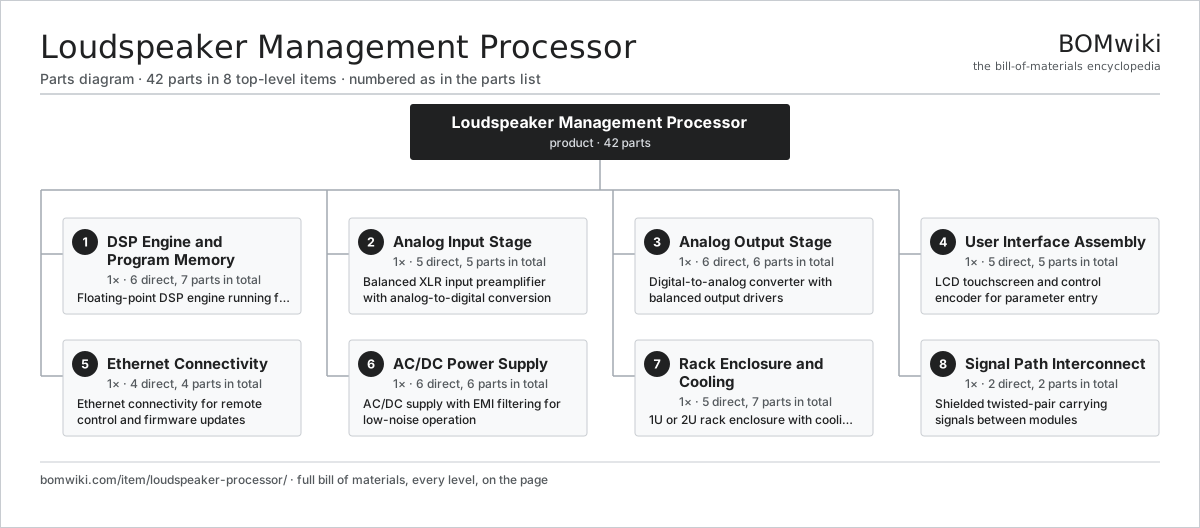
| # | Part | Qty | What it does |
|---|---|---|---|
| 1 | DSP Engine and Program Memory 6 parts | 1× | Floating-point DSP engine running filtering and control algorithms |
| 2 | Analog Input Stage 5 parts | 1× | Balanced XLR input preamplifier with analog-to-digital conversion |
| 3 | Analog Output Stage 6 parts | 1× | Digital-to-analog converter with balanced output drivers |
| 4 | User Interface Assembly 5 parts | 1× | LCD touchscreen and control encoder for parameter entry |
| 5 | Ethernet Connectivity 4 parts | 1× | Ethernet connectivity for remote control and firmware updates |
| 6 | AC/DC Power Supply 6 parts | 1× | AC/DC supply with EMI filtering for low-noise operation |
| 7 | Rack Enclosure and Cooling 5 parts | 1× | 1U or 2U rack enclosure with cooling fan |
| 8 | Signal Path Interconnect 2 parts | 1× | Shielded twisted-pair carrying signals between modules |
3D model
No 3D model yet. Have a CAD file of this? Add a 3D model. STL renders right on this page; STEP, FreeCAD, and OpenSCAD sources are welcome too (openly licensed, like all 3D models on BOMwiki).
Build & assembly graph
expand / collapse · shared sub-assemblies converge · links to related products · est. labourTap an assembly to expand/collapse · tap a part to open it · use “Open page” for any node · drag to pan, scroll to zoom.
Bill of materials for Loudspeaker Management Processor
8 top-level lines · 47 rows shown · 42 parts total · indented to 3 levels| # | Item / sub-assembly | Part no. | Qty/assy | Ext. qty | Parts | Type |
|---|---|---|---|---|---|---|
| 1 | DSP Engine and Program Memory 6 parts | loudspeaker-processor-dsp-core | 1× | 1 | 7 | assembly |
| 1.1 | DSP Processor IC | loudspeaker-processor-dsp-chip | 1× | 1 | · | part |
| 1.2 | DSP RAM Module | loudspeaker-processor-dram | 1× | 1 | · | part |
| 1.3 | Firmware Flash Memory | loudspeaker-processor-program-rom | 1× | 1 | · | part |
| 1.4 | Audio Codec IC | loudspeaker-processor-codec-ic | 1× | 1 | · | part |
| 1.5 | Bare PCB | pcb-bare | 1× | 1 | · | part |
| 1.6 | SMD Passive (R/C/L) | smd-passives | 2× | 2 | · | part |
| 2 | Analog Input Stage 5 parts | loudspeaker-processor-input-converter | 1× | 1 | 5 | assembly |
| 2.1 | Input Transformer | loudspeaker-processor-input-transformer | 1× | 1 | · | part |
| 2.2 | Input Op-Amp | loudspeaker-processor-input-opamp | 1× | 1 | · | part |
| 2.3 | Audio ADC | loudspeaker-processor-adc-chip | 1× | 1 | · | part |
| 2.4 | Connector | connector | 1× | 1 | · | part |
| 2.5 | SMD Passive (R/C/L) | smd-passives | 1× | 1 | · | part |
| 3 | Analog Output Stage 6 parts | loudspeaker-processor-output-converter | 1× | 1 | 6 | assembly |
| 3.1 | Audio DAC | loudspeaker-processor-dac-chip | 1× | 1 | · | part |
| 3.2 | Output Op-Amp | loudspeaker-processor-output-opamp | 1× | 1 | · | part |
| 3.3 | Output Transformer | loudspeaker-processor-output-transformer | 1× | 1 | · | part |
| 3.4 | Output Level Potentiometer | loudspeaker-processor-output-level-pot | 1× | 1 | · | part |
| 3.5 | Connector | connector | 1× | 1 | · | part |
| 3.6 | Fastener Set | fastener-set | 1× | 1 | · | part |
| 4 | User Interface Assembly 5 parts | loudspeaker-processor-display-panel | 1× | 1 | 5 | assembly |
| 4.1 | LCD Panel | lcd-panel | 1× | 1 | · | part |
| 4.2 | Rotary Encoder | loudspeaker-processor-encoder | 1× | 1 | · | part |
| 4.3 | UI Microcontroller | loudspeaker-processor-menu-processor | 1× | 1 | · | part |
| 4.4 | LED Status Ring | loudspeaker-processor-status-leds | 1× | 1 | · | part |
| 4.5 | Bare PCB | pcb-bare | 1× | 1 | · | part |
| 5 | Ethernet Connectivity 4 parts | loudspeaker-processor-network-module | 1× | 1 | 4 | assembly |
| 5.1 | Ethernet PHY | loudspeaker-processor-network-phy | 1× | 1 | · | part |
| 5.2 | Network Microcontroller | loudspeaker-processor-network-cpu | 1× | 1 | · | part |
| 5.3 | Connector | connector | 1× | 1 | · | part |
| 5.4 | Fastener Set | fastener-set | 1× | 1 | · | part |
| 6 | AC/DC Power Supply 6 parts | loudspeaker-processor-power-supply | 1× | 1 | 6 | assembly |
| 6.1 | Power Transformer | loudspeaker-processor-mains-transformer | 1× | 1 | · | part |
| 6.2 | Rectifier Board | loudspeaker-processor-rectifier-board | 1× | 1 | · | part |
| 6.3 | Voltage Regulator ICs | loudspeaker-processor-reg-ics | 1× | 1 | · | part |
| 6.4 | Thermal Fuse | thermal-fuse | 1× | 1 | · | part |
| 6.5 | Mains EMI Filter | loudspeaker-processor-mains-filter | 1× | 1 | · | part |
| 6.6 | Connector | connector | 1× | 1 | · | part |
| 7 | Rack Enclosure and Cooling 5 parts | loudspeaker-processor-chassis | 1× | 1 | 7 | assembly |
| 7.1 | Sheet Metal Panel | sheet-panel | 2× | 2 | · | part |
| 7.2 | Front Panel | loudspeaker-processor-front-panel | 1× | 1 | · | part |
| 7.3 | Blower Motor | blower-motor | 1× | 1 | · | part |
| 7.4 | Fan Intake Filter | loudspeaker-processor-fan-filter | 1× | 1 | · | part |
| 7.5 | Fastener Set | fastener-set | 2× | 2 | · | part |
| 8 | Signal Path Interconnect 2 parts | loudspeaker-processor-internal-wiring | 1× | 1 | 2 | assembly |
| 8.1 | Wire Bundle | wire-bundle | 1× | 1 | · | part |
| 8.2 | Fastener Set | fastener-set | 1× | 1 | · | part |
Something wrong in this list? Report a problem with this BOM.
Related products
same domain, ranked by shared parts AV Receiver
1,097 parts · shares 4 with this page
AV Receiver
1,097 parts · shares 4 with this page
 Powered Subwoofer
602 parts · shares 4 with this page
Powered Subwoofer
602 parts · shares 4 with this page
 Professional Power Amplifier
52 parts · shares 3 with this page
Active PA Speaker
602 parts · shares 3 with this page
Digital Stage Box
567 parts · shares 3 with this page
Professional Power Amplifier
52 parts · shares 3 with this page
Active PA Speaker
602 parts · shares 3 with this page
Digital Stage Box
567 parts · shares 3 with this page
 Camera Control Unit
156 parts · shares 3 with this page
Camera Control Unit
156 parts · shares 3 with this page
Sourcing: possible vendors
Browse the supplier directory → Prices, MOQ, and lead times are algorithmic estimates, not quotes, and not claims about these companies. Company mappings are curated by keyword; est. price band $50–$3k. How estimates work| Vendor | HQ | Specialty | MOQ | Lead time |
|---|---|---|---|---|
|
🇯🇵Sony
sony.com ↗
|
Tokyo, JP | Consumer electronics | 1,000 units | 8–12 wks |
| samsung.com ↗ | Suwon, KR | Electronics & displays | 1,000 units | 8–12 wks |
|
🇺🇸Harman
harman.com ↗
|
Stamford, US | Audio (JBL, AKG) | 1,000 units | 8–12 wks |
|
🇺🇸Bose
bose.com ↗
|
Framingham, US | Audio | 1,000 units | 8–12 wks |
| yamaha.com ↗ | Hamamatsu, JP | Audio & instruments | 1,000 units | 8–12 wks |
1,045-word article